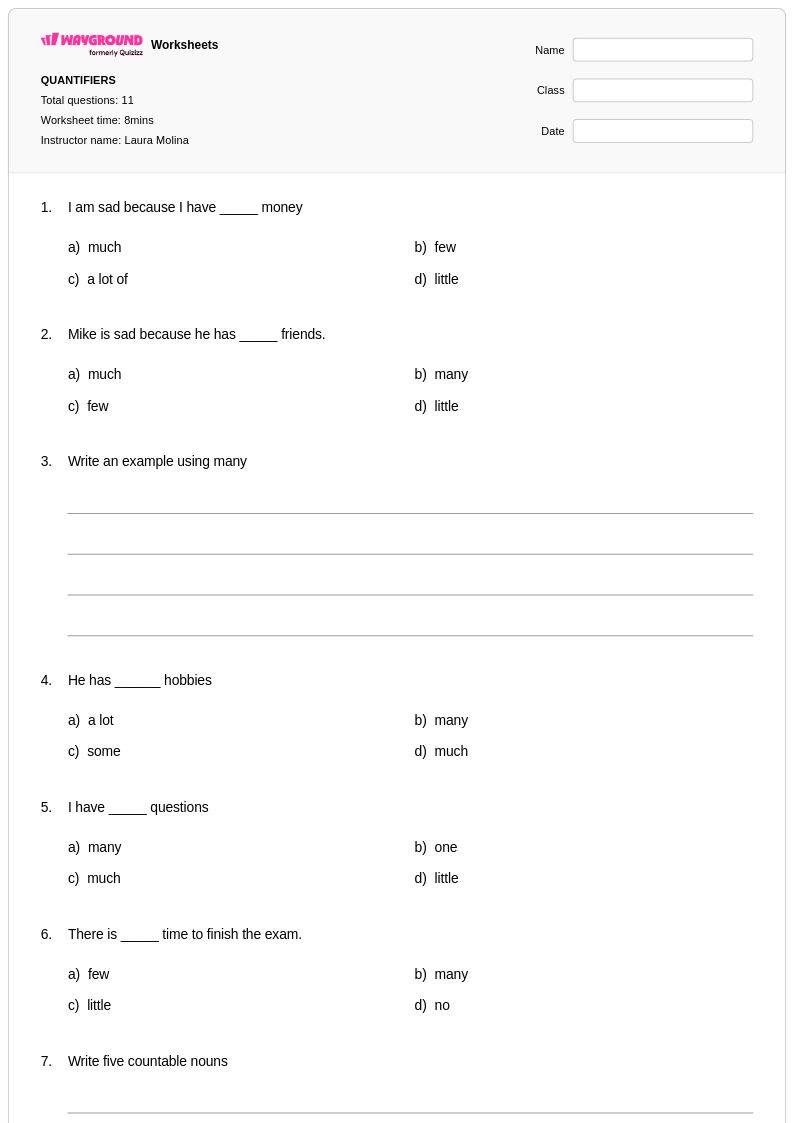
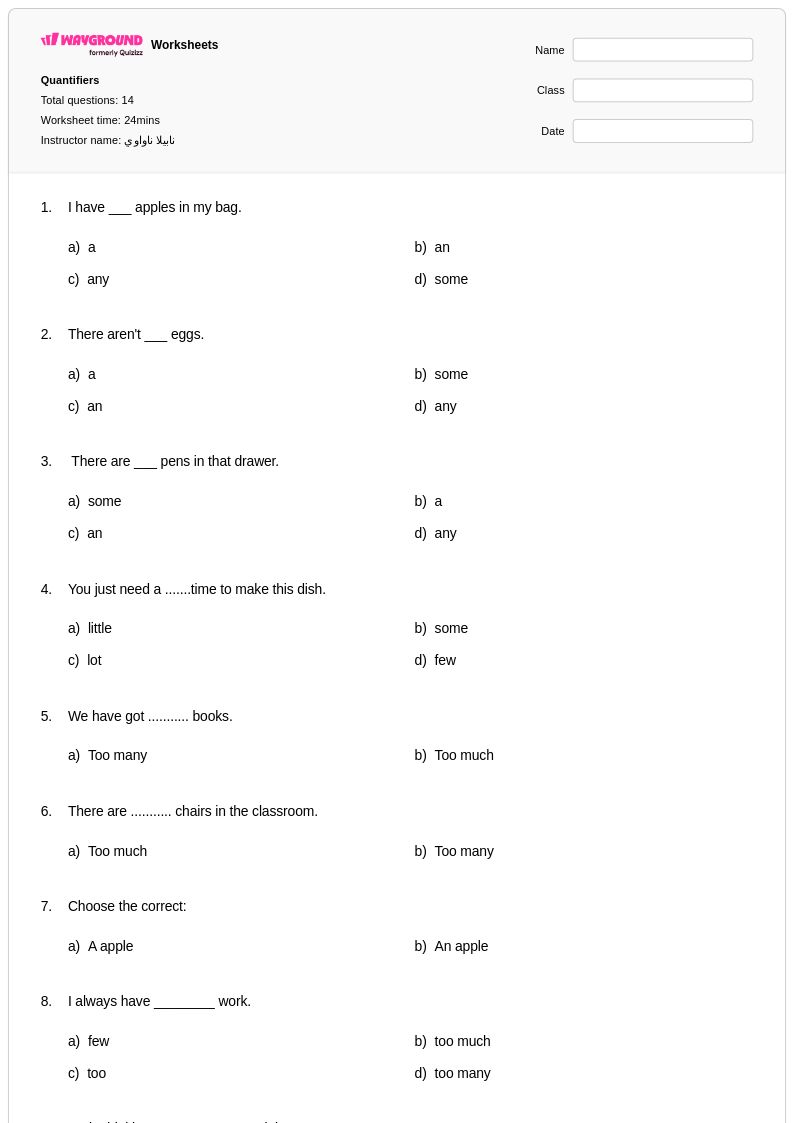
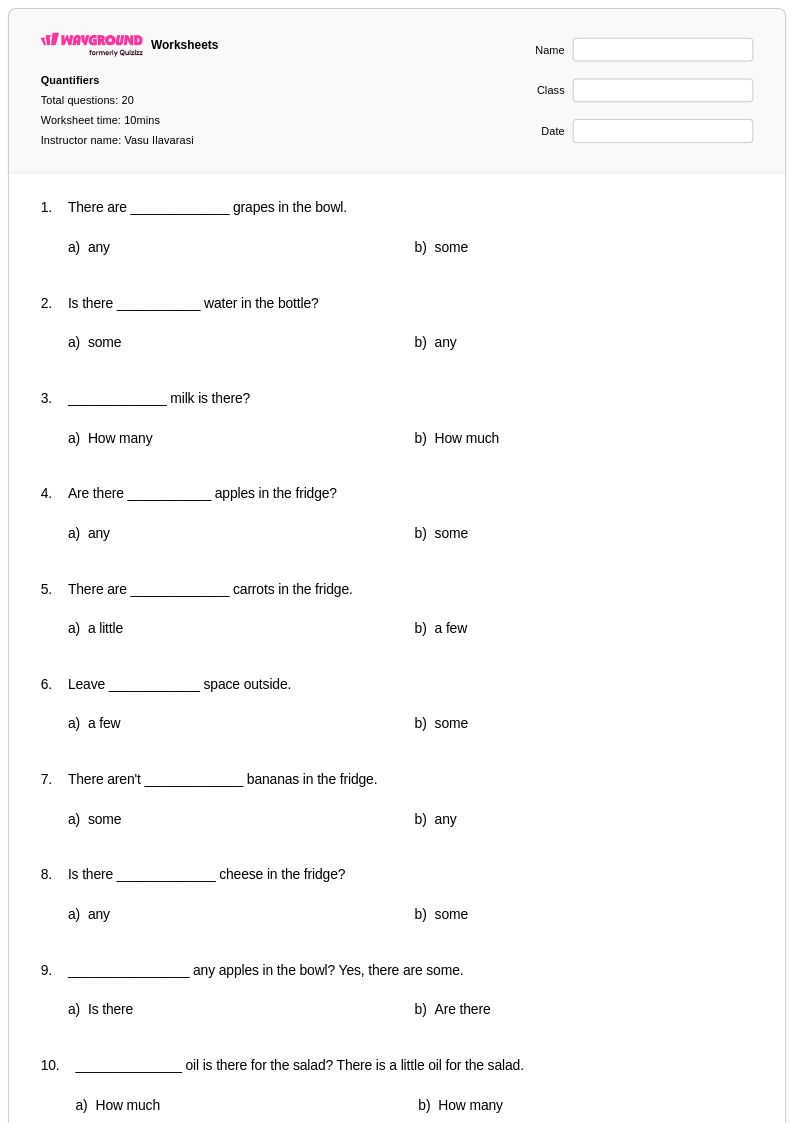
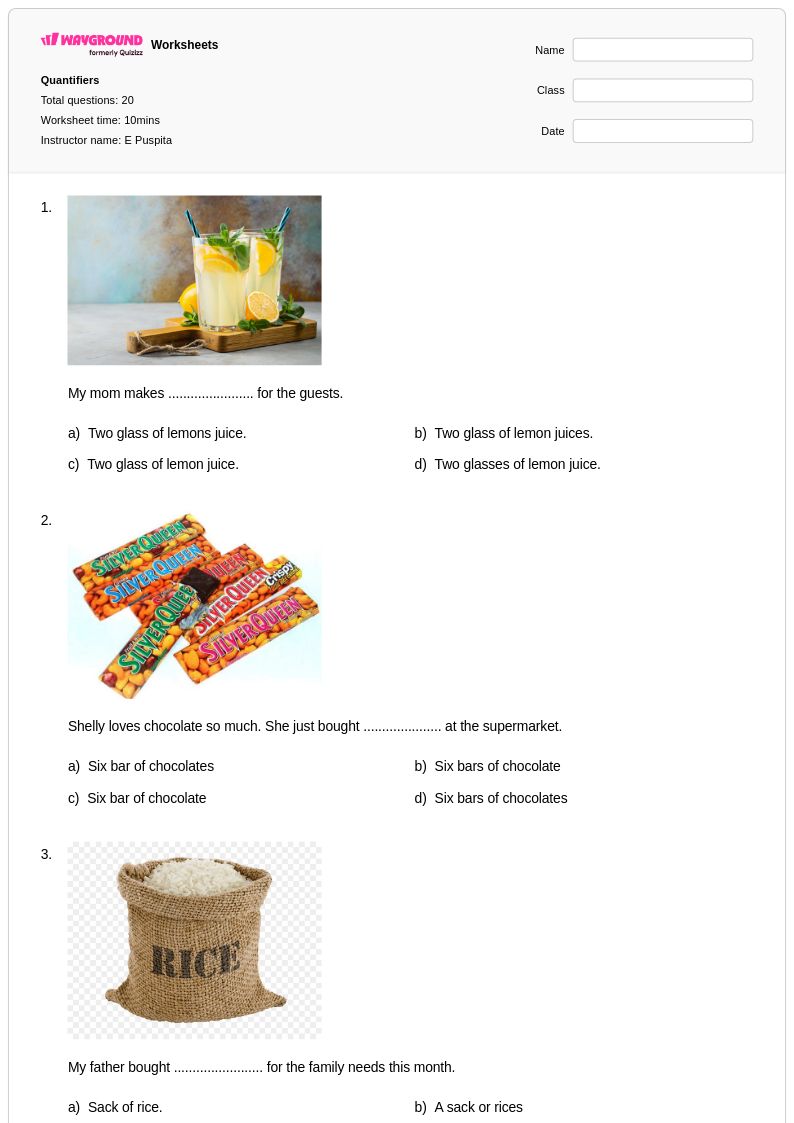
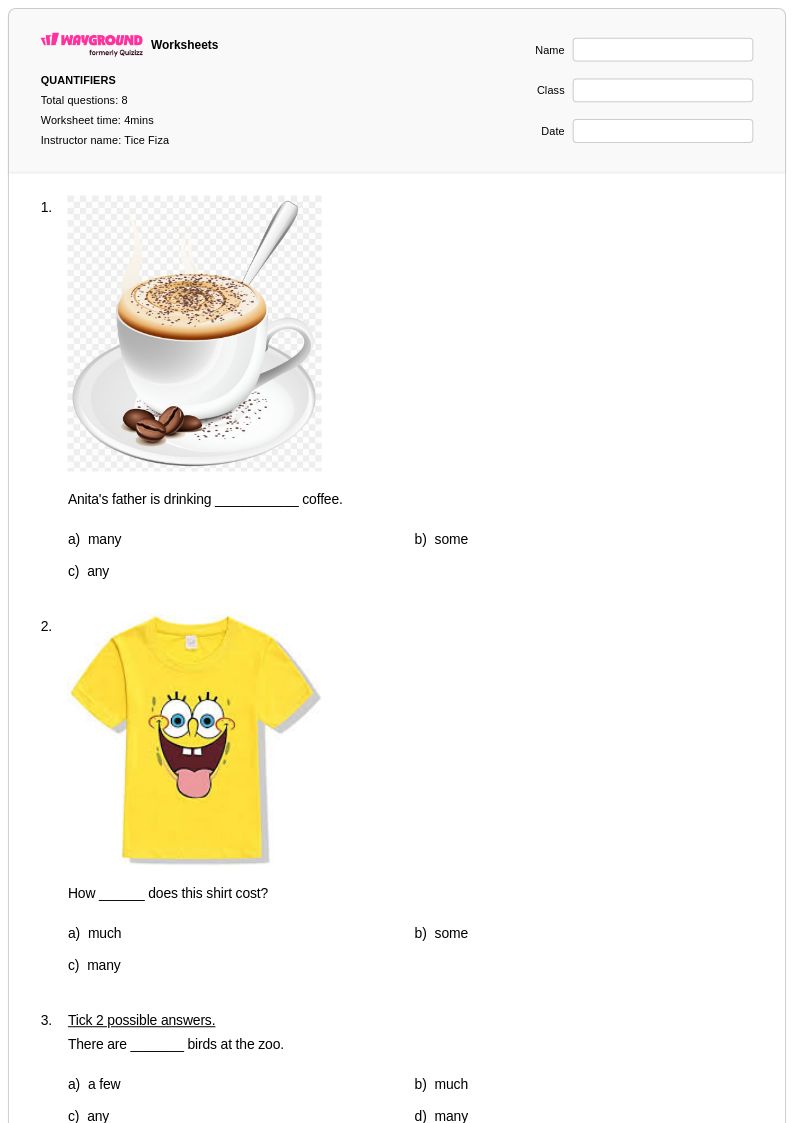
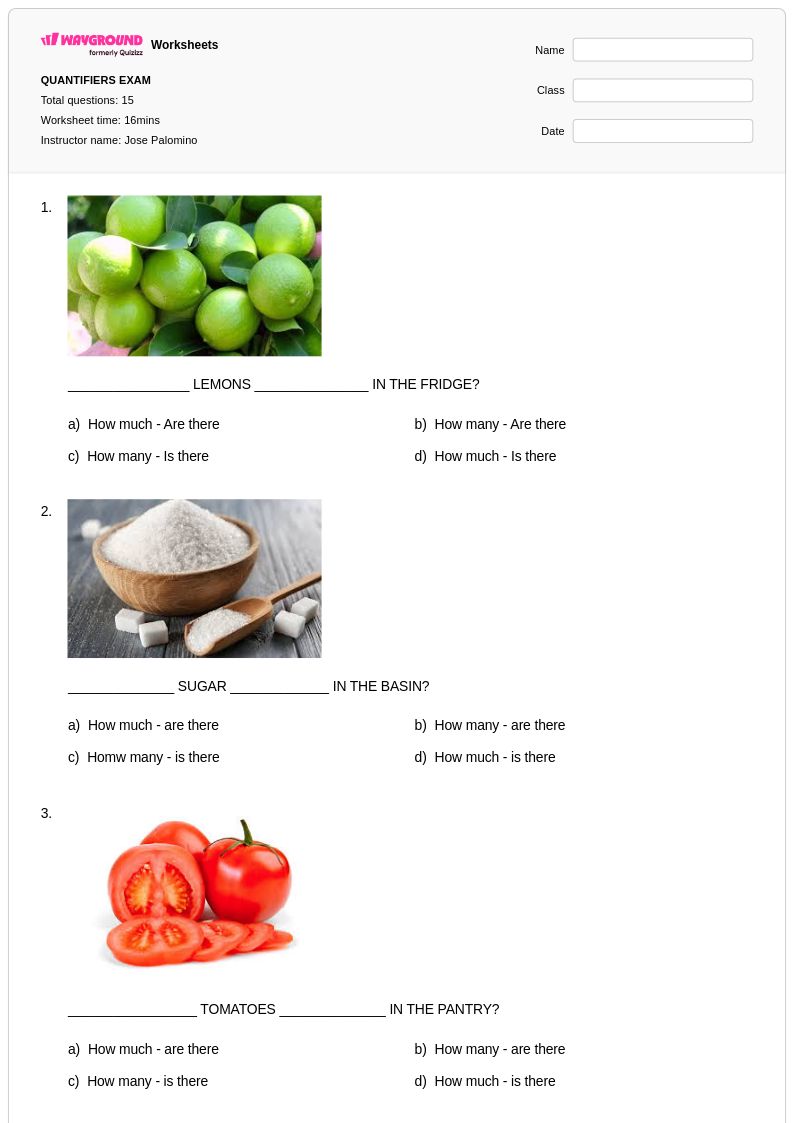
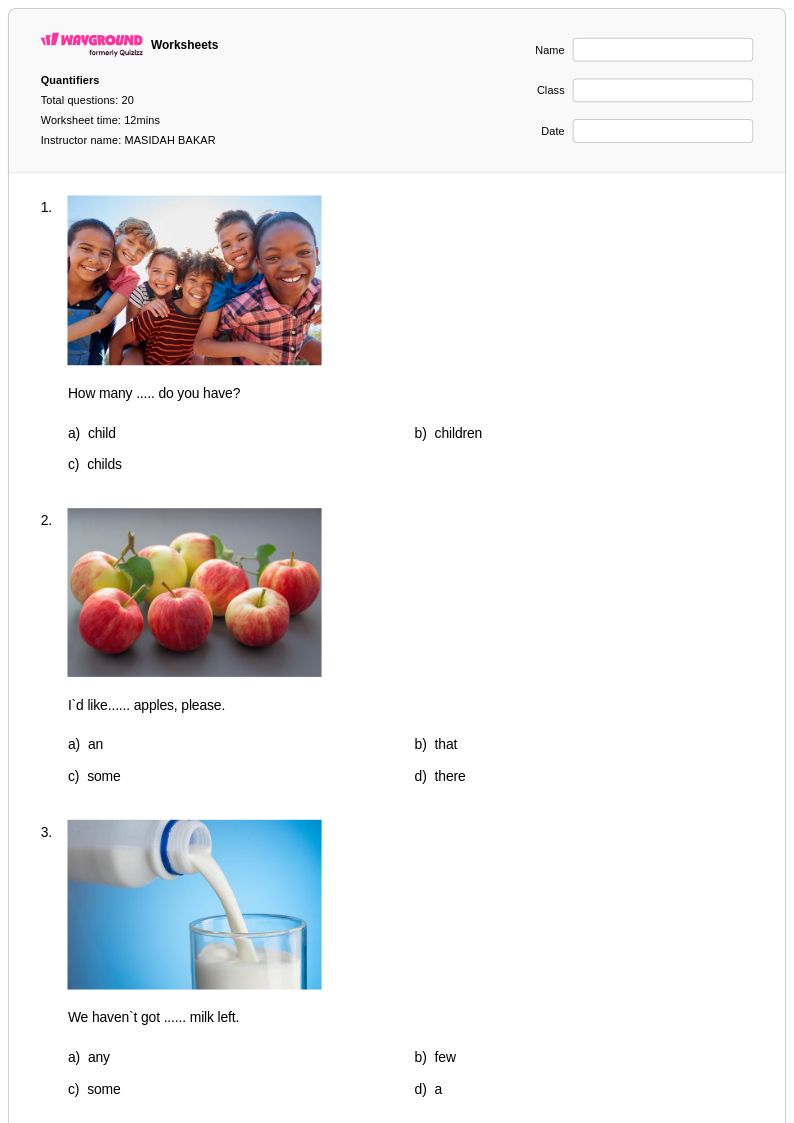
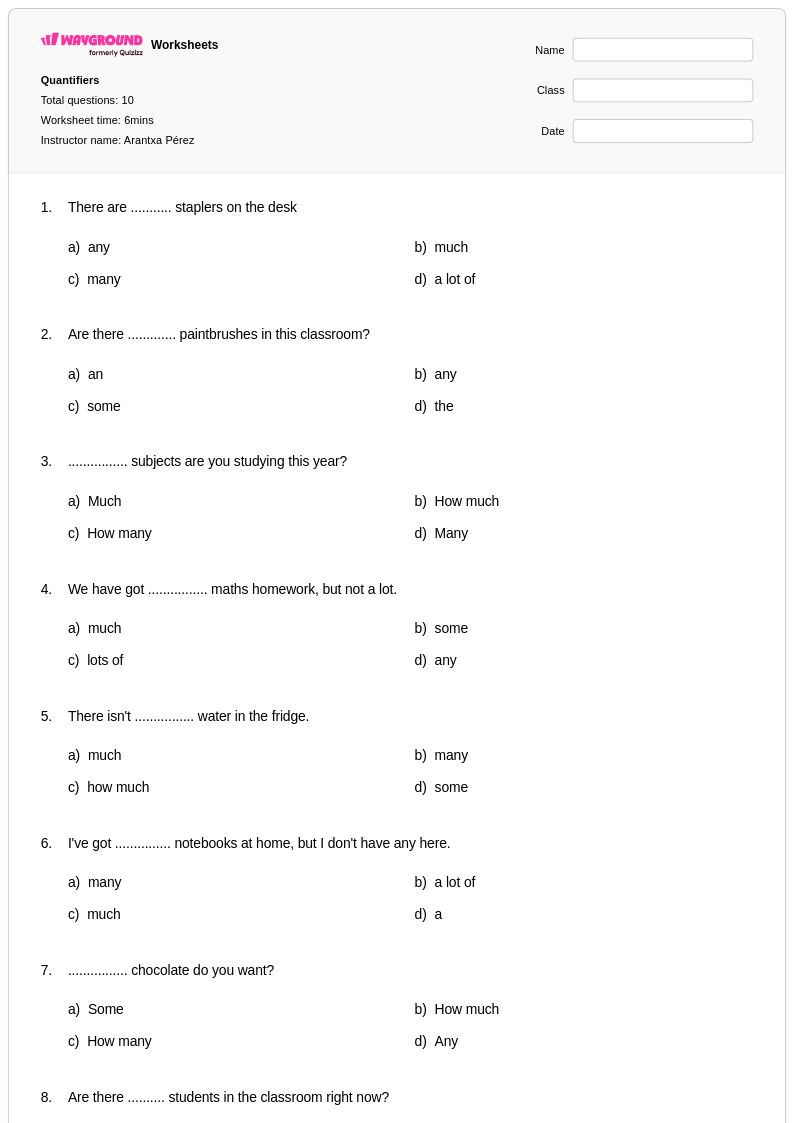
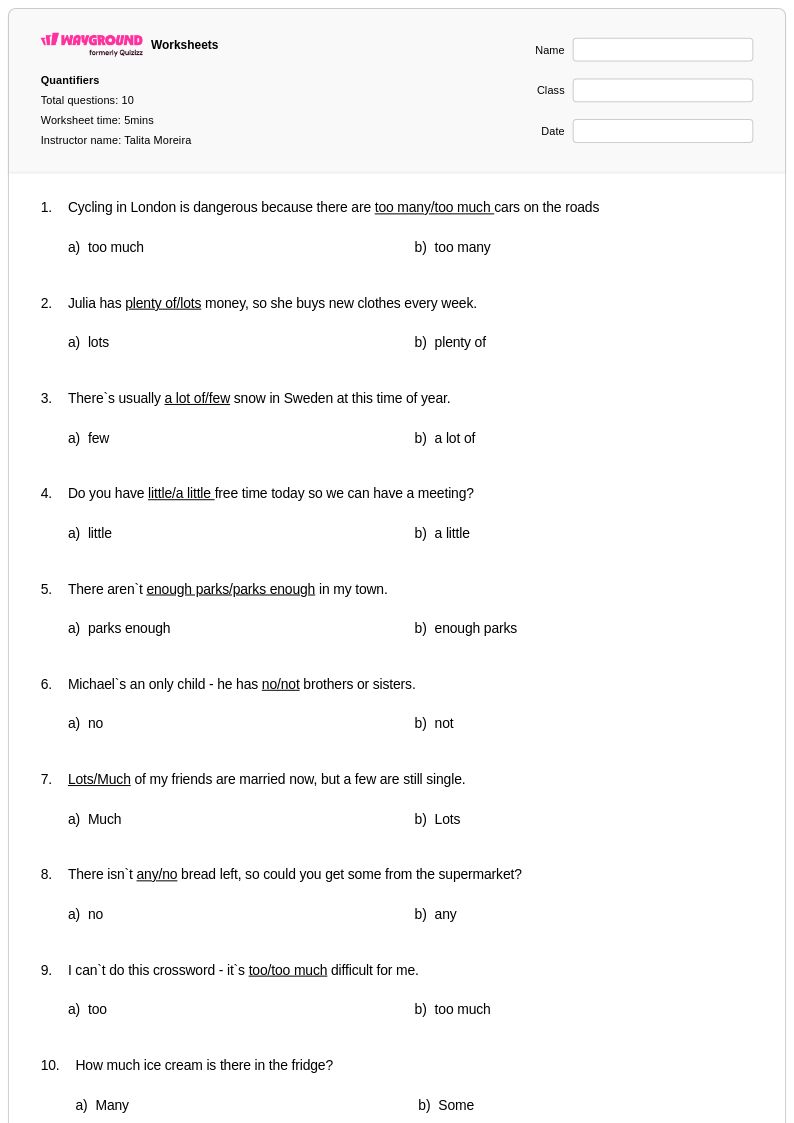
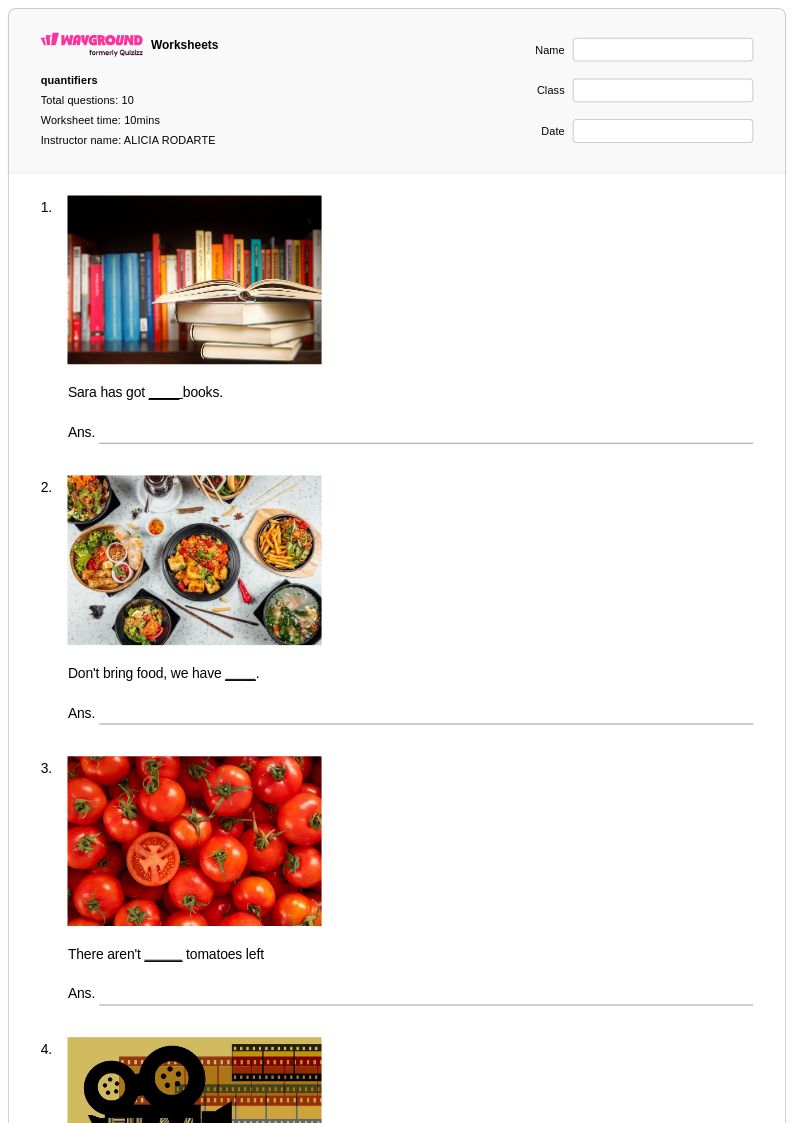
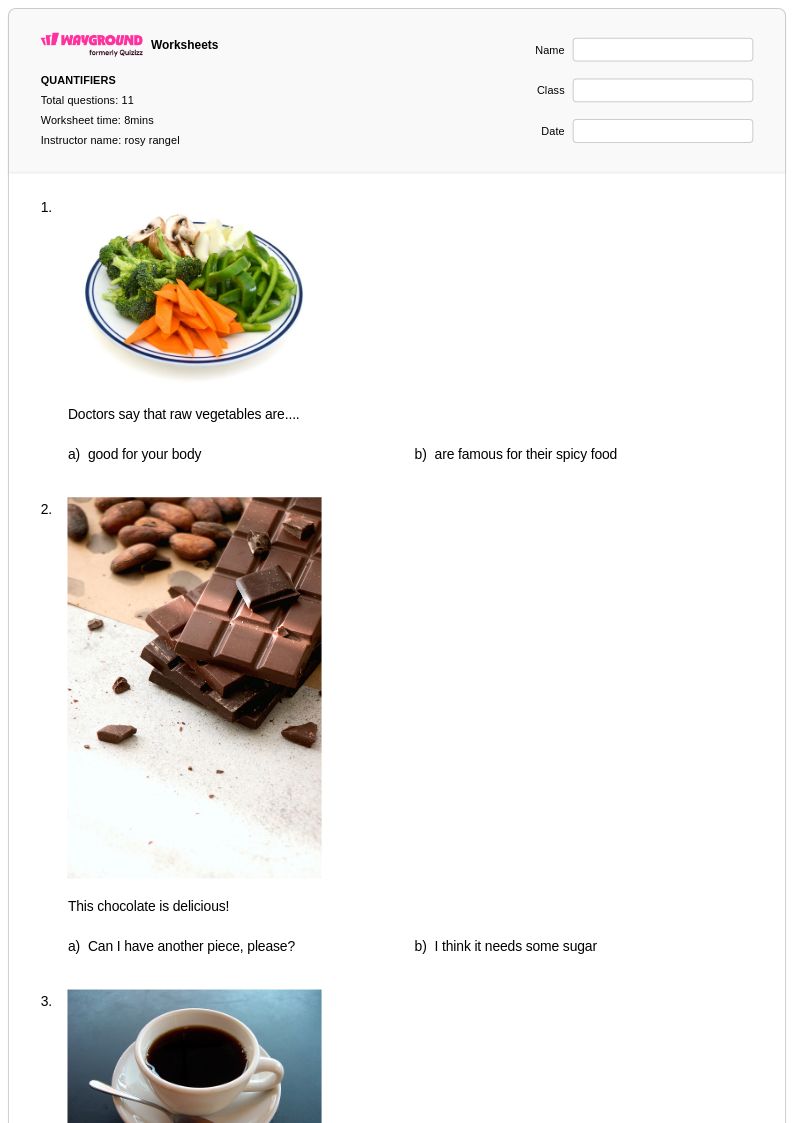
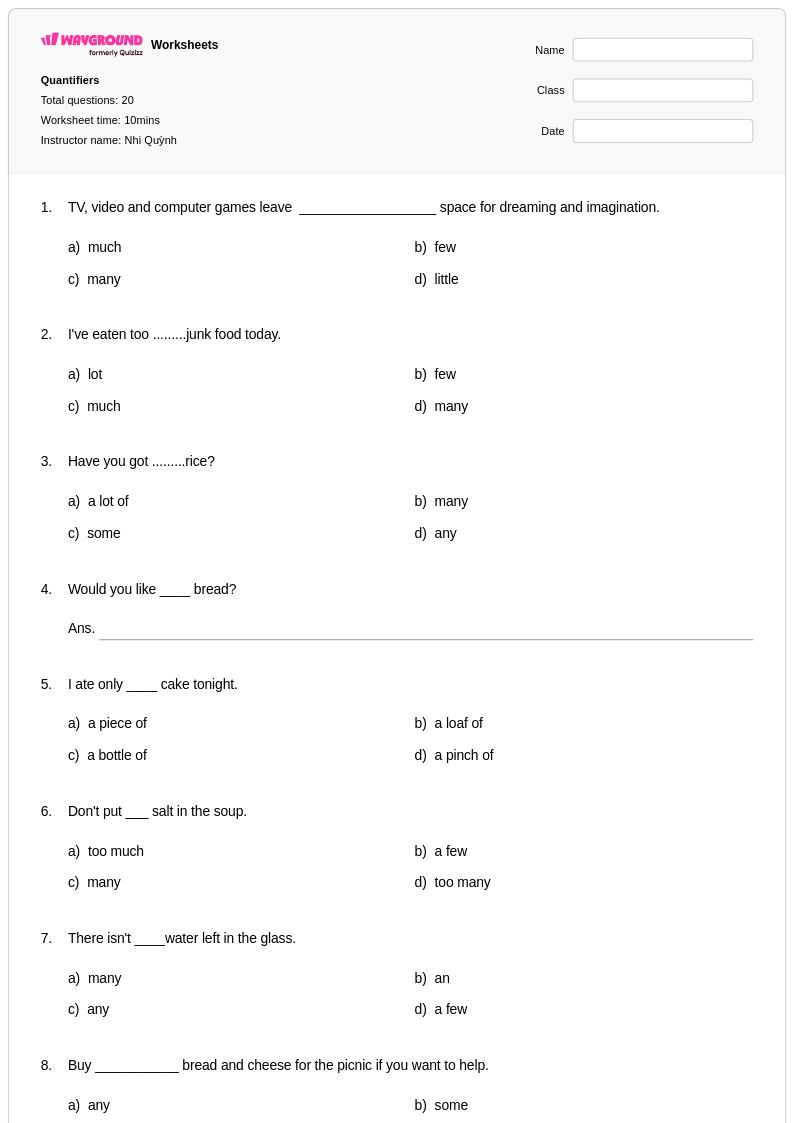
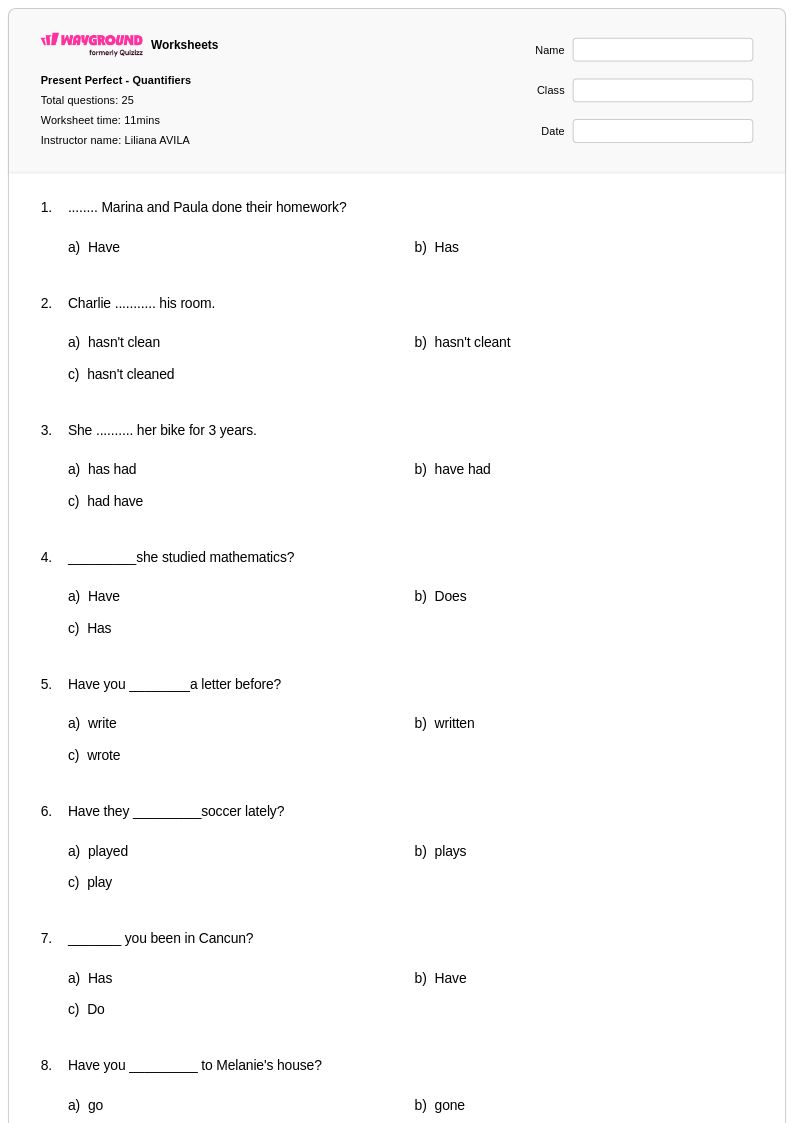
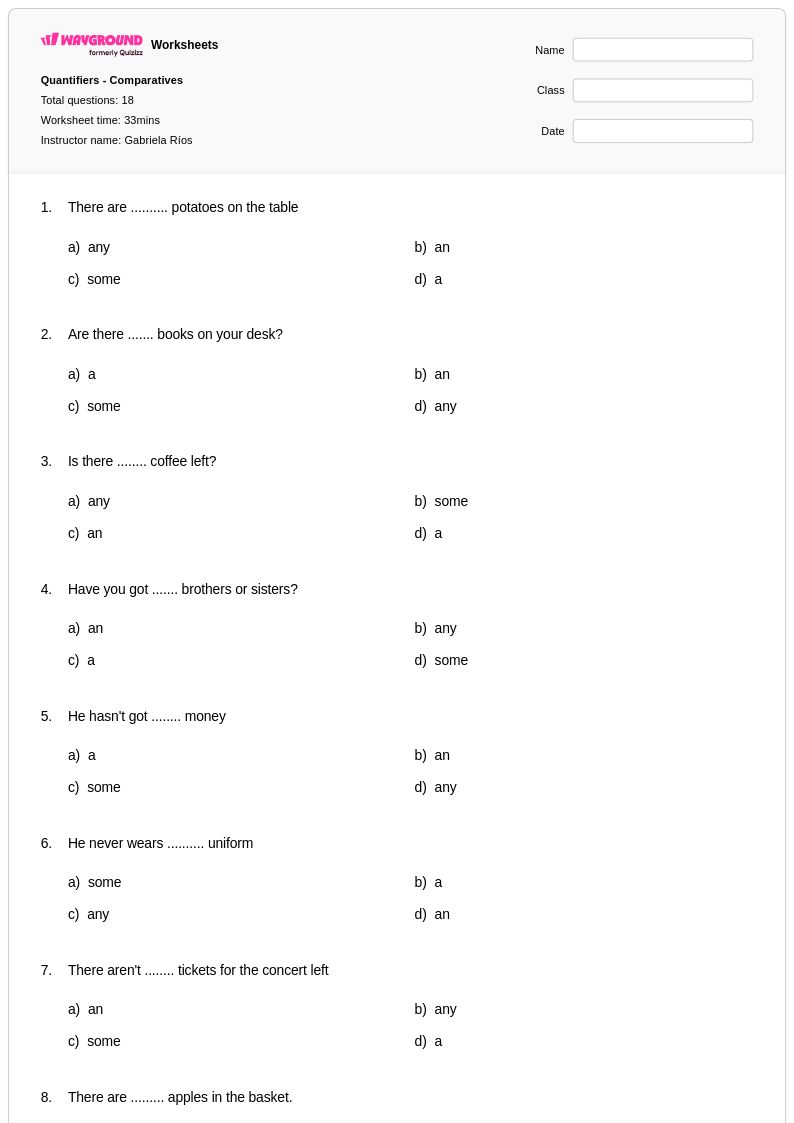
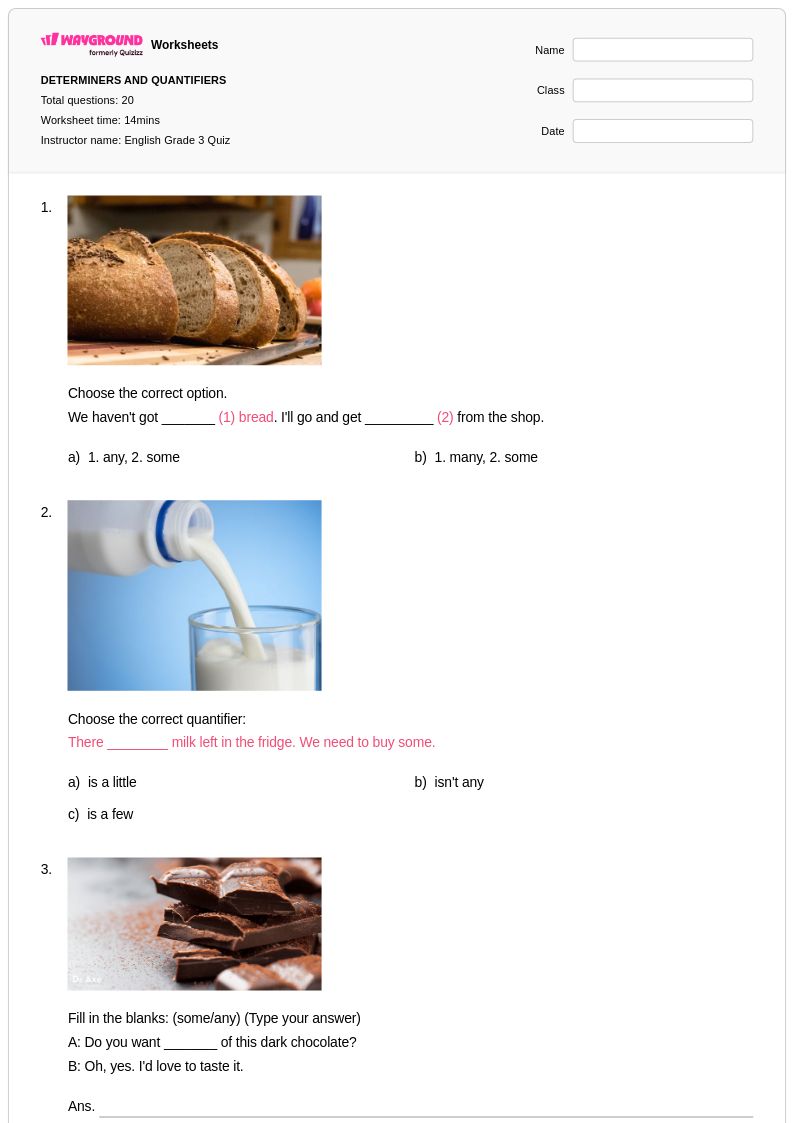
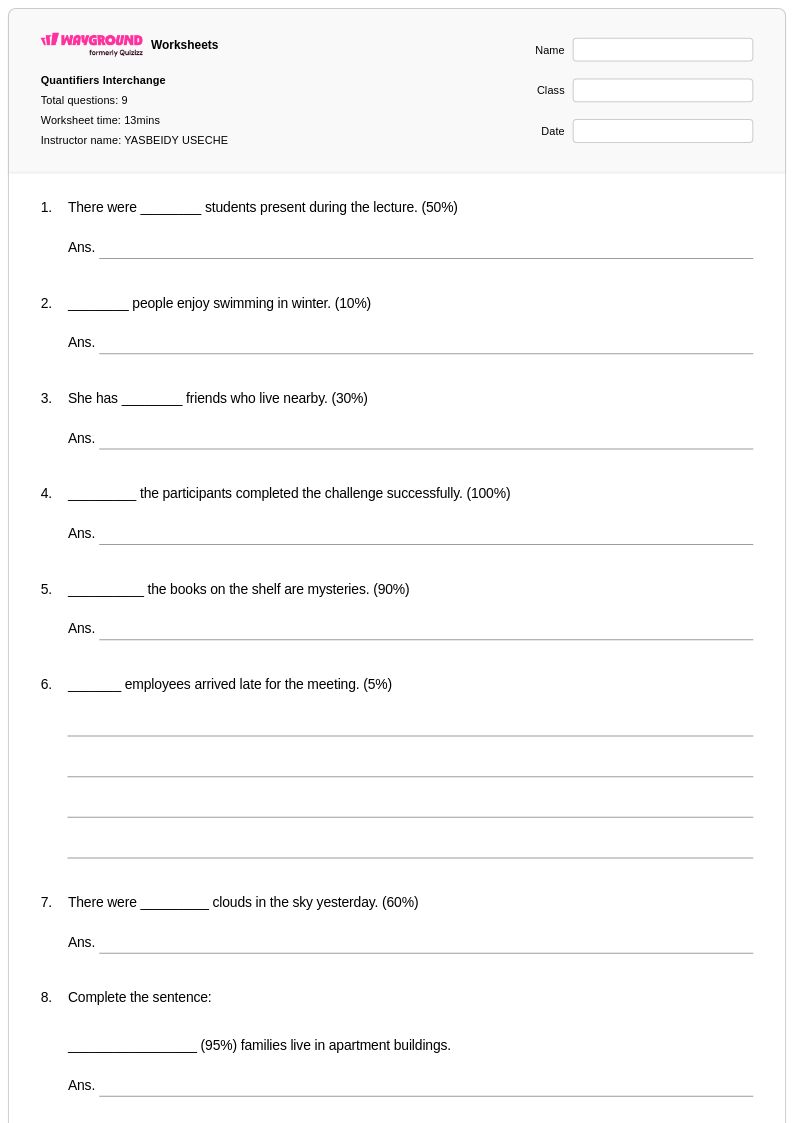
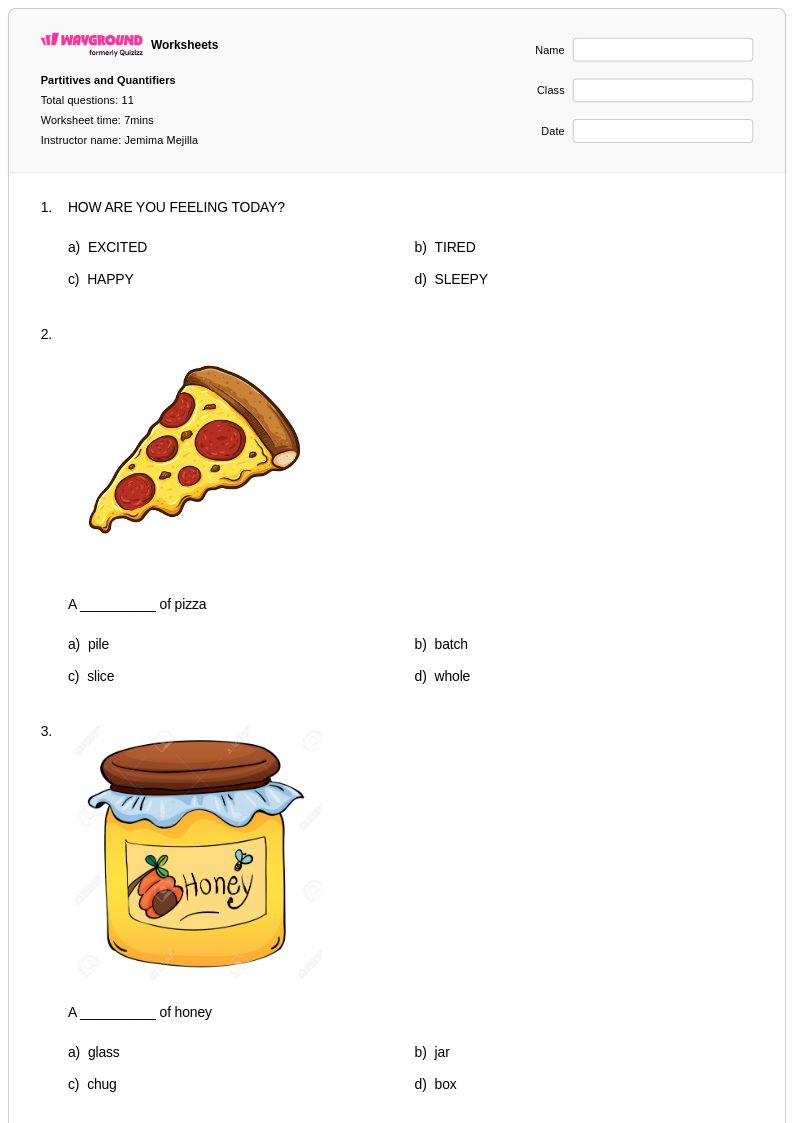
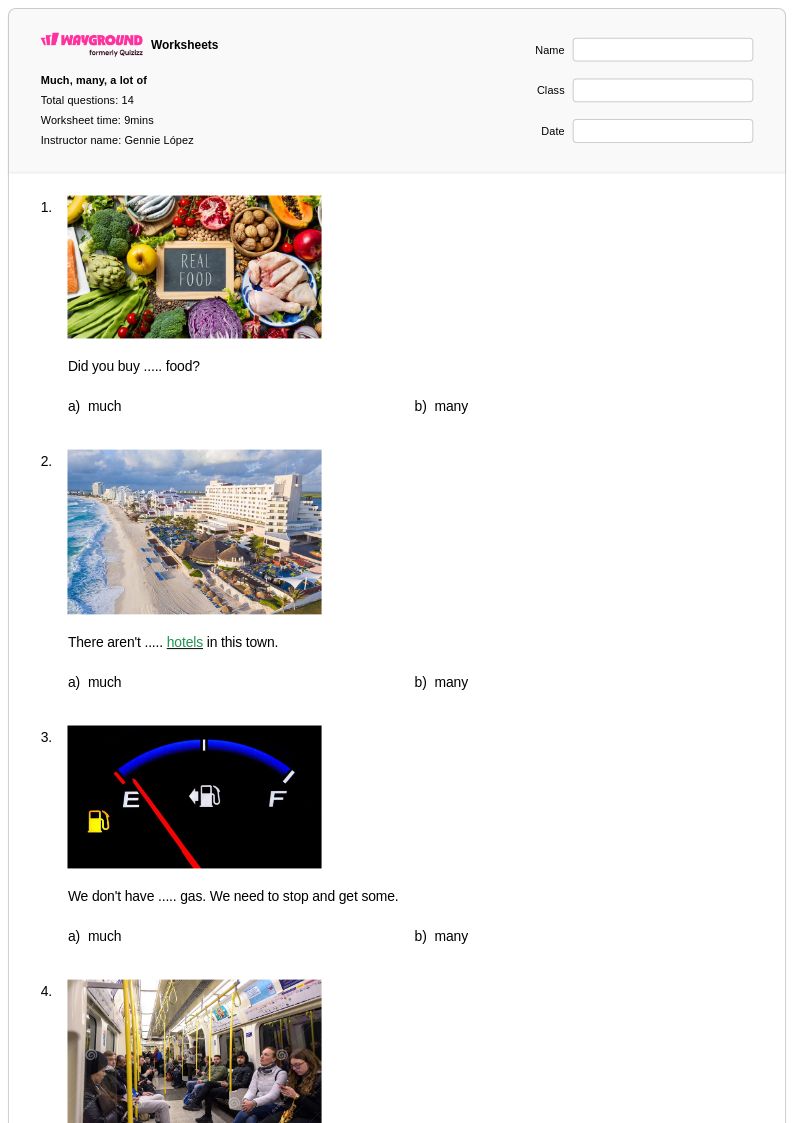
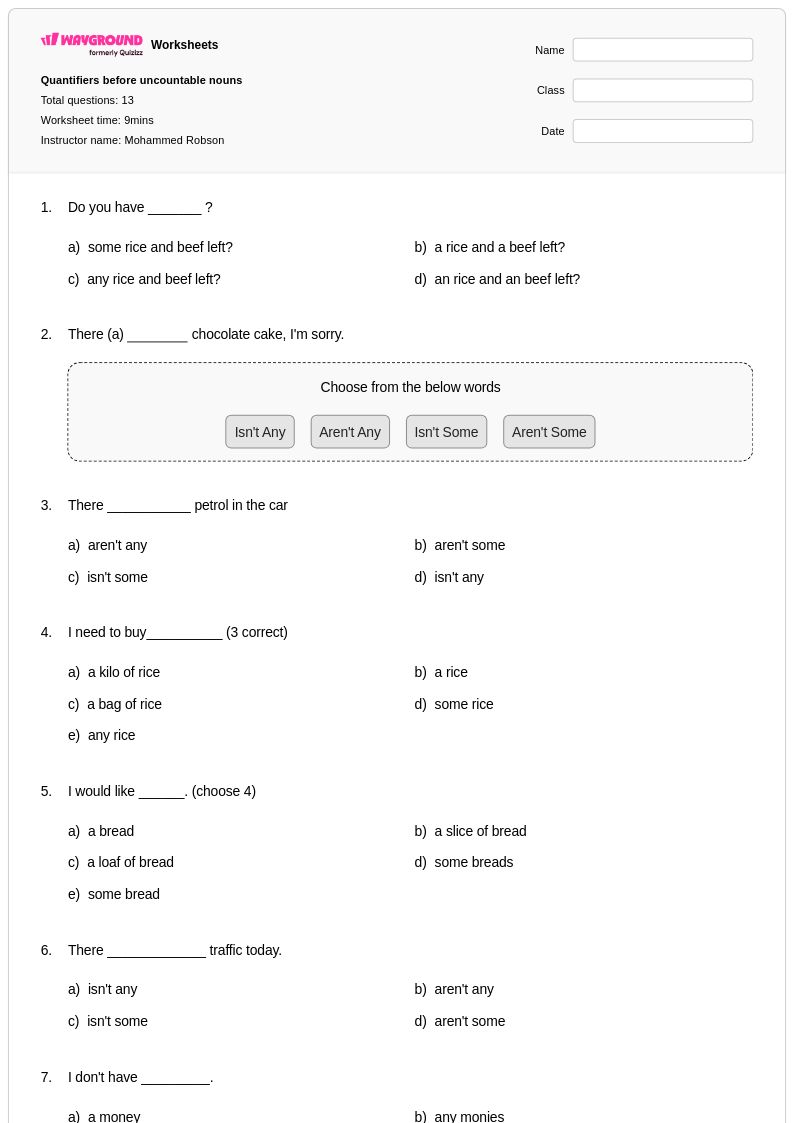
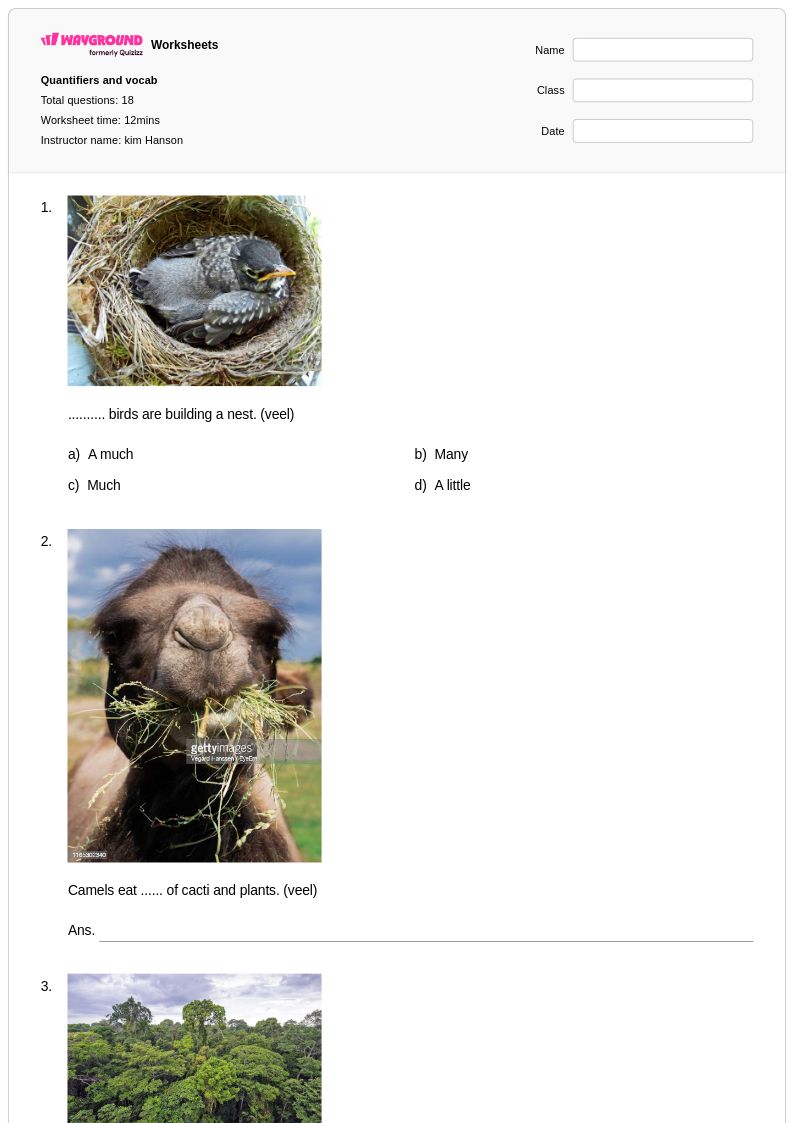
Wayground's free Grade 3 quantifiers worksheets and printables help students master words like "many," "few," and "some" through engaging practice problems with comprehensive answer keys in convenient PDF format.
Explore printable Quantifiers worksheets for Grade 3
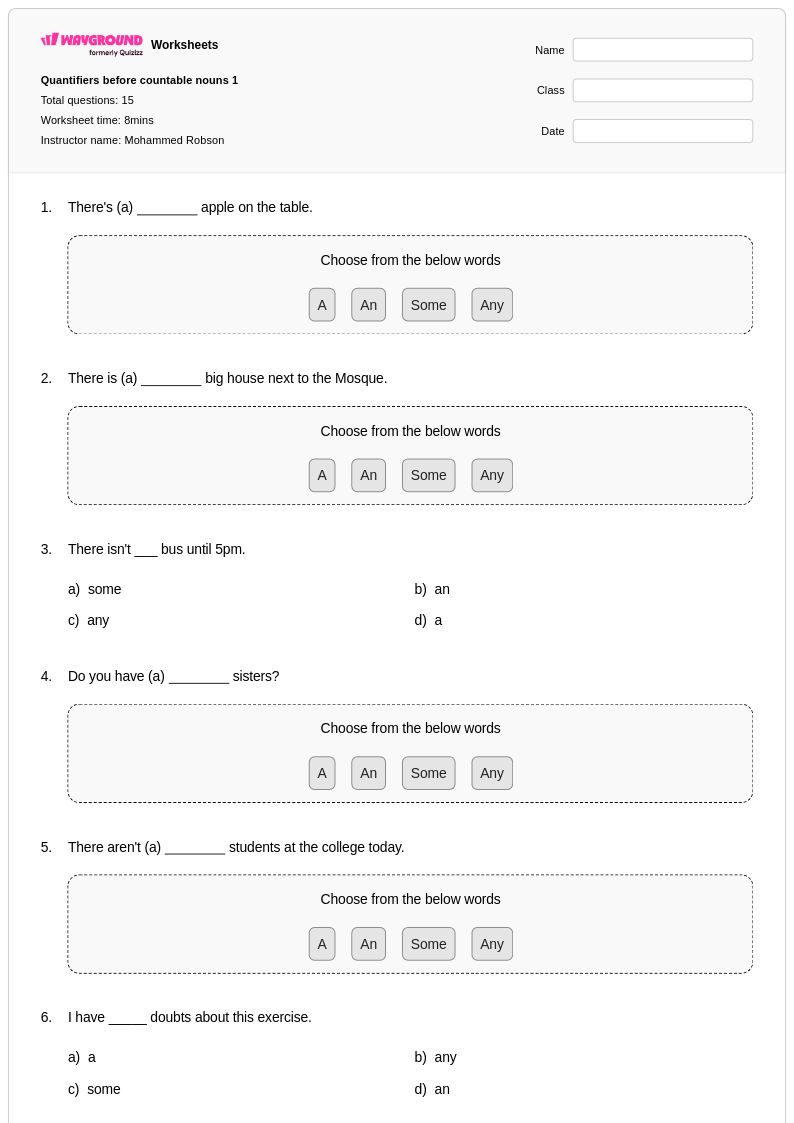
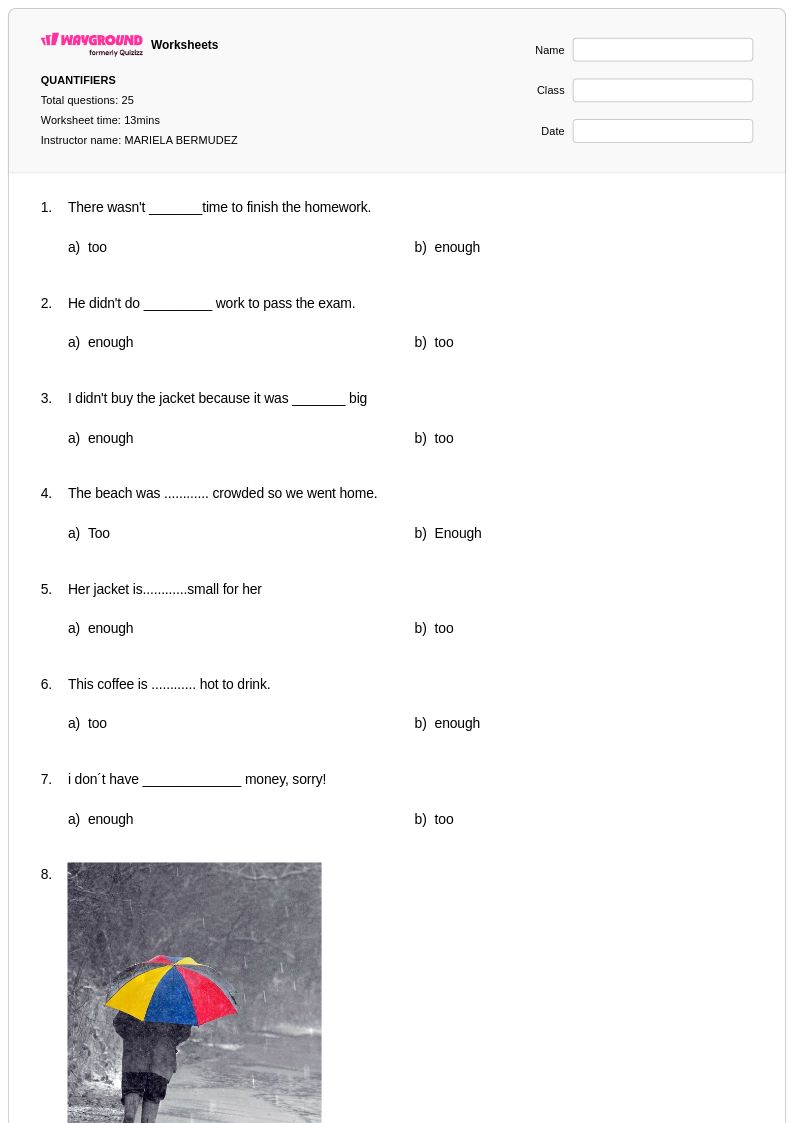
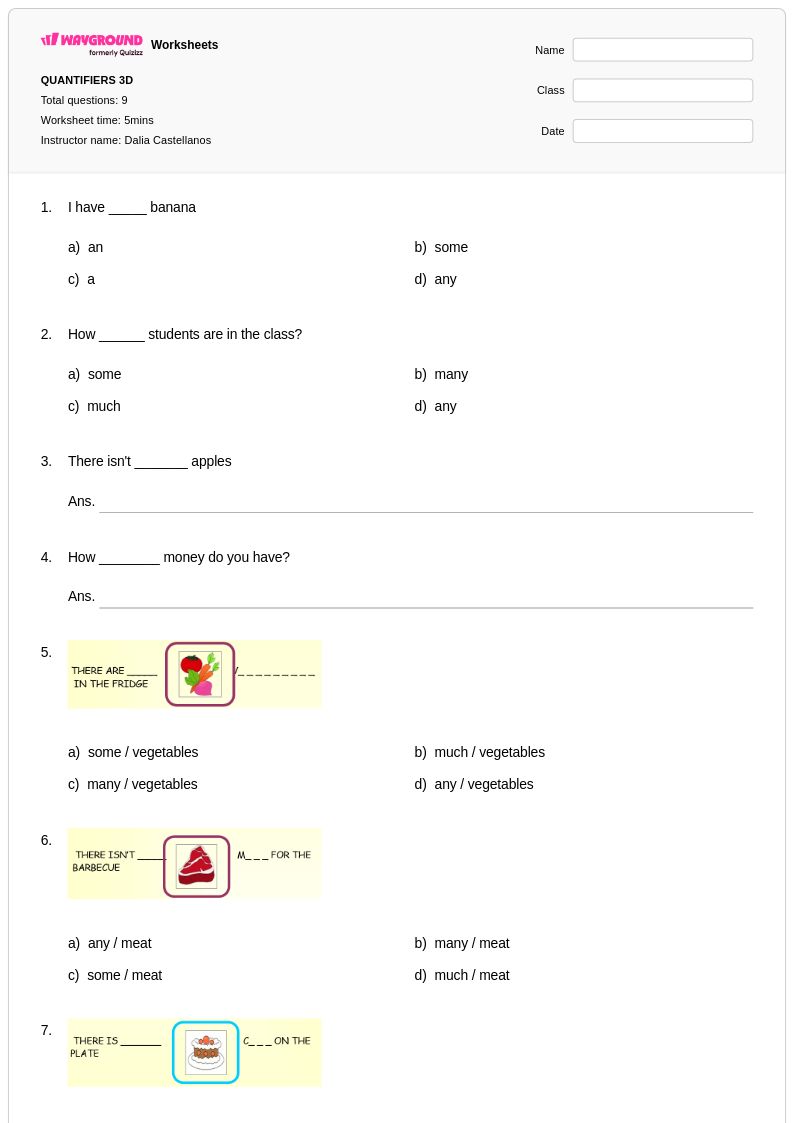
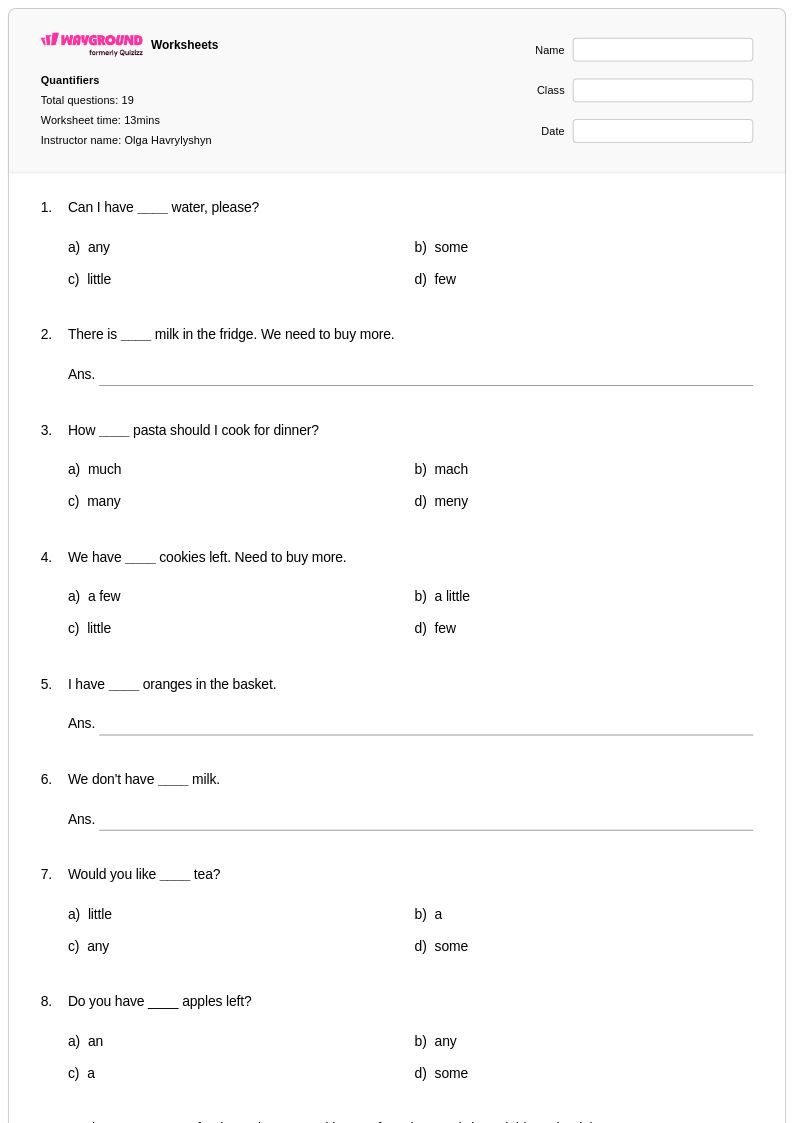
Grade 3 quantifiers worksheets available through Wayground (formerly Quizizz) provide essential practice for young learners developing their understanding of words that express quantity and amount. These comprehensive printables focus on teaching students how to properly use quantifiers such as "many," "few," "some," "all," "most," and "several" in both spoken and written English. The worksheets strengthen critical grammar skills by presenting engaging practice problems that help third-grade students recognize when to use specific quantifiers with countable and uncountable nouns, building foundational language mechanics that support clear communication. Each free resource includes detailed answer keys that enable teachers and parents to provide immediate feedback, while the pdf format ensures easy accessibility for classroom instruction and home practice.
Wayground (formerly Quizizz) supports educators with an extensive collection of teacher-created quantifier resources specifically designed for Grade 3 students, drawing from millions of professionally developed materials that align with language arts standards. The platform's robust search and filtering capabilities allow teachers to quickly locate worksheets that match their specific instructional needs, whether for initial skill introduction, targeted remediation, or enrichment activities for advanced learners. Teachers can customize these digital and printable resources to accommodate diverse learning styles and academic levels within their classrooms, making differentiation seamless and effective. The flexible format options enable educators to incorporate quantifier practice into various lesson plans, from guided instruction sessions to independent skill-building exercises, ensuring students receive consistent opportunities to master these fundamental grammar concepts.
FAQs
How do I teach quantifiers in English grammar?
Start by grouping quantifiers by the noun types they modify: words like 'many' and 'few' work with countable nouns, while 'much' and 'little' pair with uncountable nouns, and words like 'some,' 'all,' and 'both' can work across both categories. Use real sentences from familiar contexts so students see quantifiers functioning naturally before moving into isolated exercises. Building from meaningful examples to structured practice helps students internalize usage rules rather than memorize them in isolation.
What exercises help students practice quantifiers?
Effective quantifier practice includes fill-in-the-blank sentences where students choose between two similar quantifiers (such as 'few' vs. 'a few' or 'much' vs. 'many'), error-correction tasks where students identify misused quantifiers in context, and sentence-completion activities that require distinguishing countable from uncountable nouns. These exercise types push students beyond simple recognition and require them to apply the underlying grammatical logic of quantifier usage.
What mistakes do students commonly make with quantifiers?
The most frequent error is applying countable-noun quantifiers to uncountable nouns, such as writing 'many water' instead of 'much water.' Students also frequently confuse 'few' and 'a few,' not recognizing that 'few' carries a negative implication (hardly any) while 'a few' is neutral or positive (some). Mixing up 'neither' and 'both' in negative constructions is another persistent source of error, particularly for English language learners.
How can I use quantifier worksheets to support English language learners?
For ELL students, quantifier worksheets are most effective when paired with a reference chart showing which quantifiers match countable nouns, uncountable nouns, or both. Starting with high-frequency quantifiers like 'some,' 'many,' and 'a lot of' before introducing more nuanced pairs like 'few/a few' reduces cognitive overload. On Wayground, teachers can enable the Read Aloud feature so students hear questions read to them, and Reduced Answer Choices can be activated for individual students who need additional scaffolding without affecting the rest of the class.
How do I use Wayground's quantifier worksheets in my classroom?
Wayground's quantifier worksheets are available as printable PDFs for traditional classroom distribution and in digital formats for technology-integrated learning environments, including the option to host them as a quiz directly on Wayground. Each worksheet includes a complete answer key, making them practical for independent practice, homework assignments, or in-class review. The digital format allows teachers to assign worksheets remotely and track student responses, while the printable version suits classrooms without device access.
How do I differentiate quantifier instruction for mixed-ability classes?
For mixed-ability classes, use tiered tasks: below-level students benefit from exercises with clear noun-type labels (countable vs. uncountable) visible on the page, while on-level students work with unlabeled sentences, and advanced learners tackle error-correction or open-ended writing tasks. Wayground supports this by allowing teachers to assign different worksheet versions to individual students and apply accommodations such as extended time or reduced answer choices to specific learners without notifying the rest of the class.