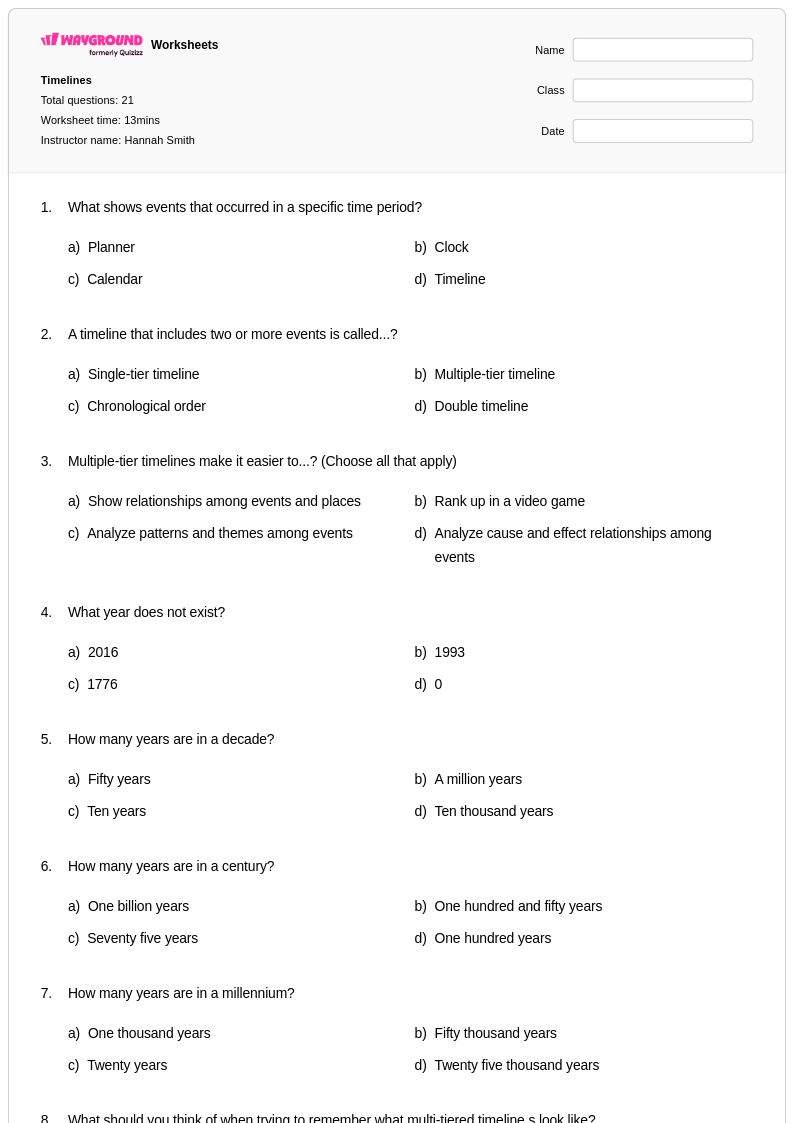
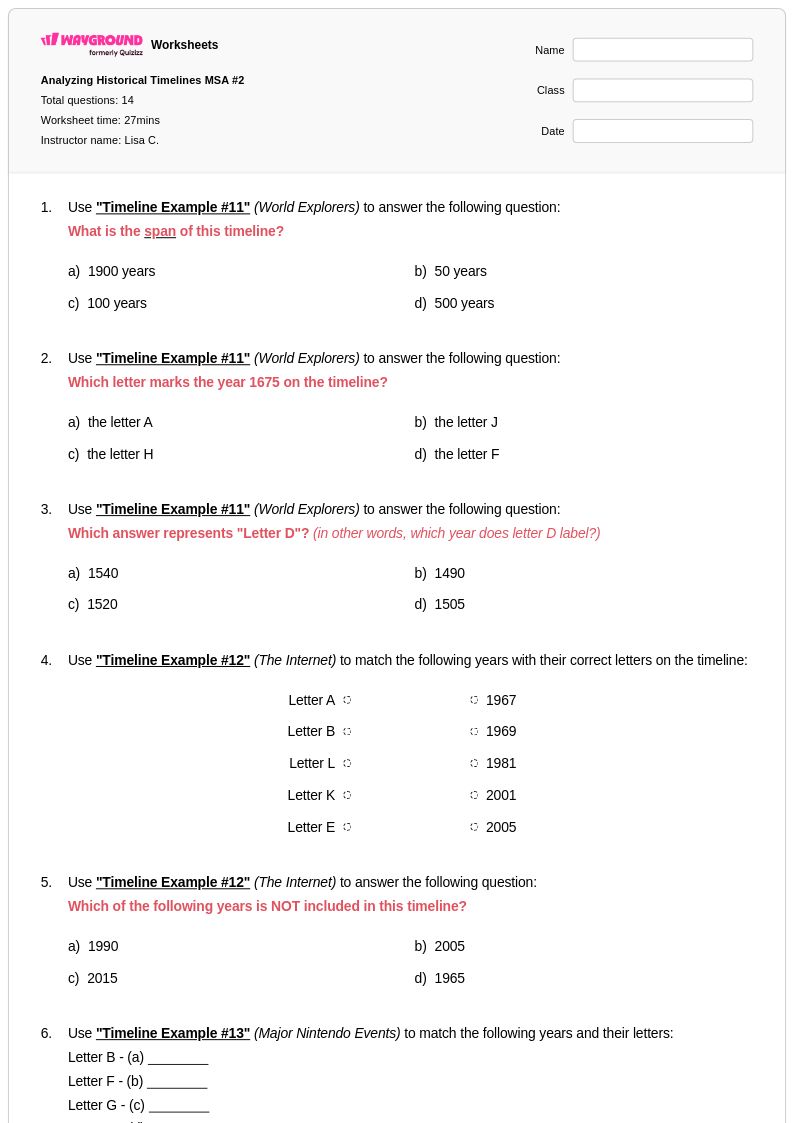
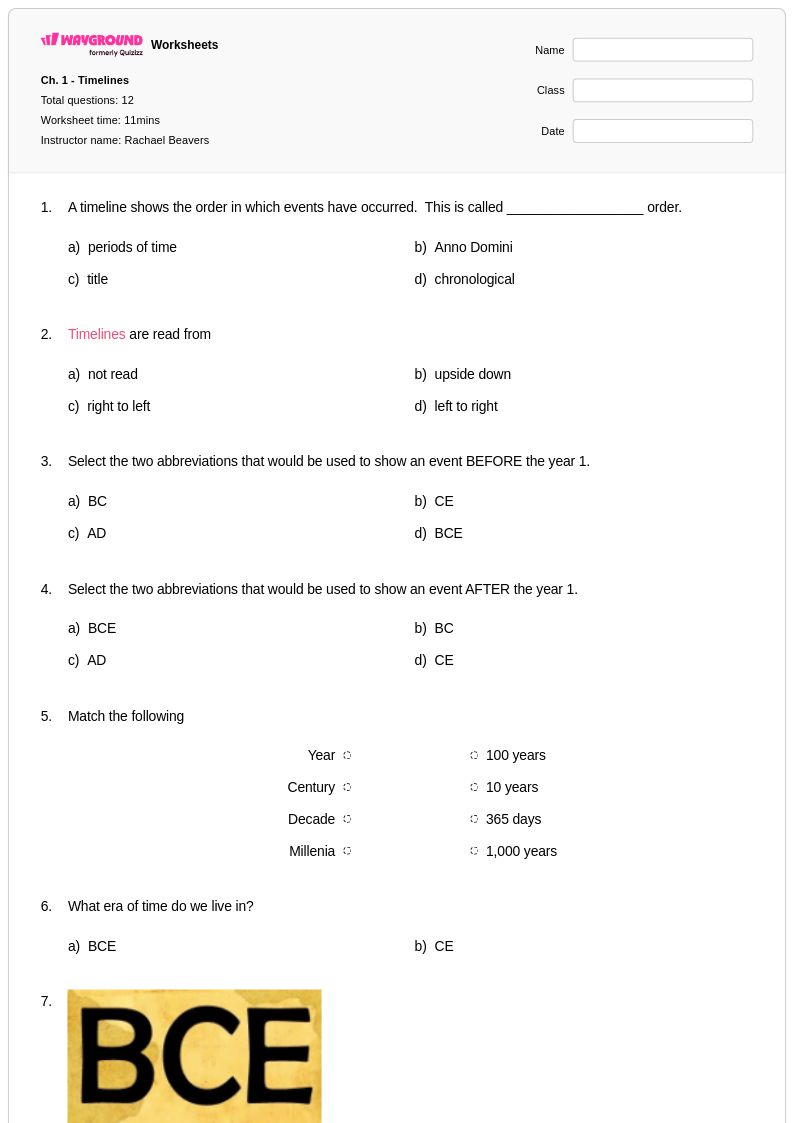
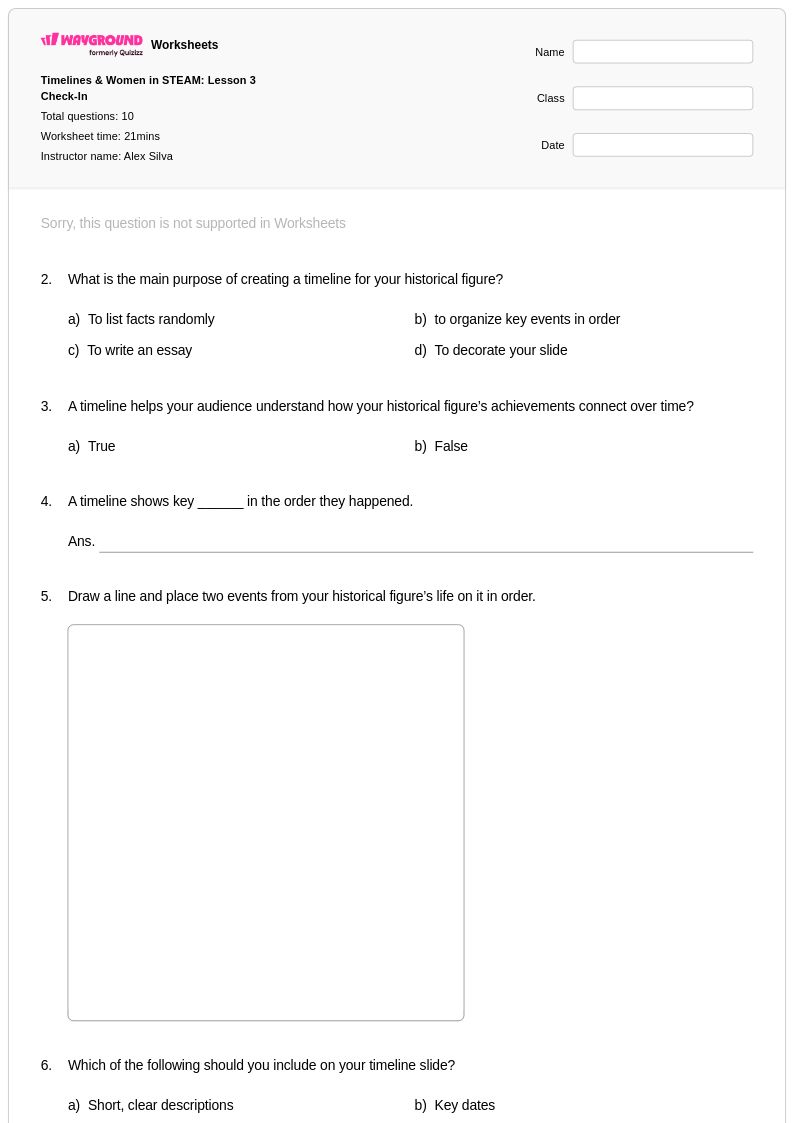
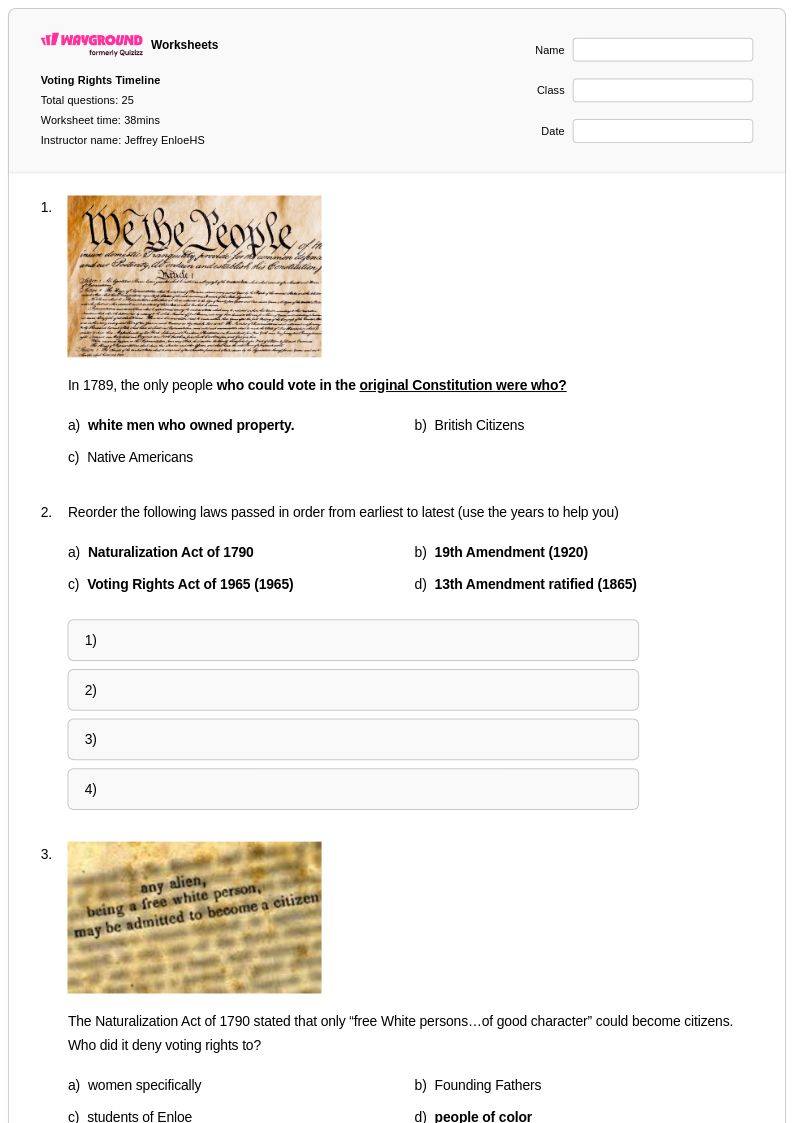
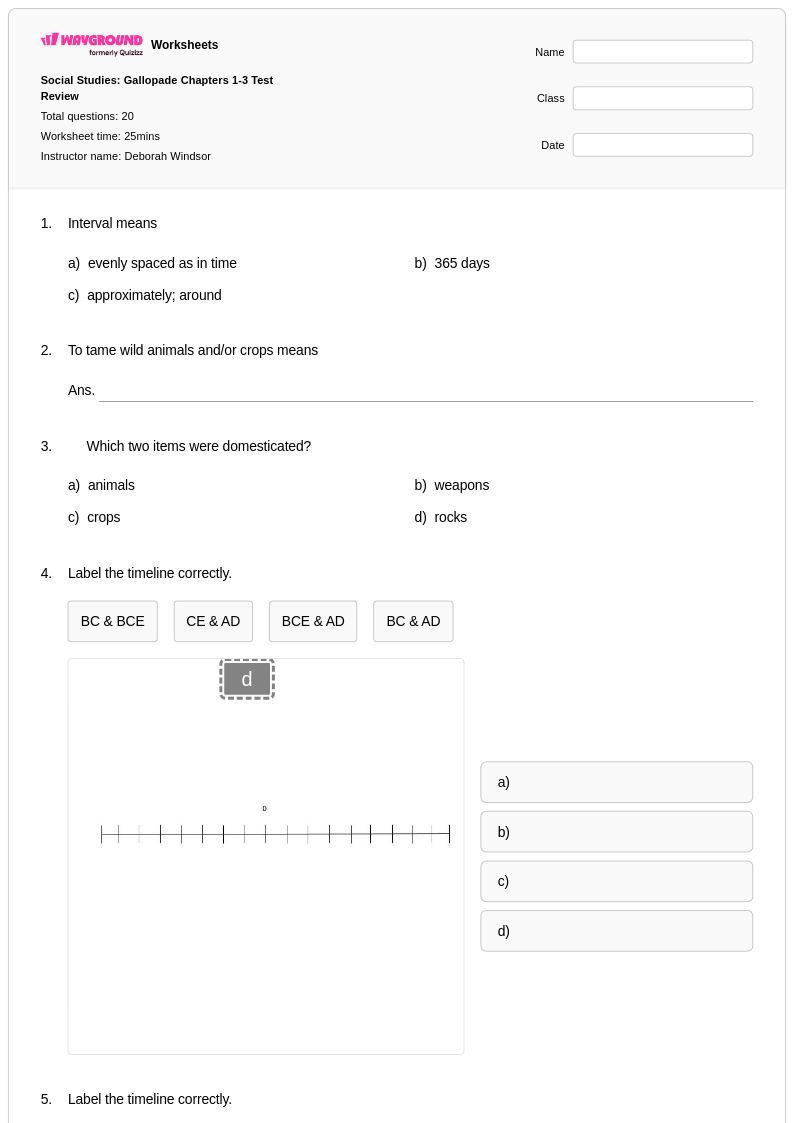
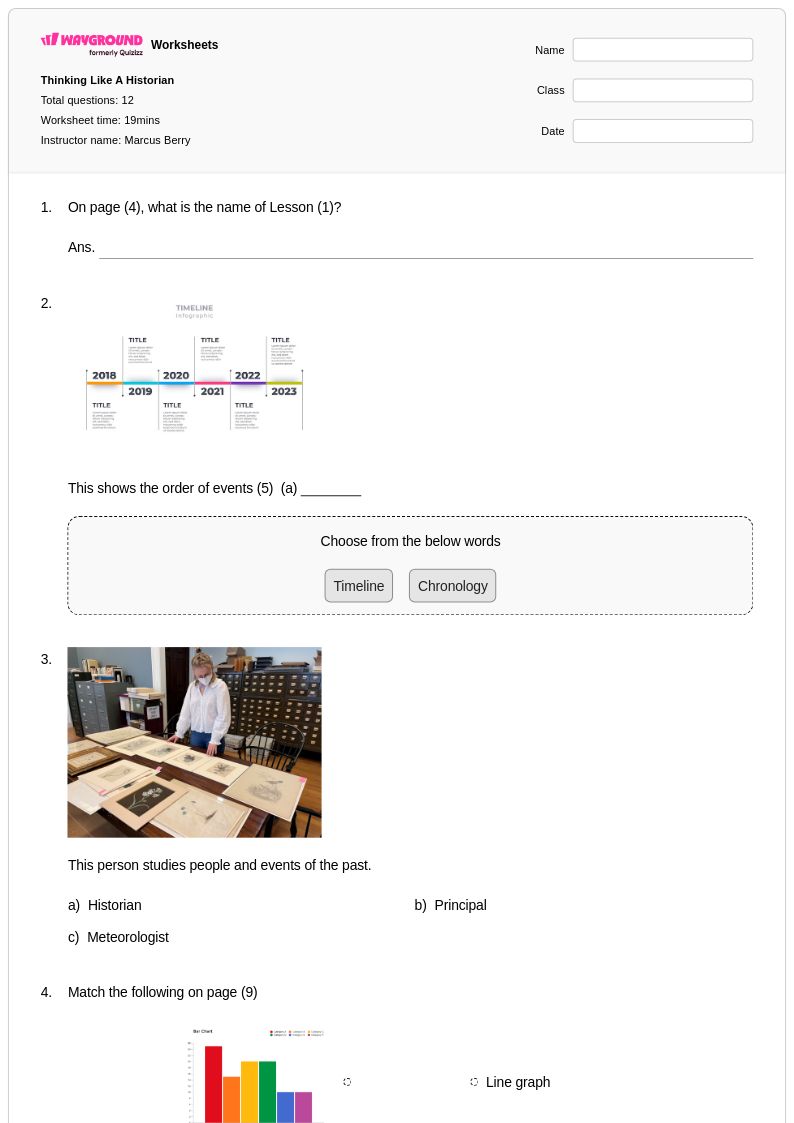
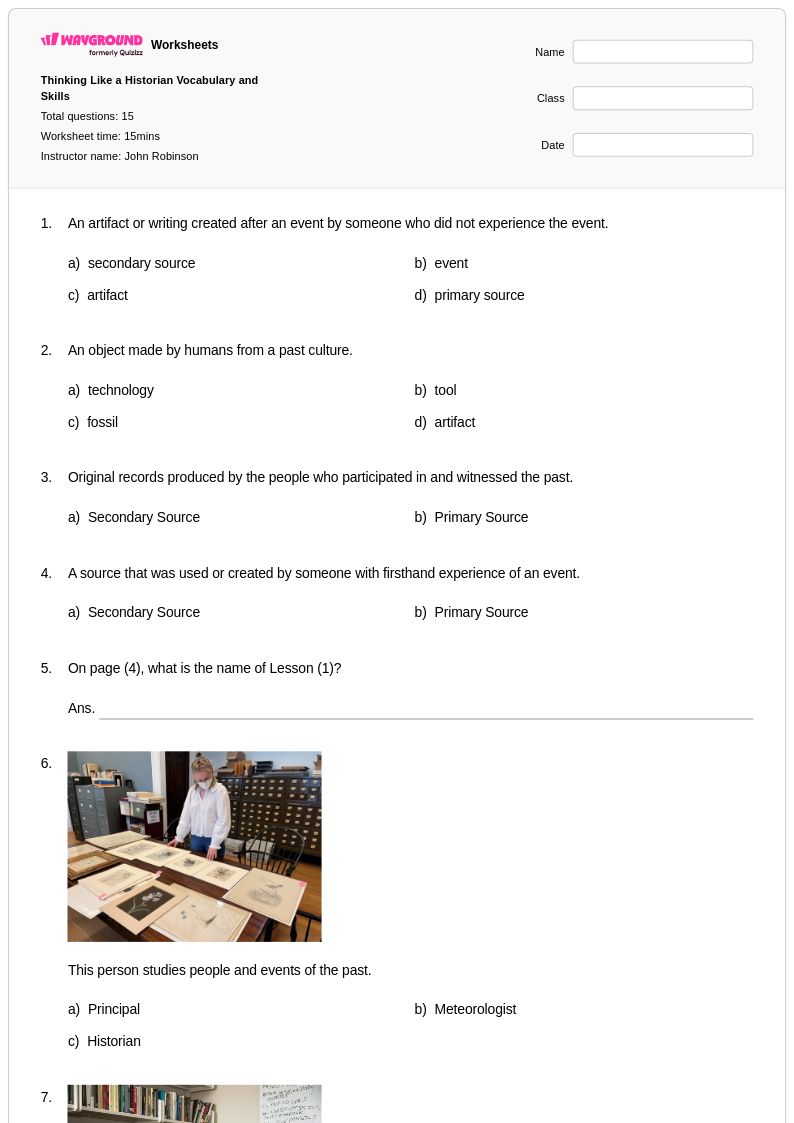
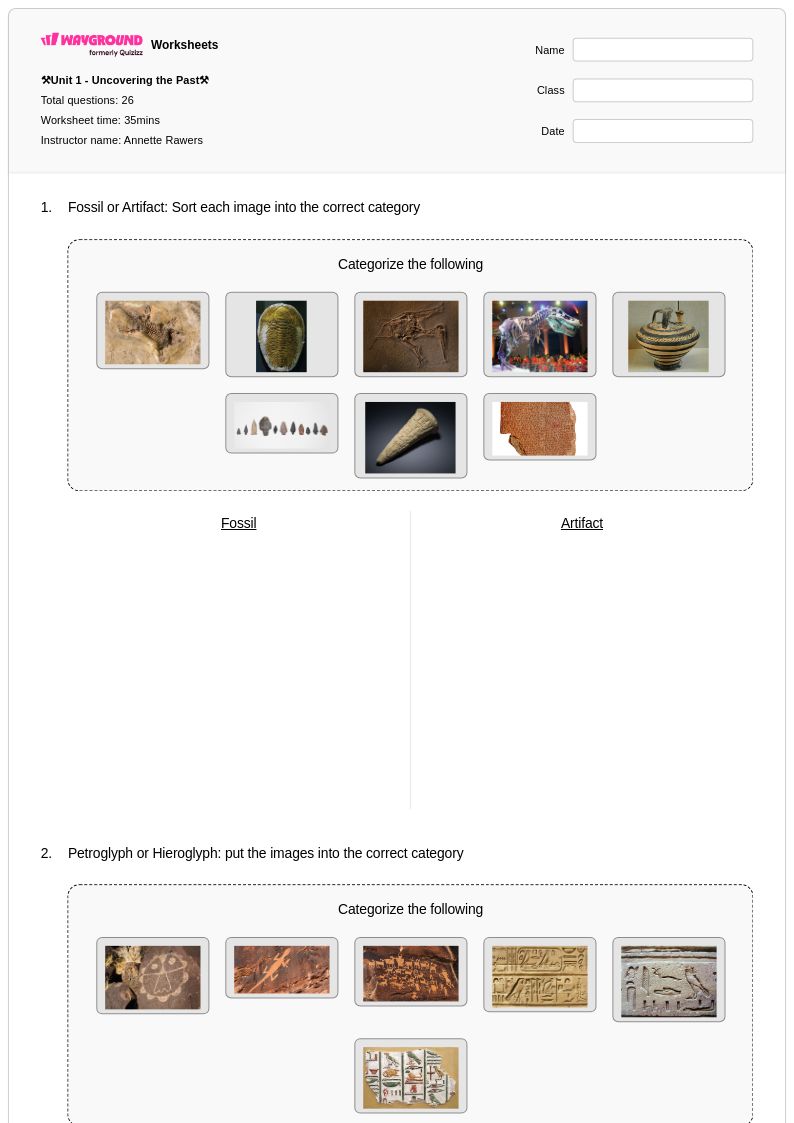
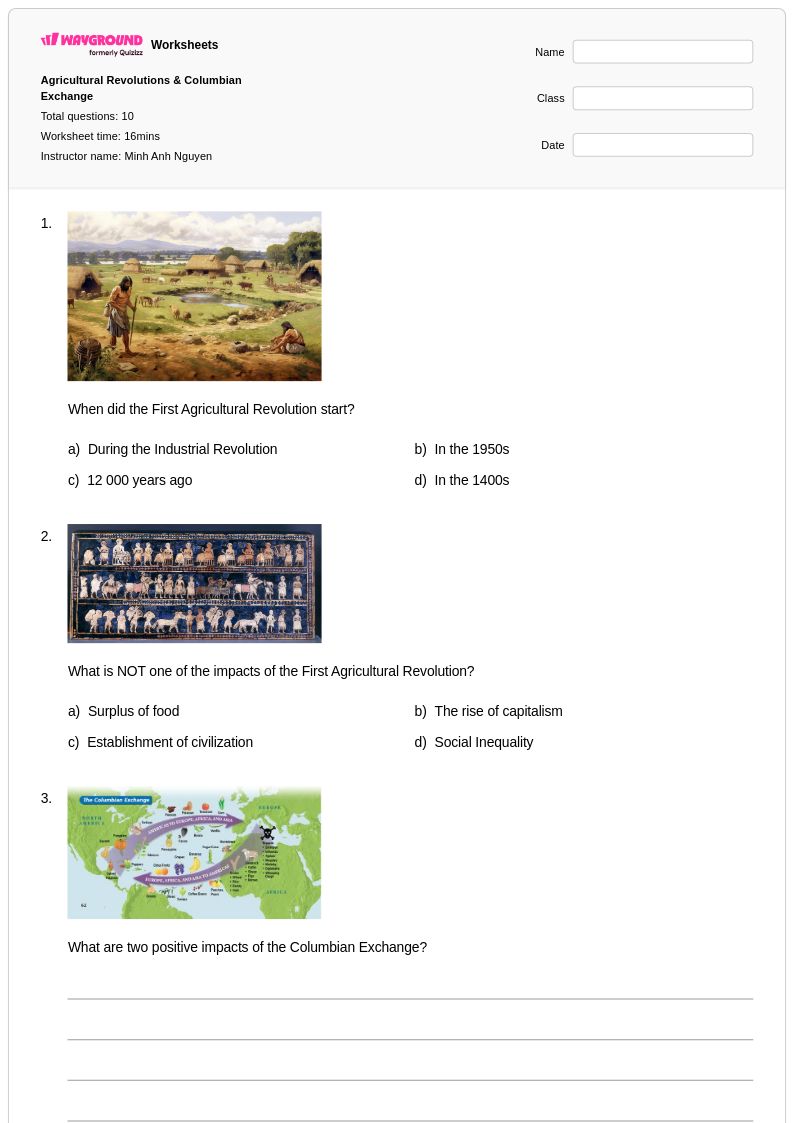
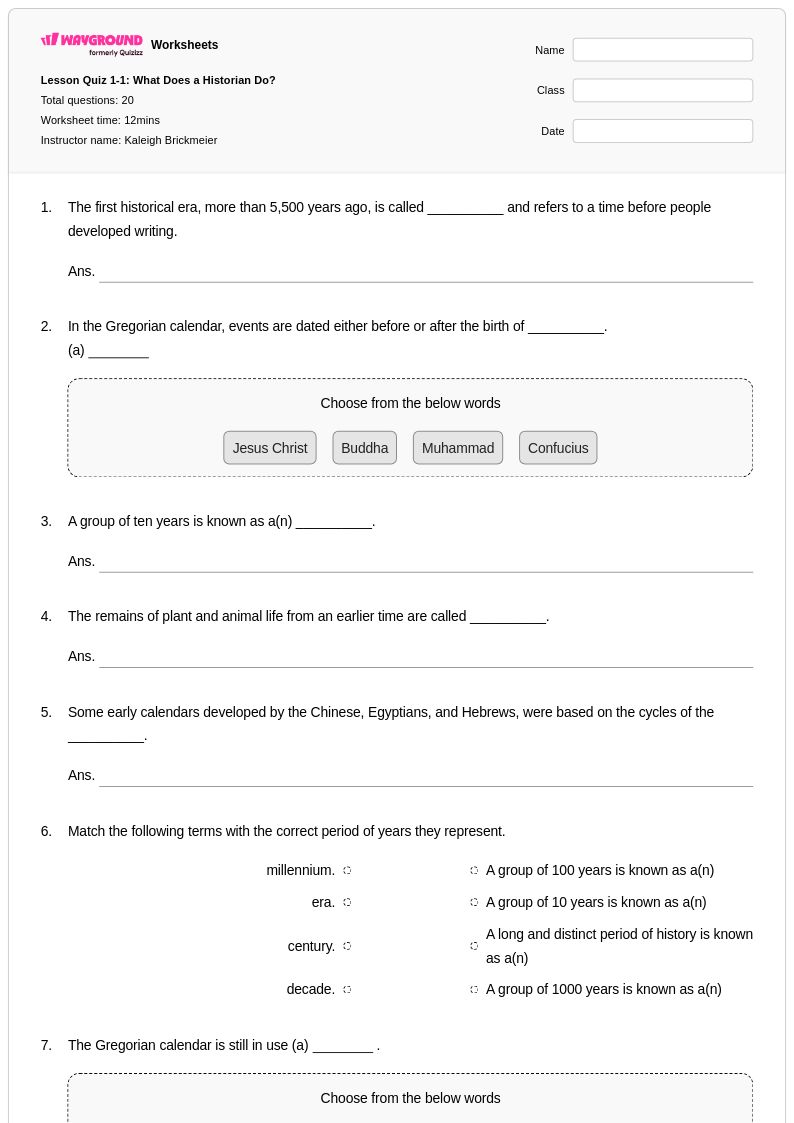
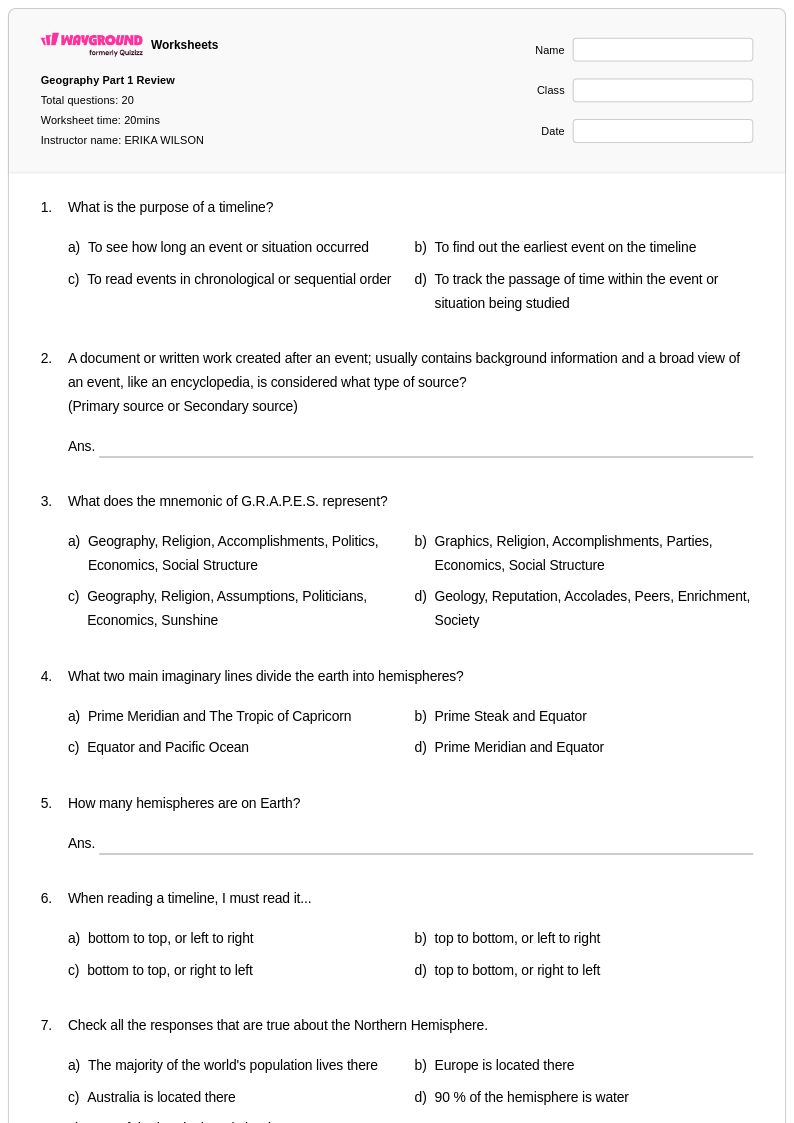
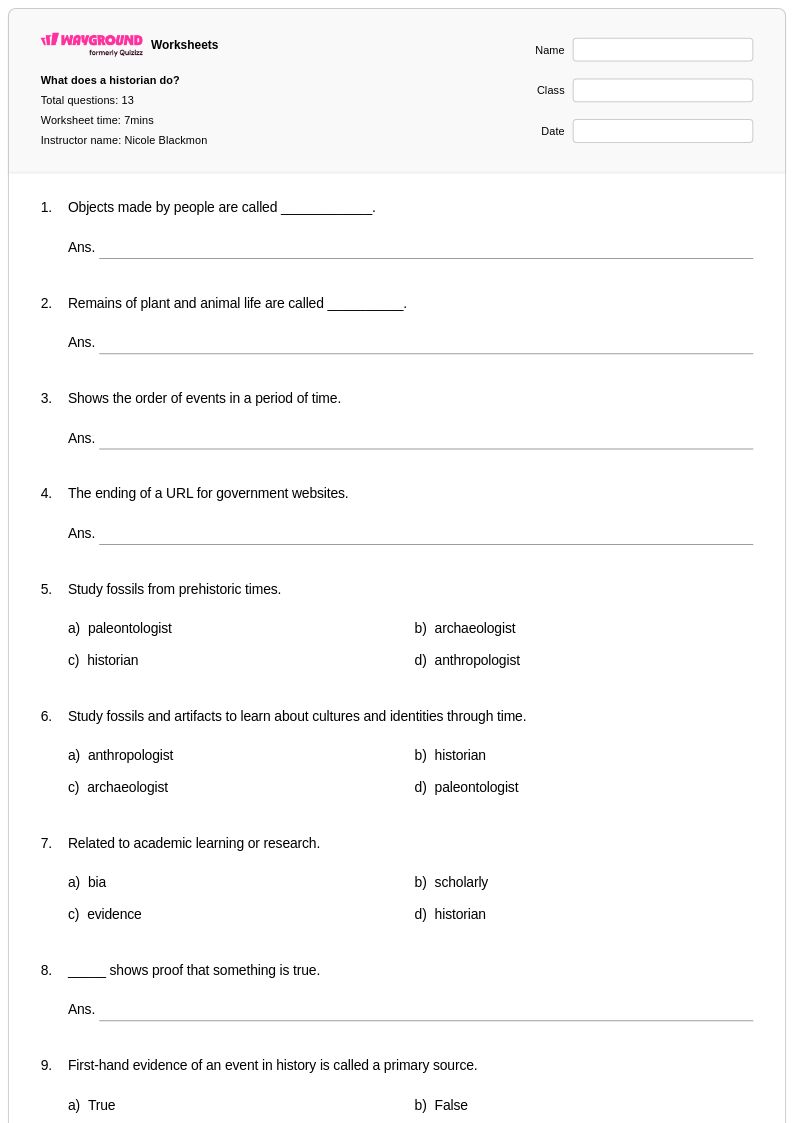
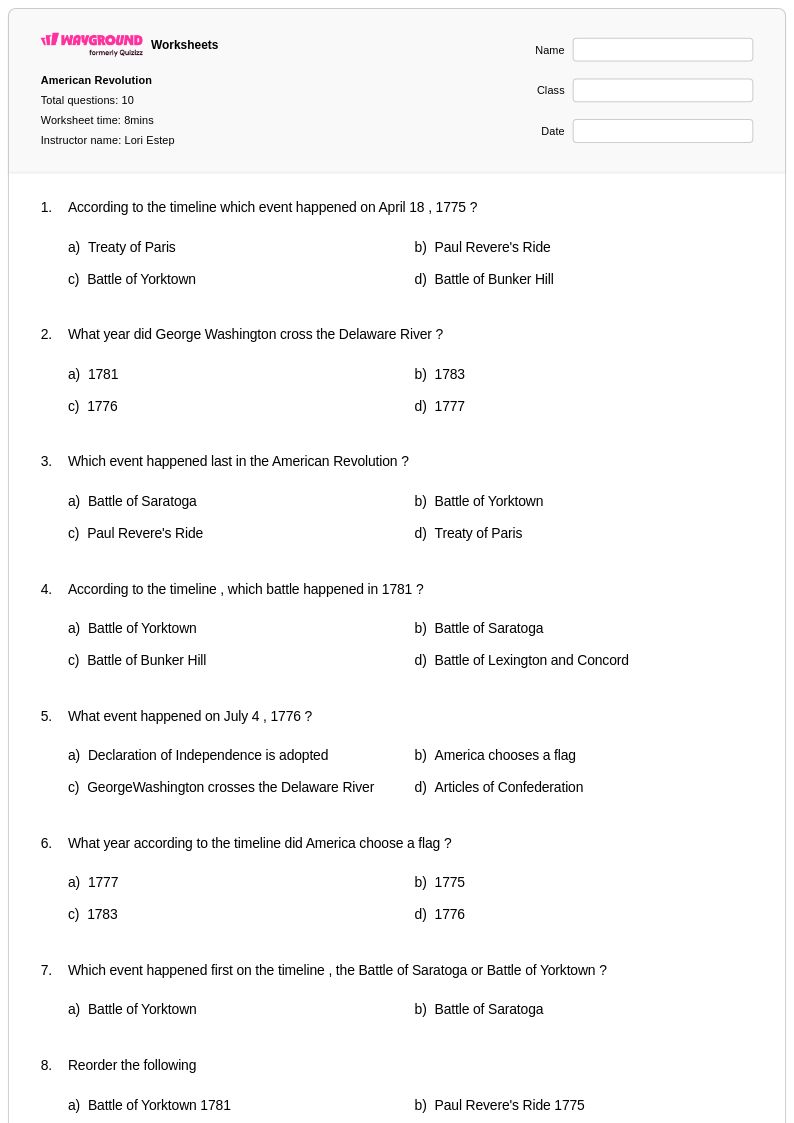
Enhance students' timeline reading skills with Wayground's comprehensive collection of free Social Studies worksheets, featuring engaging printables, practice problems, and detailed answer keys in convenient PDF format.
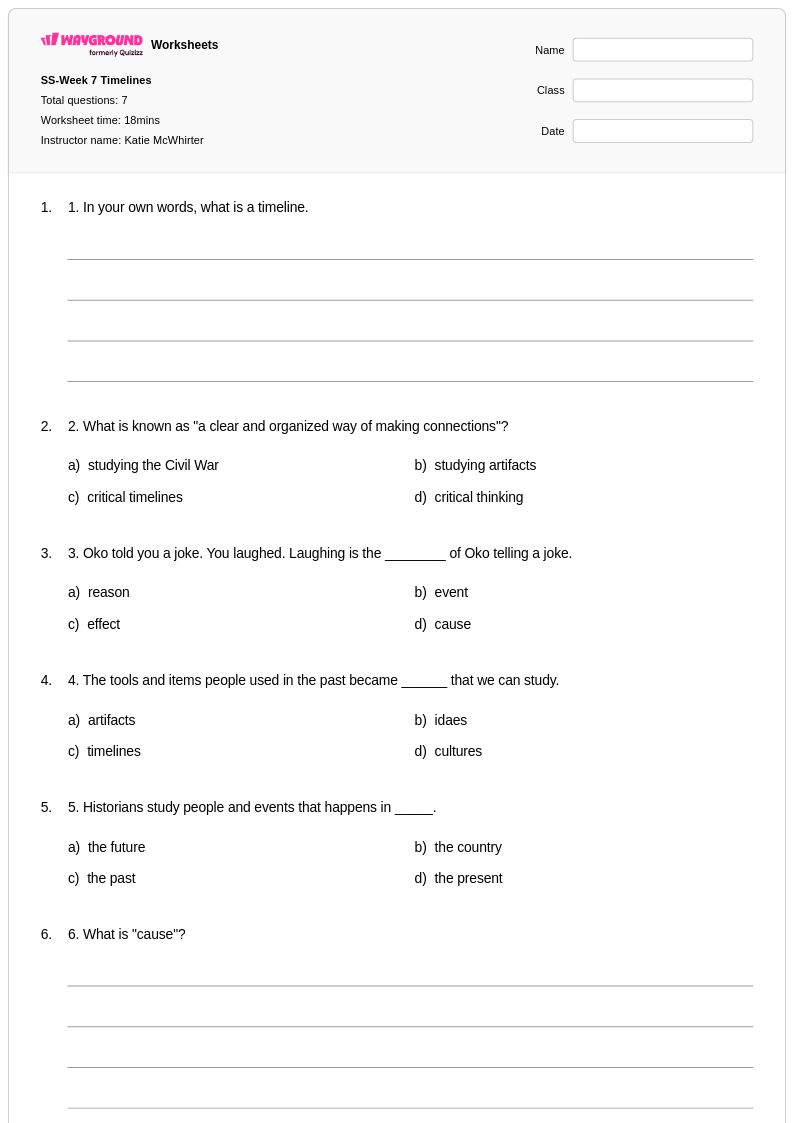
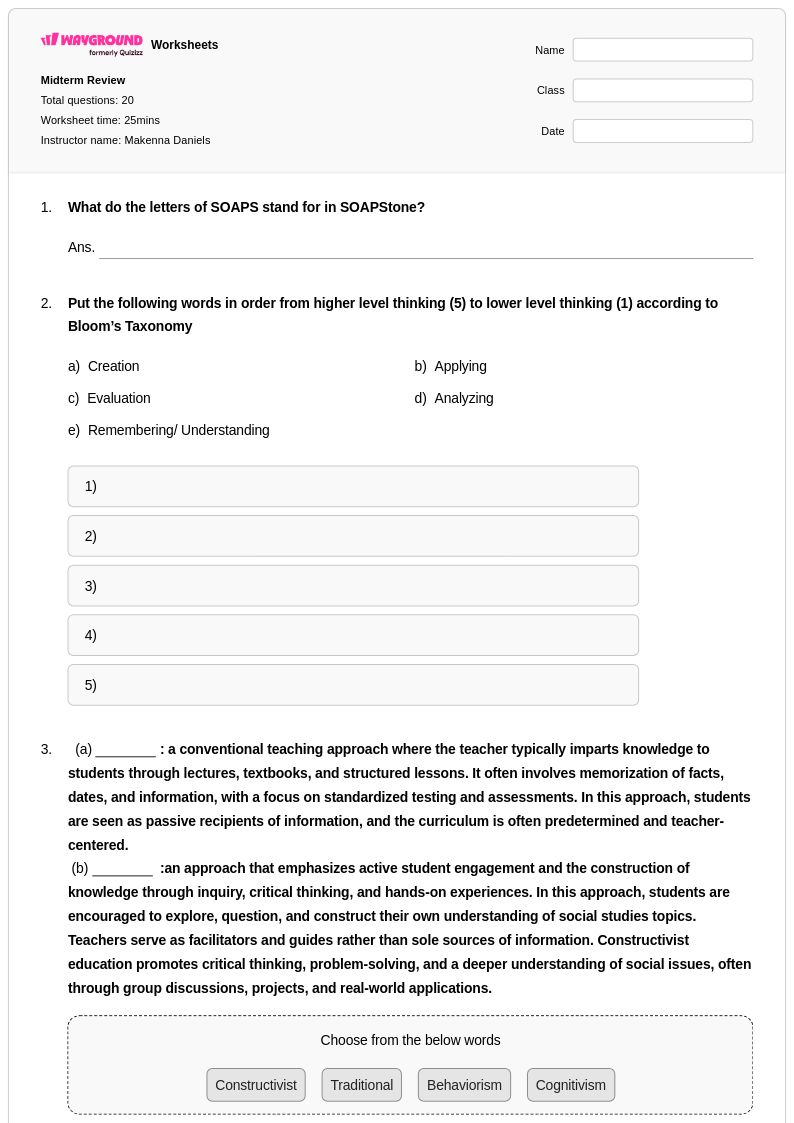
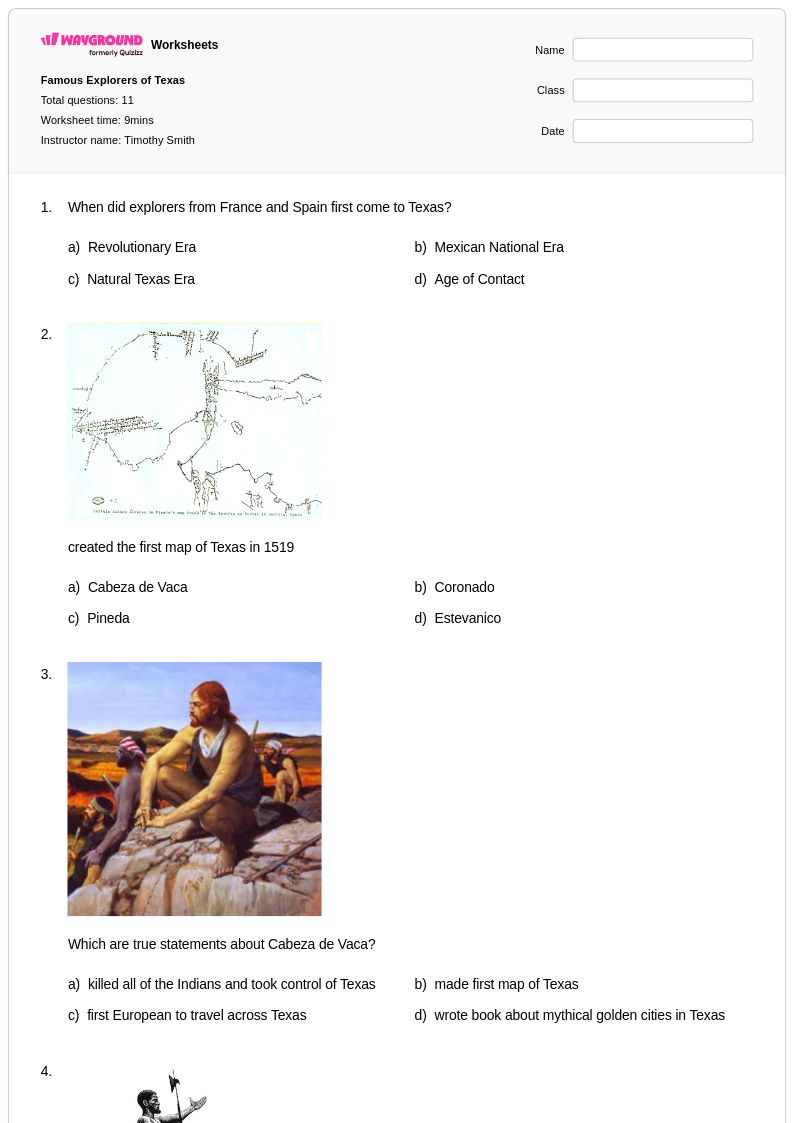
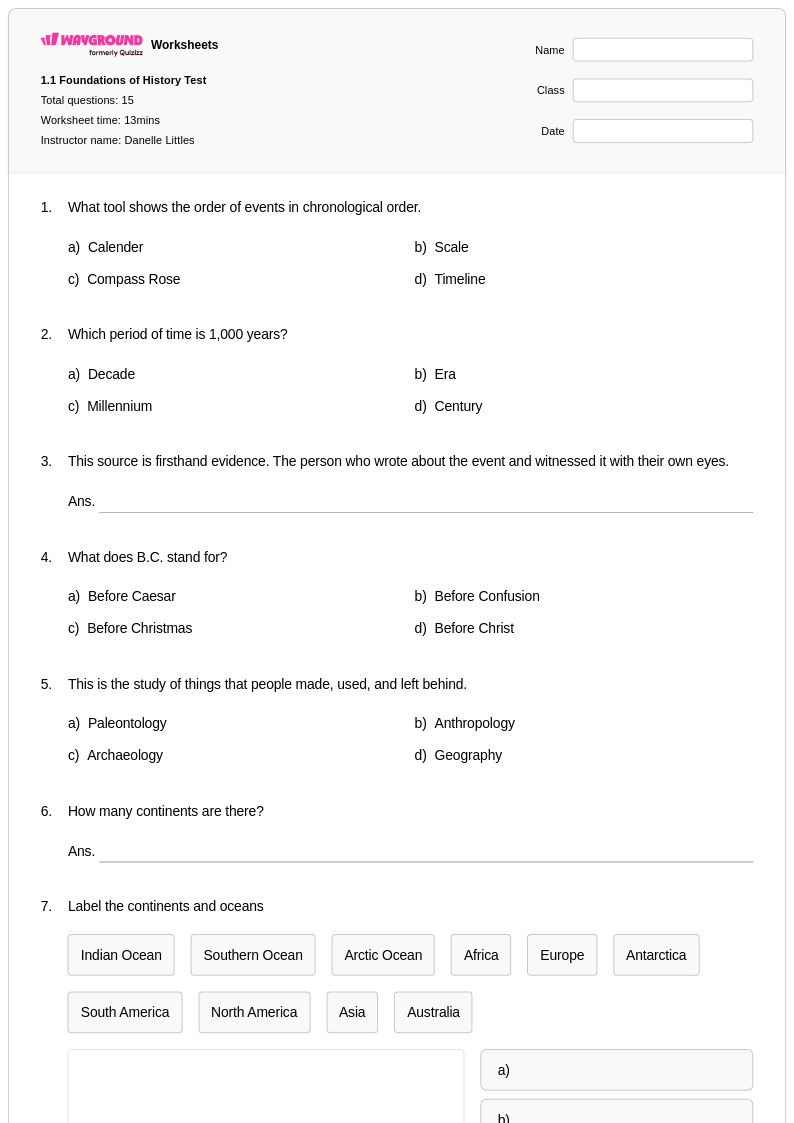
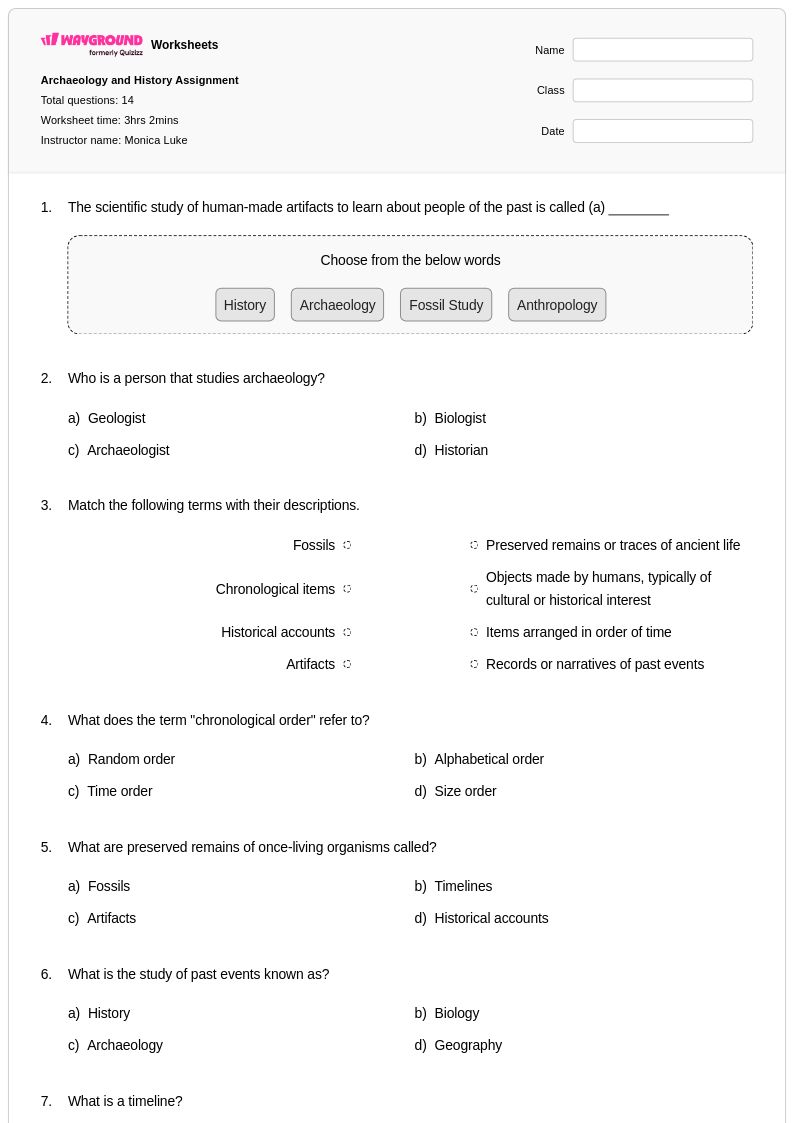
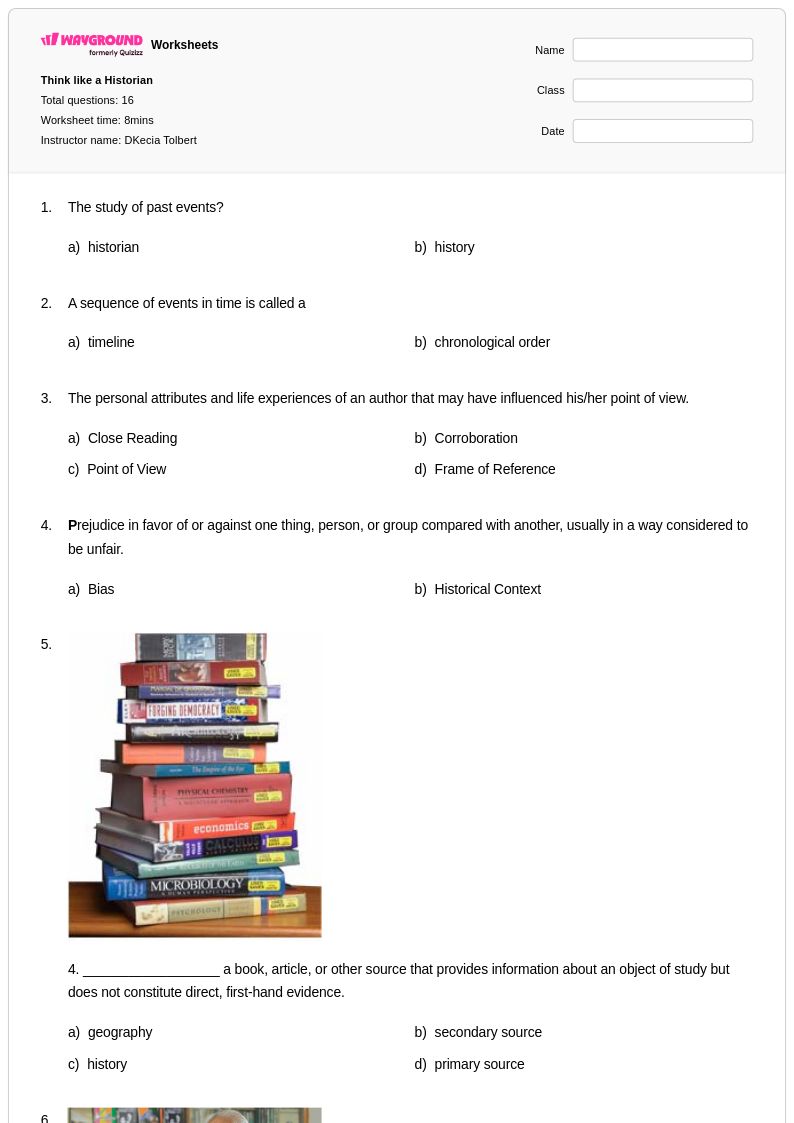
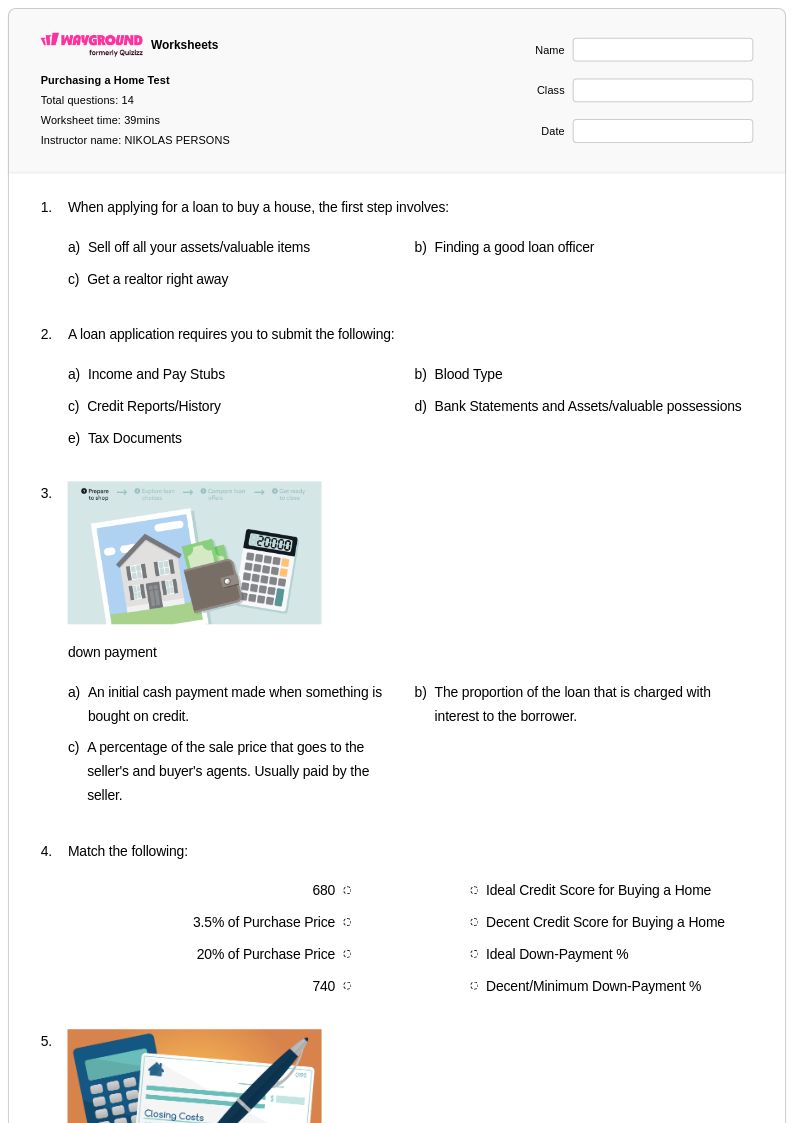
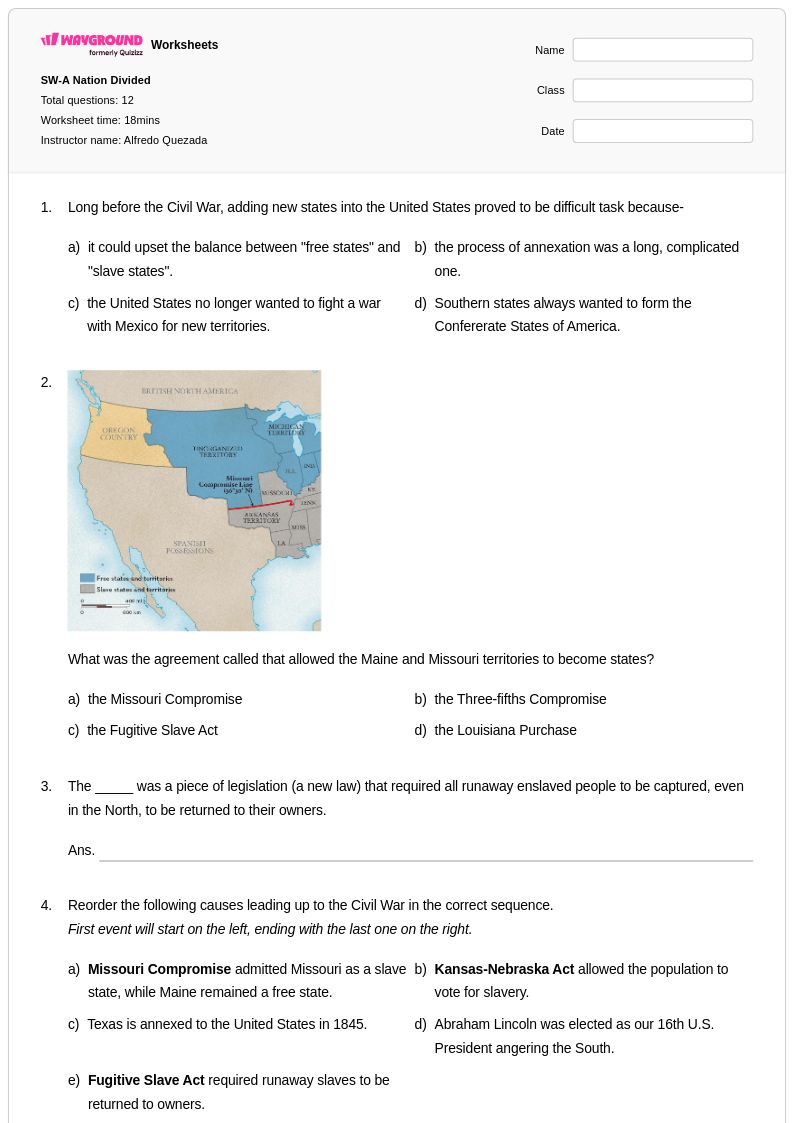
Reading a timeline worksheets from Wayground (formerly Quizizz) provide comprehensive practice materials that develop students' chronological thinking and historical analysis skills across all grade levels. These carefully designed printables strengthen essential abilities including sequencing historical events, interpreting time periods and intervals, identifying cause-and-effect relationships, and understanding the progression of civilizations and significant developments. Each worksheet collection includes detailed answer keys and spans various historical topics from ancient civilizations to modern events, offering free practice problems that range from basic timeline reading exercises to complex analytical tasks requiring students to synthesize information from multiple sources and create their own chronological narratives.
Wayground's extensive collection of reading a timeline worksheets draws from millions of teacher-created resources, providing educators with powerful search and filtering capabilities to locate materials perfectly suited to their instructional needs. The platform's robust standards alignment ensures that worksheets meet curriculum requirements while offering differentiation tools that allow teachers to customize content for diverse learner needs and abilities. Available in both printable pdf format and interactive digital versions, these resources support flexible lesson planning whether educators need quick remediation activities, enrichment challenges for advanced students, or systematic skill practice sessions. The comprehensive filtering system enables teachers to quickly identify worksheets by specific historical periods, complexity levels, or particular timeline reading skills, streamlining the process of finding targeted materials for whole-class instruction, small group work, or individual student practice.
FAQs
How do I teach students to read a timeline?
Start by introducing the core components of a timeline: the chronological axis, labeled intervals, and event markers. Teach students to read left to right as time progresses, identify the scale of intervals (decades vs. centuries), and locate specific events relative to one another. Once students understand structure, move into interpretation by asking them to describe the sequence of events, calculate time elapsed between events, and identify patterns or turning points. Anchoring early lessons to familiar events, such as personal or school history, helps students internalize chronological thinking before applying it to historical content.
What exercises help students practice reading a timeline?
Effective practice exercises include sequencing events by placing them in chronological order, calculating the time elapsed between two events, and identifying which event came before or after another. Students also benefit from exercises that require them to interpret a completed timeline and answer analytical questions, such as identifying cause-and-effect relationships or explaining why a particular period saw rapid change. More advanced practice involves reading timelines with multiple parallel tracks, where students must synthesize information across different threads of history simultaneously.
What mistakes do students commonly make when reading a timeline?
One of the most common errors is misreading the scale of intervals, leading students to assume equal spacing means equal time when the intervals may represent different durations. Students also frequently confuse the direction of time on timelines that span BCE and CE dates, particularly around the transition point where numbers decrease toward zero and then increase again. Another common mistake is treating events as isolated facts rather than recognizing their sequential or causal relationships, which limits deeper historical analysis.
How can I differentiate timeline reading instruction for students at different skill levels?
For students who need additional support, use simplified timelines with fewer events, larger fonts, and clear interval markers before introducing complex multi-event timelines. More advanced students can be challenged with activities that require synthesizing information from two or more timelines or constructing their own. On Wayground, teachers can apply accommodations such as read aloud, reduced answer choices, and extended time to individual students without affecting the rest of the class, making it easier to support diverse learners within the same assignment.
How do I use Wayground's reading a timeline worksheets in my classroom?
Wayground's reading a timeline worksheets are available as printable PDFs for traditional classroom use and in digital formats for technology-integrated environments, giving teachers flexibility depending on their setup. Teachers can also host worksheets as a quiz directly on Wayground. Each worksheet includes a complete answer key, which reduces prep time and supports consistent grading. The platform's filtering tools allow teachers to locate worksheets by historical period, complexity level, or specific skill, making it straightforward to find materials suited to whole-class instruction, small group work, or individual practice.
How do I help students understand BCE and CE dates on a timeline?
Explicitly teach students that BCE dates count down toward zero and CE dates count up from zero, so a larger BCE number represents an earlier point in time. Use a number line analogy with negative and positive numbers to make this concept concrete before applying it to a historical timeline. Practice problems that require students to calculate the number of years between a BCE date and a CE date are particularly effective at reinforcing this understanding, as they force students to work through the zero boundary rather than simply recognizing labels.
How do timeline reading skills connect to broader historical thinking?
Reading a timeline builds the foundational skill of chronological thinking, which underlies nearly all historical reasoning. When students can accurately sequence events and interpret intervals, they are better positioned to identify cause-and-effect relationships, recognize patterns of change and continuity, and evaluate historical significance. These skills are directly tied to standards-based historical thinking practices across grade levels and transfer to document analysis, essay writing, and standardized assessment performance.