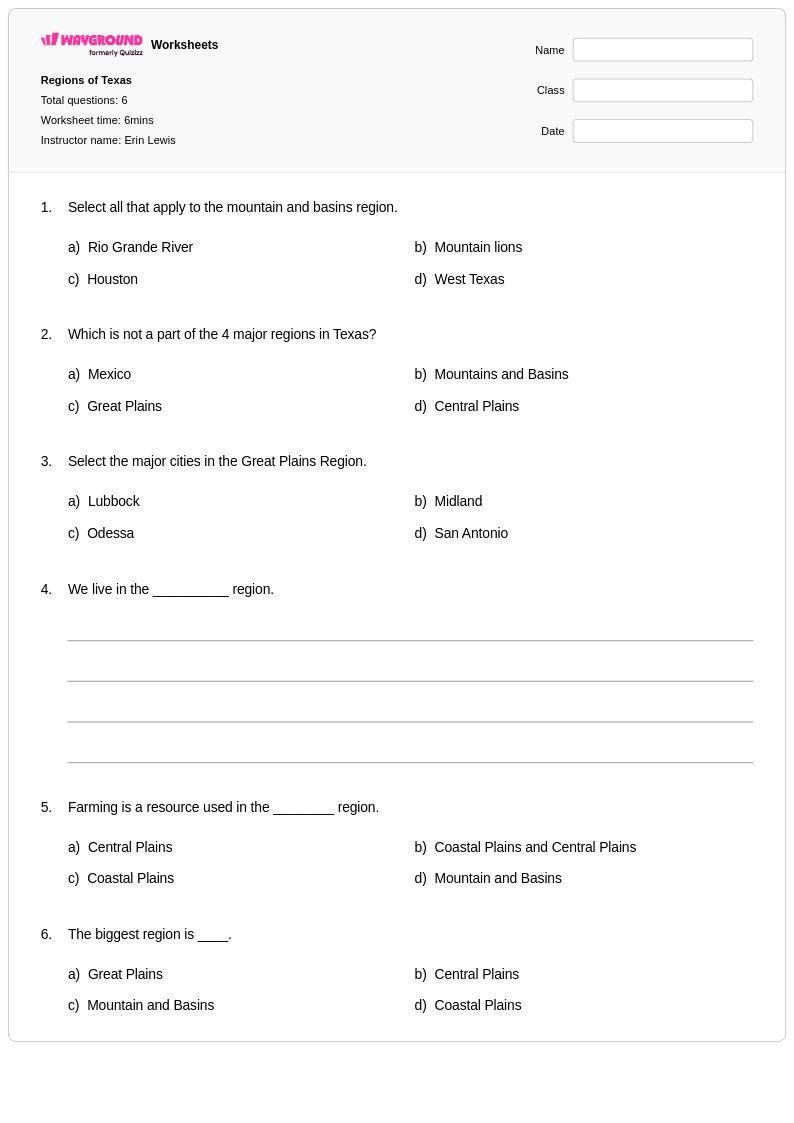
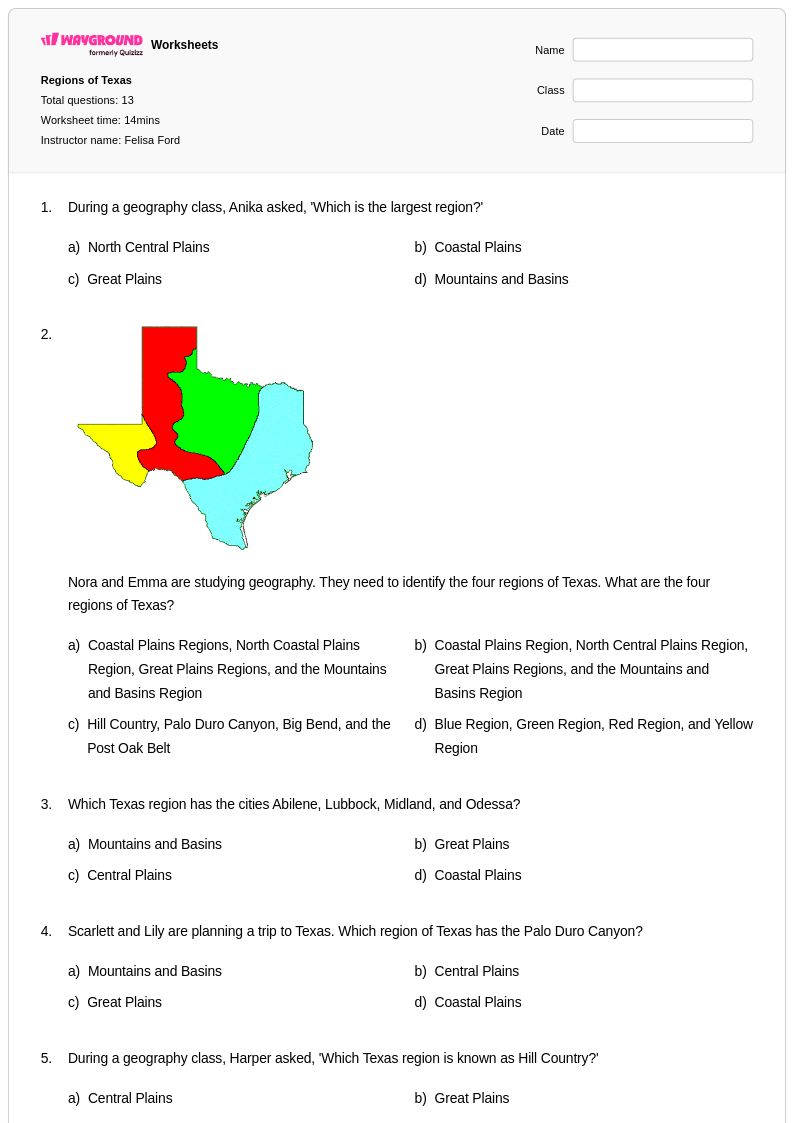
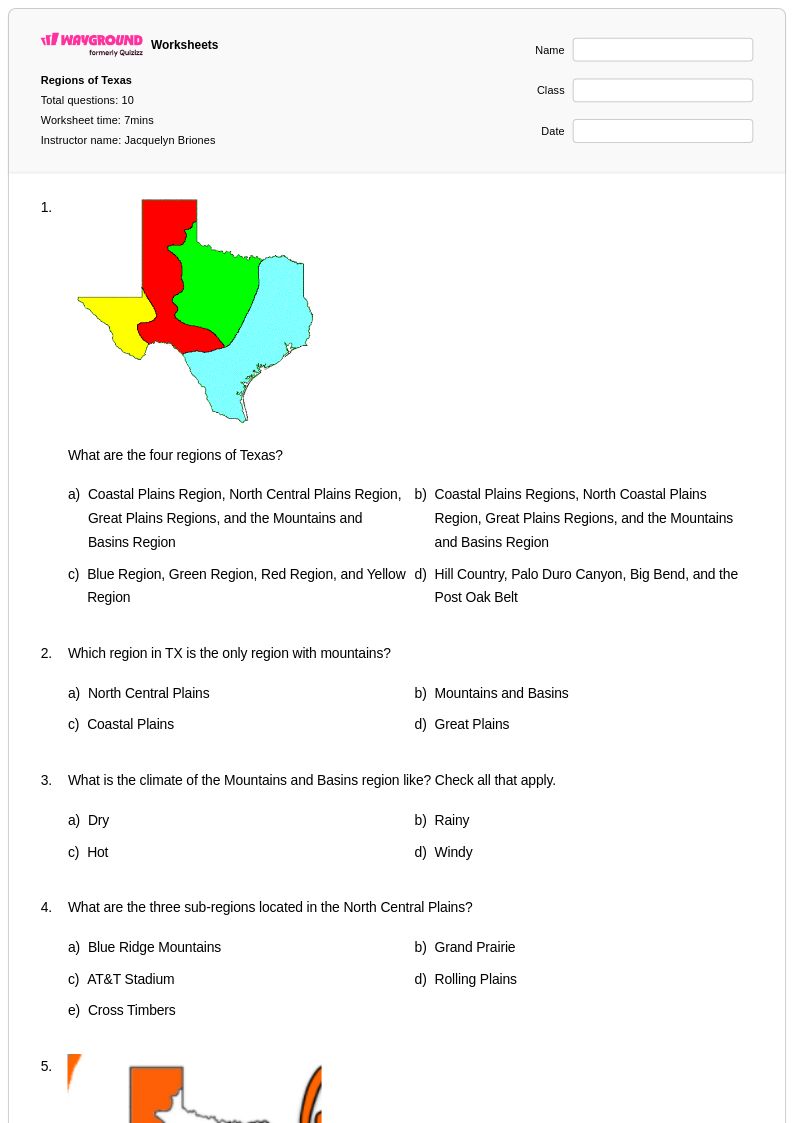
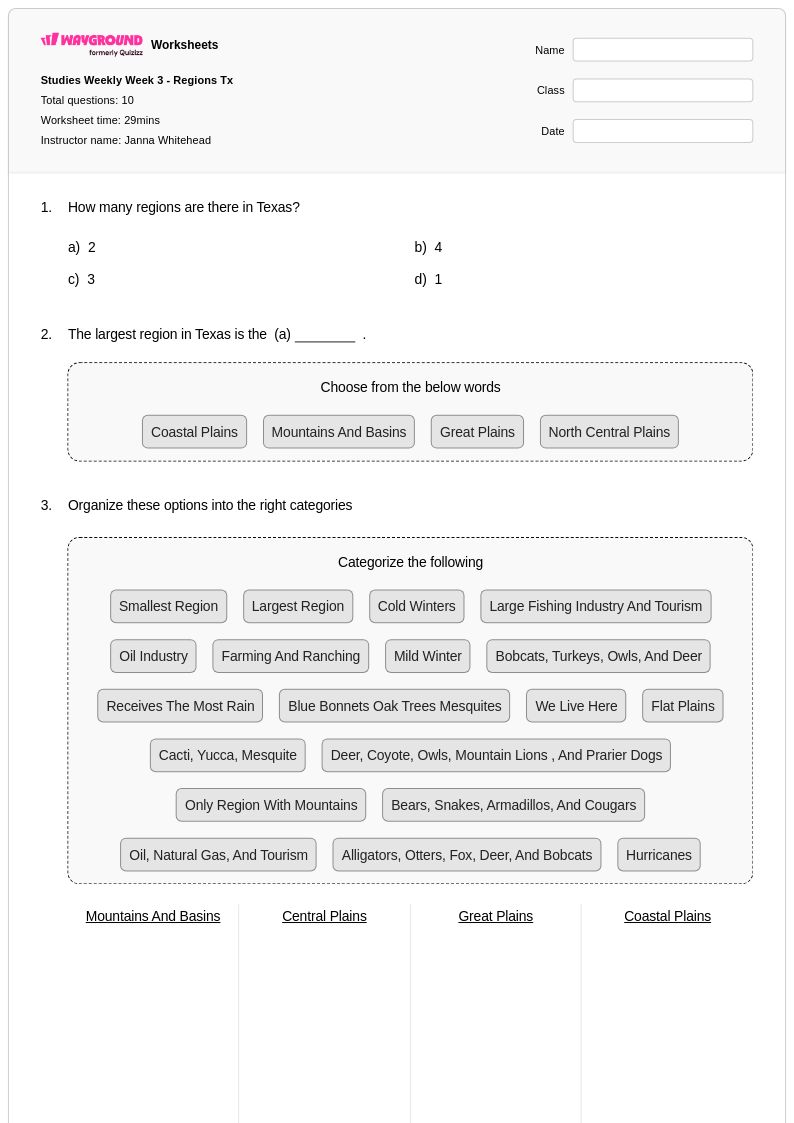
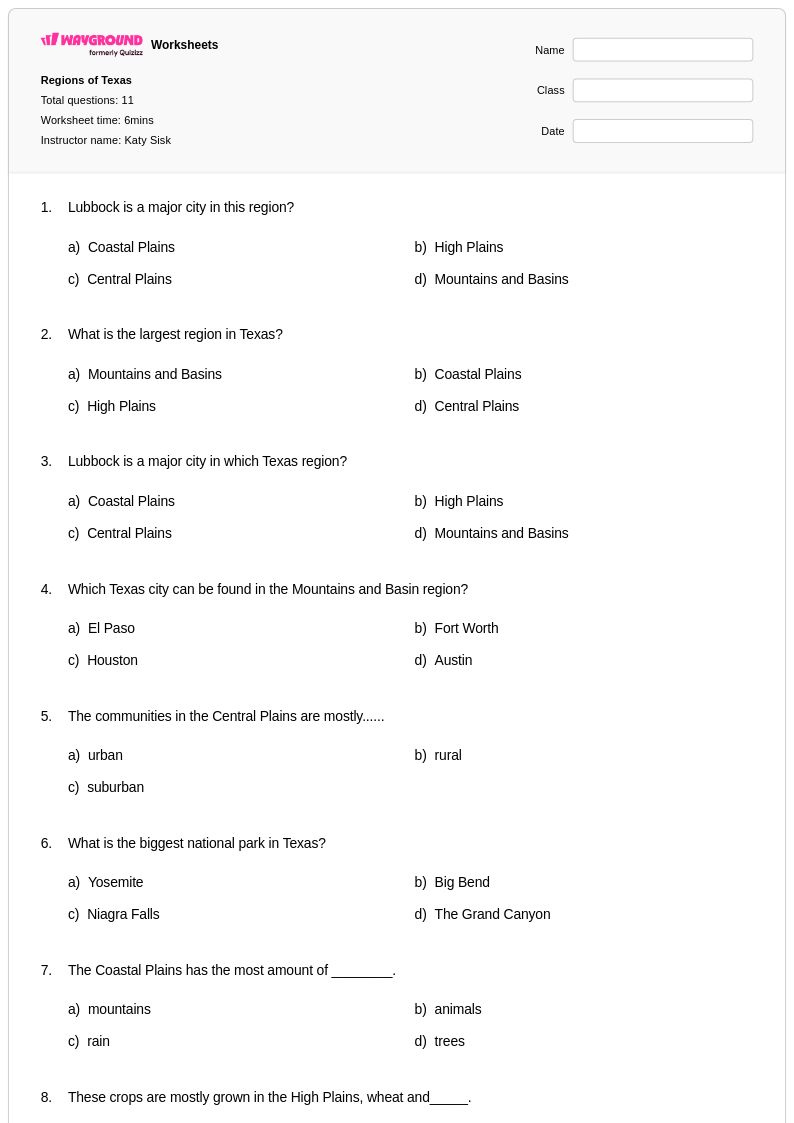
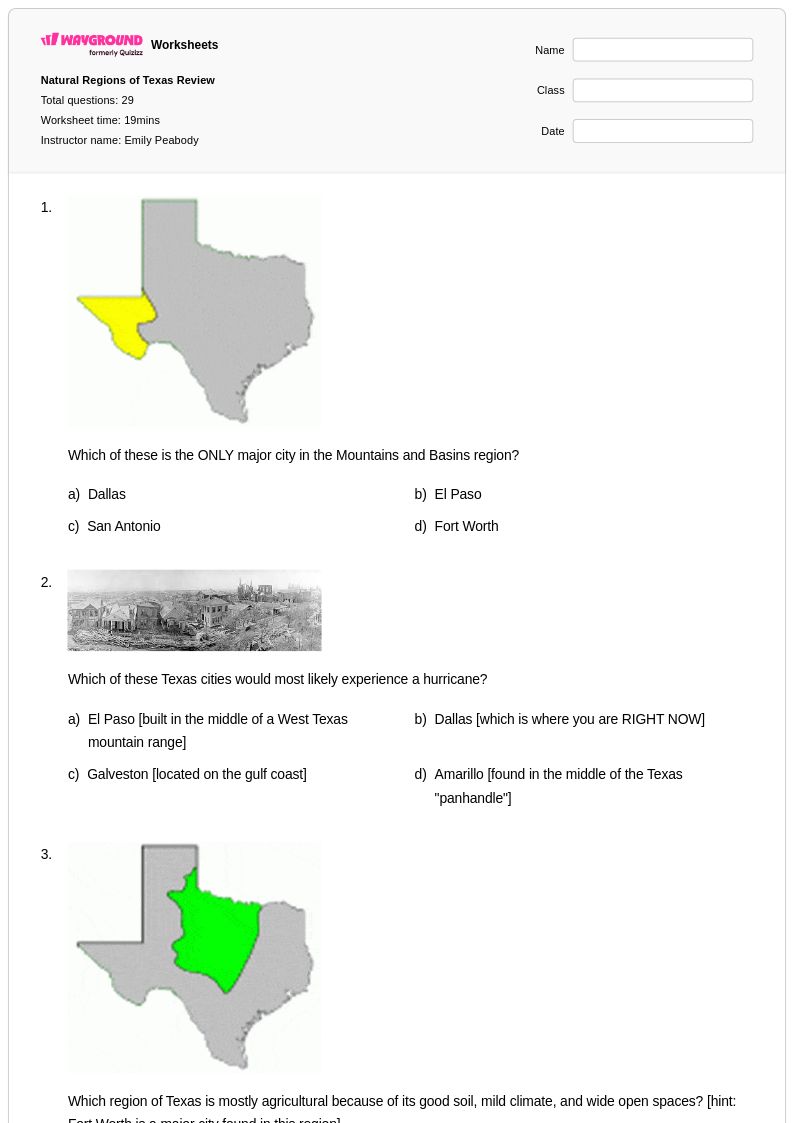
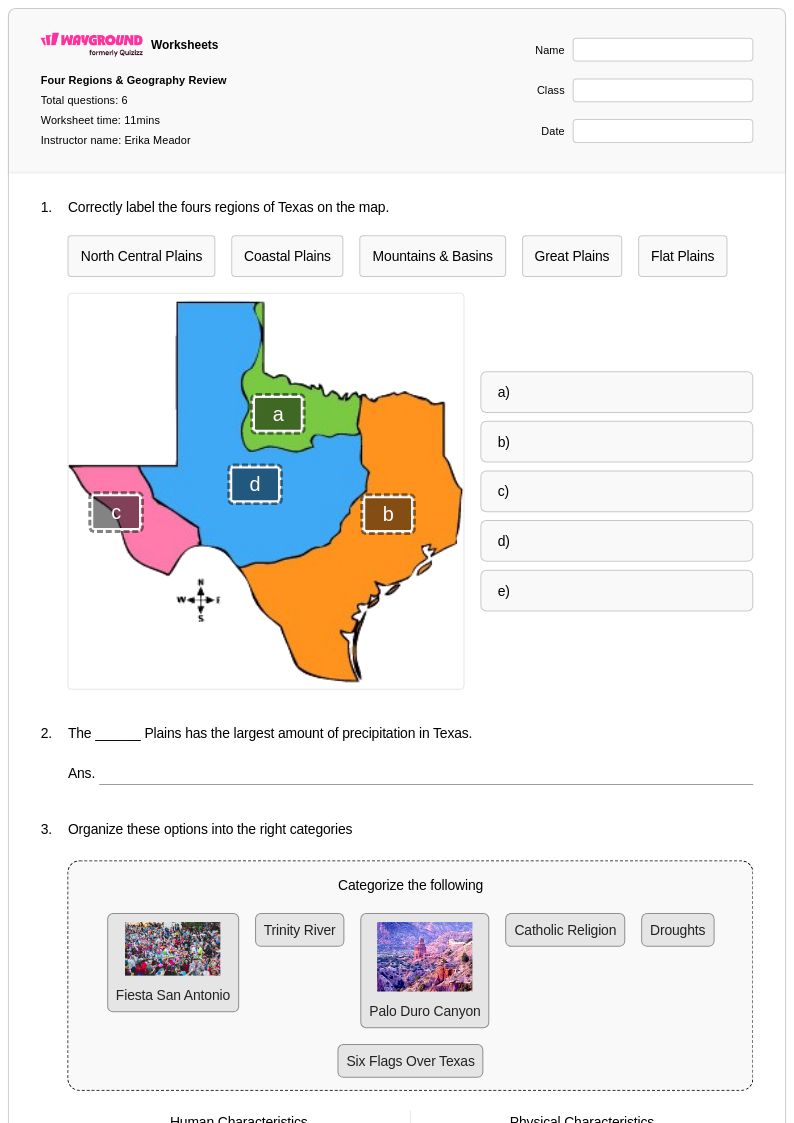
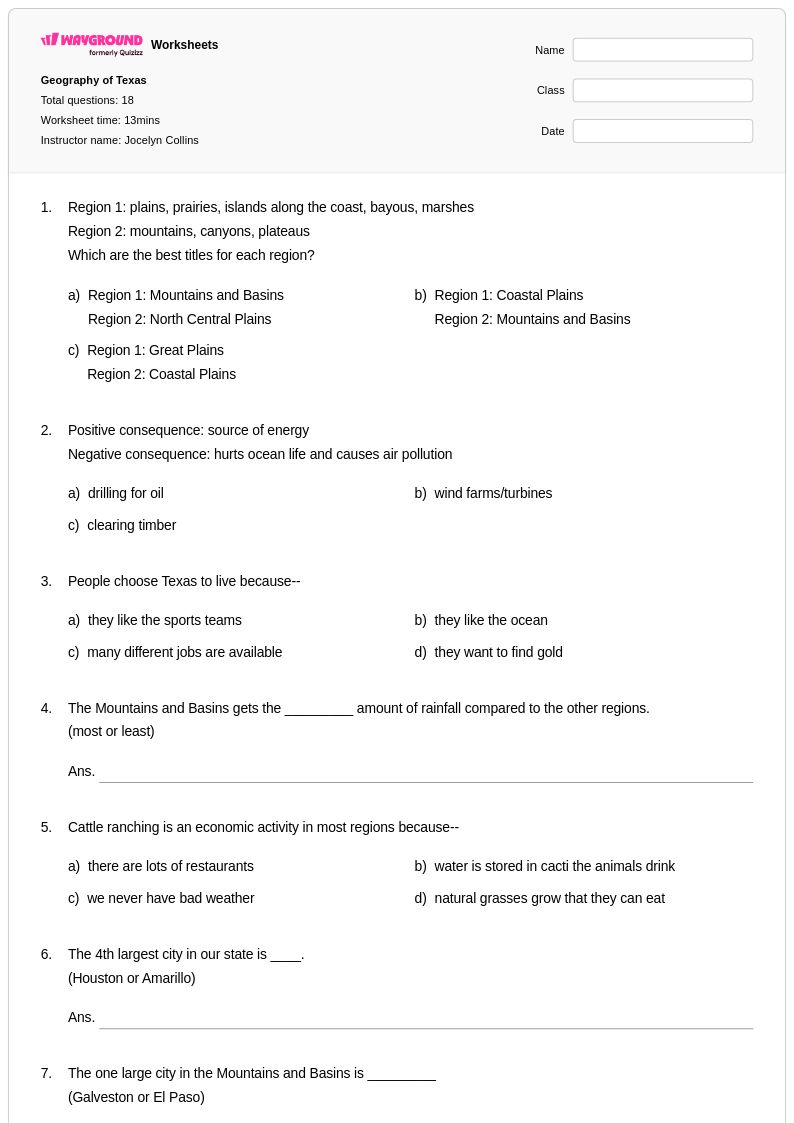
Explore Wayground's free printable worksheets and practice problems on the regions of Texas, helping students master geographic divisions, cultural areas, and regional characteristics with comprehensive PDF resources and answer keys.
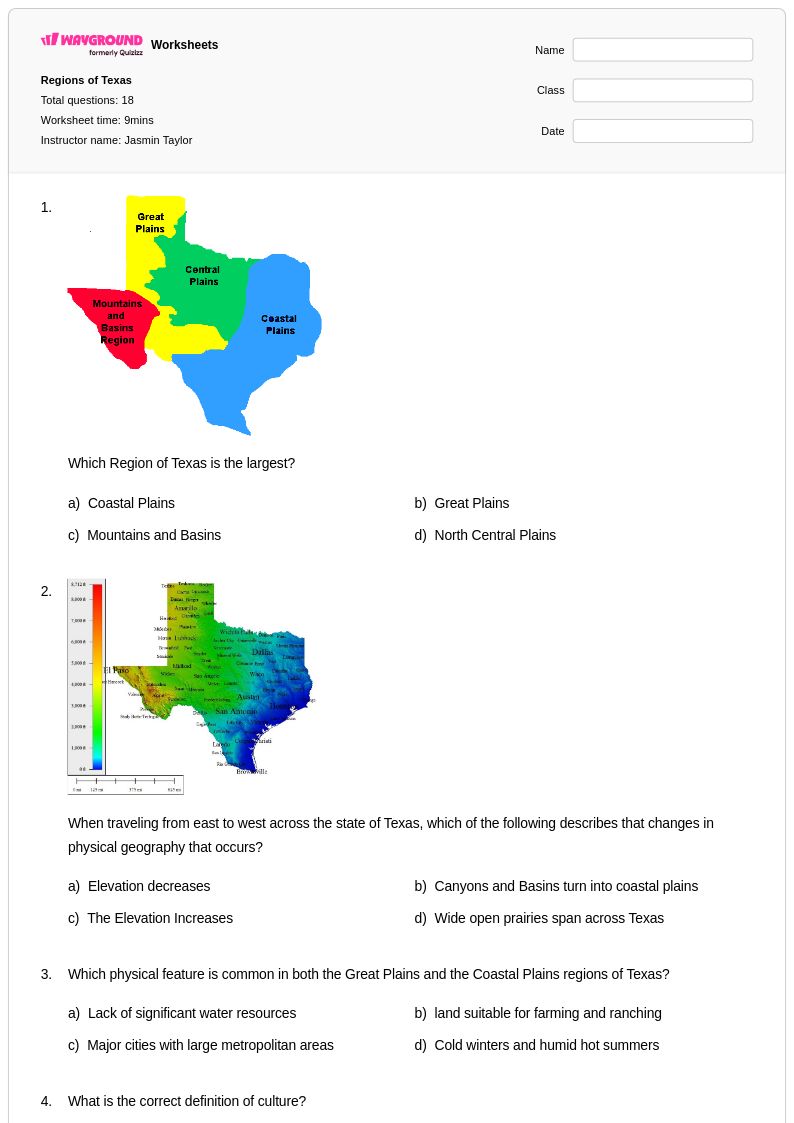
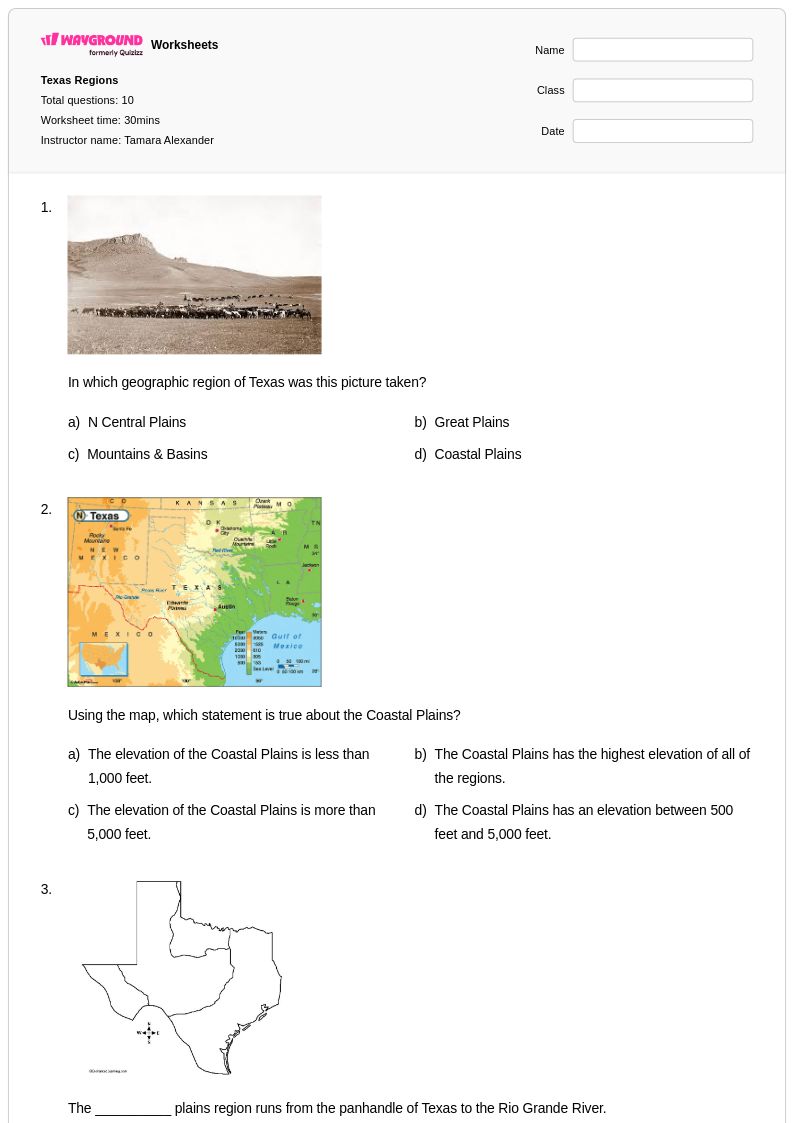
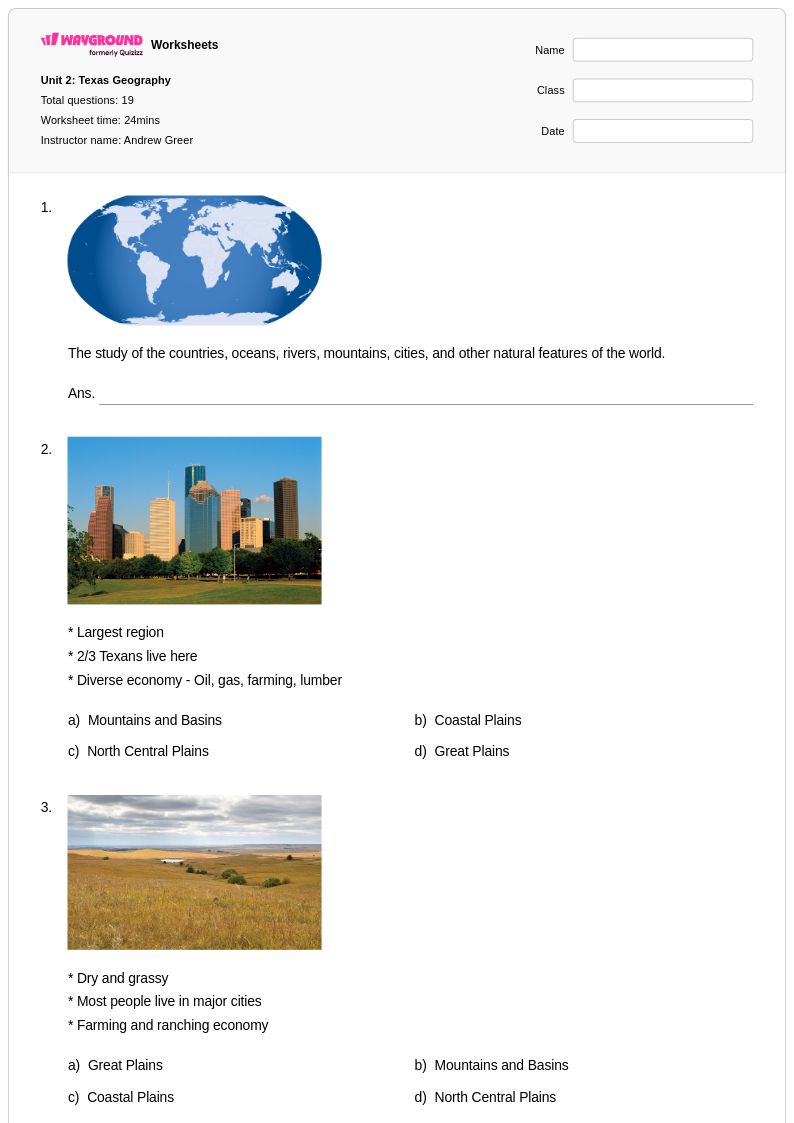
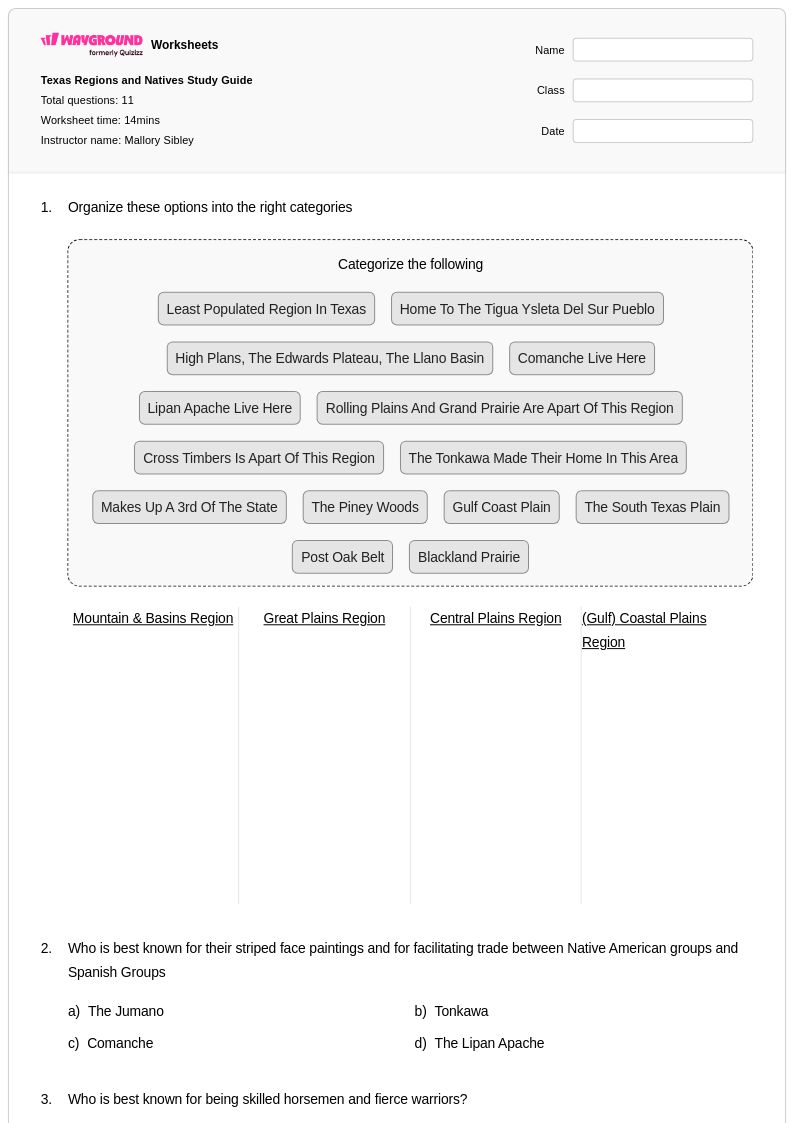
Regions of Texas worksheets available through Wayground (formerly Quizizz) provide comprehensive coverage of the diverse geographical areas that define the Lone Star State, from the Piney Woods of East Texas to the arid Chihuahuan Desert of West Texas. These educational resources strengthen students' understanding of the four primary regions—the Gulf Coastal Plains, Interior Lowlands, Great Plains, and Basin and Range Province—while developing critical geographic analysis skills including map interpretation, climate pattern recognition, and natural resource identification. Each worksheet collection includes carefully crafted practice problems that explore regional characteristics such as topography, vegetation, economic activities, and population distribution, accompanied by detailed answer keys that support both independent study and classroom instruction. The free printables cover essential concepts like the Edwards Plateau, Blackland Prairie, and Coastal Bend, enabling students to master the distinctive features that make each Texas region unique through engaging pdf formats suitable for various learning environments.
Wayground (formerly Quizizz) empowers educators with millions of teacher-created resources specifically designed to explore Texas geography, offering robust search and filtering capabilities that allow instructors to quickly locate materials aligned with state standards and curriculum requirements. The platform's comprehensive worksheet collections support differentiated instruction through flexible customization options, enabling teachers to modify content difficulty and focus areas to meet diverse student needs across grade levels. Available in both printable and digital formats including downloadable pdfs, these resources facilitate seamless integration into lesson planning while providing valuable tools for remediation, enrichment, and targeted skill practice. Teachers can efficiently assess student understanding of regional concepts, reinforce map skills, and provide additional practice opportunities that deepen geographical literacy and foster appreciation for Texas's remarkable physical and cultural diversity.
FAQs
How do I teach the regions of Texas to my students?
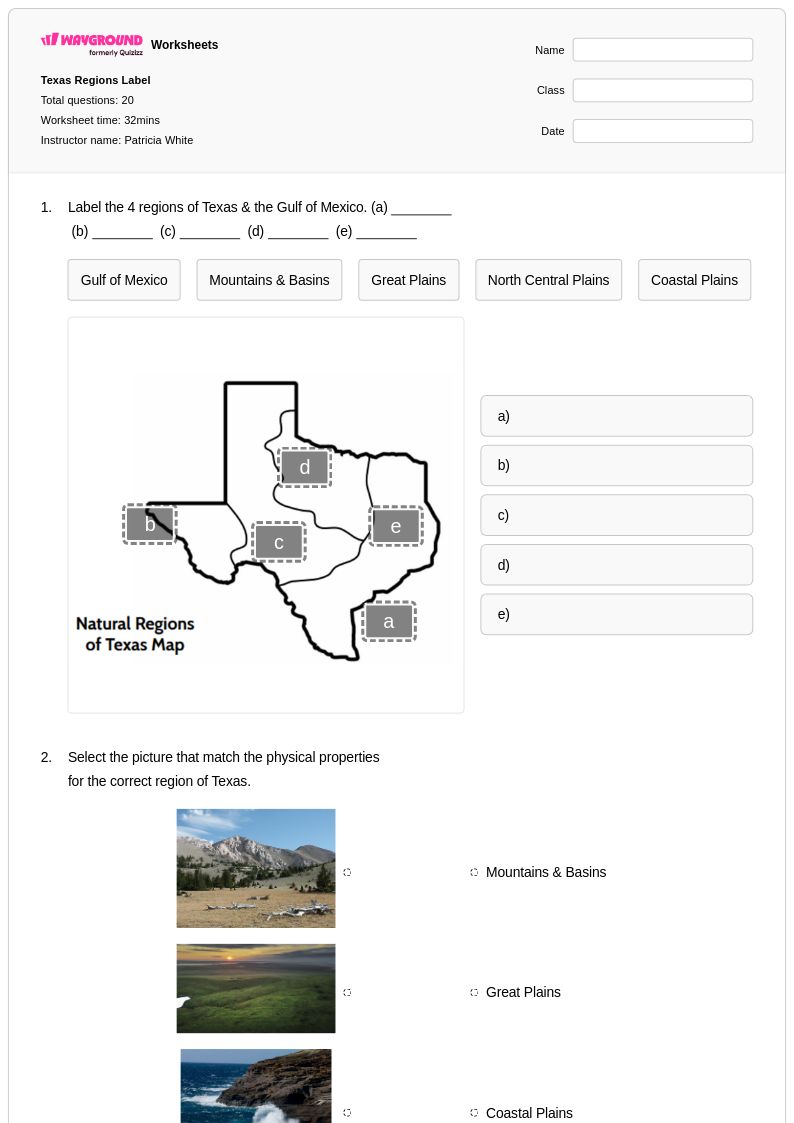
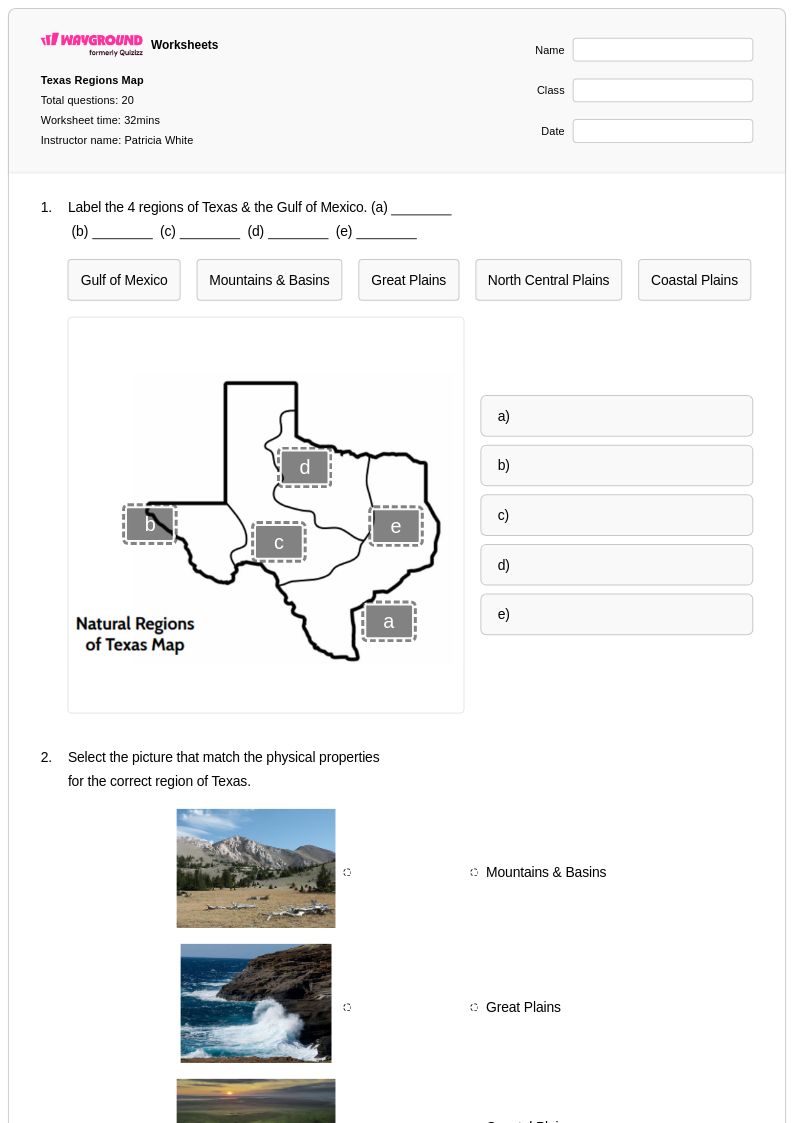
Start by anchoring instruction around the four primary geographic regions: the Gulf Coastal Plains, Interior Lowlands, Great Plains, and Basin and Range Province. Use physical and political maps to help students visualize regional boundaries, then layer in characteristics like topography, vegetation, climate, and economic activity for each area. Comparing regions side by side, rather than teaching them in isolation, helps students build mental frameworks that stick.
What are good activities for practicing the regions of Texas in class?
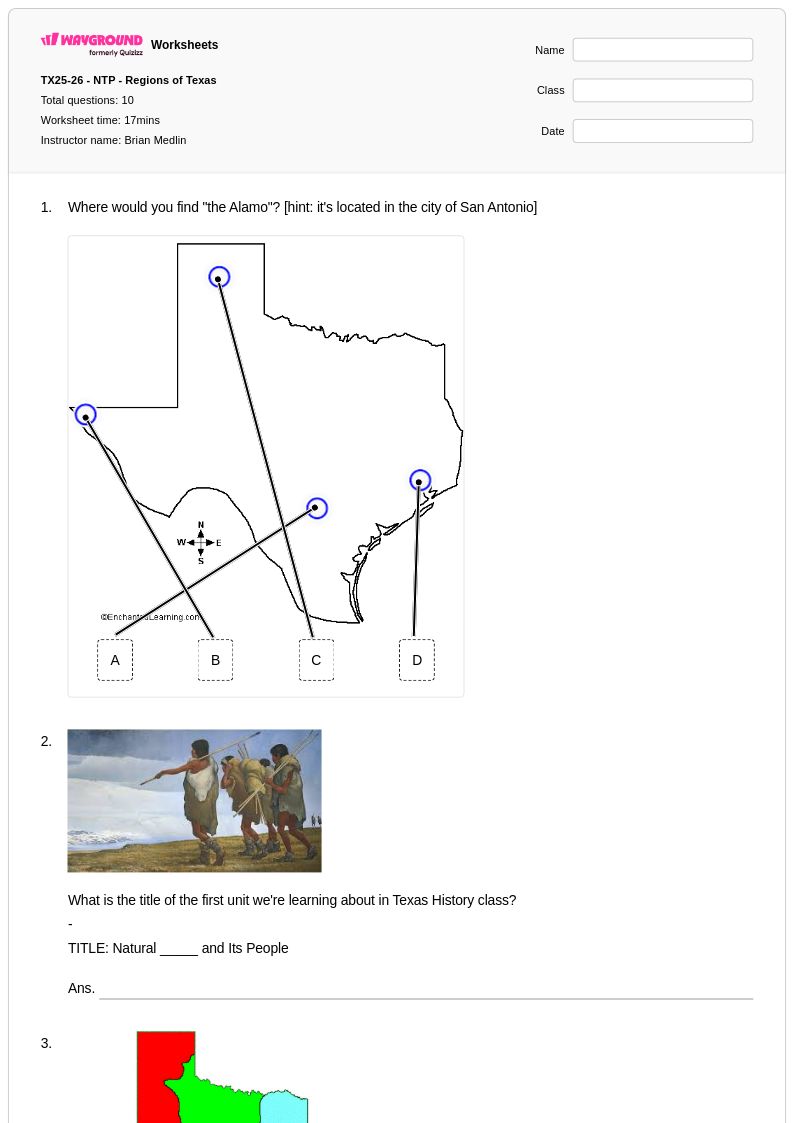
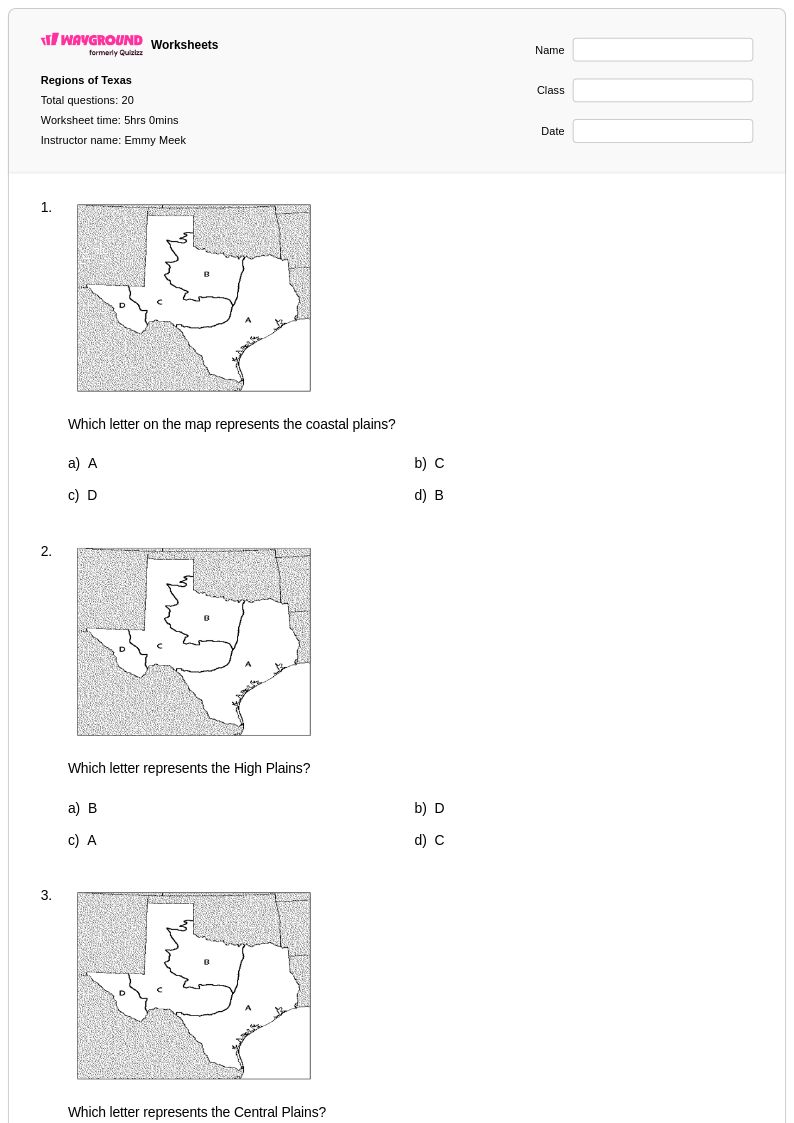
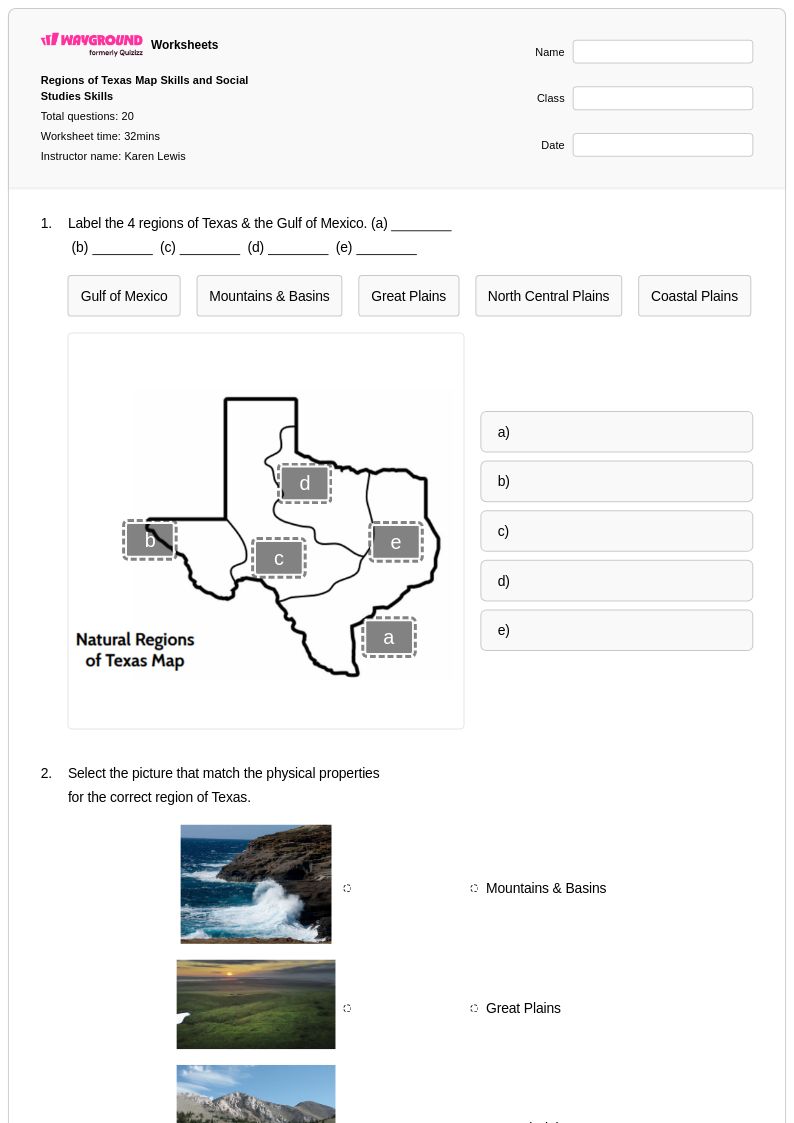
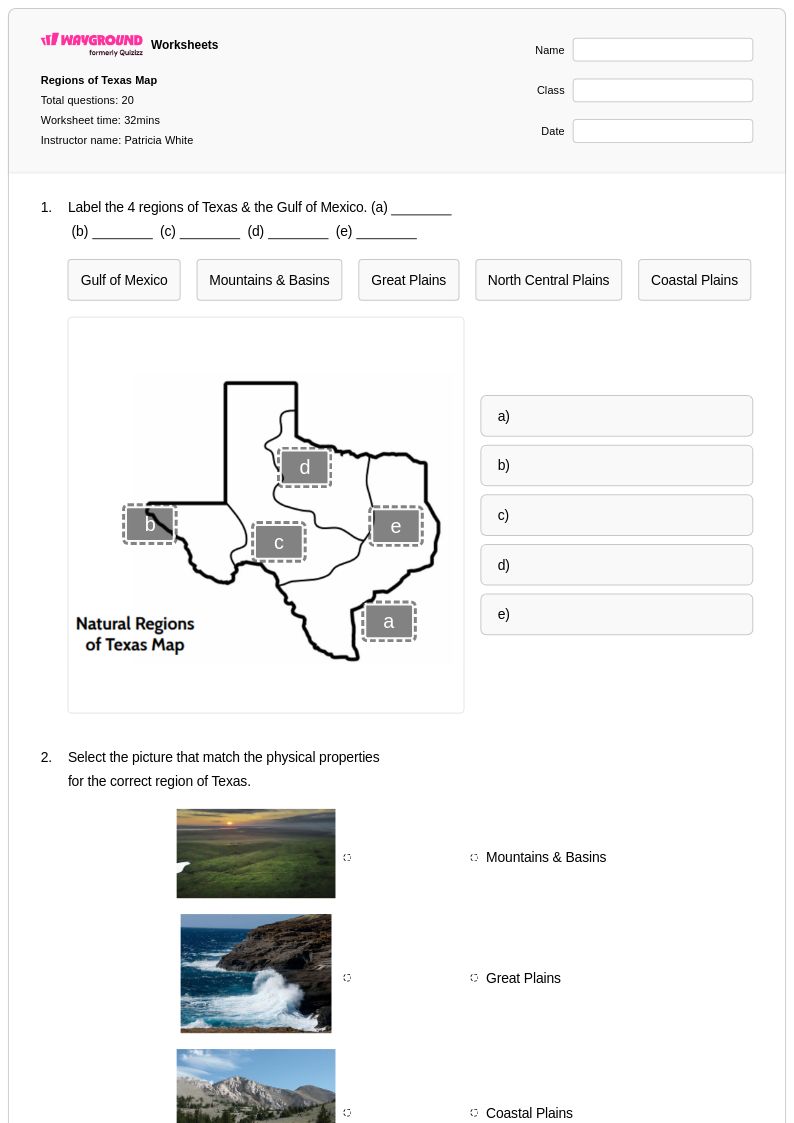
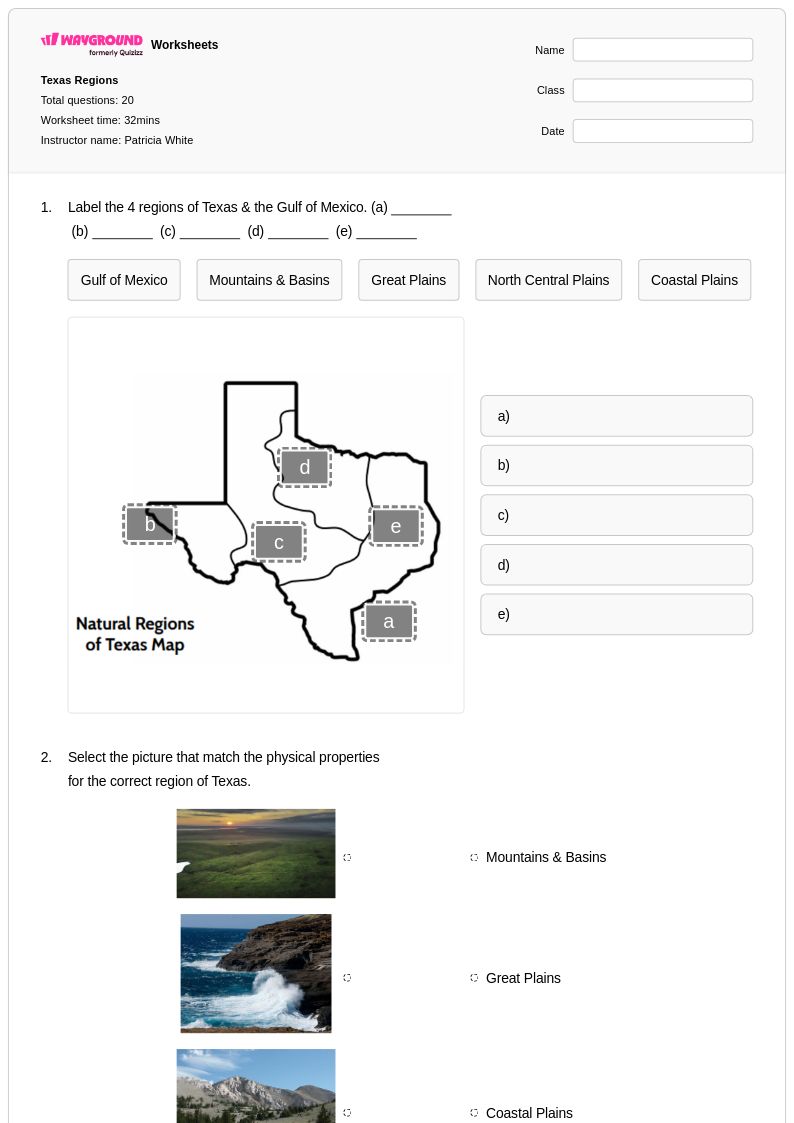
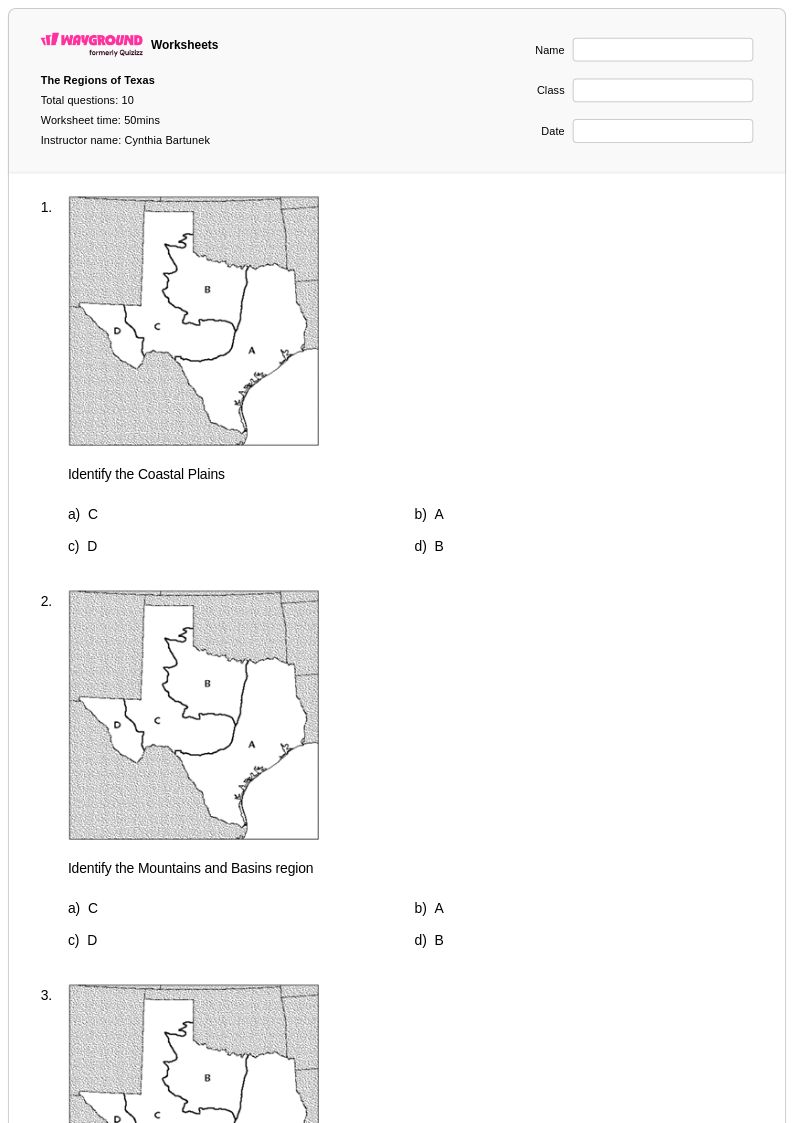
Effective practice activities include map labeling exercises where students identify and color-code each region, matching tasks that pair regional features like the Edwards Plateau or Blackland Prairie to their correct location, and short-answer problems that ask students to explain how geography influences economic activity. Worksheet-based practice that targets specific regional characteristics, such as vegetation zones or natural resources, helps reinforce the distinctions between regions that students often blur together.
What mistakes do students commonly make when learning the regions of Texas?
The most common error is conflating the Gulf Coastal Plains with all of coastal Texas, when in fact it is a broad interior region extending well inland. Students also frequently mix up the Interior Lowlands and Great Plains due to superficial similarities in terrain descriptions. Another persistent misconception is treating Texas's regions as strictly natural divisions, when regional boundaries also reflect cultural, economic, and historical patterns that overlay the physical geography.
How do I differentiate regions of Texas instruction for students at different levels?
For students who need additional support, reduce the number of regions covered in a single lesson and focus on one or two distinguishing characteristics per region rather than comprehensive lists. For advanced learners, extend the task by asking them to analyze how regional geography has shaped historical settlement patterns or current economic industries. On Wayground, teachers can apply accommodations such as reduced answer choices or read-aloud settings to individual students without disrupting the rest of the class.
How do I use Wayground's regions of Texas worksheets in my classroom?
Wayground's regions of Texas worksheets are available as printable PDFs for traditional classroom use and in digital formats for technology-integrated environments, including the option to host them as a live quiz on the platform. Teachers can use them for direct instruction support, independent practice, review sessions, or remediation, with complete answer keys included to streamline grading. The digital format allows teachers to assign worksheets remotely or in a blended learning setting, while the printable version works equally well for paper-based classrooms.
What sub-topics within Texas geography should I cover alongside the four main regions?
Beyond the four primary regions, instruction should include key sub-regions and geographic features such as the Edwards Plateau, Blackland Prairie, Piney Woods, Chihuahuan Desert, and Coastal Bend. Students should also explore how climate patterns, natural resources, and population distribution vary across these areas. Connecting these features to the broader regional framework gives students a more complete and accurate picture of Texas geography rather than a list of disconnected place names.