Develop gratitude and appreciation skills with Wayground's free thankfulness worksheets and printables, featuring engaging practice problems and comprehensive answer keys to help students build essential social-emotional learning foundations.
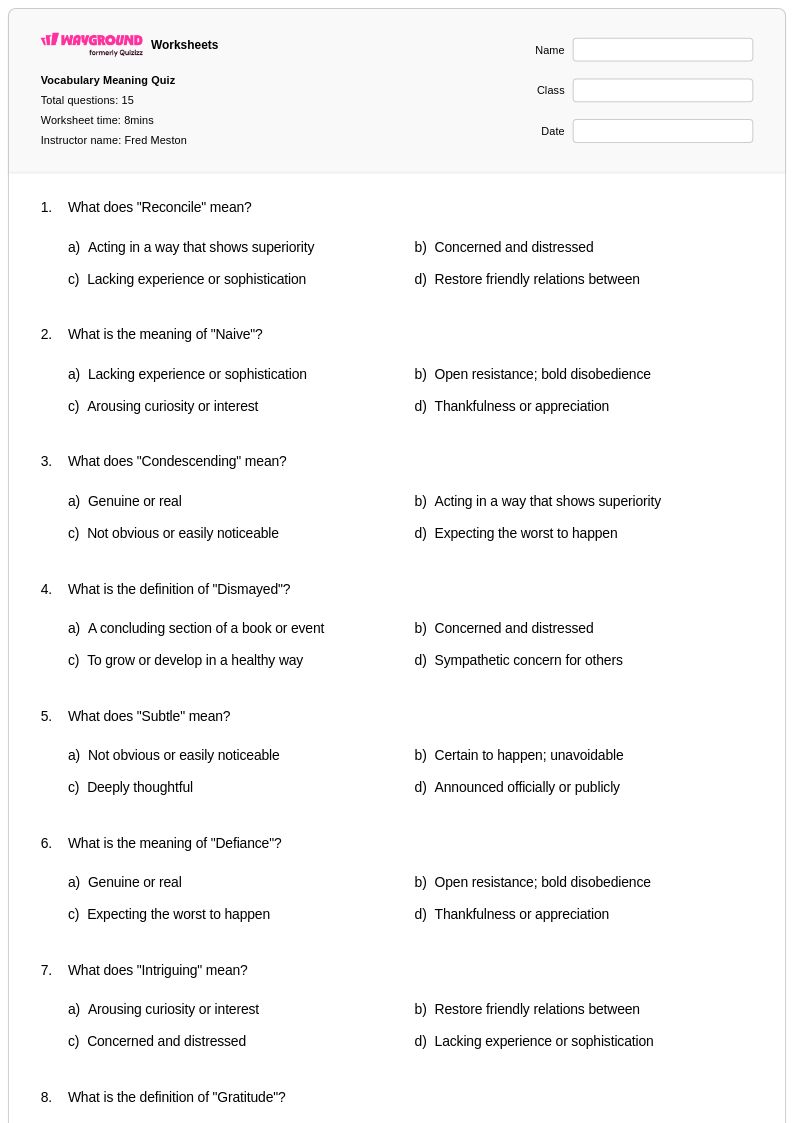
Thankfulness worksheets available through Wayground (formerly Quizizz) provide comprehensive resources for developing students' understanding of gratitude and appreciation across all educational levels. These thoughtfully designed materials strengthen essential social-emotional learning skills by guiding students through exercises that help them recognize positive aspects of their lives, express appreciation effectively, and understand the impact of gratitude on personal relationships and community well-being. Each worksheet collection includes detailed answer keys to support accurate assessment, while the printable pdf format ensures easy classroom distribution and home practice. Students engage with varied practice problems that range from gratitude journaling prompts to scenarios requiring thankful responses, building both emotional intelligence and communication skills through structured, age-appropriate activities.
Wayground (formerly Quizizz) empowers educators with an extensive library of millions of teacher-created thankfulness resources that streamline lesson planning and enhance instructional effectiveness. The platform's robust search and filtering capabilities allow teachers to quickly locate materials that align with social-emotional learning standards and match their specific classroom needs. Advanced differentiation tools enable seamless customization of worksheets to accommodate diverse learning styles and ability levels, while the dual availability in both printable and digital pdf formats provides maximum flexibility for various teaching environments. These comprehensive features support teachers in implementing targeted skill practice sessions, designing effective remediation strategies for students struggling with gratitude concepts, and creating enrichment opportunities that deepen understanding of thankfulness as a foundational social skill.
FAQs
How do I teach thankfulness and gratitude to students?
Teaching thankfulness works best when it moves beyond seasonal activities and becomes a consistent classroom practice. Effective strategies include daily or weekly gratitude journaling, guided reflection prompts that ask students to identify specific people or moments they appreciate, and class discussions that connect gratitude to real-world relationship outcomes. Helping students articulate why they are grateful, not just what they are grateful for, deepens the social-emotional learning impact.
What exercises help students practice gratitude and appreciation?
Structured practice activities for thankfulness include gratitude journaling prompts, thankful response scenarios, letter-writing to someone who has helped them, and reflection exercises that ask students to identify positive aspects of their daily lives. Scenario-based exercises are especially effective because they require students to apply grateful responses in context, building both emotional intelligence and communication skills simultaneously.
What misconceptions do students commonly have about thankfulness?
A common misconception is that thankfulness only applies to receiving gifts or major favors, which limits students' ability to recognize everyday gratitude opportunities. Students may also conflate saying 'thank you' out of politeness with genuinely expressing appreciation, without understanding the emotional and relational impact of sincere gratitude. Addressing these distinctions directly in instruction helps students internalize thankfulness as a meaningful social skill rather than a scripted response.
How does practicing gratitude support students' social-emotional development?
Research consistently links regular gratitude practice to improved emotional regulation, stronger peer relationships, and greater overall well-being in students. When students learn to recognize and articulate appreciation, they develop perspective-taking skills and a stronger sense of community belonging. Embedding thankfulness practice into SEL instruction gives students a concrete, repeatable tool for building positive relationships and navigating social situations constructively.
How can I use Wayground's thankfulness worksheets in my classroom?
Wayground's thankfulness worksheets are available as printable PDFs for traditional classroom use and in digital formats for technology-integrated environments, making them flexible for in-person, hybrid, or remote instruction. Teachers can also host the worksheets as a quiz directly on Wayground, enabling real-time student engagement and built-in assessment. Each worksheet includes a complete answer key, which supports accurate and efficient grading. For students who need additional support, Wayground's accommodation tools allow teachers to enable read-aloud, extended time, or reduced answer choices on an individual basis.
How can I differentiate thankfulness worksheets for students at different ability levels?
Differentiation for thankfulness activities can involve adjusting the complexity of reflection prompts, scaffolding sentence starters for students who struggle with open-ended writing, or providing visual supports that illustrate gratitude scenarios. On Wayground, teachers can apply individual accommodations such as read-aloud for struggling readers, reduced answer choices to lower cognitive load, or extended time for students who need more processing time, all without other students being notified. These settings are saved per student and carry over to future sessions.