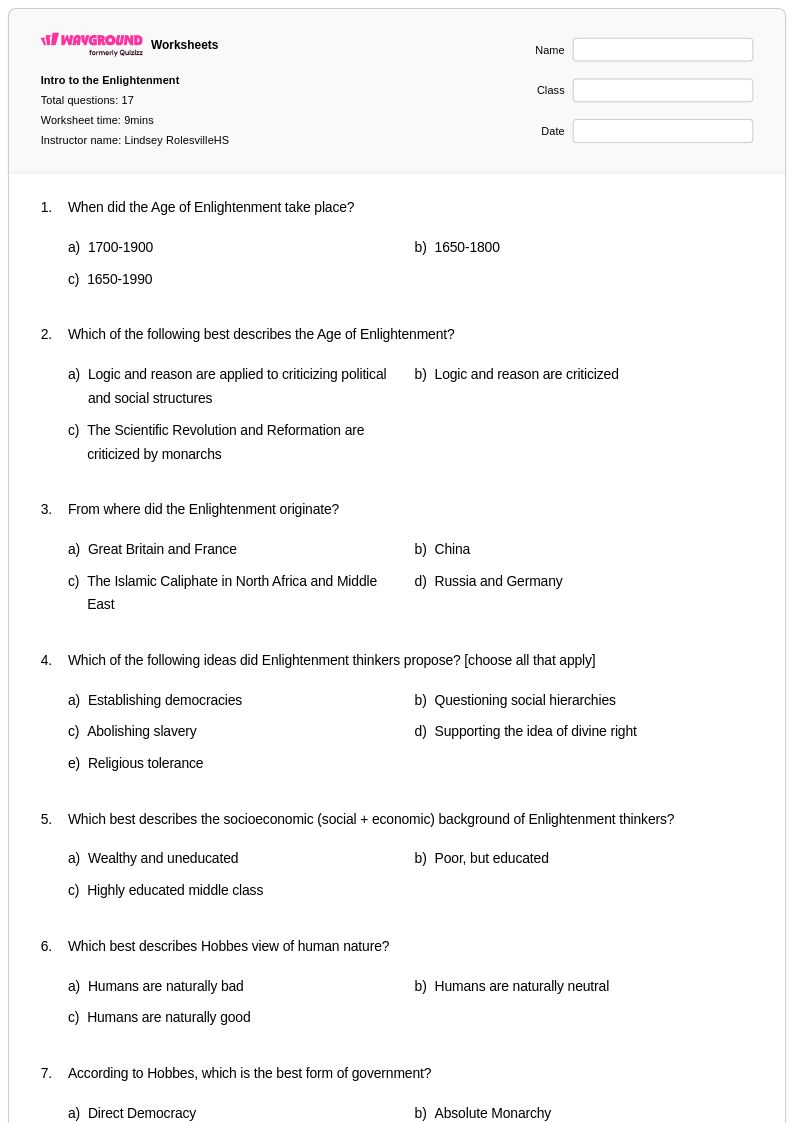
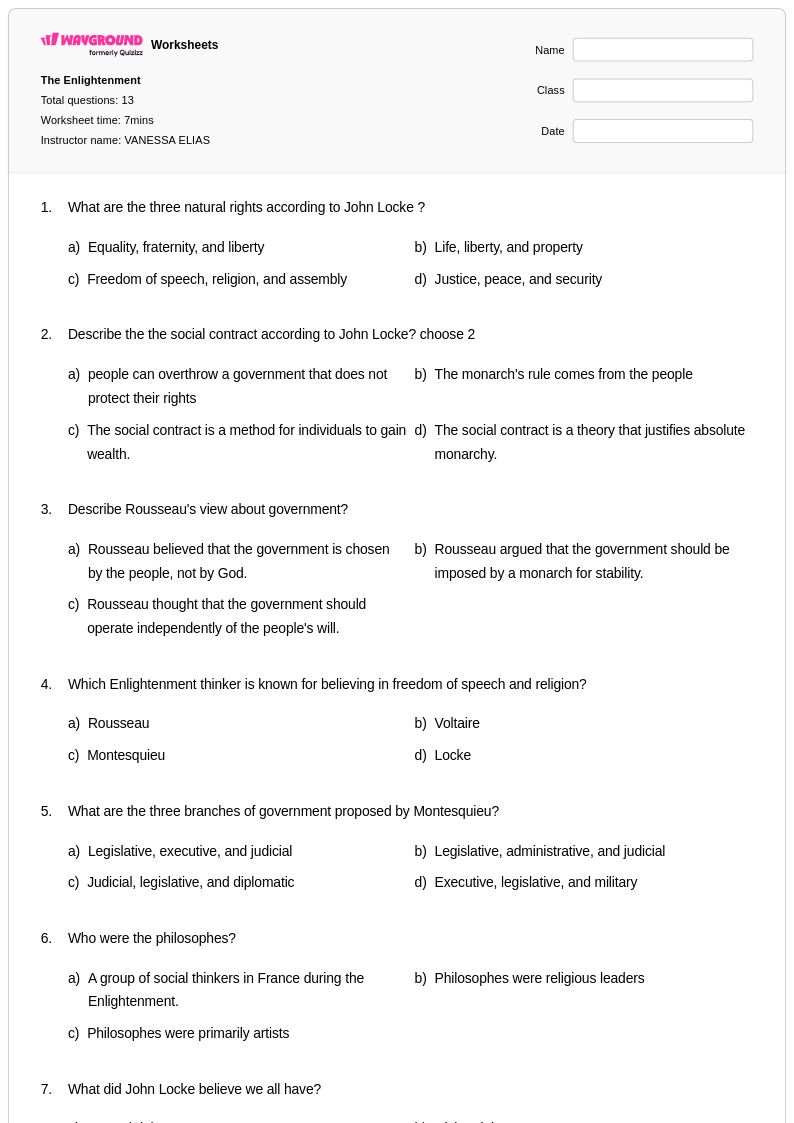
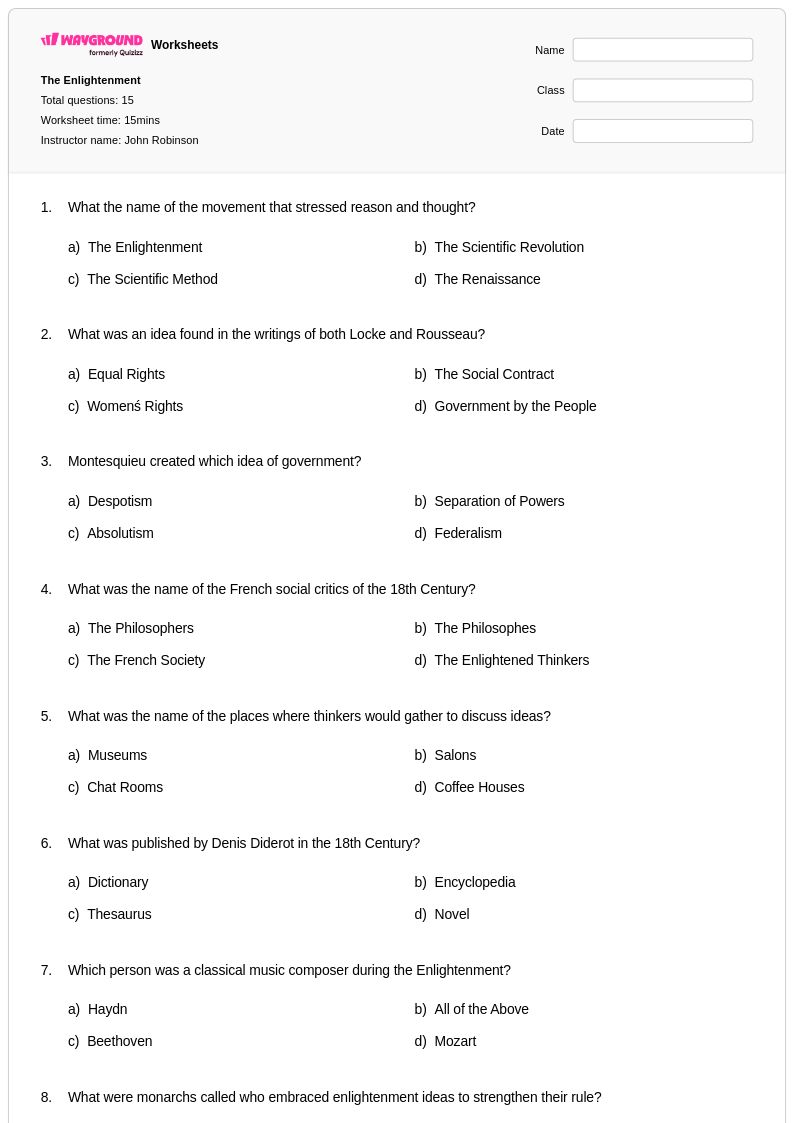
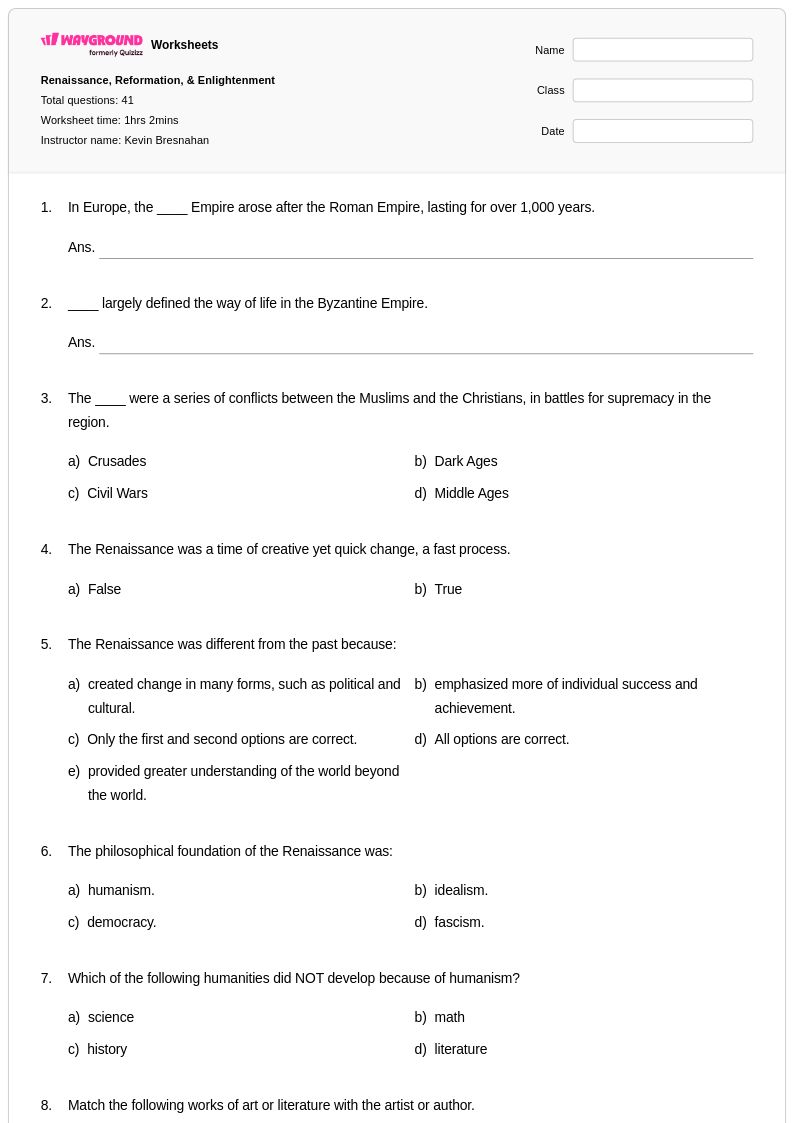
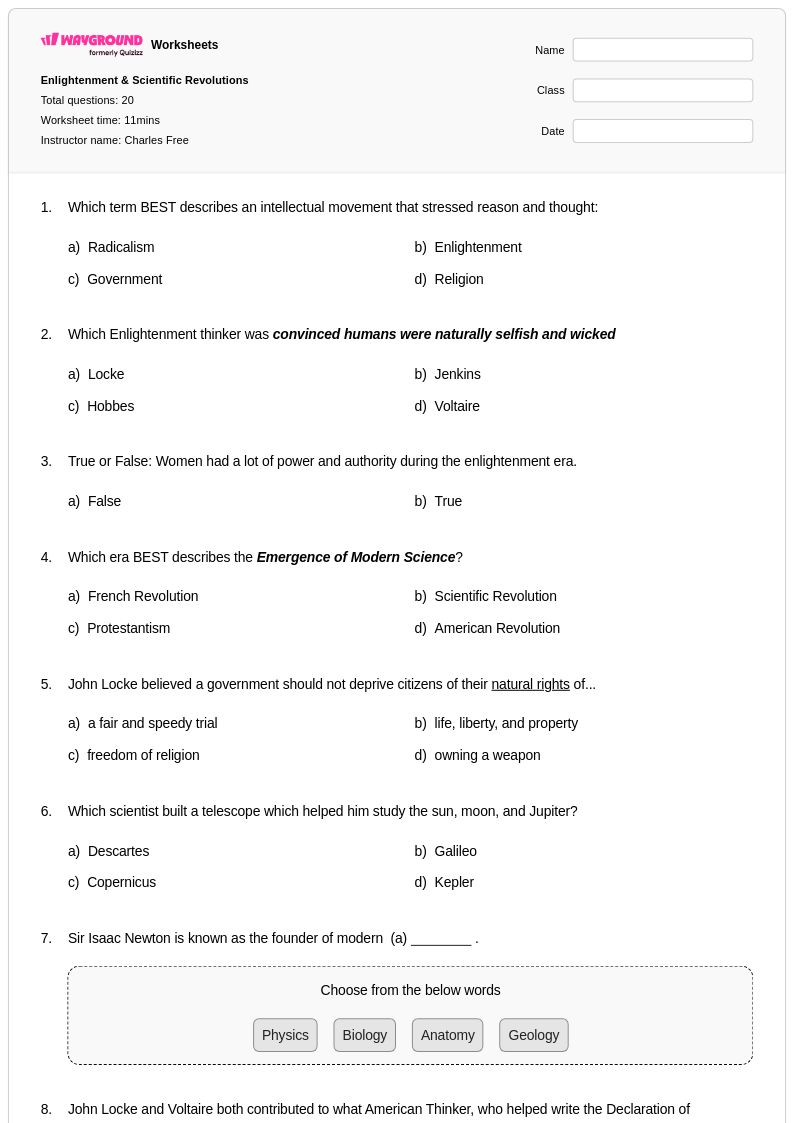
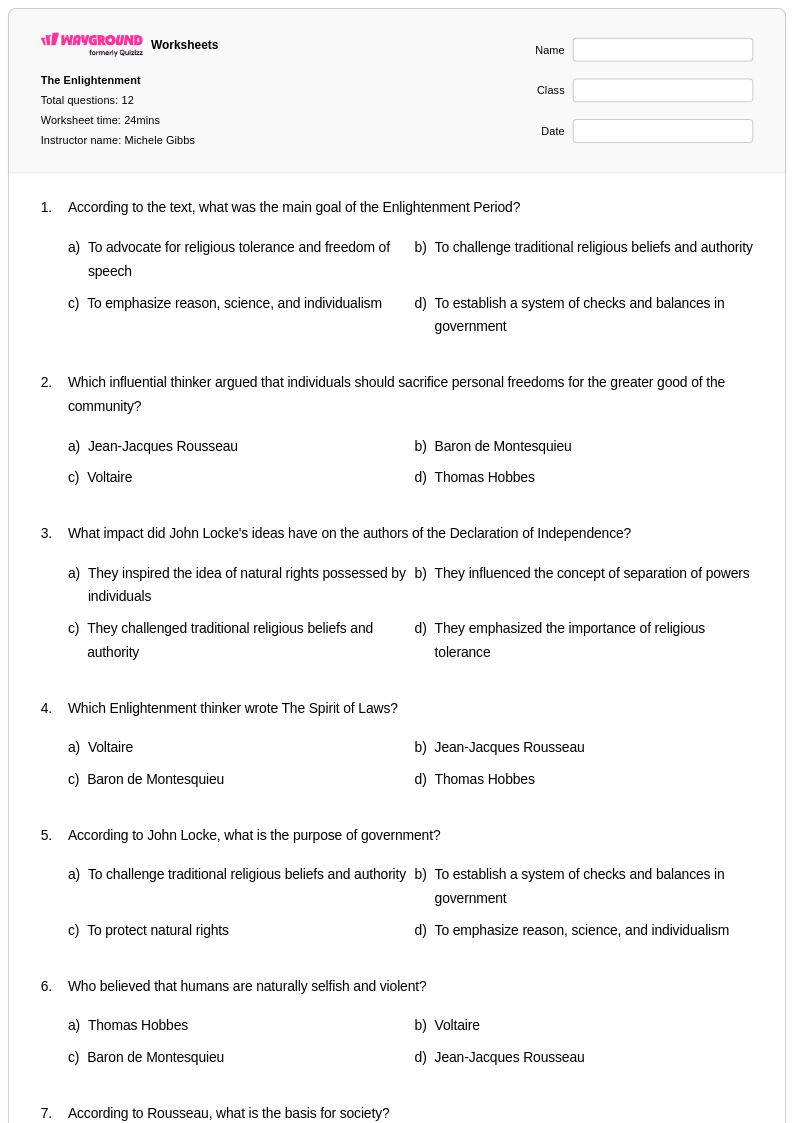
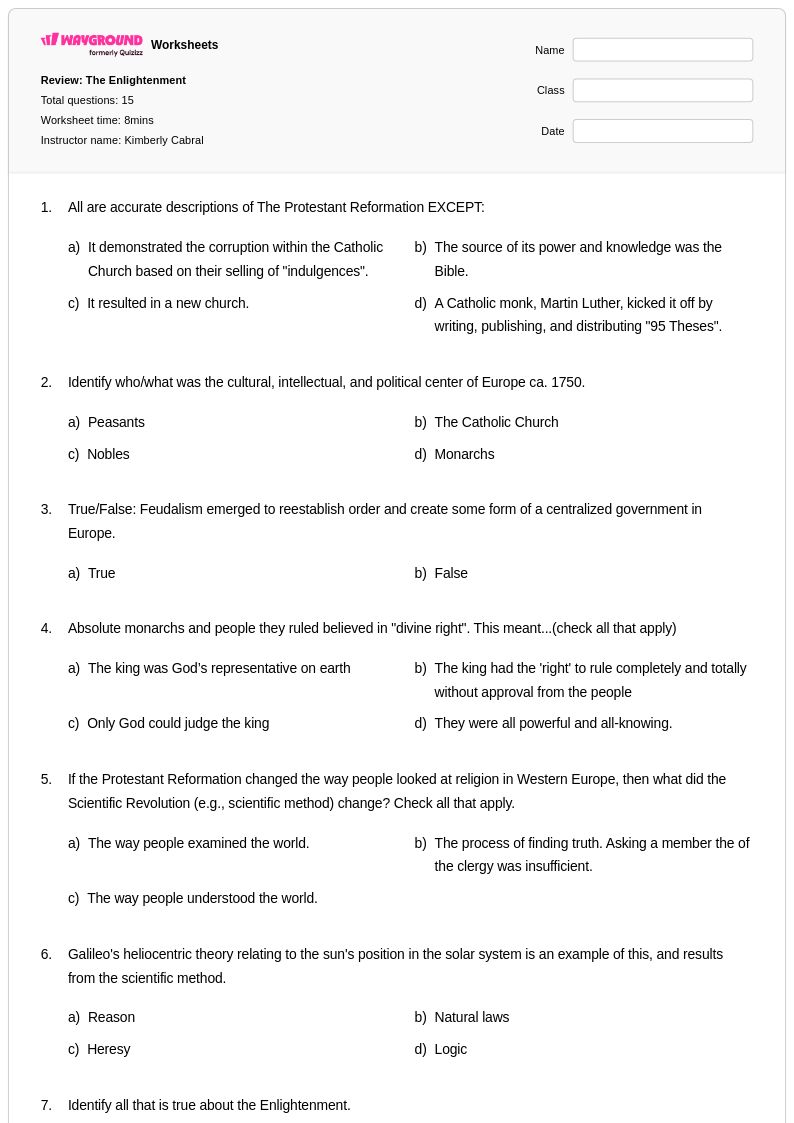
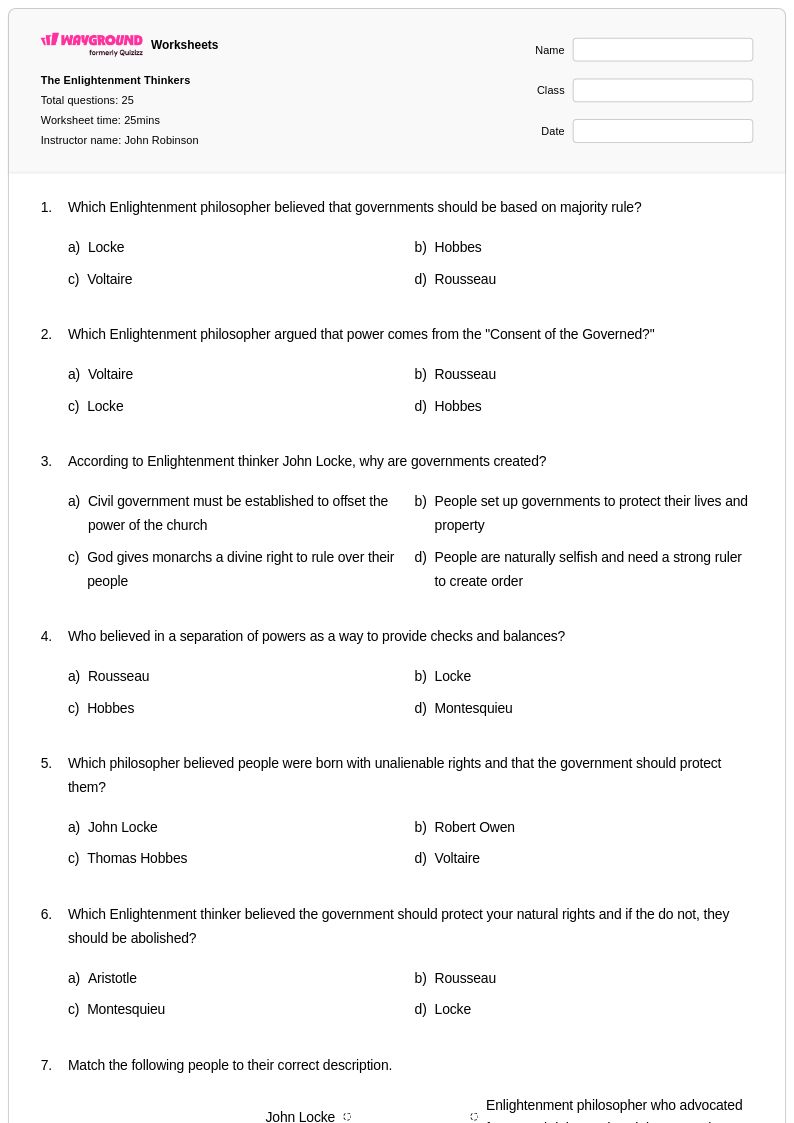
Free Printable The Enlightenment Worksheets for Grade 11
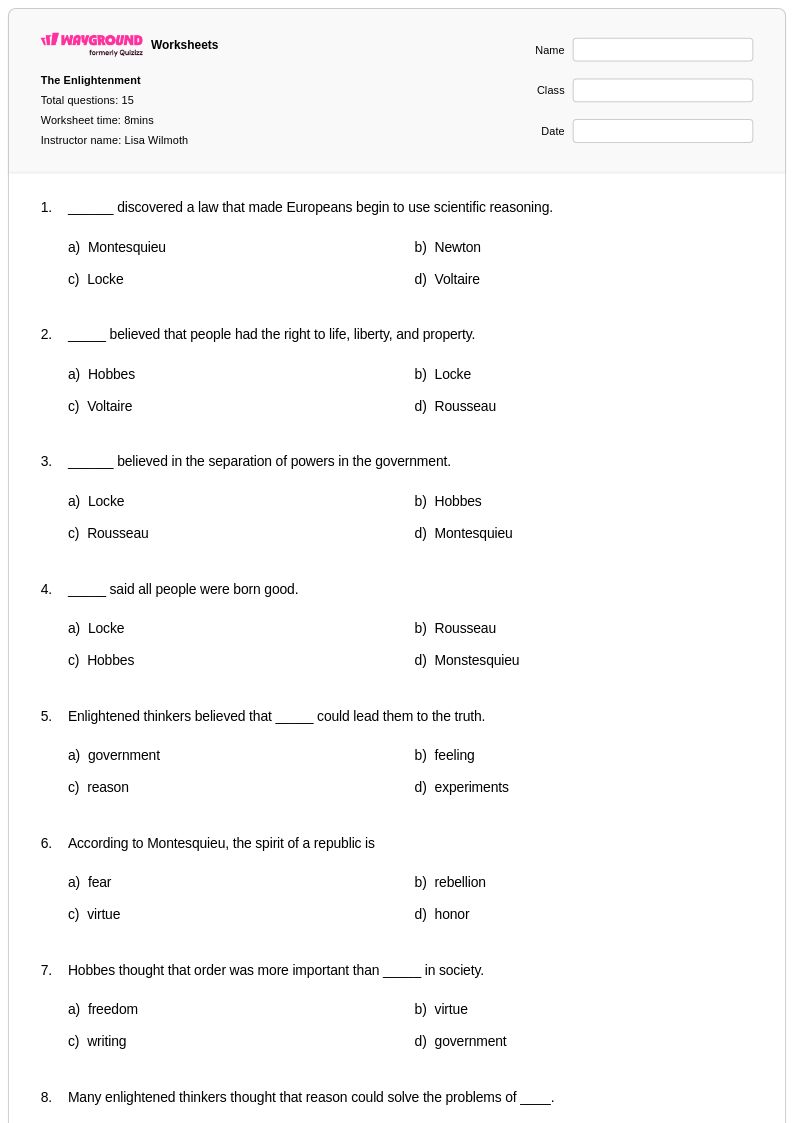
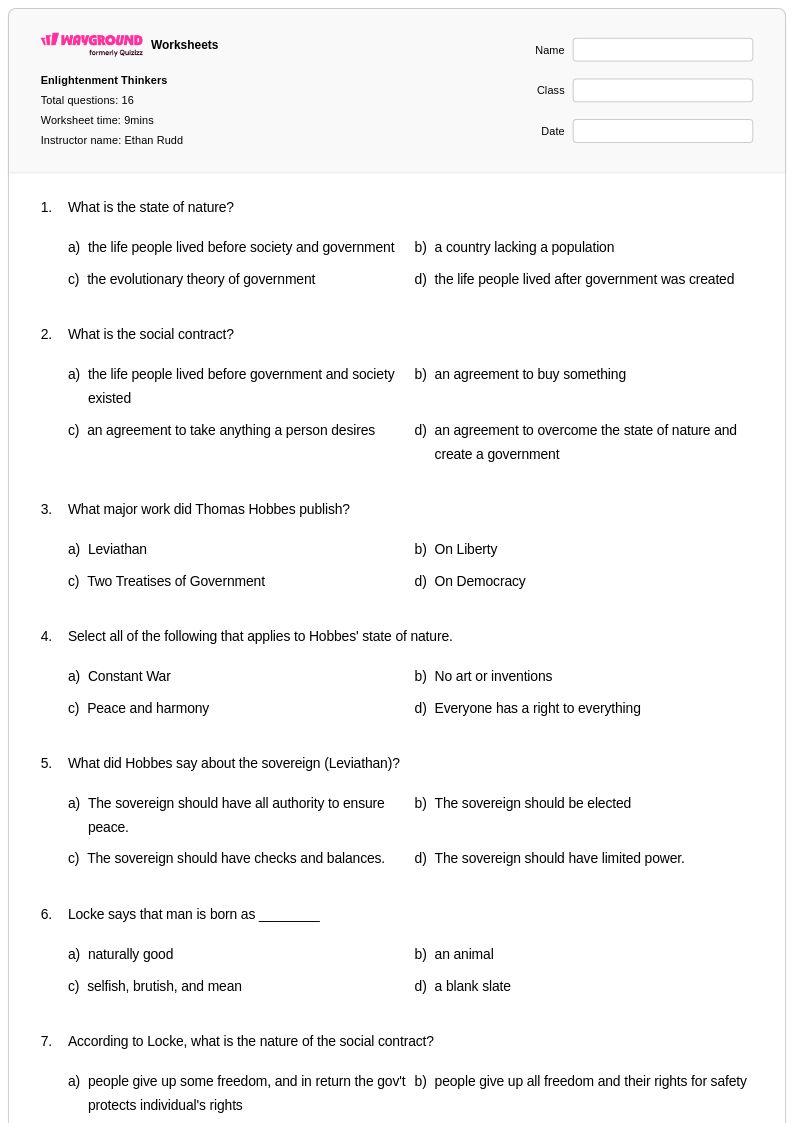
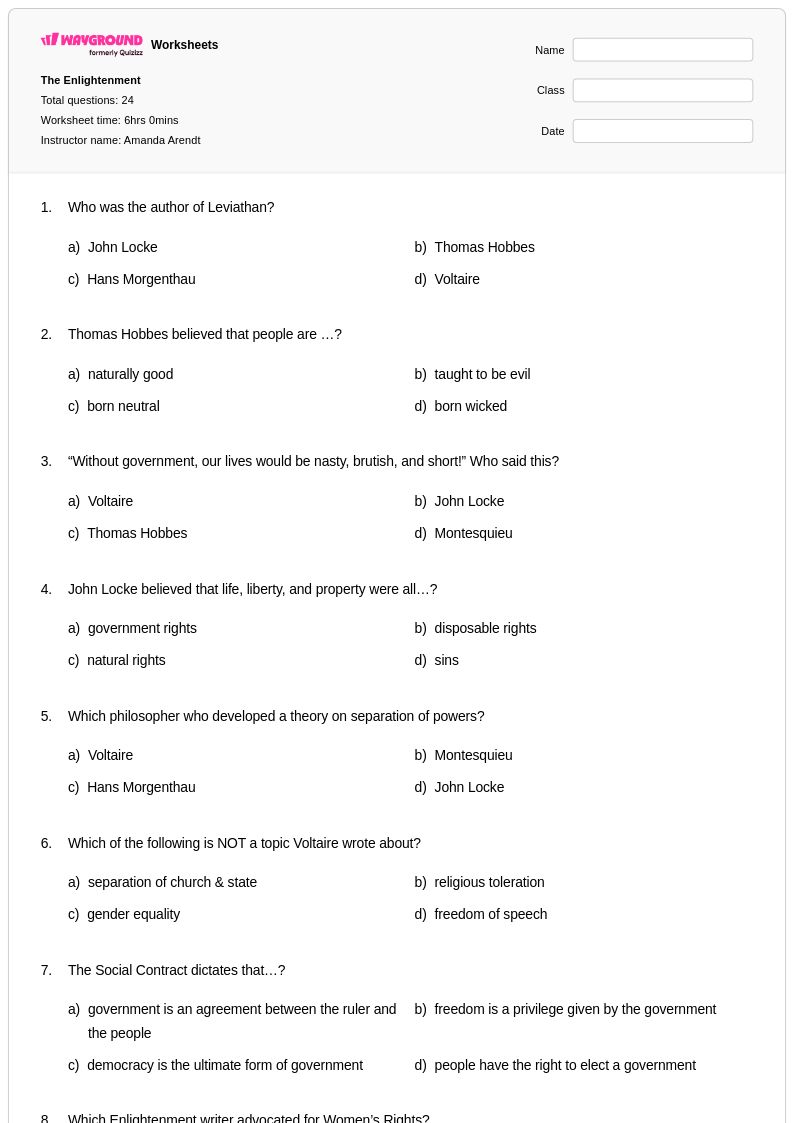
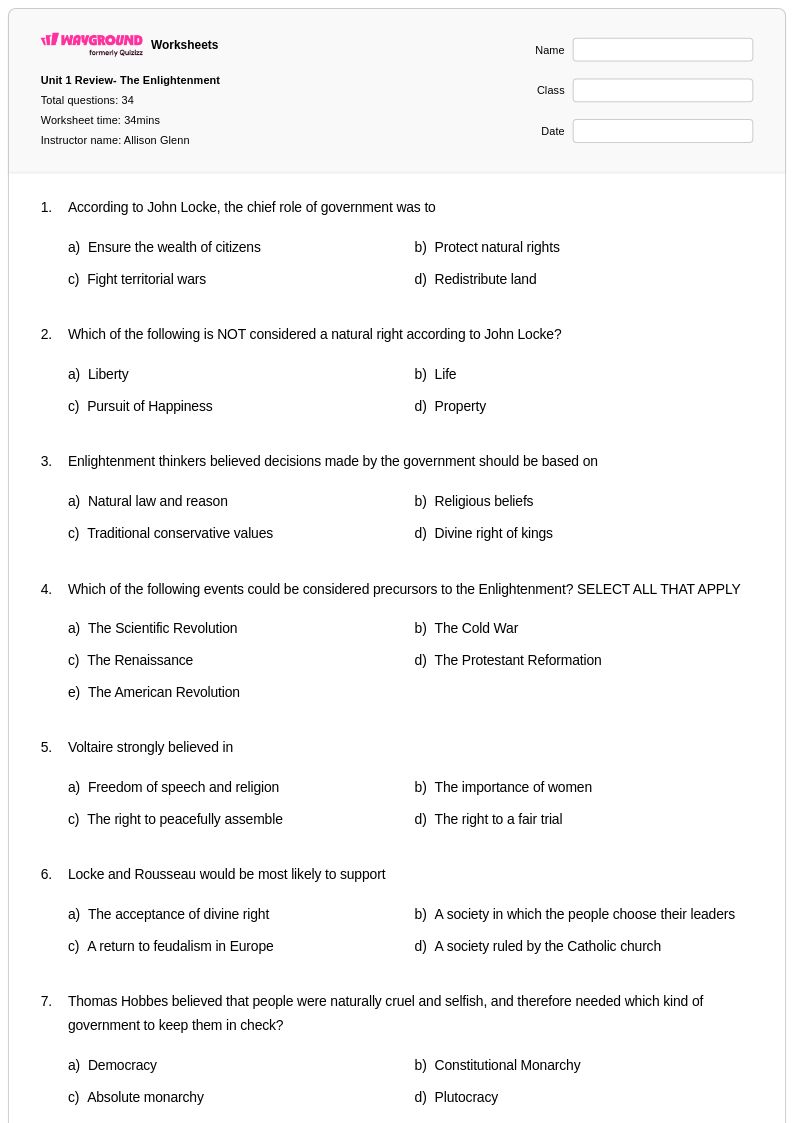
Free Grade 11 Enlightenment worksheets and printables from Wayground help students explore key philosophers, ideas, and impacts of this transformative historical period through engaging practice problems with comprehensive answer keys.
Explore printable The Enlightenment worksheets for Grade 11
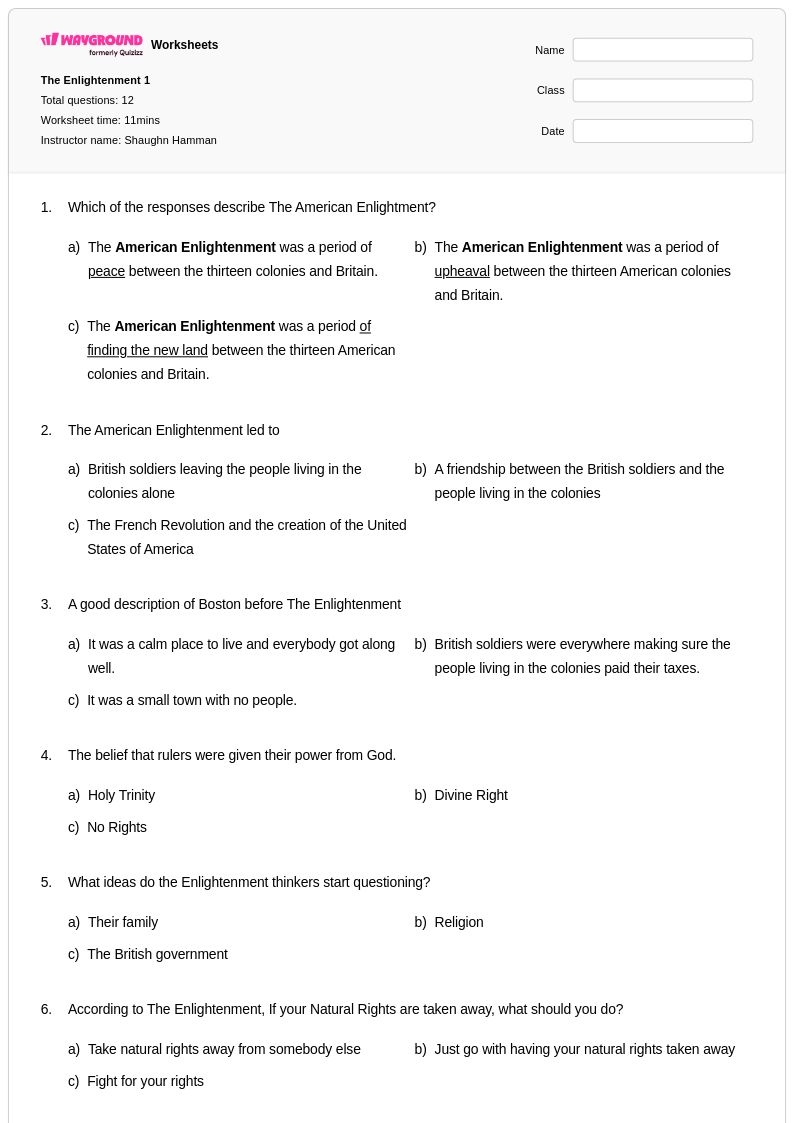
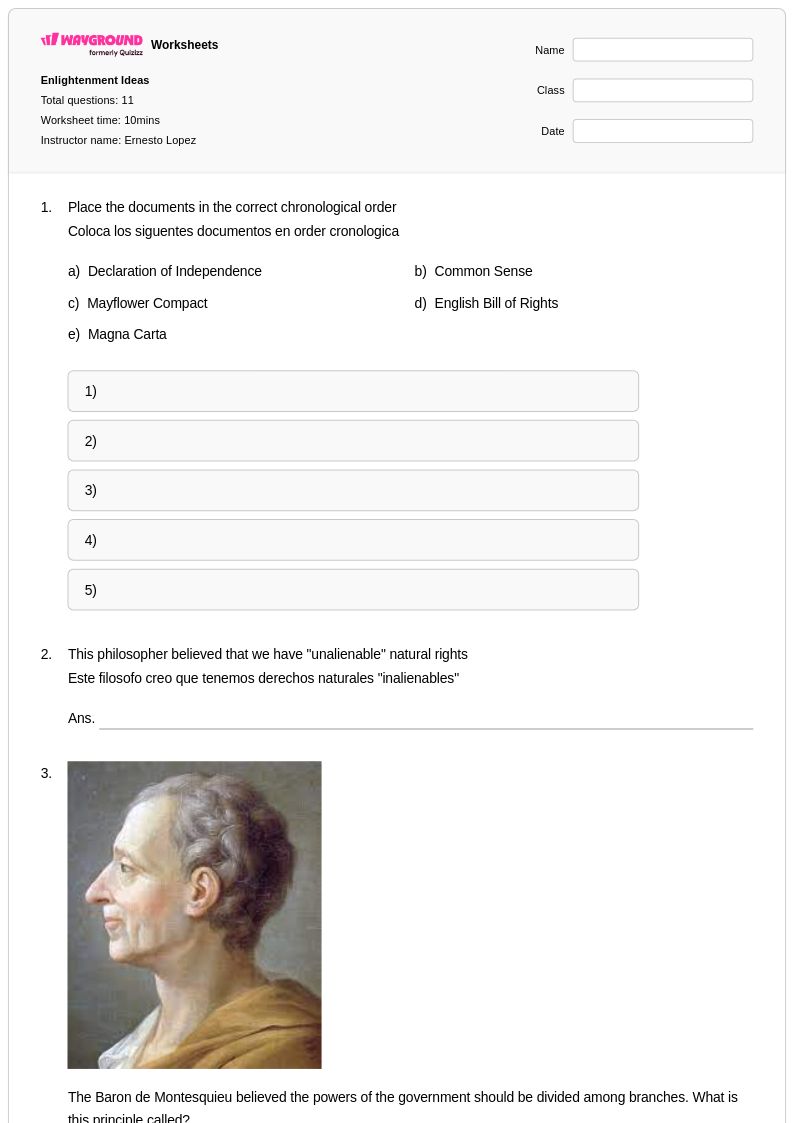
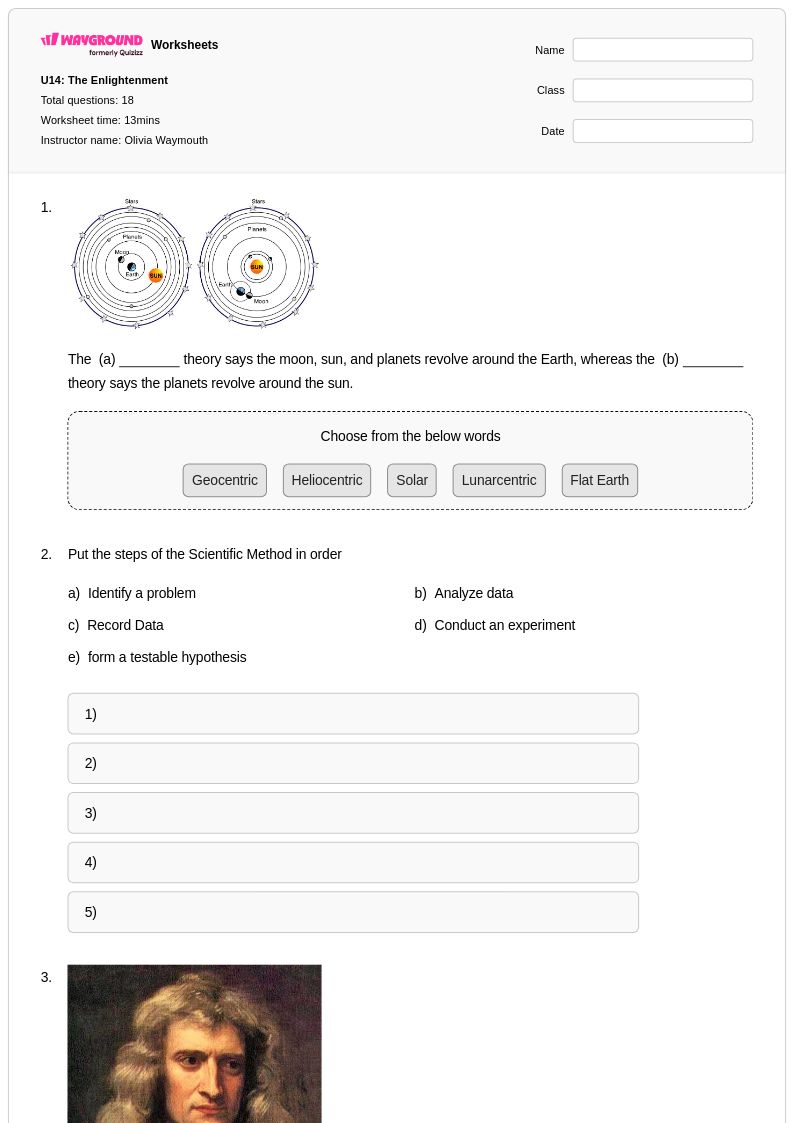
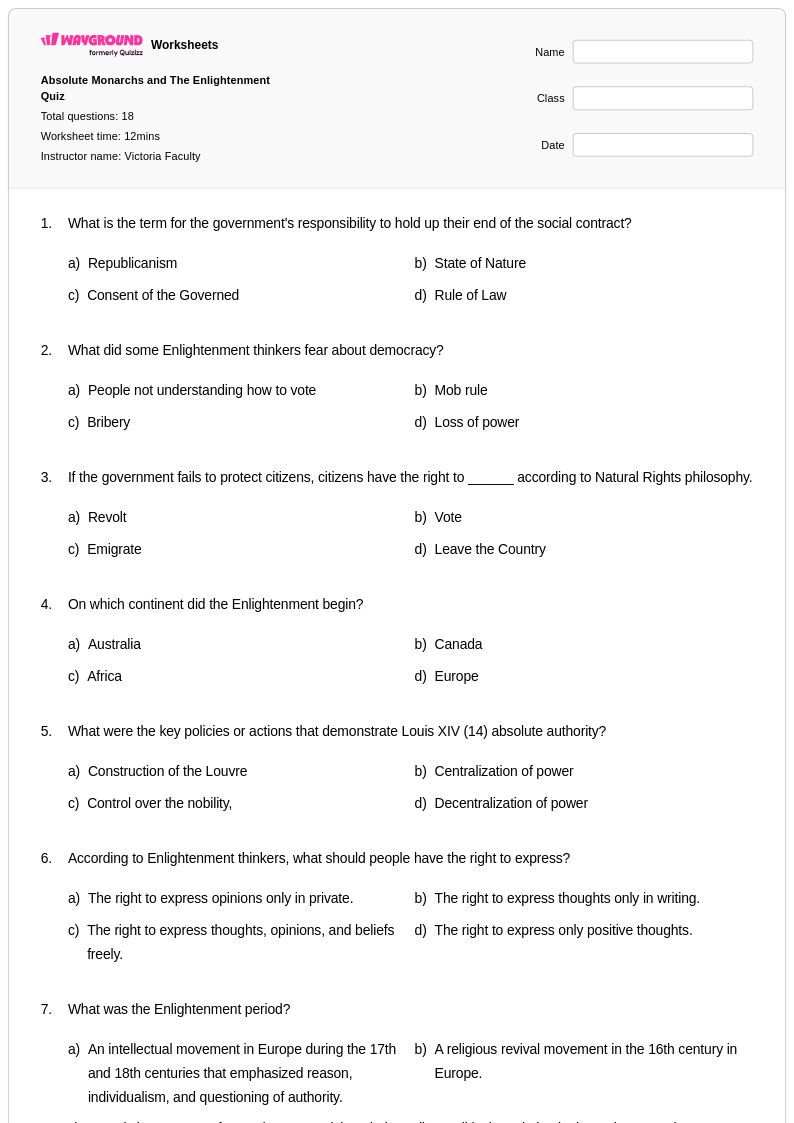
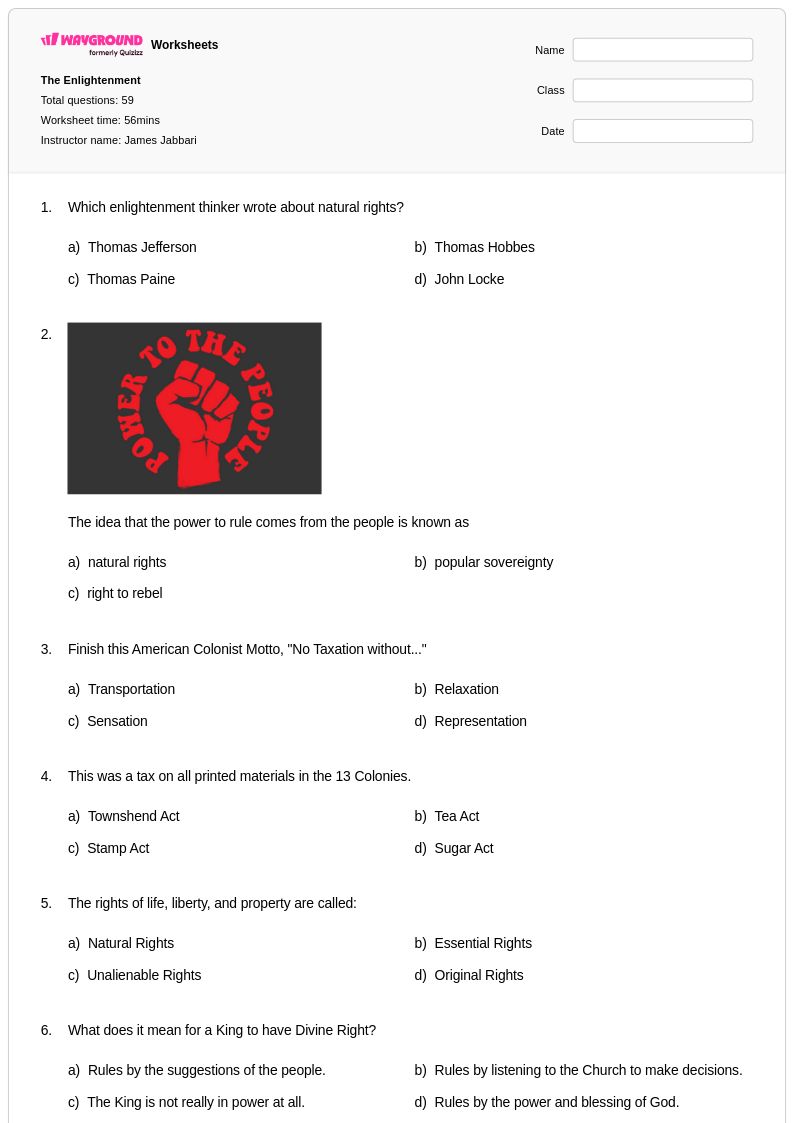
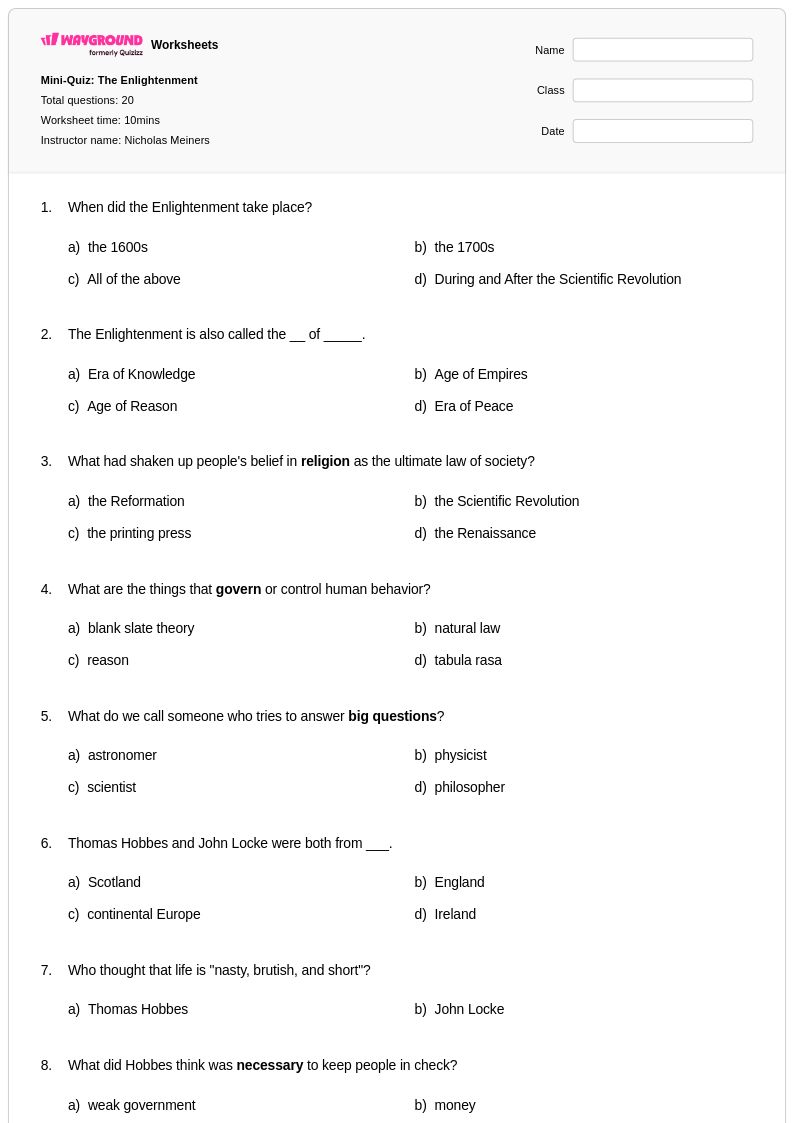
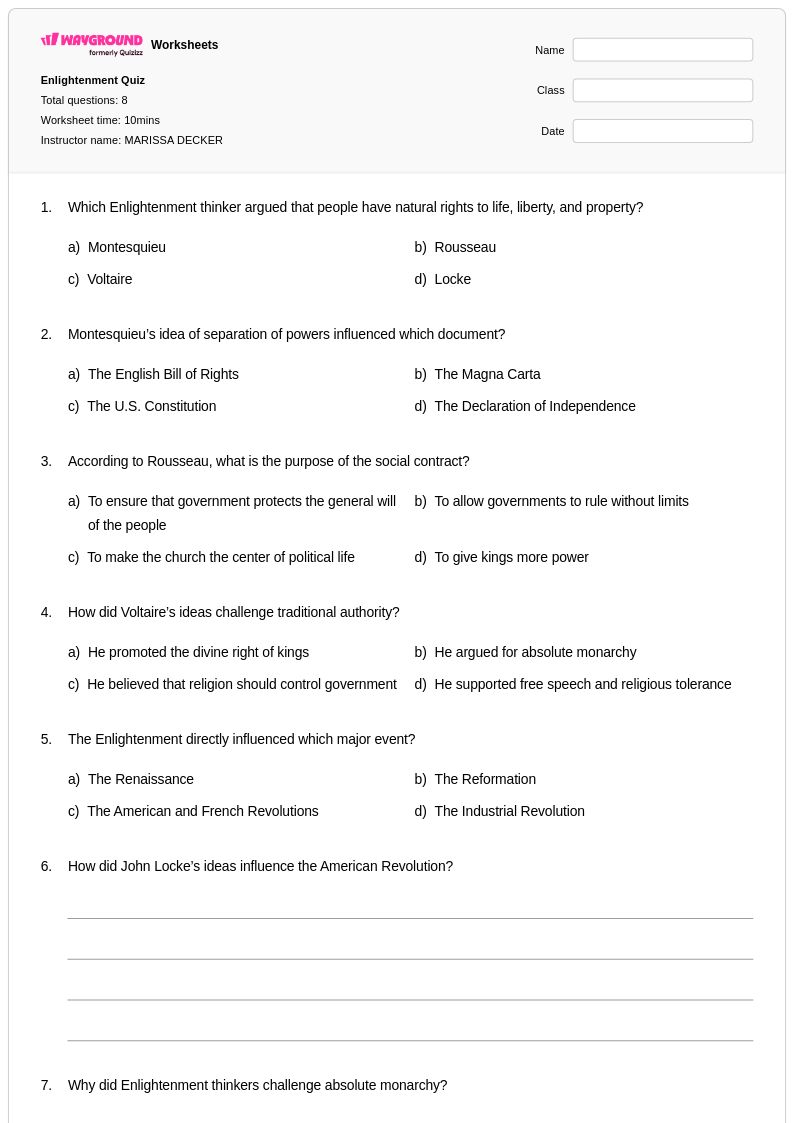
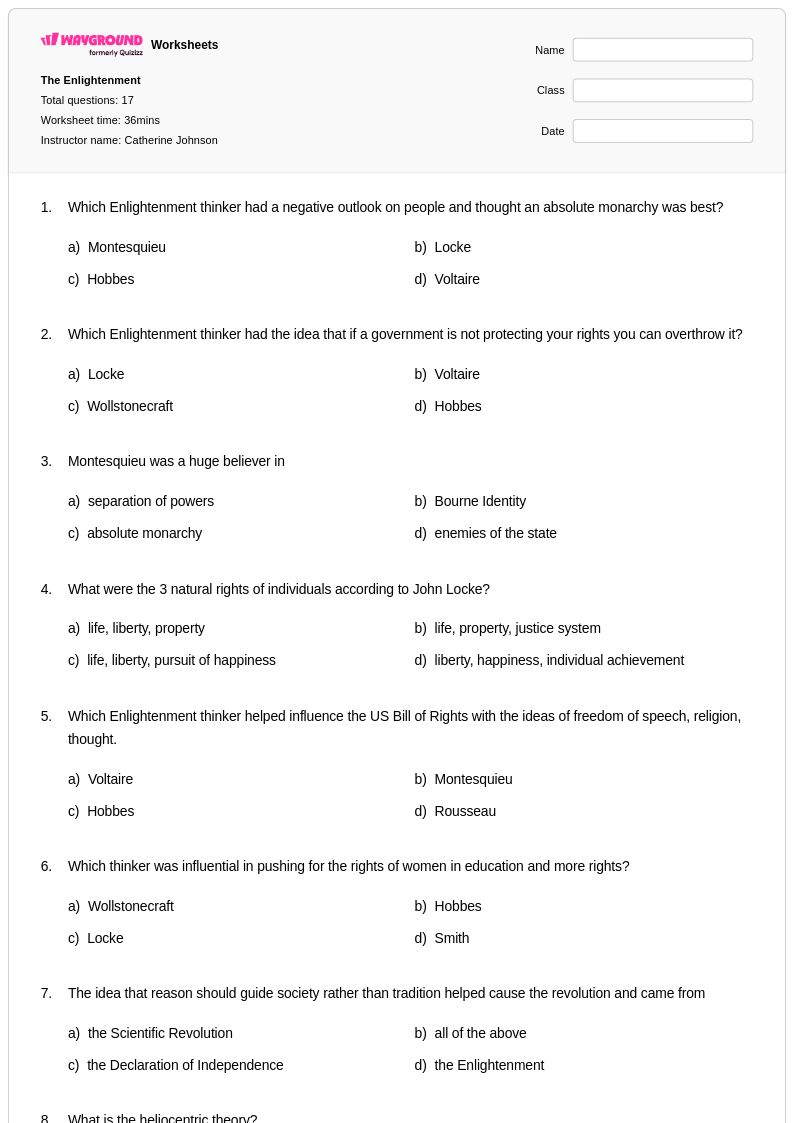
The Enlightenment worksheets available through Wayground (formerly Quizizz) provide Grade 11 students with comprehensive resources to explore this pivotal intellectual movement of the 17th and 18th centuries. These expertly crafted materials strengthen critical thinking skills by examining key Enlightenment philosophers like Voltaire, Rousseau, and Locke, while analyzing their revolutionary ideas about natural rights, separation of powers, and social contracts. Students engage with primary source documents, compare competing philosophical frameworks, and trace the influence of Enlightenment thinking on democratic revolutions and modern political systems. Each worksheet includes detailed answer keys to support independent learning, and the free printables offer practice problems that reinforce understanding of concepts such as religious tolerance, scientific rationalism, and popular sovereignty. The pdf format ensures easy access for both classroom instruction and homework assignments, allowing students to develop sophisticated analytical skills through structured examination of this transformative historical period.
Wayground (formerly Quizizz) empowers educators with millions of teacher-created resources specifically designed for Enlightenment instruction at the Grade 11 level. The platform's robust search and filtering capabilities enable teachers to quickly locate materials aligned with curriculum standards, whether focusing on specific philosophers, key texts, or thematic connections to contemporary issues. Advanced differentiation tools allow instructors to modify content complexity for diverse learners, while flexible customization options support targeted skill development in areas such as document analysis, comparative reasoning, and historical argumentation. Available in both printable and digital formats including downloadable pdfs, these resources seamlessly integrate into lesson planning for initial instruction, remediation of challenging concepts, and enrichment activities for advanced students. Teachers can efficiently organize practice sessions that build students' capacity to evaluate Enlightenment ideas within their historical context while drawing meaningful connections to modern democratic principles and human rights frameworks.
FAQs
How do I teach the Enlightenment to middle or high school students?
Teaching the Enlightenment effectively means anchoring abstract philosophical ideas to concrete historical consequences. Start by grounding students in the core thinkers — Locke, Voltaire, Rousseau, and Montesquieu — and connect each philosopher's key concept (natural rights, separation of powers, religious tolerance) to a specific political outcome, such as the U.S. Constitution or the French Revolution. Using primary source excerpts alongside guided analysis questions helps students move beyond memorization toward genuine historical reasoning.
What types of exercises help students practice Enlightenment concepts?
Effective practice for the Enlightenment includes cause-and-effect mapping, where students trace how a philosophical idea led to a specific political or social change, as well as philosopher matching activities that reinforce who argued what. Primary source analysis tasks — asking students to identify Enlightenment principles in documents like the Declaration of Independence — build critical thinking while reinforcing content. These varied exercise types prevent rote memorization and push students to apply concepts across contexts.
What misconceptions do students commonly have about the Enlightenment?
A common misconception is that Enlightenment thinkers were uniformly radical or anti-religious; in reality, many were deists or supported measured reform rather than revolution. Students also frequently conflate the philosophers' ideas — attributing separation of powers to Locke rather than Montesquieu, for example. Another error is treating the Enlightenment as a purely French phenomenon, overlooking its strong roots in England and Scotland and its transatlantic influence on American political thought.
How do I help struggling students understand Enlightenment philosophers and their ideas?
Breaking down each philosopher into a single core claim — Locke believed government derives its authority from the consent of the governed — before expanding to secondary ideas helps struggling students build a stable mental framework. Graphic organizers that compare philosophers side by side are particularly effective because they reduce cognitive load while reinforcing distinctions. On Wayground, teachers can also enable accommodations such as read aloud and reduced answer choices for individual students, making digital practice more accessible without singling those students out.
How do I use Enlightenment worksheets from Wayground in my classroom?
Wayground's Enlightenment worksheets are available as printable PDFs for traditional classroom use and in digital formats for technology-integrated instruction, including the option to host them as a live quiz on the platform. Teachers can use printable versions for in-class close reading and analysis tasks, while digital formats work well for homework, bellringers, or formative assessment. The answer keys included with each worksheet make it straightforward to review responses and identify gaps in student understanding.
How does the Enlightenment connect to modern democratic institutions?
The Enlightenment directly shaped the foundational documents of modern democracy — Locke's theory of natural rights is embedded in the Declaration of Independence, and Montesquieu's separation of powers framework is the structural basis of the U.S. Constitution. Teaching these connections explicitly helps students understand that democratic institutions are not accidental but are deliberate applications of Enlightenment philosophy. Making this link concrete is one of the most effective ways to demonstrate the Enlightenment's historical significance.