Free Printable Uniformly Accelerated Motion Worksheets for Grade 9
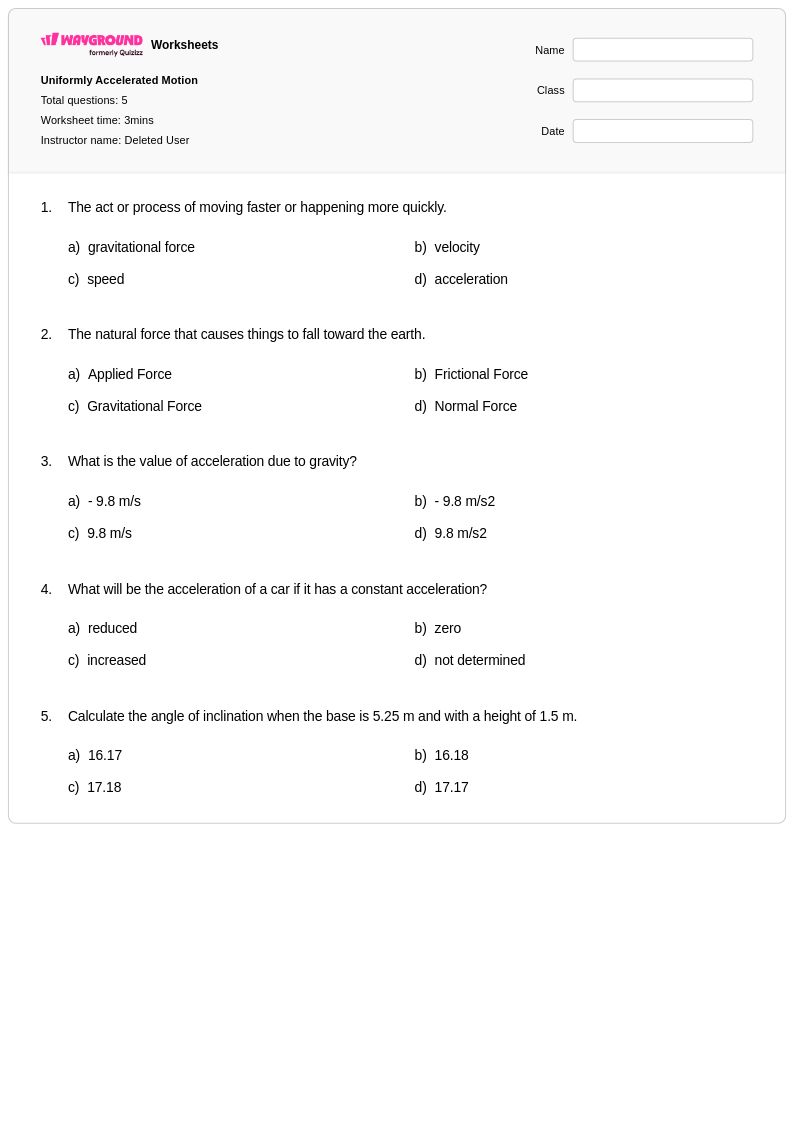
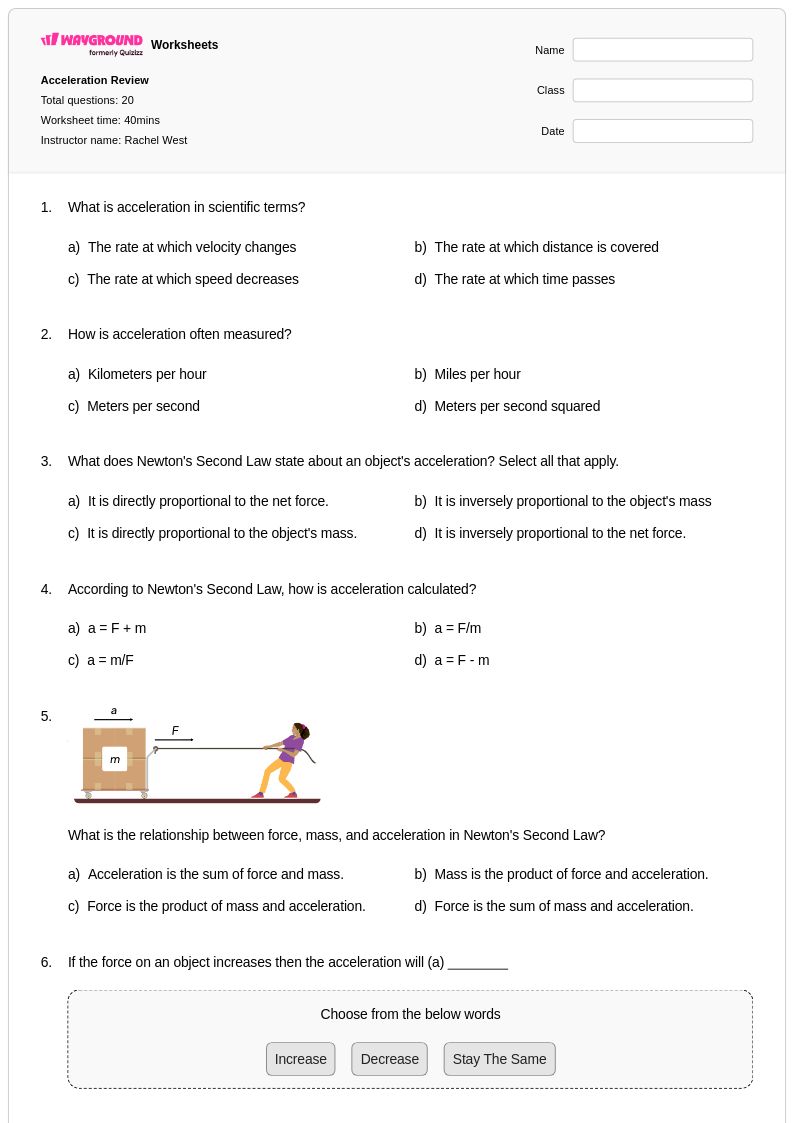
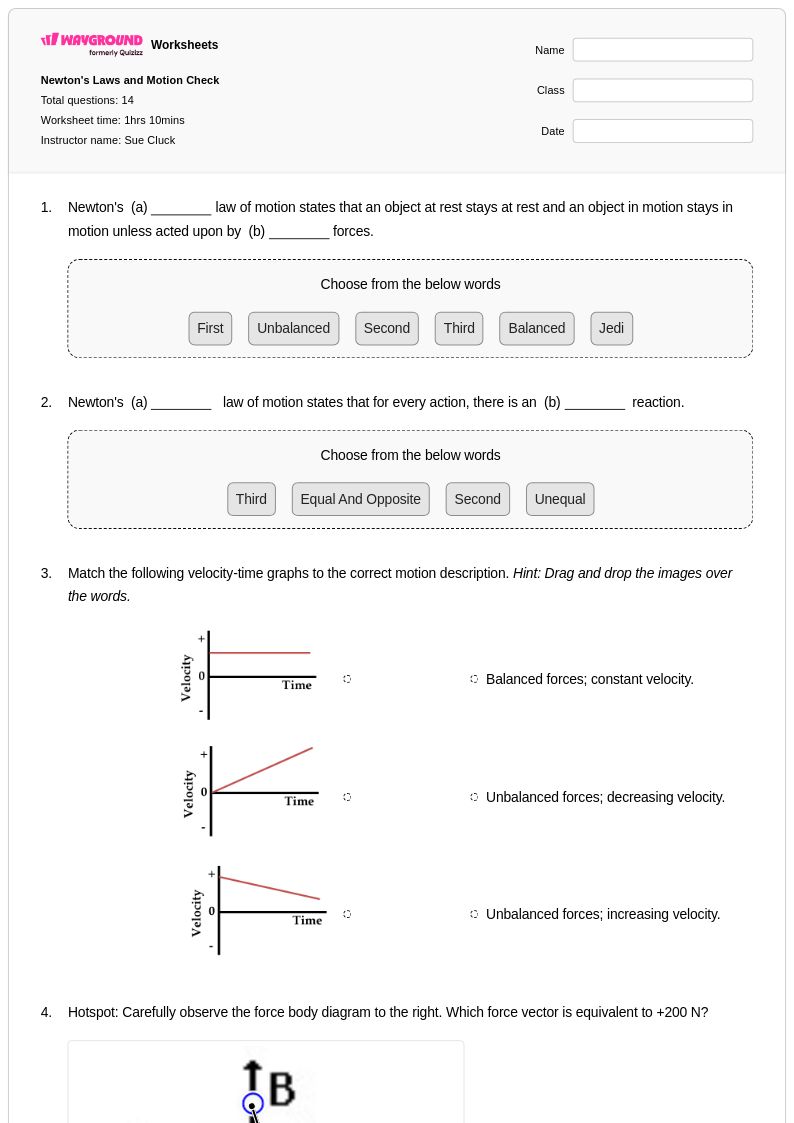
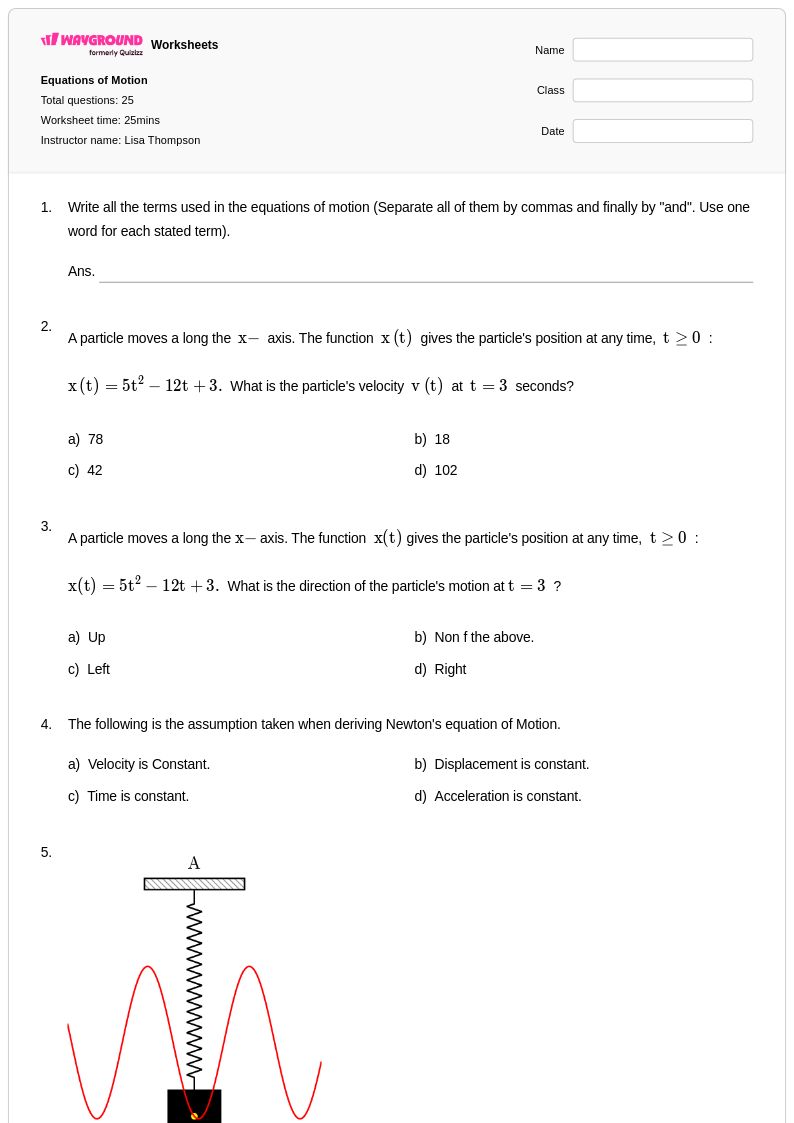
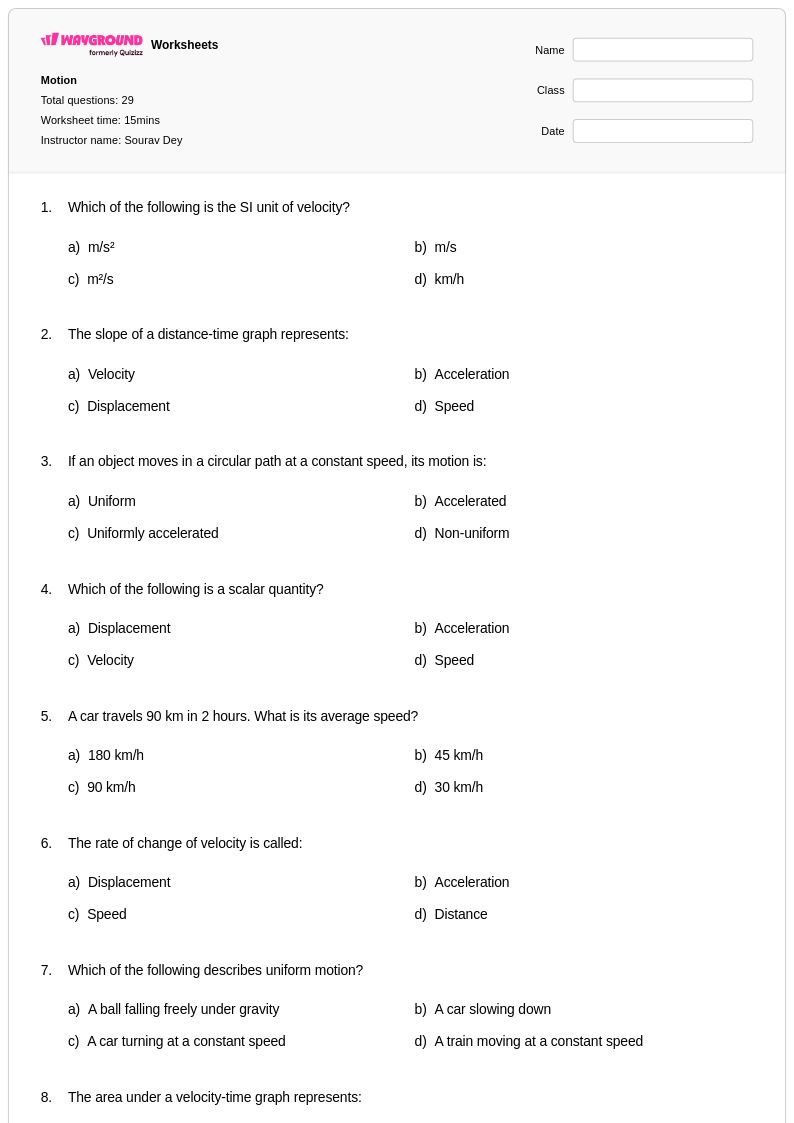
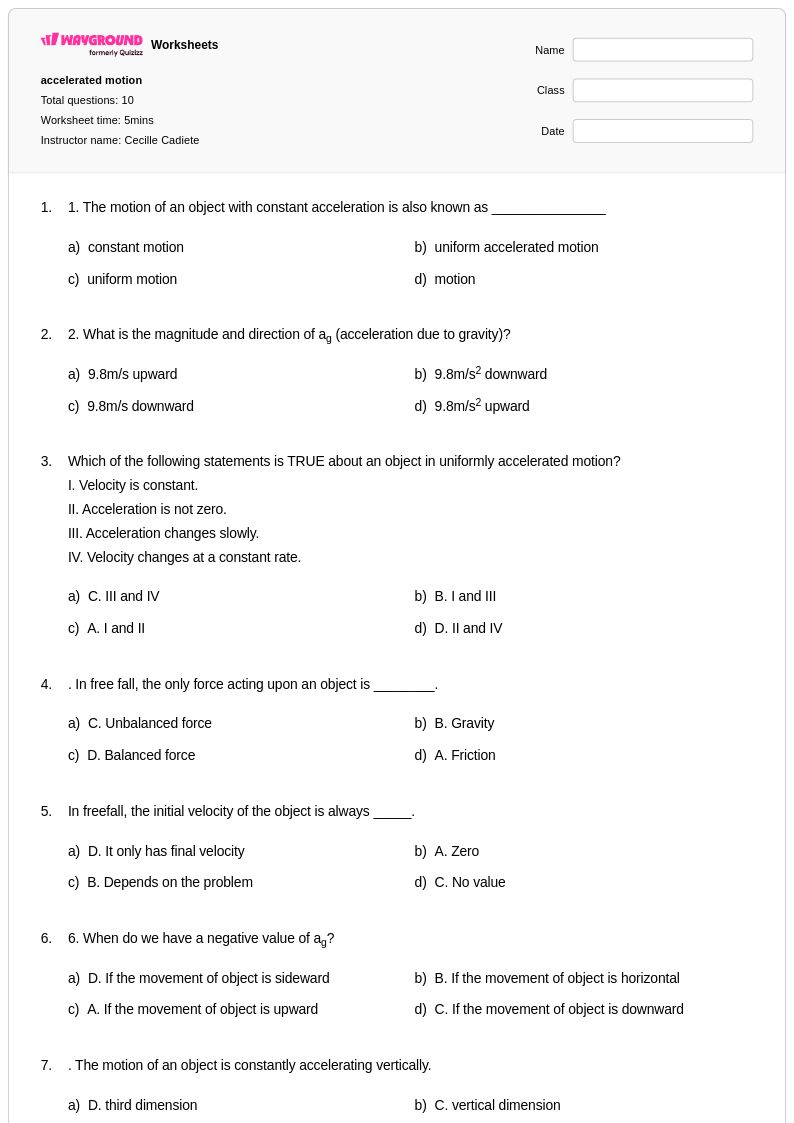
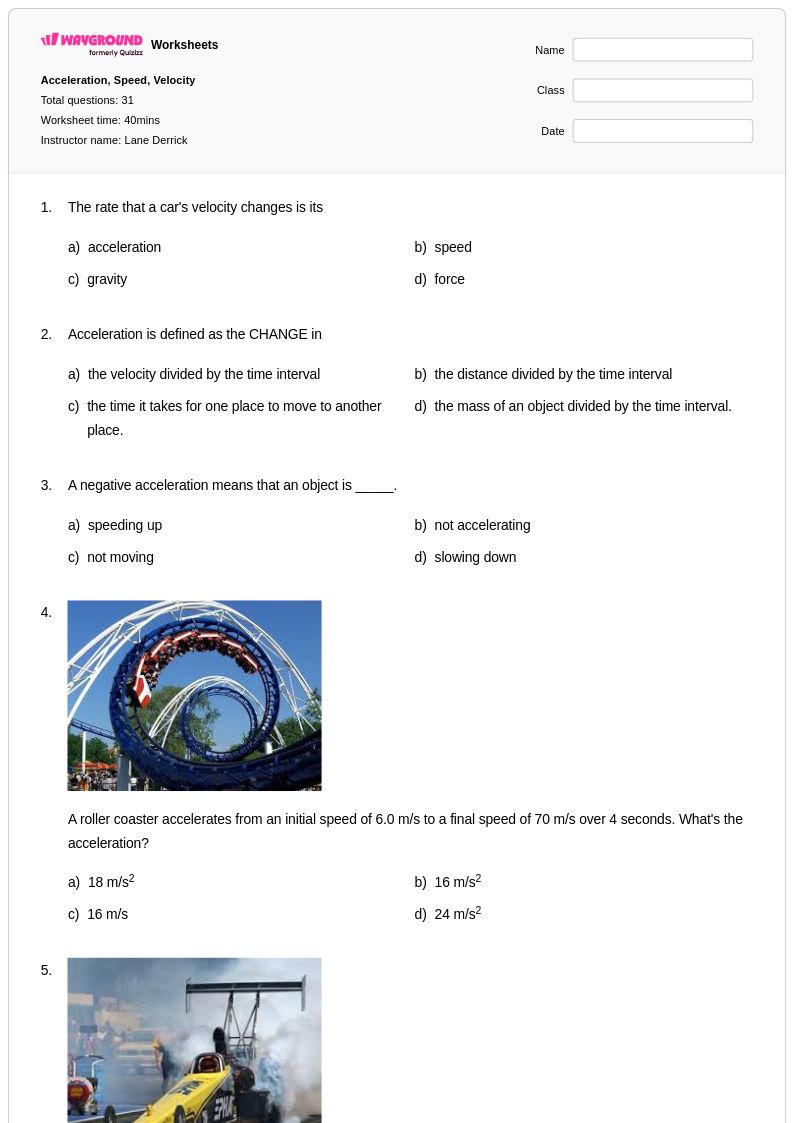
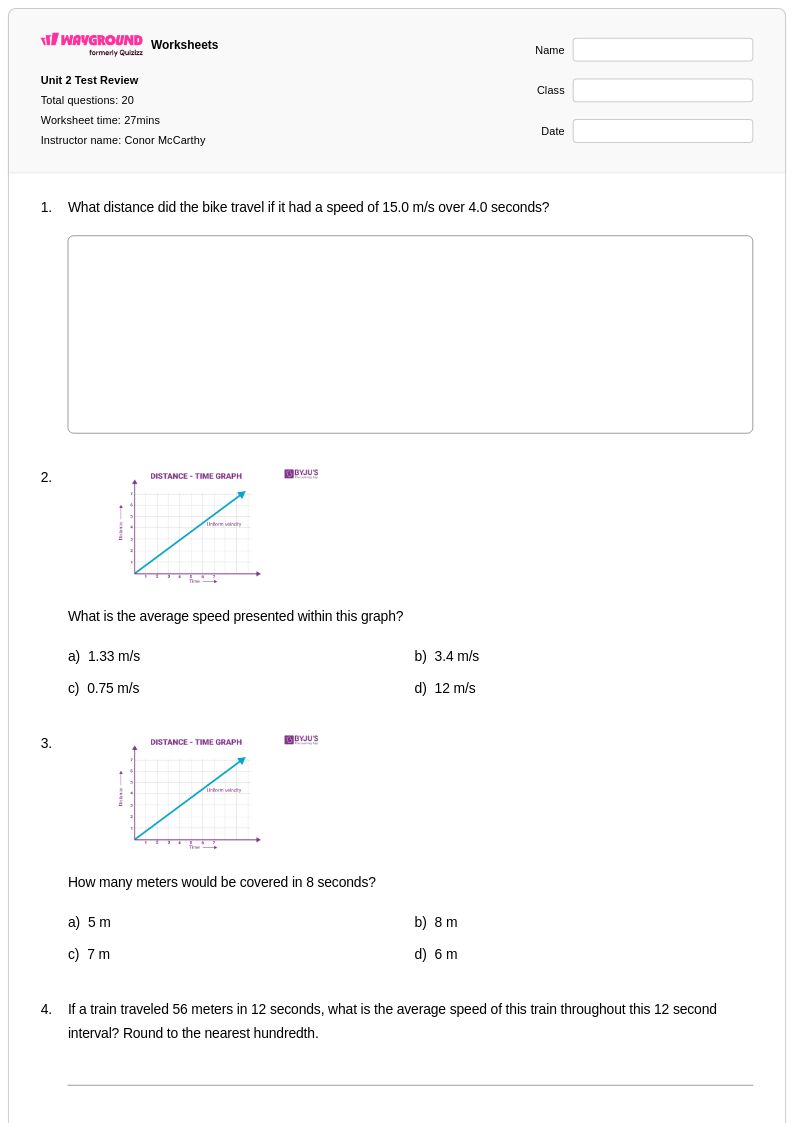
Grade 9 uniformly accelerated motion worksheets from Wayground provide free printables and practice problems with answer keys to help students master velocity, acceleration, and kinematic equations in physics.
Explore printable Uniformly Accelerated Motion worksheets for Grade 9
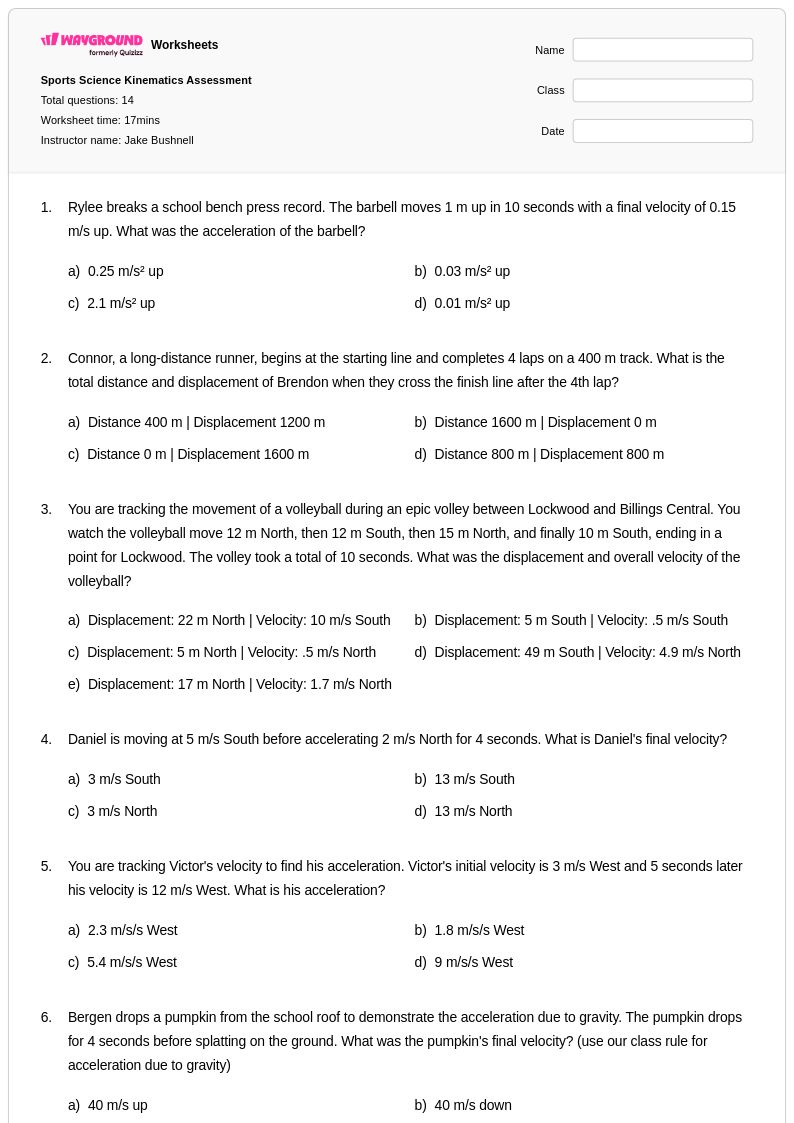
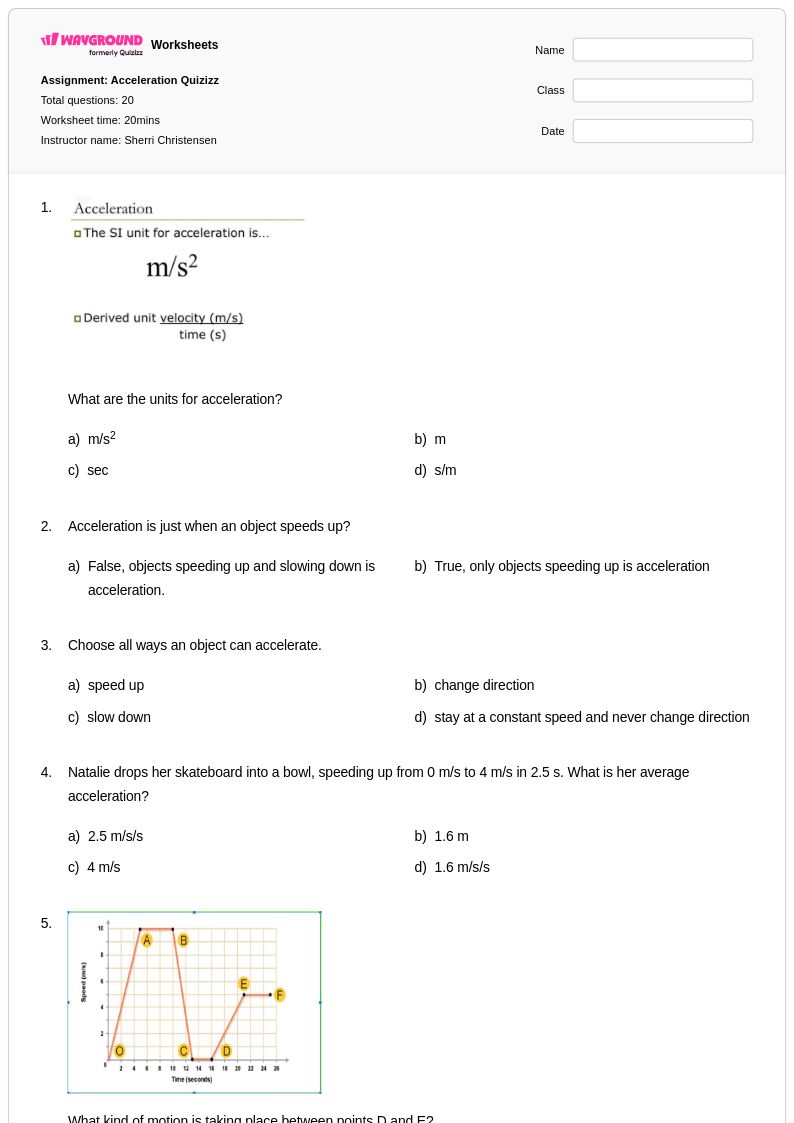
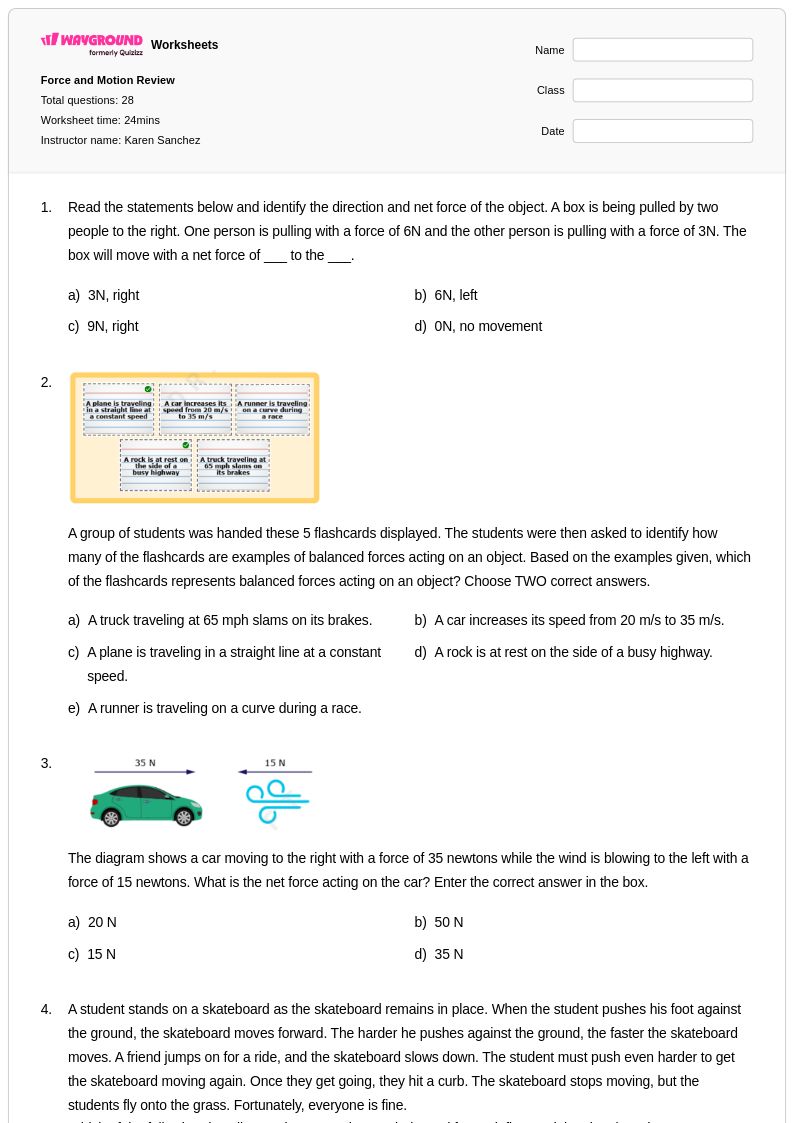
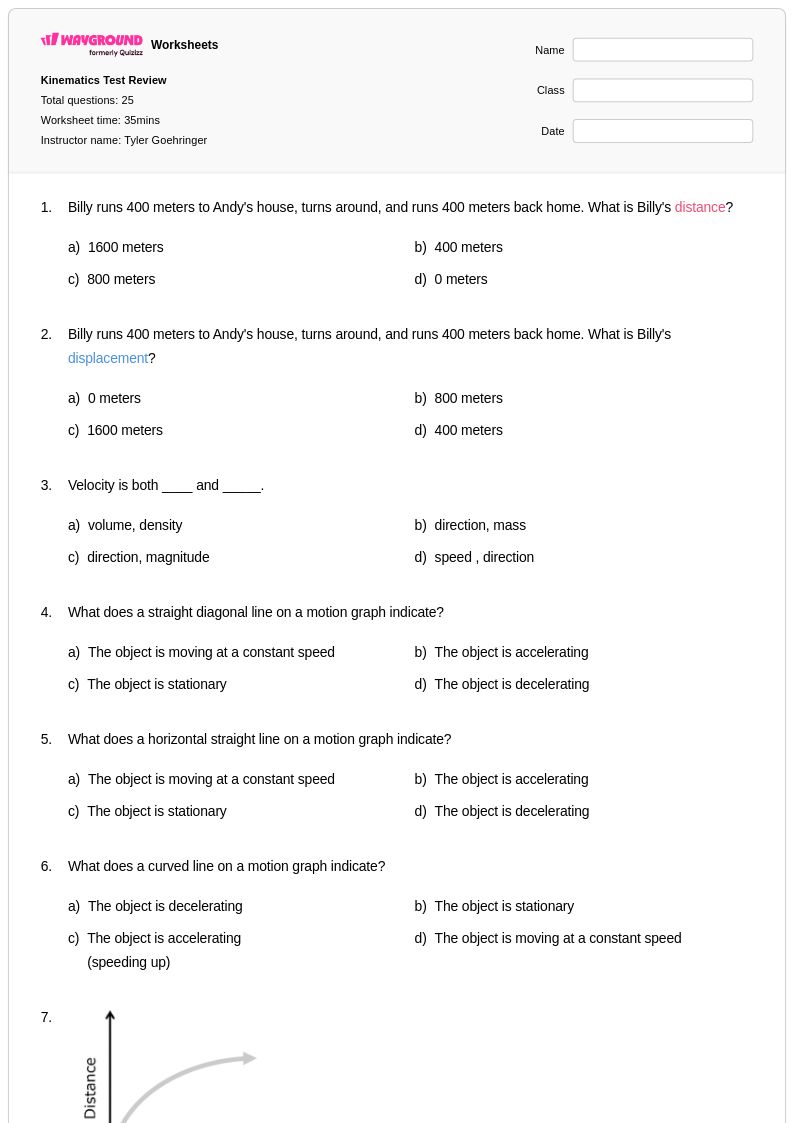
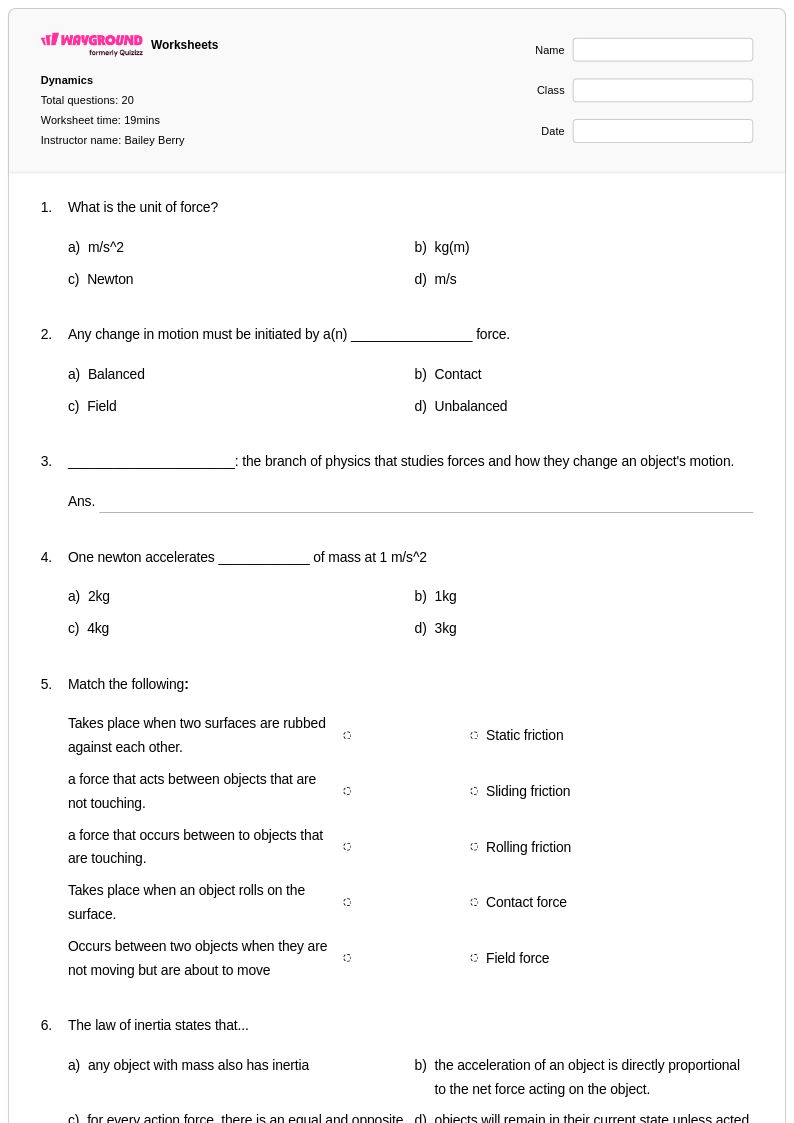
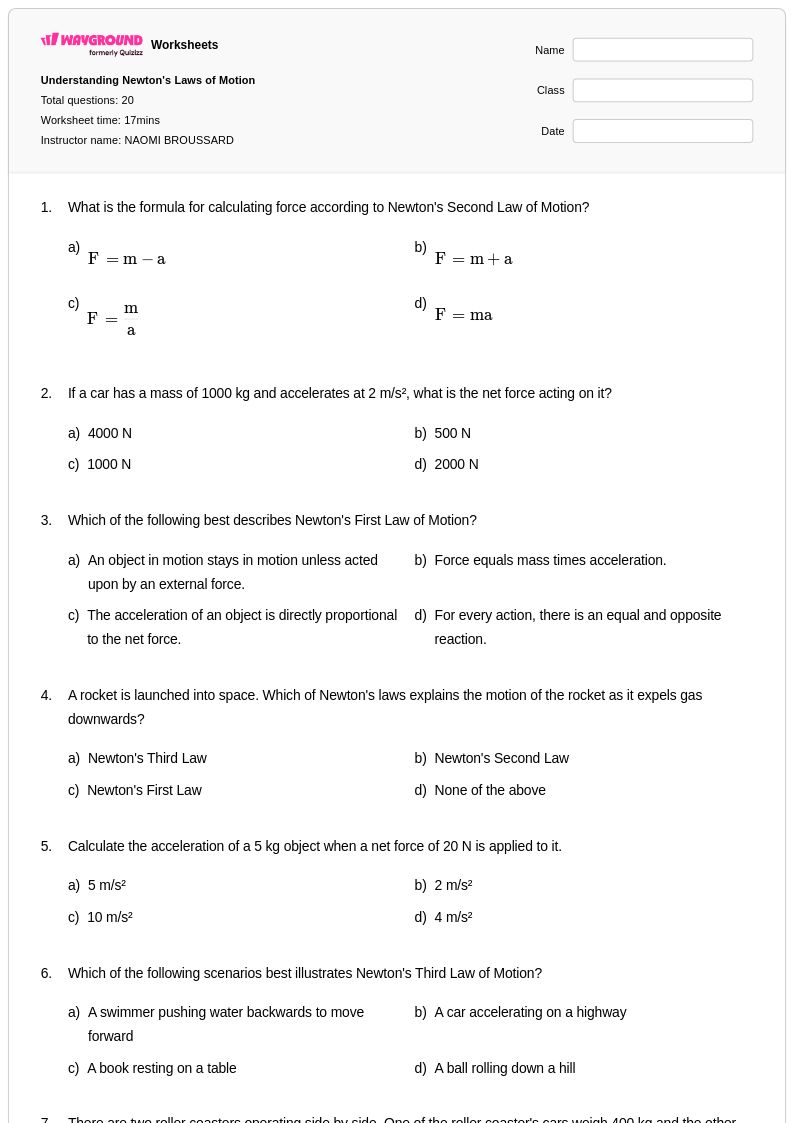
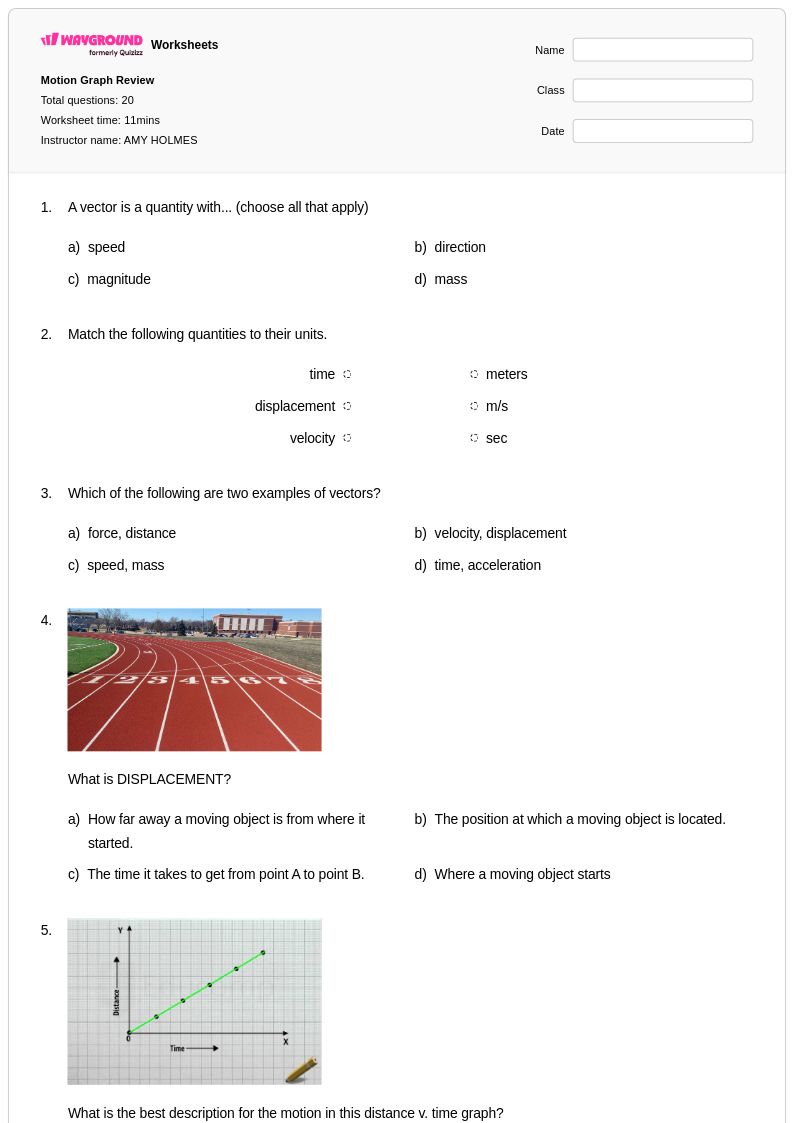
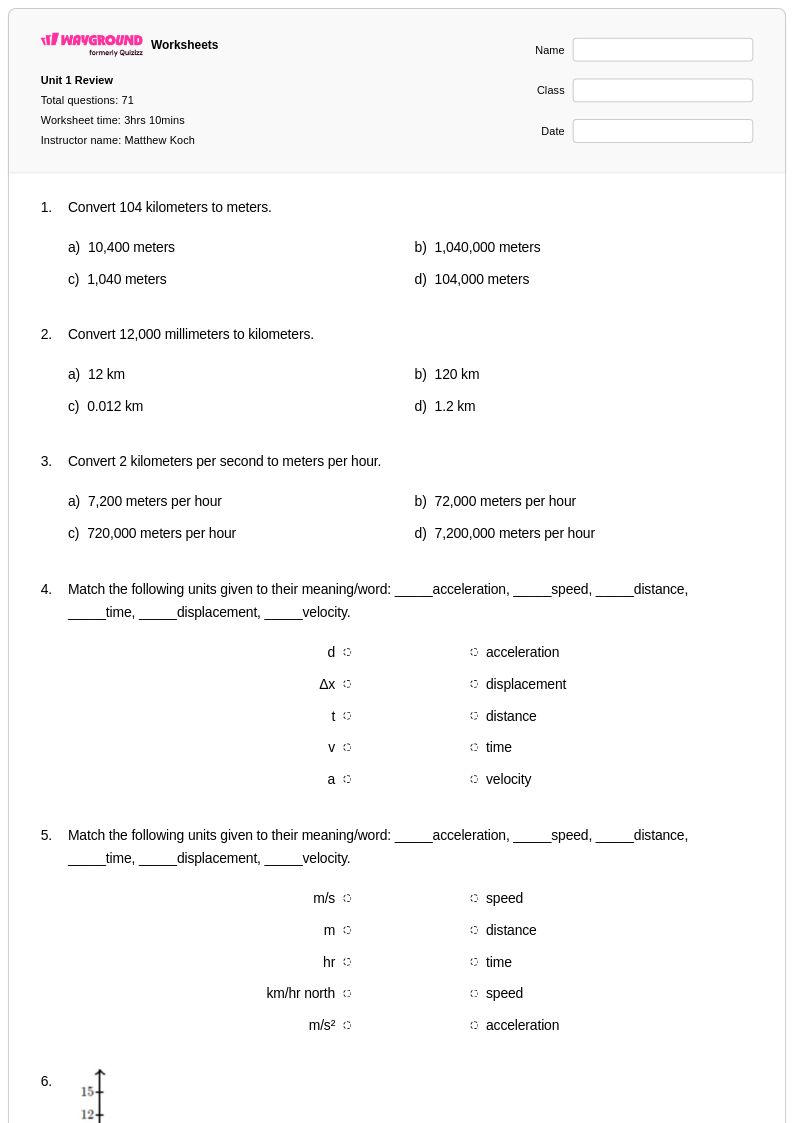
Uniformly accelerated motion worksheets for Grade 9 students available through Wayground (formerly Quizizz) provide comprehensive practice opportunities for mastering this fundamental physics concept. These expertly designed resources help students develop critical skills in analyzing motion with constant acceleration, including calculating displacement, velocity, and time relationships using kinematic equations. The worksheet collections feature carefully structured practice problems that progress from basic conceptual understanding to complex multi-step calculations, with each printable resource including detailed answer keys to support independent learning. Students work through real-world scenarios involving free-falling objects, vehicles accelerating from rest, and objects moving with uniform deceleration, strengthening their ability to apply mathematical formulas to physical situations. These free educational materials serve as essential tools for building confidence in problem-solving techniques and developing intuitive understanding of acceleration principles.
Wayground's extensive collection of uniformly accelerated motion worksheets draws from millions of teacher-created resources, offering educators unprecedented flexibility in addressing diverse classroom needs for Grade 9 physics instruction. The platform's robust search and filtering capabilities enable teachers to quickly locate materials aligned with specific curriculum standards and differentiate instruction based on individual student readiness levels. Educators can seamlessly customize existing worksheets or create entirely new practice sets, with all materials available in both printable pdf format and interactive digital versions for varied learning environments. These comprehensive tools support effective lesson planning by providing immediate access to scaffolded practice problems for skill development, targeted remediation exercises for students struggling with kinematic concepts, and challenging enrichment activities for advanced learners ready to explore more complex motion scenarios.
FAQs
How do I teach uniformly accelerated motion to physics students?
Start by establishing the concept of constant acceleration before introducing the kinematic equations. Build from v = u + at to displacement formulas like s = ut + ½at², using concrete examples such as a car braking at a steady rate or a ball in free fall. Once students are comfortable with the equations individually, move to multi-step problems that require selecting the right formula based on the known and unknown variables. Motion graphs — particularly velocity-time graphs — are essential alongside algebraic methods, as they give students a visual anchor for understanding what constant acceleration actually looks like.
What practice problems help students get better at kinematic equations?
Students benefit most from problems that require them to identify givens and unknowns before selecting an equation, rather than problems that tell them which formula to use. Effective practice includes calculating displacement when initial velocity, acceleration, and time are known; finding final velocity after a given distance; and working backwards to determine acceleration from motion data. Mixing straightforward computation problems with real-world scenario problems — such as braking distances or projectile launch phases — builds both procedural fluency and applied understanding.
What mistakes do students commonly make when solving uniformly accelerated motion problems?
The most frequent error is sign confusion — students often treat deceleration as positive acceleration or fail to assign consistent positive and negative directions before solving. Another common mistake is selecting the wrong kinematic equation because they did not first identify which variables are known and which is being solved for. Students also frequently misread motion graphs, conflating the slope of a position-time graph with the slope of a velocity-time graph. Targeted practice that requires students to define a sign convention and list their knowns before touching an equation can significantly reduce these errors.
How can I use uniformly accelerated motion worksheets to support students at different skill levels?
Differentiation works well when worksheets are structured in tiers — direct substitution problems for students still building equation fluency, multi-variable problems for grade-level learners, and scenario-based or graph-interpretation problems for advanced students. On Wayground, teachers can apply accommodations such as read aloud, extended time, and reduced answer choices to individual students when using digital formats, so the same resource can serve the full range of learners without requiring separate materials. These settings can be configured per student and reused across future sessions.
How do I use Wayground's uniformly accelerated motion worksheets in my classroom?
Wayground's uniformly accelerated motion worksheets are available as printable PDFs for traditional classroom use and in digital formats for technology-integrated instruction, including the option to host them as a live quiz directly on the platform. Teachers can use the printable versions for guided practice, homework, or formative assessment, while the digital format allows for real-time feedback and student-level accommodations. Wayground's search and filtering tools make it straightforward to find worksheets aligned to specific kinematic concepts or physics curriculum standards.
How do motion graphs connect to kinematic equations in uniformly accelerated motion?
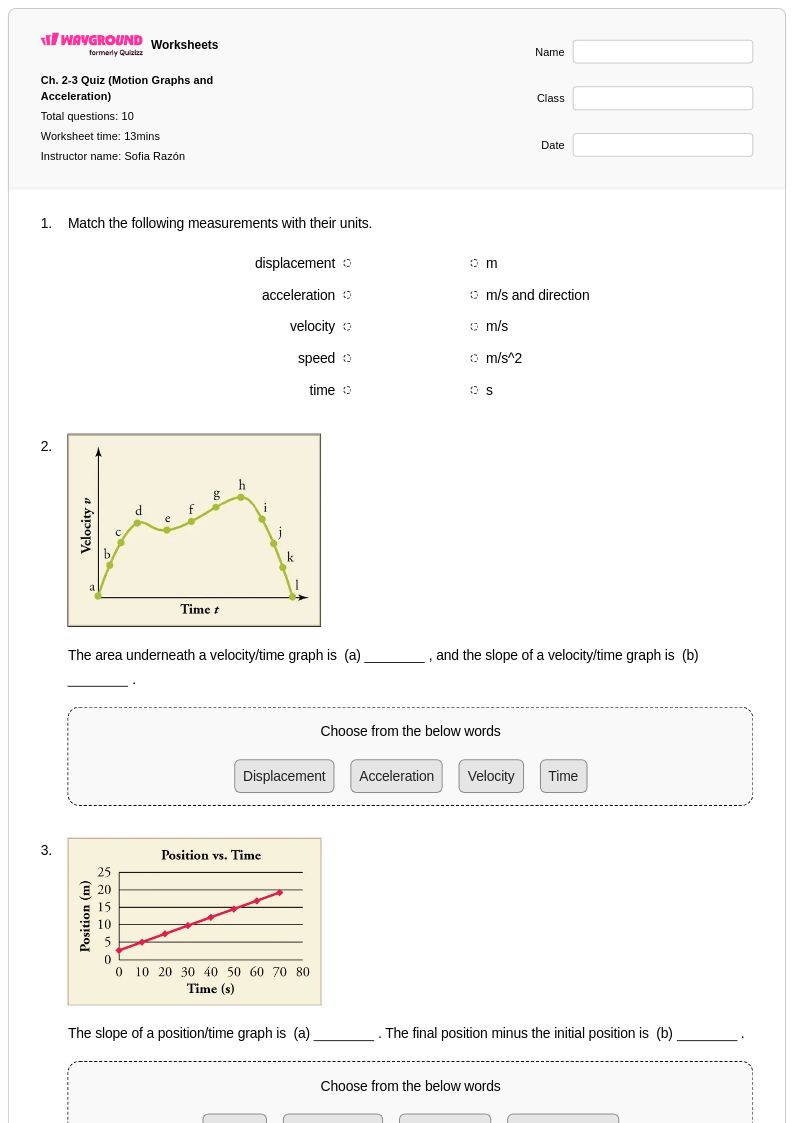
In uniformly accelerated motion, a velocity-time graph produces a straight line whose slope equals the acceleration and whose enclosed area equals displacement — both of which directly correspond to the kinematic equations. Teaching students to extract acceleration from a v-t graph before solving algebraically reinforces why the equations work, not just how to use them. Position-time graphs for uniformly accelerated motion produce a parabola, which helps students recognize that constant acceleration produces non-linear displacement growth over time. Connecting graphical and algebraic representations deepens conceptual understanding and reduces equation-selection errors.