Free Printable Universal Gravitation Worksheets for Grade 9
Grade 9 Universal Gravitation worksheets from Wayground offer free printables and practice problems with answer keys to help students master gravitational forces, Newton's law of universal gravitation, and planetary motion concepts.
Explore printable Universal Gravitation worksheets for Grade 9
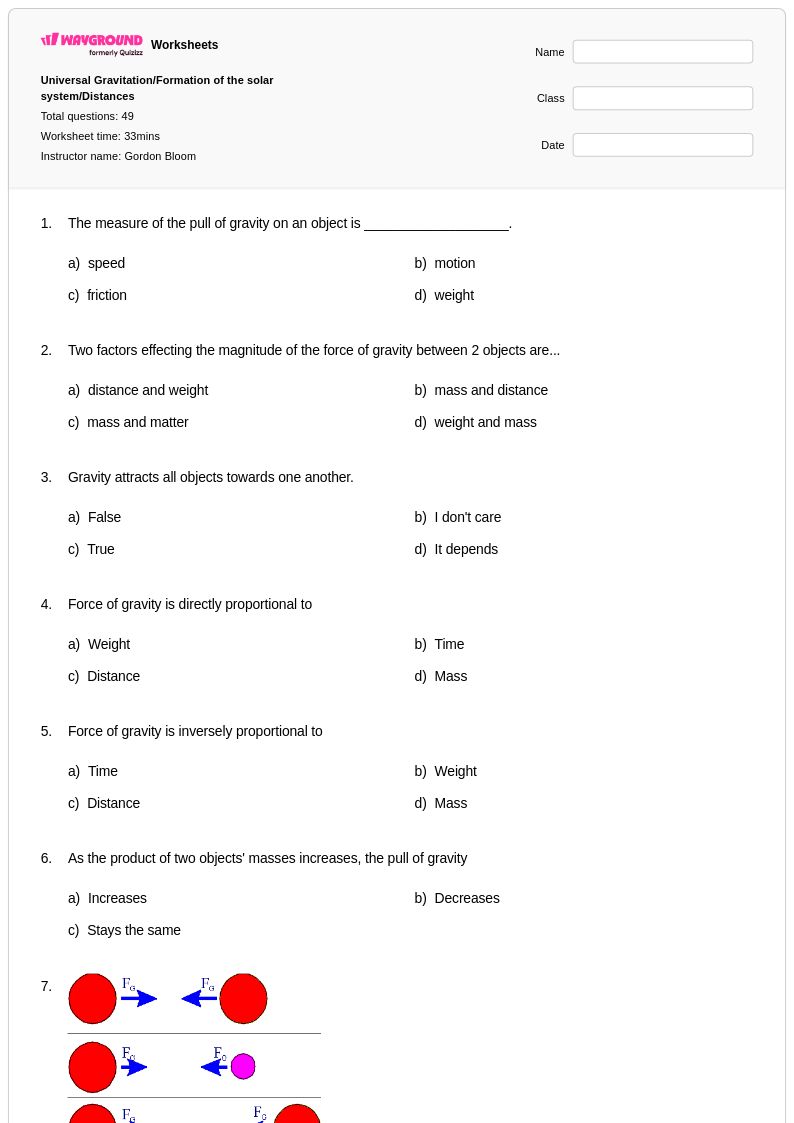
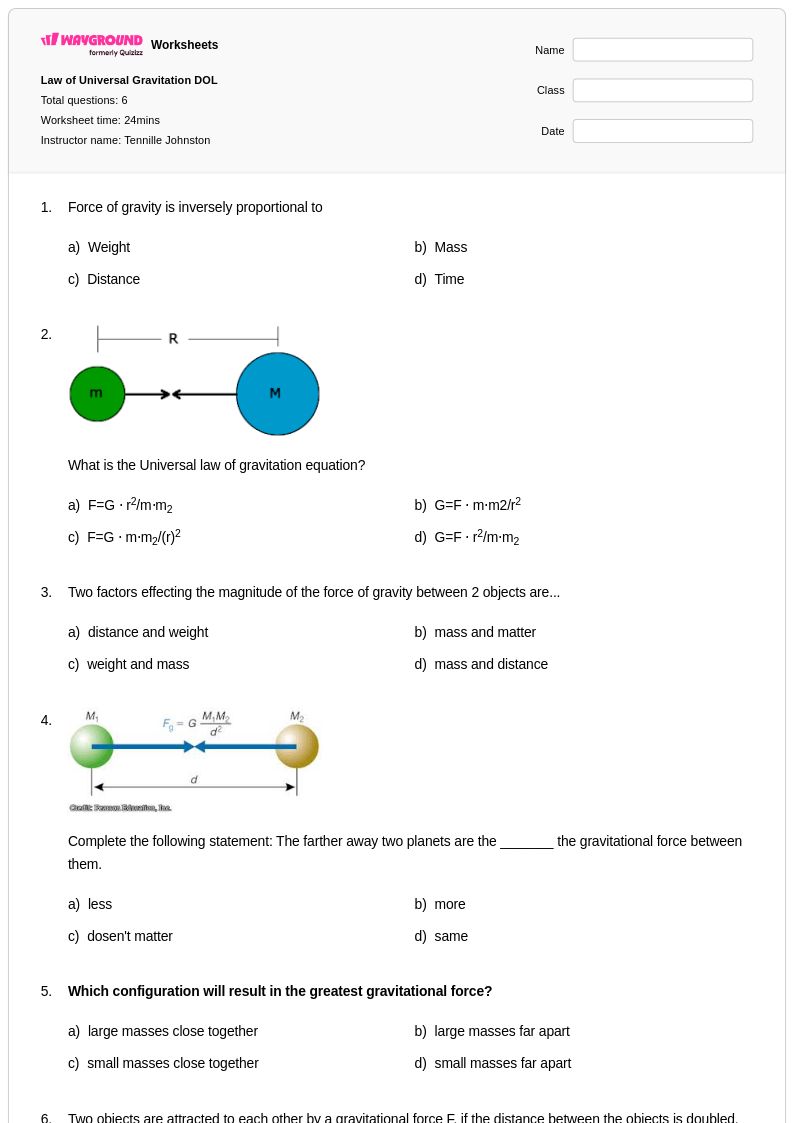
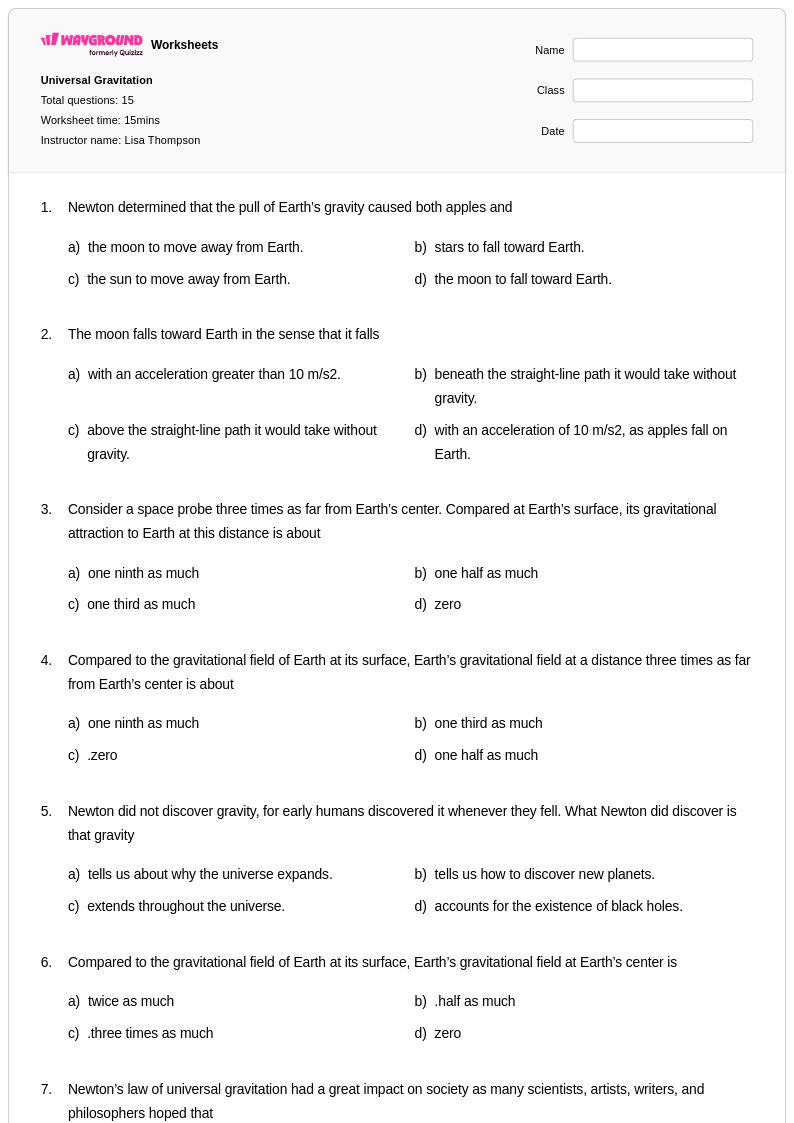
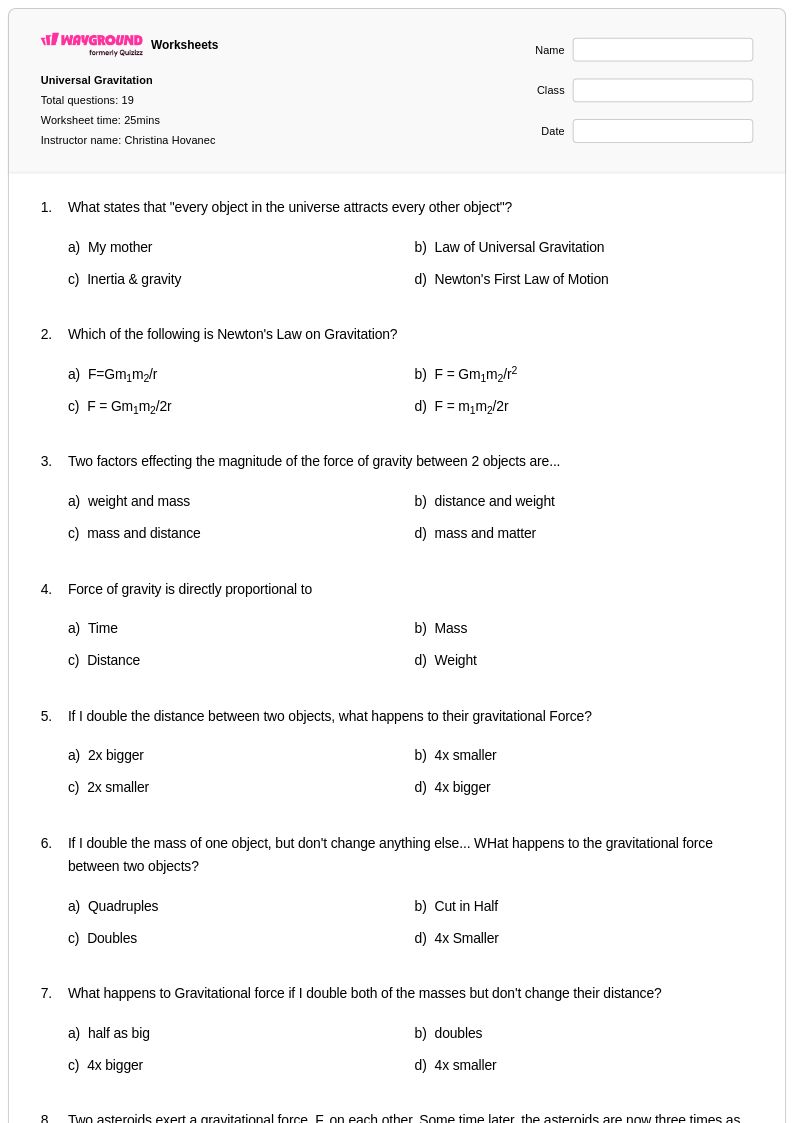
Universal Gravitation worksheets for Grade 9 students available through Wayground (formerly Quizizz) provide comprehensive coverage of Newton's law of universal gravitation and its fundamental applications in physics education. These carefully designed educational materials strengthen students' understanding of gravitational force calculations, the inverse square law relationship, and the mathematical concepts underlying planetary motion and satellite orbits. The worksheet collection includes practice problems that guide students through calculating gravitational forces between objects of varying masses and distances, interpreting gravitational field strength, and applying universal gravitation principles to real-world scenarios. Each worksheet comes with a complete answer key and is available as free printable pdf resources, enabling students to develop proficiency in using the universal gravitation equation and understanding how gravitational forces govern celestial mechanics.
Wayground (formerly Quizizz) empowers educators with millions of teacher-created universal gravitation resources that support diverse instructional needs and learning objectives in Grade 9 physics classrooms. The platform's robust search and filtering capabilities allow teachers to quickly locate worksheets aligned with specific physics standards and curriculum requirements, while built-in differentiation tools enable customization for students with varying skill levels and learning preferences. These versatile materials are available in both printable and digital formats, including downloadable pdf versions, making them ideal for traditional classroom instruction, homework assignments, laboratory supplements, and remote learning environments. Teachers can seamlessly integrate these resources into lesson planning for initial skill introduction, targeted remediation of challenging gravitational concepts, enrichment activities for advanced learners, and ongoing practice to reinforce mastery of universal gravitation principles throughout the academic year.
FAQs
How do I teach Newton's law of universal gravitation to physics students?
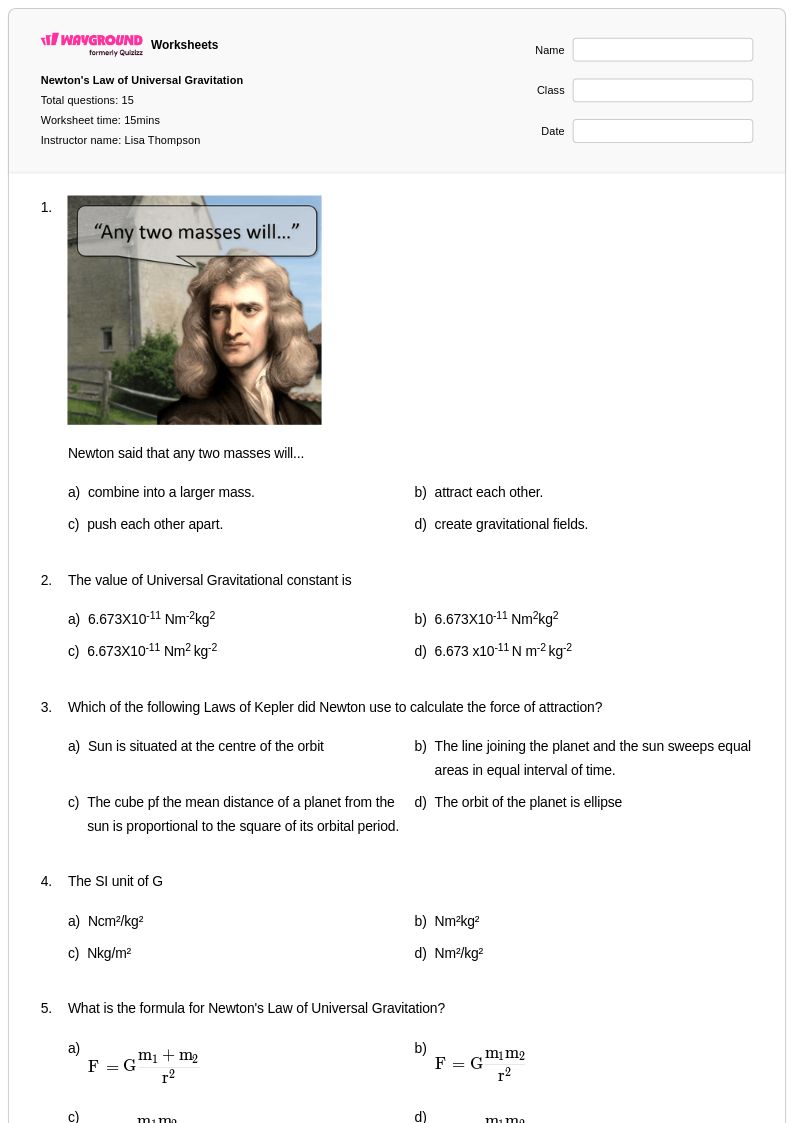
Start by grounding the concept in observable phenomena: why the Moon orbits Earth, why satellites stay in orbit, why objects fall at the same rate regardless of mass. Introduce the equation F = Gm₁m₂/r² systematically, helping students understand each variable before combining them. Emphasize the inverse square relationship early, as students often underestimate how rapidly gravitational force drops off with distance. Connecting the math to real-world scenarios like planetary orbits and satellite mechanics helps students build conceptual understanding alongside procedural fluency.
What practice problems help students master universal gravitation calculations?
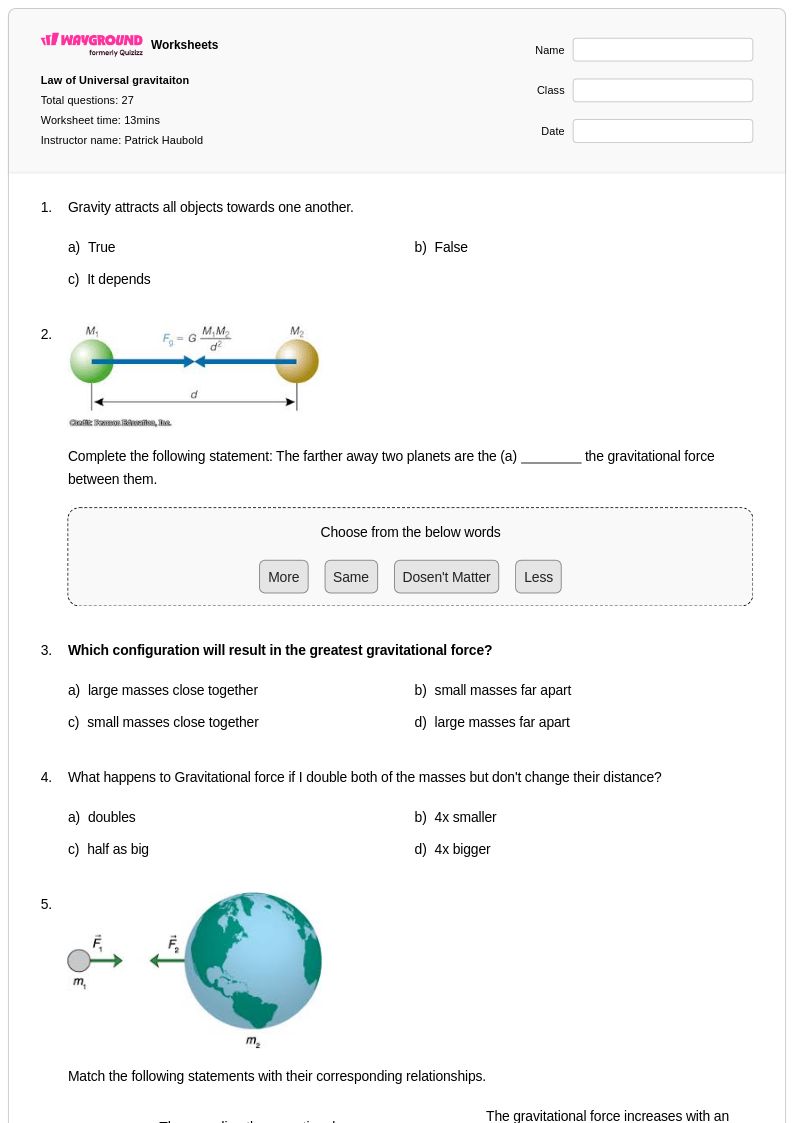
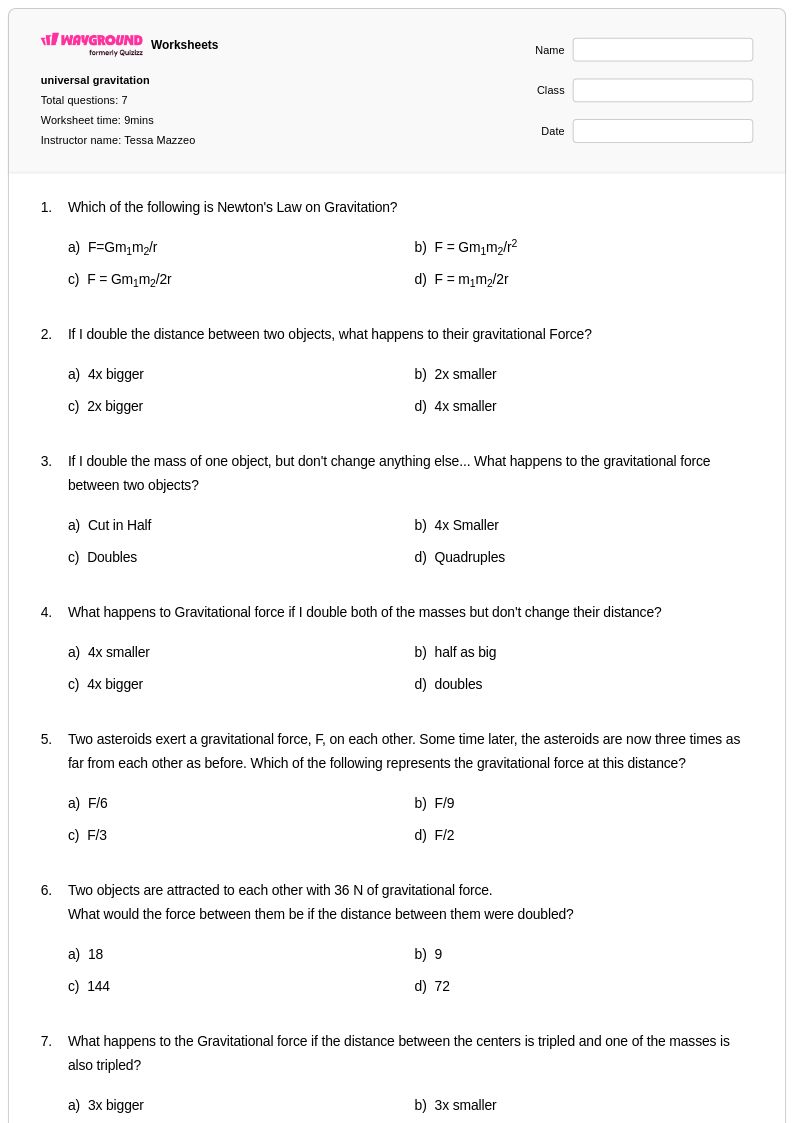
Effective practice should progress from single-variable isolation (solving for force, mass, or distance given the other two) to multi-step problems involving orbital speed, orbital period, and gravitational acceleration at varying altitudes. Students also benefit from problems comparing gravitational forces between different planet-moon pairs, which reinforces proportional reasoning. Including problems that require students to apply the inverse square law numerically, such as determining how force changes when distance doubles or triples, builds the kind of flexible thinking assessments demand.
What misconceptions do students commonly have about universal gravitation?
The most persistent misconception is that gravity stops acting in space or that astronauts in orbit are weightless because gravity is absent. Students need explicit instruction that gravitational force decreases with distance but never reaches zero, and that orbital free fall is the cause of apparent weightlessness. A second common error is misapplying the inverse square relationship, with students often halving force when distance doubles instead of quartering it. Students also frequently confuse gravitational force with gravitational acceleration, particularly when comparing conditions on different planets.
How does universal gravitation connect to planetary motion and orbital mechanics?
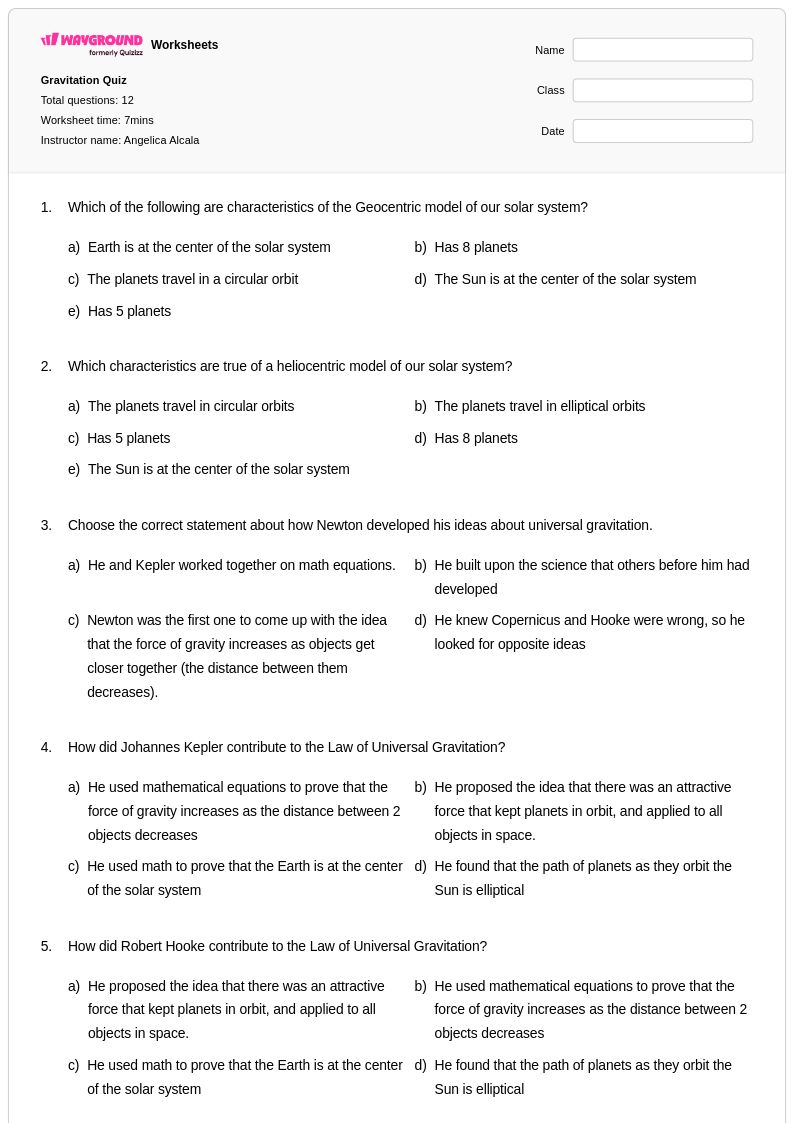
Newton's law of universal gravitation provides the physical basis for Kepler's empirical laws of planetary motion, particularly the relationship between orbital period and orbital radius described in Kepler's third law. Gravitational force acts as the centripetal force that keeps planets and satellites in stable orbits, which allows students to derive orbital speed and period formulas directly from F = Gm₁m₂/r². Teaching this connection helps students see gravitation not as an isolated equation but as the unifying principle behind satellite behavior, tidal forces, and the structure of solar systems.
How can I use Wayground's universal gravitation worksheets in my classroom?
Wayground's universal gravitation worksheets are available as printable PDFs for traditional classroom use and in digital formats for technology-integrated instruction, making them adaptable to in-person, hybrid, and remote settings. Teachers can host worksheets as a quiz directly on Wayground, enabling real-time student responses and automatic grading. Each worksheet includes answer keys and step-by-step solutions, so they work equally well for guided practice, independent review, or homework. Wayground also supports student-level accommodations including extended time, read aloud, and reduced answer choices, which can be configured individually to support diverse learners without disrupting the rest of the class.
How can I differentiate universal gravitation instruction for students at different skill levels?
For students still building foundational skills, focus on single-step force calculations with scaffolded equation setups before introducing multi-variable problems. Advanced learners can be extended into astrophysics applications such as calculating escape velocity, analyzing gravitational fields of multiple bodies, or exploring how Newton's law underpins orbital insertion mechanics. On Wayground, teachers can apply accommodations such as reduced answer choices or read aloud at the individual student level, so struggling students receive targeted support while the rest of the class works at standard difficulty, all within the same assignment.