Explore Wayground's free Catholic Religion worksheets and printables that help students deepen their understanding of faith traditions, religious practices, and Catholic teachings through engaging practice problems with comprehensive answer keys.
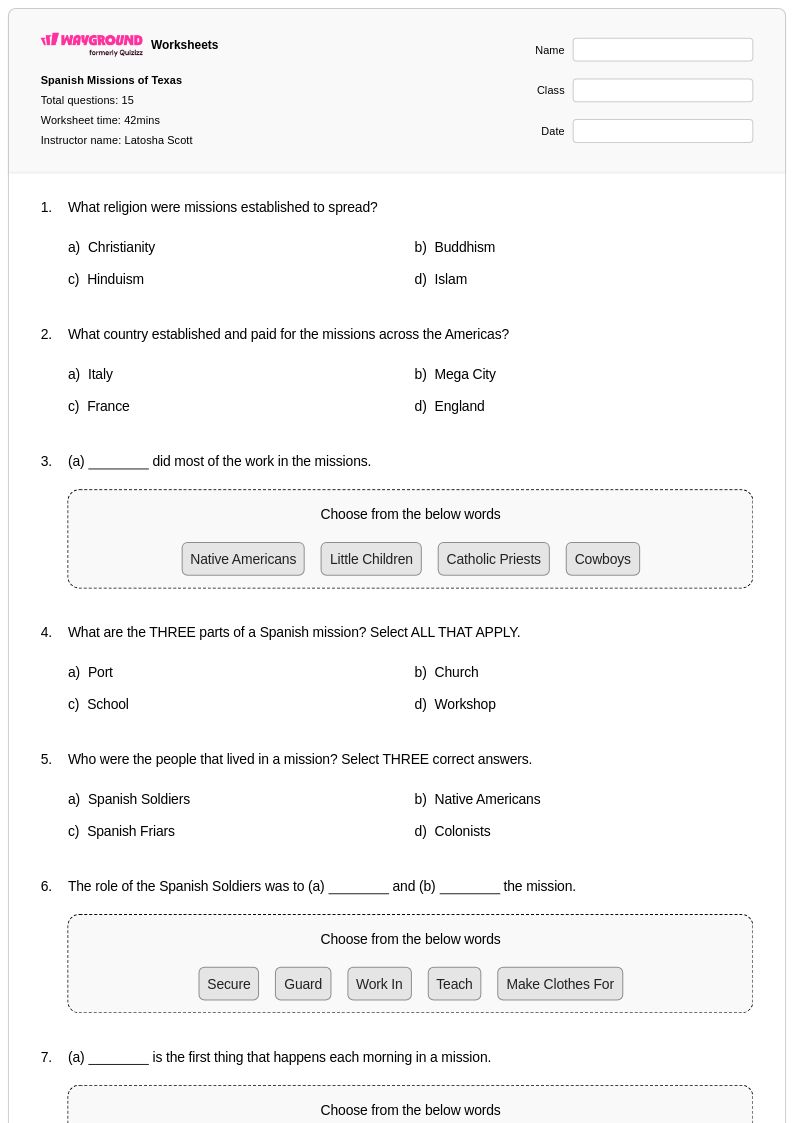
Catholic Religion worksheets available through Wayground (formerly Quizizz) provide comprehensive educational resources that explore the fundamental beliefs, traditions, and practices of the Catholic faith within the broader context of community and cultural studies. These carefully designed materials help students develop critical understanding of Catholic teachings, sacraments, liturgical seasons, and the role of the Catholic Church in shaping communities throughout history and today. The worksheets strengthen analytical thinking skills as students examine religious texts, compare Catholic traditions with other faith practices, and investigate how Catholic values influence social justice initiatives and community service. Each resource includes detailed answer keys and is available as free printable pdf materials, featuring practice problems that encourage students to connect religious concepts with real-world applications and cultural understanding.
Wayground (formerly Quizizz) supports educators with an extensive collection of millions of teacher-created resources focused on Catholic religious education and cultural studies. The platform's robust search and filtering capabilities enable teachers to quickly locate materials that align with specific curriculum standards and learning objectives, while differentiation tools allow for customization based on individual student needs and varying levels of religious background knowledge. These flexible resources are available in both printable and digital pdf formats, making them ideal for diverse classroom environments and learning preferences. Teachers can effectively utilize these materials for lesson planning, targeted remediation of religious literacy gaps, enrichment activities for advanced learners, and ongoing skill practice in religious studies, cultural analysis, and comparative religion discussions.
FAQs
How do I teach Catholic religion in a way that's engaging and academically rigorous?
Effective Catholic religion instruction combines doctrinal content with contextual understanding, helping students see how Catholic teachings connect to history, community, and social justice. Start with foundational concepts like the sacraments and liturgical seasons, then build outward to how the Catholic Church has shaped communities over time. Asking students to compare Catholic traditions with other faith practices encourages critical thinking rather than passive memorization.
What topics should Catholic religion worksheets cover at the K-12 level?
Catholic religion worksheets should address core areas including the seven sacraments, liturgical seasons, Catholic social teaching, Scripture analysis, and the historical role of the Catholic Church in shaping communities. Strong materials also prompt students to examine how Catholic values connect to real-world issues like social justice and community service. Covering both belief and practice gives students a more complete and academically grounded understanding of the faith.
What exercises help students practice and retain Catholic religious concepts?
Practice exercises that ask students to analyze religious texts, compare Catholic traditions with other faith practices, and apply Catholic social teaching to real-world scenarios are especially effective for retention. Structured activities that connect doctrinal knowledge to community and cultural contexts help students move beyond rote memorization. Worksheets with clear prompts and comprehensive answer keys allow students to check their understanding and self-correct.
What misconceptions do students commonly have about Catholic teachings and practices?
Students frequently conflate Catholic practices with broader Christian traditions, missing what is doctrinally and liturgically distinct about Catholicism. Another common misconception is treating the sacraments as purely symbolic rather than understanding their theological significance within Catholic teaching. Students also sometimes misunderstand the Catholic Church's historical relationship with social justice movements, viewing it as purely institutional rather than as a driver of community-level change.
How can I differentiate Catholic religion worksheets for students with varying levels of religious background knowledge?
For students with limited prior exposure to Catholic traditions, begin with vocabulary-building exercises around key terms like liturgy, sacrament, and magisterium before moving to analytical tasks. For students with stronger backgrounds, comparative religion prompts and document-based questions about Catholic social teaching offer appropriate challenge. On Wayground, teachers can apply individual accommodations such as reduced answer choices or read aloud support to help students with diverse learning needs engage with the same material.
How do I use Wayground's Catholic religion worksheets in my classroom?
Wayground's Catholic religion worksheets are available as printable PDFs for traditional classroom use and in digital formats for technology-integrated learning environments, including the option to host them as a quiz directly on the platform. Teachers can use Wayground's search and filtering tools to locate materials aligned with specific curriculum standards or learning objectives, making it straightforward to plan lessons or targeted remediation sessions. The included answer keys support both independent student practice and teacher-led review.


![TX24-25 - Republic of Texas 2 [and unit review] - Printable Catholic-religion Worksheets - Wayground](https://quizizz-static.s3.amazonaws.com/_media/worksheets-new/67325430b6b1e000b90dd5be-tx24-25-republic-of-texas-2-and-unit-review)