Free Printable Chemistry of Life Worksheets for Class 8
Explore Wayground's free Class 8 chemistry of life worksheets and printables that help students master biological molecules, chemical reactions in living systems, and cellular processes through engaging practice problems and comprehensive answer keys.
Explore printable Chemistry of Life worksheets for Class 8
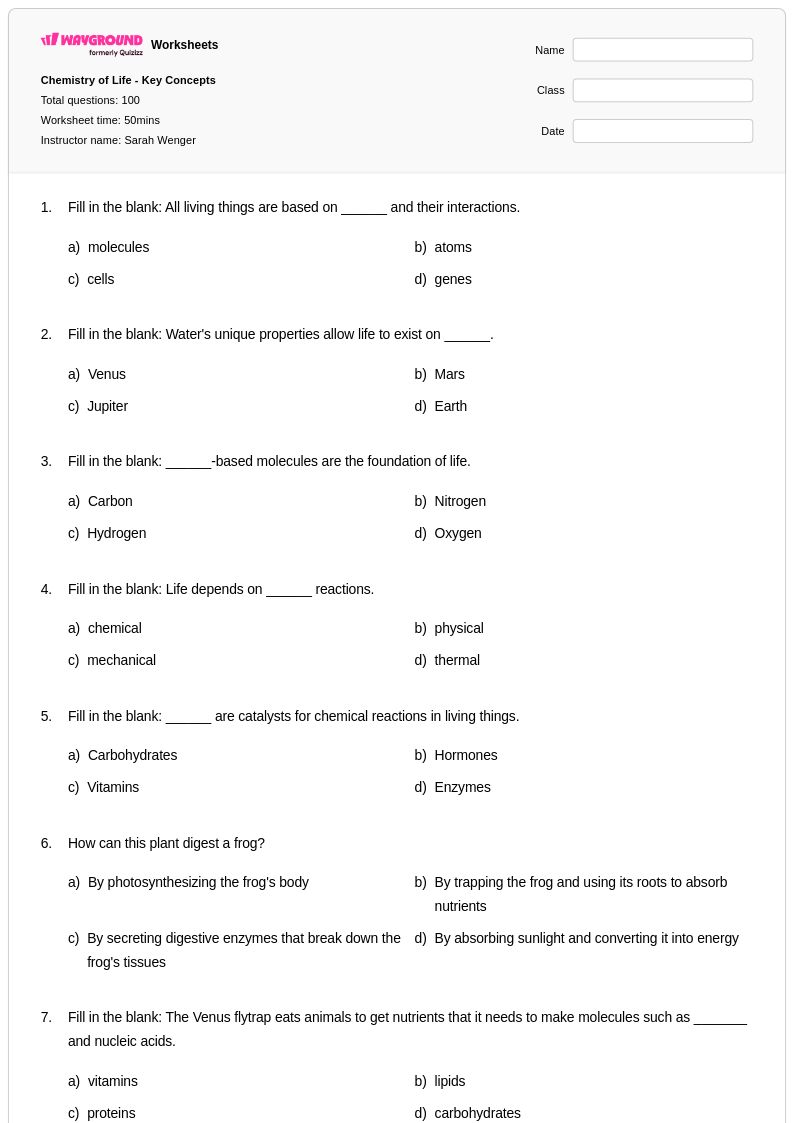
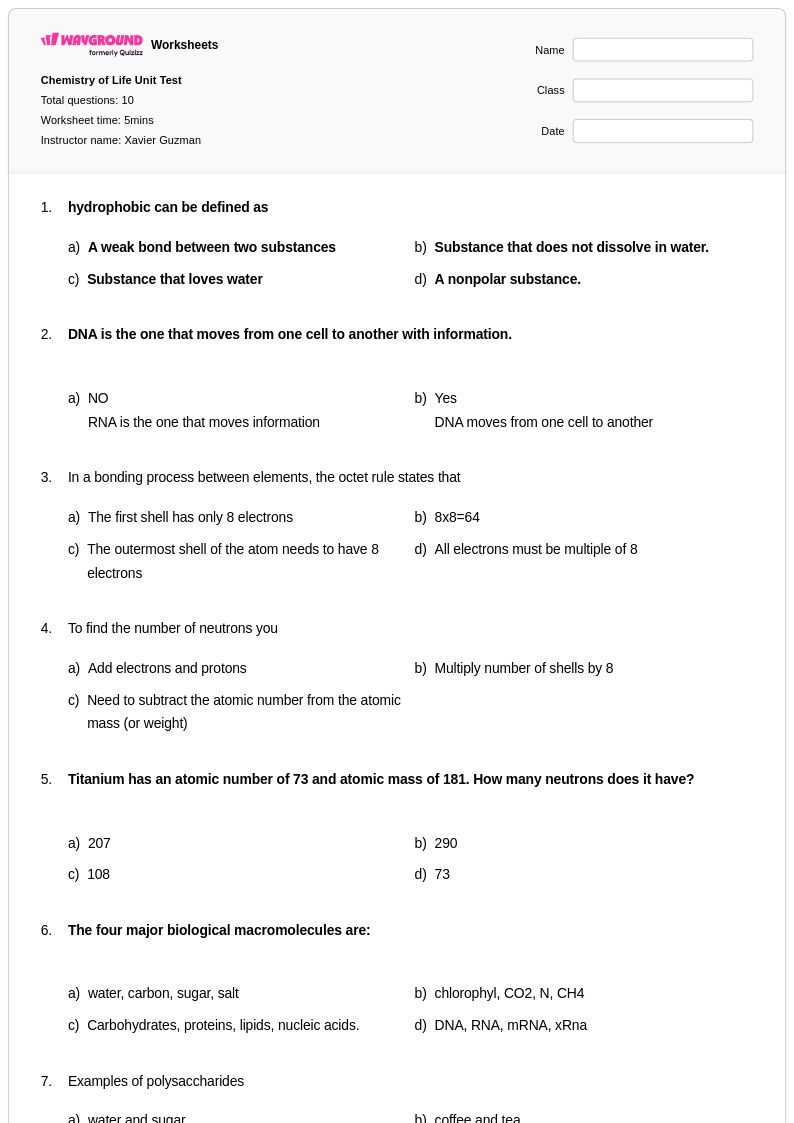
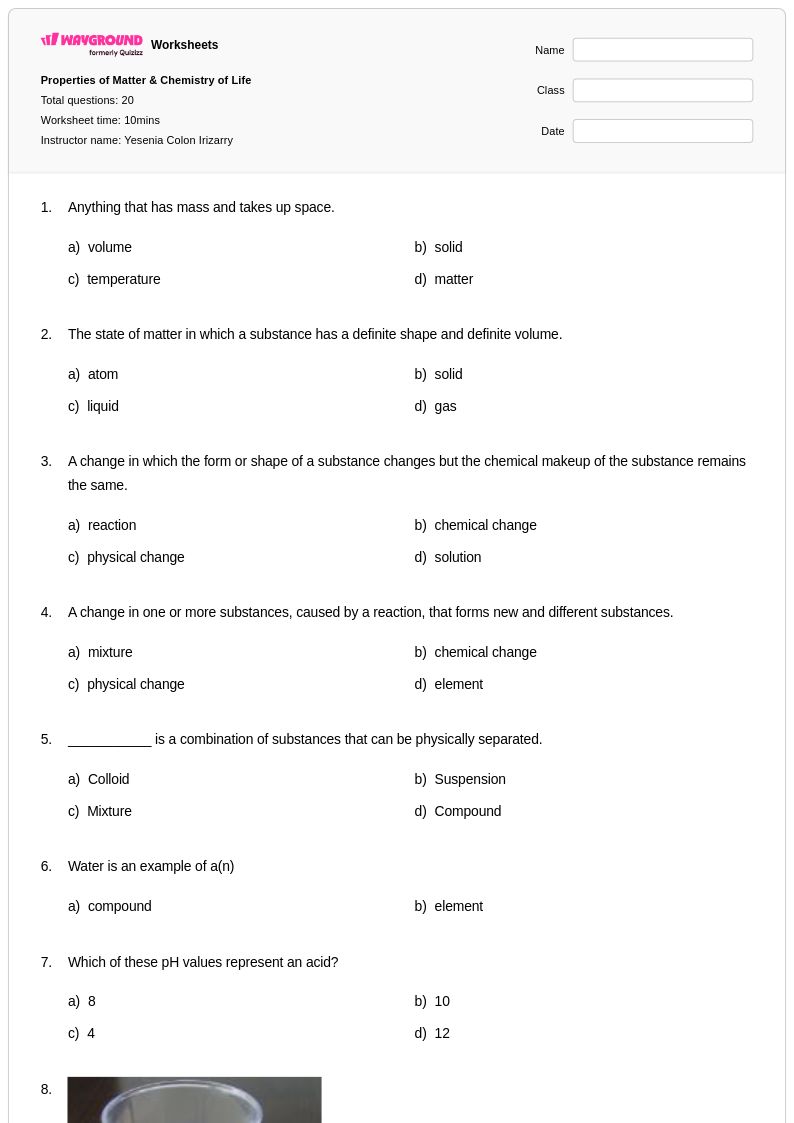
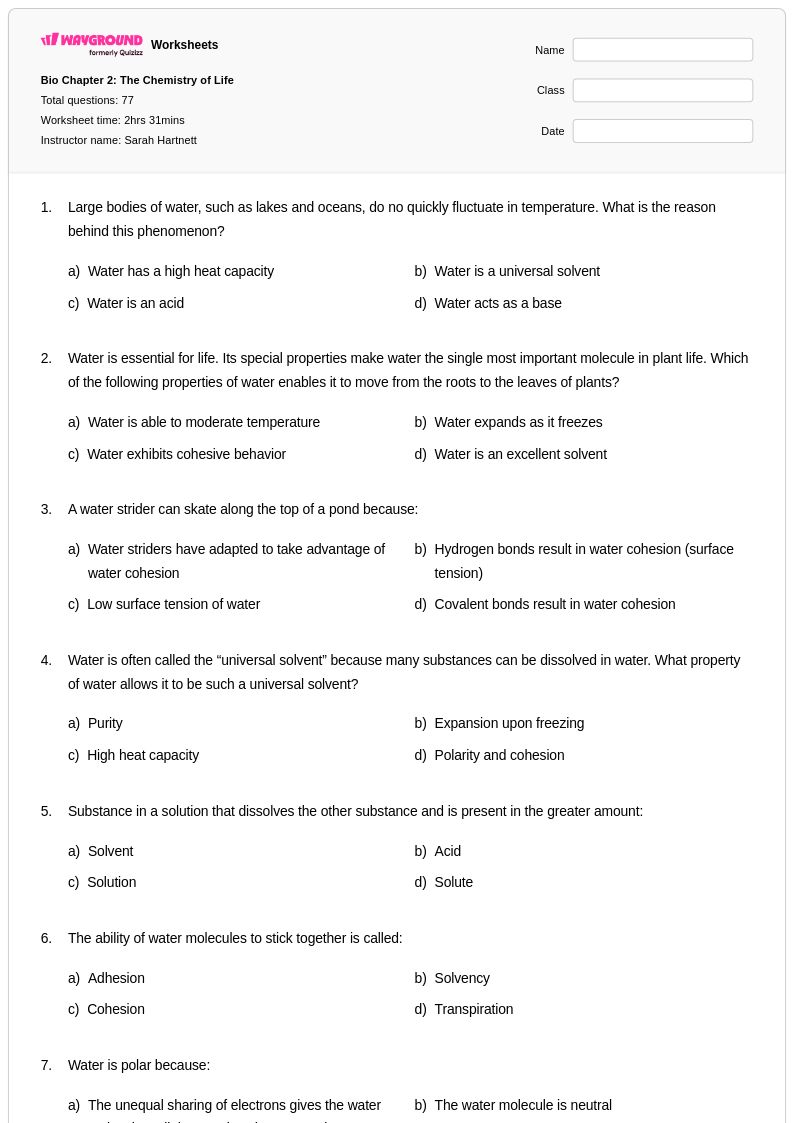
Chemistry of Life worksheets for Class 8 students available through Wayground (formerly Quizizz) provide comprehensive coverage of the fundamental chemical processes that sustain living organisms. These expertly designed educational materials focus on essential concepts including the structure and function of biological macromolecules, enzyme activity, pH and acid-base balance, and the role of water in biological systems. Students develop critical analytical skills as they work through practice problems involving carbohydrates, lipids, proteins, and nucleic acids, while exploring how chemical reactions drive cellular processes like photosynthesis and cellular respiration. Each worksheet comes with a detailed answer key and is available as a free printable pdf, making it easy for educators to incorporate these resources into their lesson plans and provide students with targeted skill practice in understanding life's chemical foundations.
Wayground (formerly Quizizz) empowers educators with an extensive collection of millions of teacher-created Chemistry of Life worksheets specifically aligned with Class 8 science standards and learning objectives. The platform's robust search and filtering capabilities allow teachers to quickly locate materials that match their specific curriculum needs, whether focusing on molecular structure, biochemical pathways, or chemical properties of living systems. Advanced differentiation tools enable educators to customize worksheets for diverse learning levels, supporting both remediation for struggling students and enrichment opportunities for advanced learners. Available in both printable and digital formats including downloadable pdfs, these resources streamline lesson planning while providing flexible options for in-class instruction, homework assignments, and assessment preparation that reinforce students' understanding of how chemistry principles apply to biological processes.
FAQs
How do I teach the chemistry of life to biology students?
Start by grounding students in atomic structure and chemical bonding before introducing biological macromolecules, since understanding why molecules behave the way they do makes memorizing their structures far more meaningful. Sequence instruction from monomers to polymers, then connect each macromolecule class to its biological function — for example, linking protein structure directly to enzyme activity. Concrete analogies, such as comparing nucleic acid base pairing to a zipper, help students build mental models for abstract biochemical concepts.
What exercises help students practice identifying macromolecules and their functions?
Labeling diagrams of carbohydrate, lipid, protein, and nucleic acid structures reinforces structural recognition, while function-matching activities build the connection between molecular form and biological role. Practice problems involving enzyme kinetics — such as interpreting rate-versus-substrate-concentration graphs — push students beyond recall into analytical application. Scenario-based questions, like predicting what happens to enzyme activity when pH shifts outside the optimal range, are especially effective for deepening biochemical reasoning.
What mistakes do students commonly make when learning about biological macromolecules?
A frequent error is confusing the roles of carbohydrates and lipids in energy storage — students often do not distinguish between short-term glucose-based energy and long-term fatty acid reserves. Many students also struggle with protein structure levels, conflating primary sequence with tertiary folding or failing to connect denaturation to changes in hydrogen and disulfide bonds. For nucleic acids, mixing up DNA and RNA structural differences (such as deoxyribose vs. ribose or thymine vs. uracil) is a persistent misconception that targeted practice can address directly.
How do I help students understand enzyme kinetics and pH buffering in the chemistry of life unit?
Use graph interpretation exercises where students analyze how reaction rate changes with substrate concentration, temperature, and pH, since visual data builds intuition for concepts like enzyme saturation and optimal activity ranges. For buffer systems, connecting pH stability to real biological contexts — such as blood pH regulation — helps students see why these chemical principles matter beyond the textbook. Pairing conceptual questions with calculation problems ensures students develop both qualitative understanding and quantitative competency.
How do I use Chemistry of Life worksheets from Wayground in my class?
Chemistry of Life worksheets on Wayground are available as printable PDFs for traditional classroom use and in digital formats for technology-integrated learning environments, including the option to host them as a live quiz directly on Wayground. Teachers can search and filter the worksheet library to locate resources targeting specific concepts — from macromolecule structure to metabolic pathways — and assign them for in-class practice, homework, or independent review. For students who need additional support, Wayground's accommodation tools allow teachers to enable read-aloud, extended time, or reduced answer choices on an individual basis without disrupting the experience for the rest of the class.
How can I differentiate Chemistry of Life worksheets for students at different skill levels?
For students who need remediation, start with vocabulary and structure-identification tasks before moving to application-level problems involving enzyme activity or metabolic pathways. For advanced learners, open-ended analysis questions — such as predicting the effect of a mutation on protein function — push biochemical reasoning further. On Wayground, teachers can apply individual student accommodations such as reduced answer choices or read-aloud settings, allowing the same worksheet to serve the full range of learners in one class session.