Free Printable Collision Analysis Worksheets for Class 12
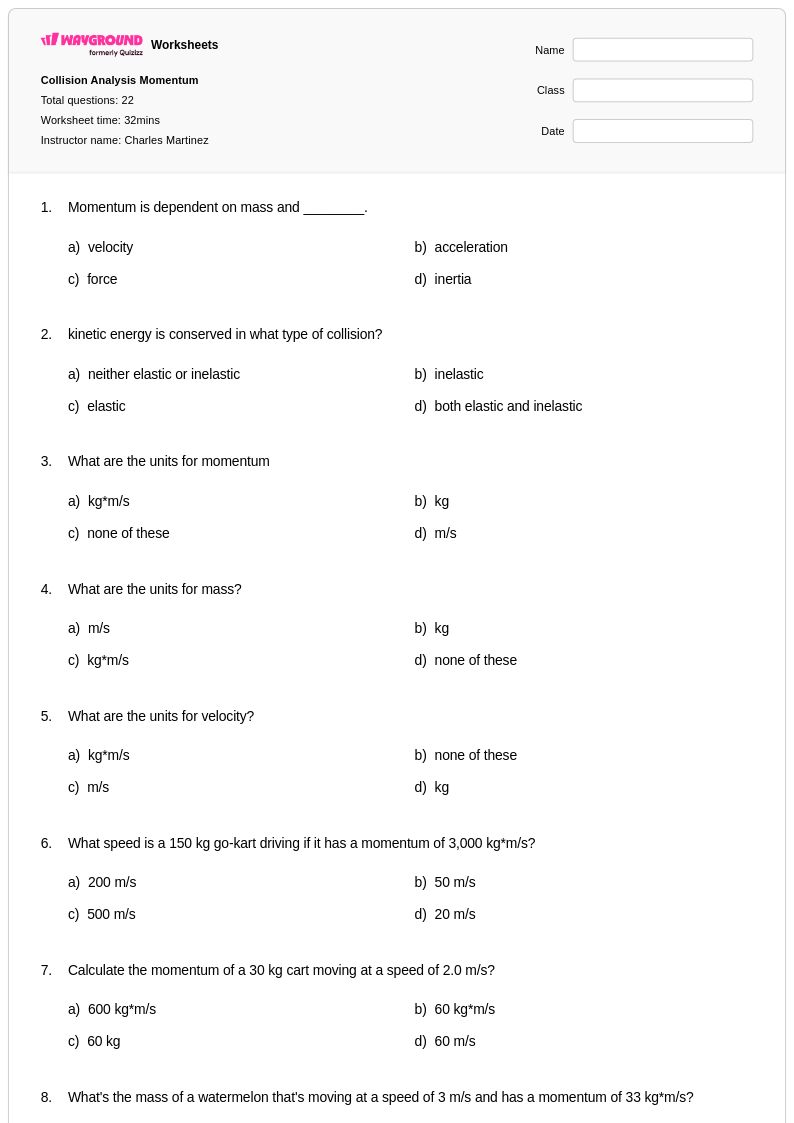
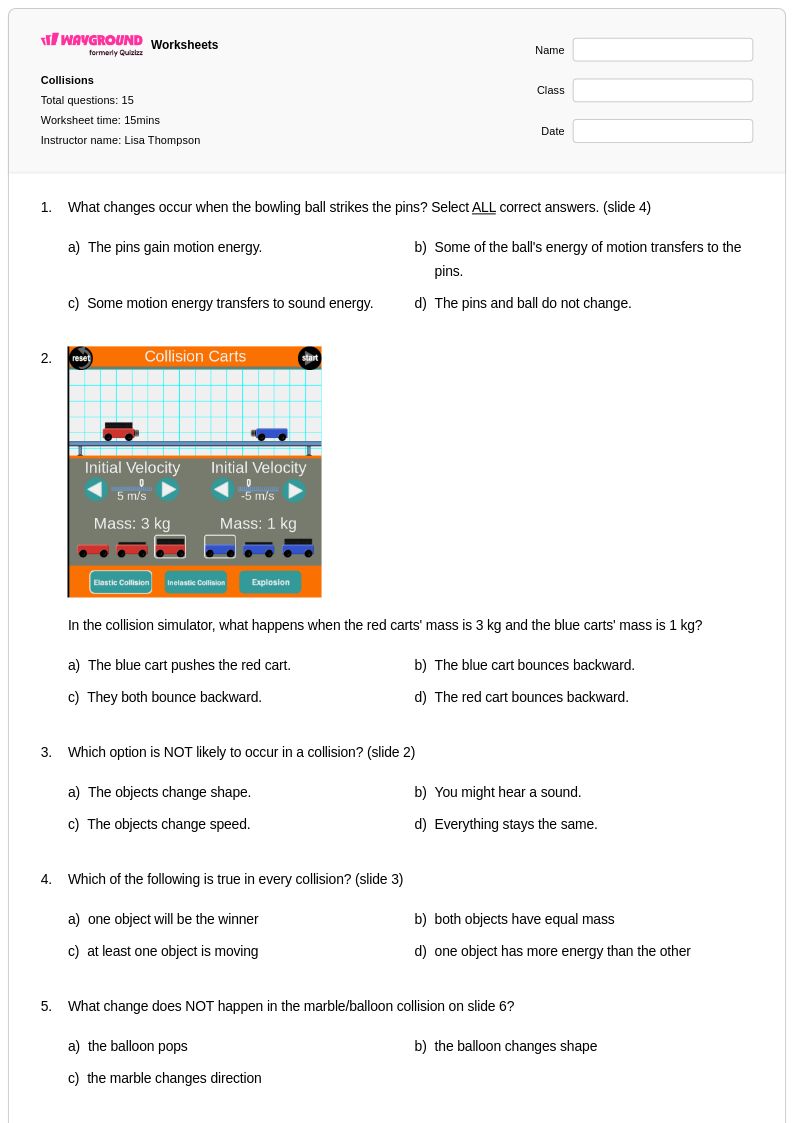
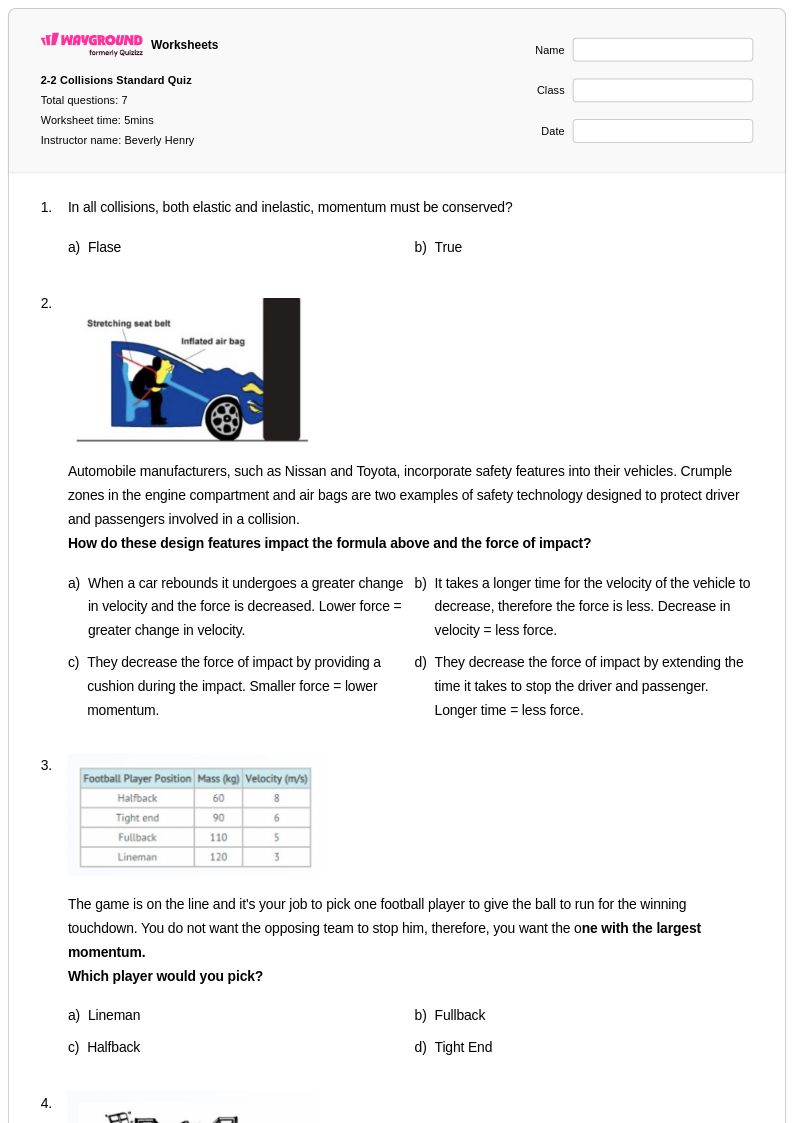
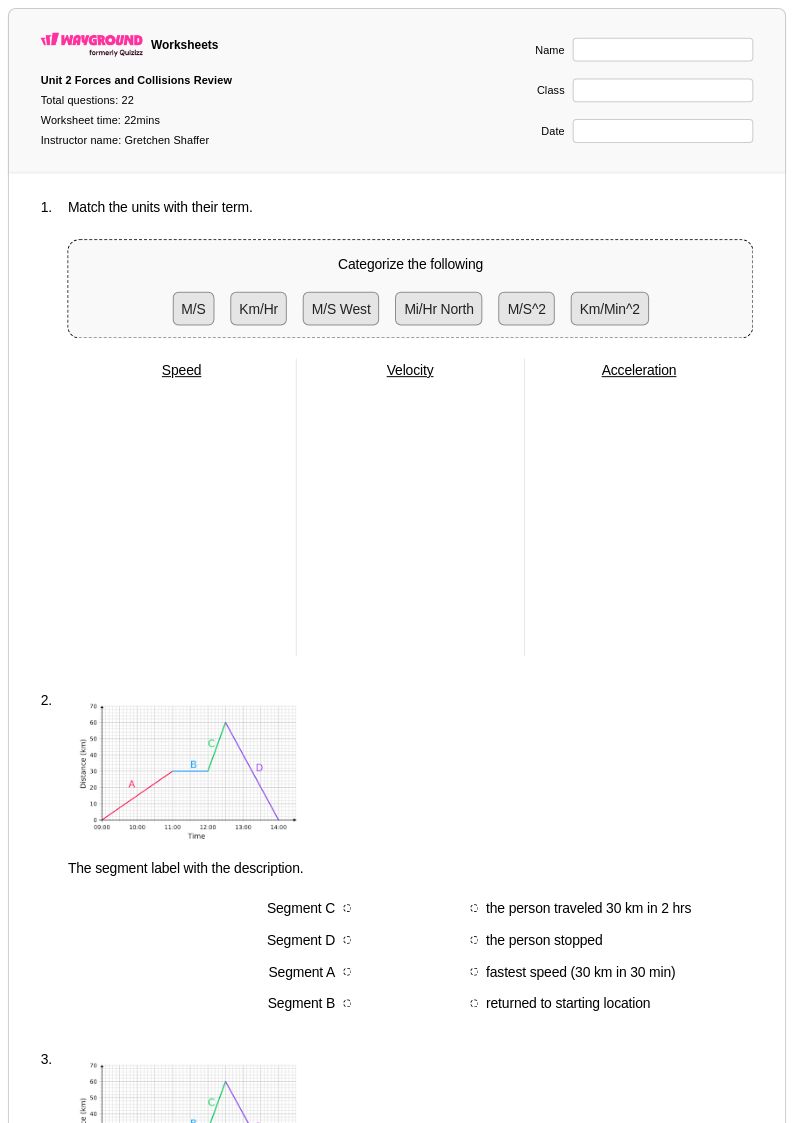
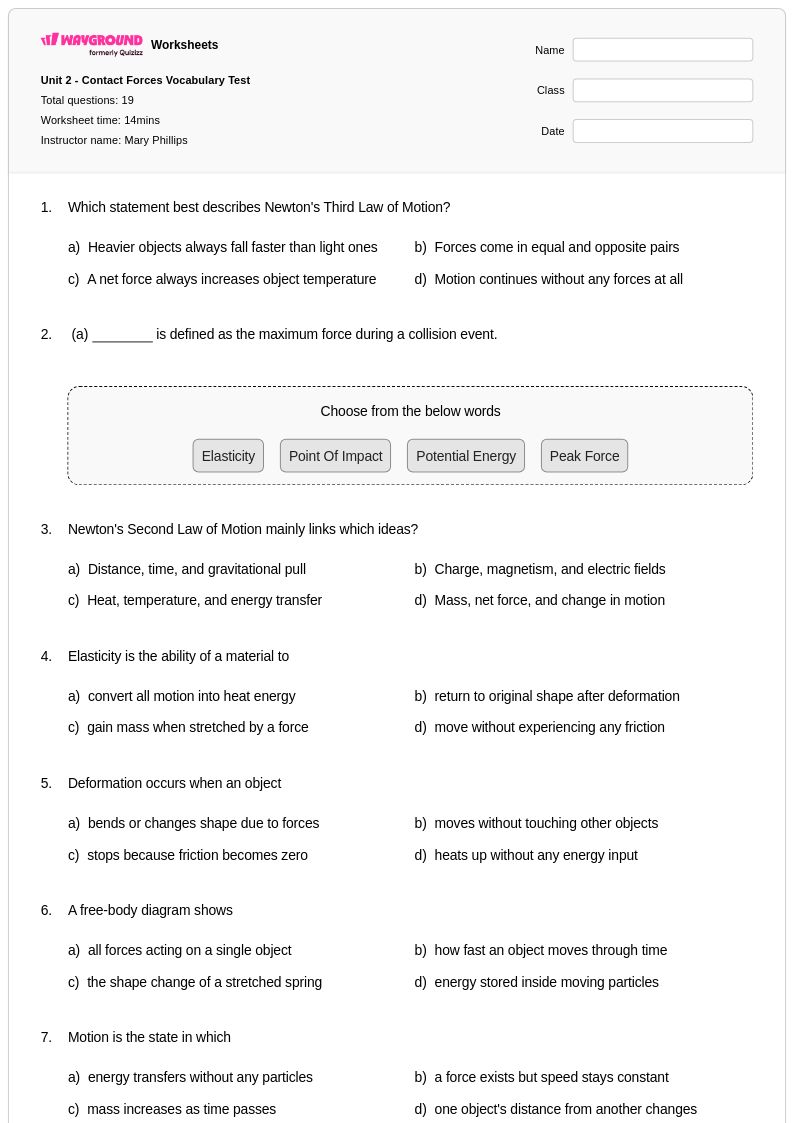
Class 12 collision analysis worksheets from Wayground provide comprehensive printables and practice problems with answer keys, helping students master momentum conservation, elastic and inelastic collisions, and kinetic energy calculations through free PDF resources.
Explore printable Collision Analysis worksheets for Class 12
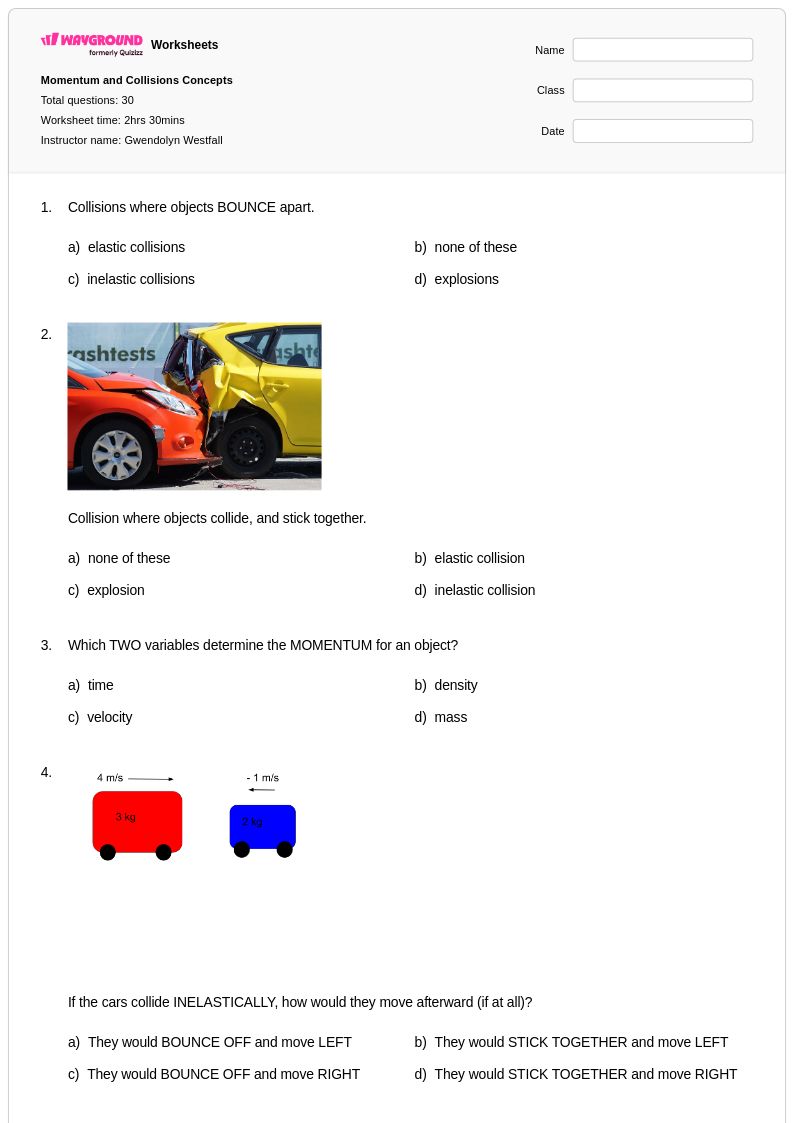
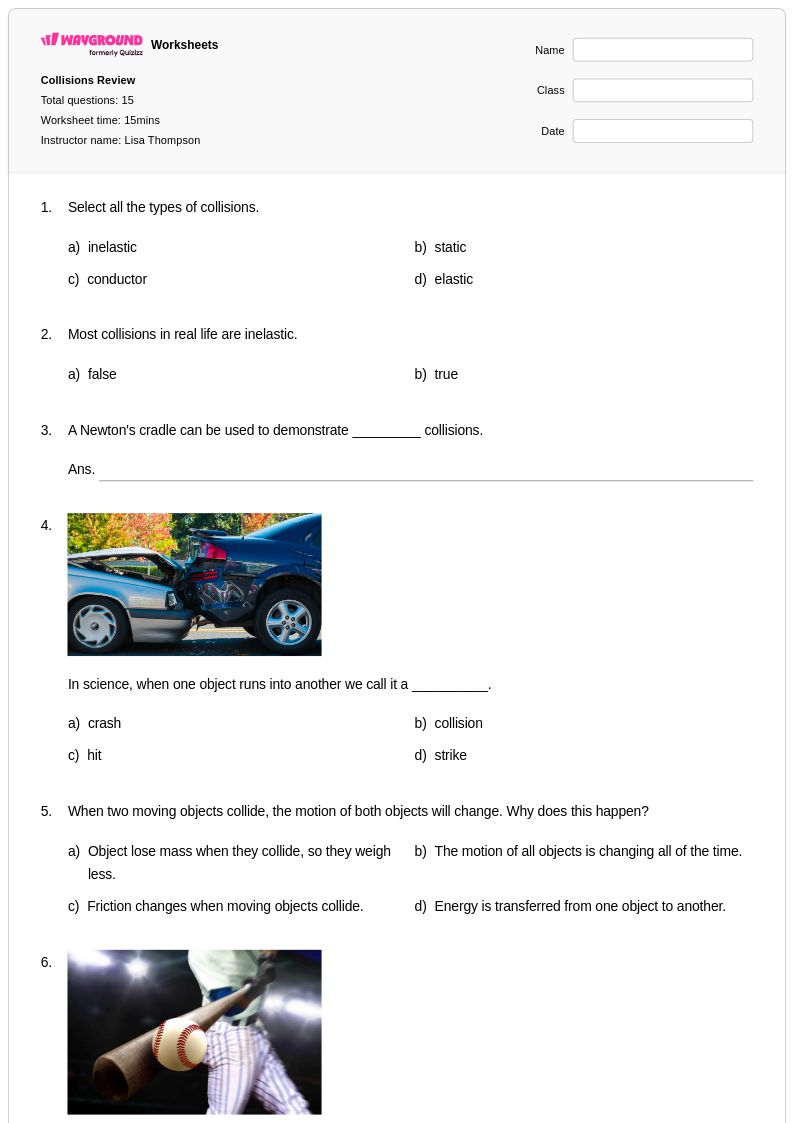
Class 12 collision analysis worksheets available through Wayground (formerly Quizizz) provide comprehensive practice opportunities for students mastering the complex physics principles governing momentum conservation, energy transfer, and impact dynamics. These expertly crafted resources strengthen critical analytical skills including calculating collision velocities, determining coefficient of restitution values, and solving multi-body interaction problems across elastic, inelastic, and perfectly inelastic collision scenarios. Students develop proficiency in applying conservation laws, analyzing vector components in two-dimensional collisions, and interpreting real-world applications from automotive safety to particle physics. Each worksheet includes detailed answer keys and step-by-step solution guides, with free printable pdf formats ensuring accessibility for independent study and homework assignments while reinforcing mathematical problem-solving techniques essential for advanced physics coursework.
Wayground (formerly Quizizz) empowers educators with millions of teacher-created collision analysis resources featuring robust search and filtering capabilities that align with physics curriculum standards and accommodate diverse learning needs. The platform's comprehensive worksheet collection supports effective lesson planning through differentiation tools that allow instructors to customize problem difficulty levels, modify numerical values, and adapt content for remediation or enrichment activities. Teachers can seamlessly integrate these materials into both digital classroom environments and traditional print-based instruction, with flexible pdf download options enabling immediate access to high-quality practice problems. The extensive variety of collision analysis worksheets facilitates targeted skill development, from fundamental momentum calculations to advanced multi-step scenarios, ensuring students receive appropriate challenge levels while building confidence in complex physics problem-solving methodologies.
FAQs
How do I teach collision analysis in a physics class?
Start by establishing momentum as a conserved quantity before introducing collision types. Teach elastic collisions first, where both momentum and kinetic energy are conserved, then contrast with inelastic collisions where kinetic energy is lost but momentum is still conserved. Using real-world scenarios like car crashes or billiard balls helps students connect abstract conservation laws to observable events. Building from one-dimensional to two-dimensional problems progressively reinforces both conceptual understanding and mathematical fluency.
What are the best practice problems for collision analysis?
Effective collision analysis practice should span three tiers: basic momentum calculations before and after impact, elastic versus inelastic collision comparisons, and multi-body systems in two dimensions. Problems involving coefficient of restitution calculations are particularly valuable for bridging conceptual and computational understanding. Varying the context across billiard balls, automotive crashes, and projectile impacts keeps problems meaningful and helps students generalize conservation laws across scenarios.
What mistakes do students commonly make when solving collision problems?
The most common error is assuming kinetic energy is conserved in all collisions, which only applies to perfectly elastic collisions. Students also frequently forget that momentum is a vector quantity, leading to sign errors in one-dimensional problems and component errors in two-dimensional problems. Another common misconception is conflating impulse with momentum, which causes errors when interpreting force-time relationships during impact. Explicitly contrasting elastic and inelastic cases in practice problems helps correct these patterns early.
How do I differentiate collision analysis instruction for students at different skill levels?
For students still building foundational skills, begin with single-object momentum calculations before introducing two-body interactions. Advanced learners can be challenged with two-dimensional collisions requiring vector decomposition and coefficient of restitution analysis. On Wayground, teachers can apply accommodations such as reduced answer choices to lower cognitive load for struggling students, and extended time settings for students who need additional processing time, all without disrupting the experience for the rest of the class.
How can I use Wayground's collision analysis worksheets in my classroom?
Wayground's collision analysis worksheets are available as printable PDFs for traditional classroom use and in digital formats for technology-integrated environments, including the option to host them as a quiz directly on Wayground. Each worksheet includes a complete answer key, making them practical for independent practice, homework, or in-class problem sets. The digital format supports flexible deployment whether students are working in-person, remotely, or in a blended setting.
How do I help students understand the difference between elastic and inelastic collisions?
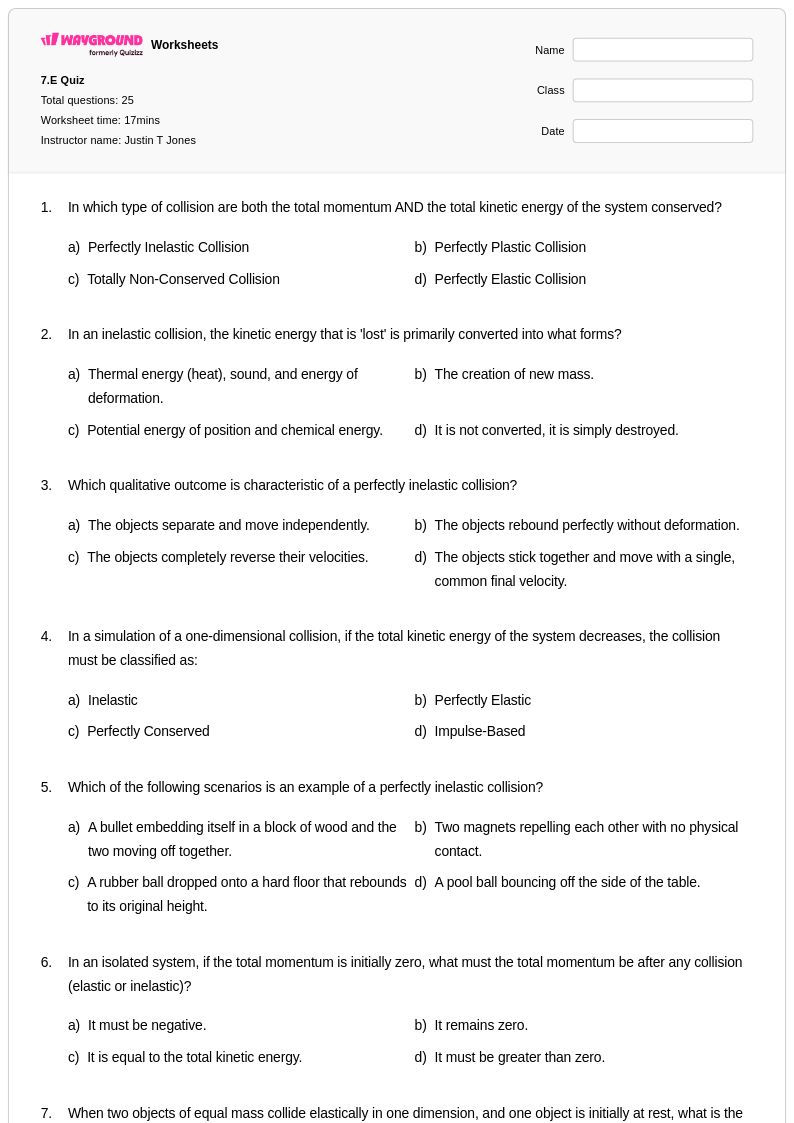
Elastic collisions conserve both momentum and kinetic energy, while inelastic collisions conserve only momentum, with kinetic energy converted to heat, sound, or deformation. A perfectly inelastic collision, where objects stick together after impact, represents the maximum loss of kinetic energy while still obeying momentum conservation. Having students calculate kinetic energy before and after both collision types side by side is one of the most effective ways to make this distinction concrete and testable.