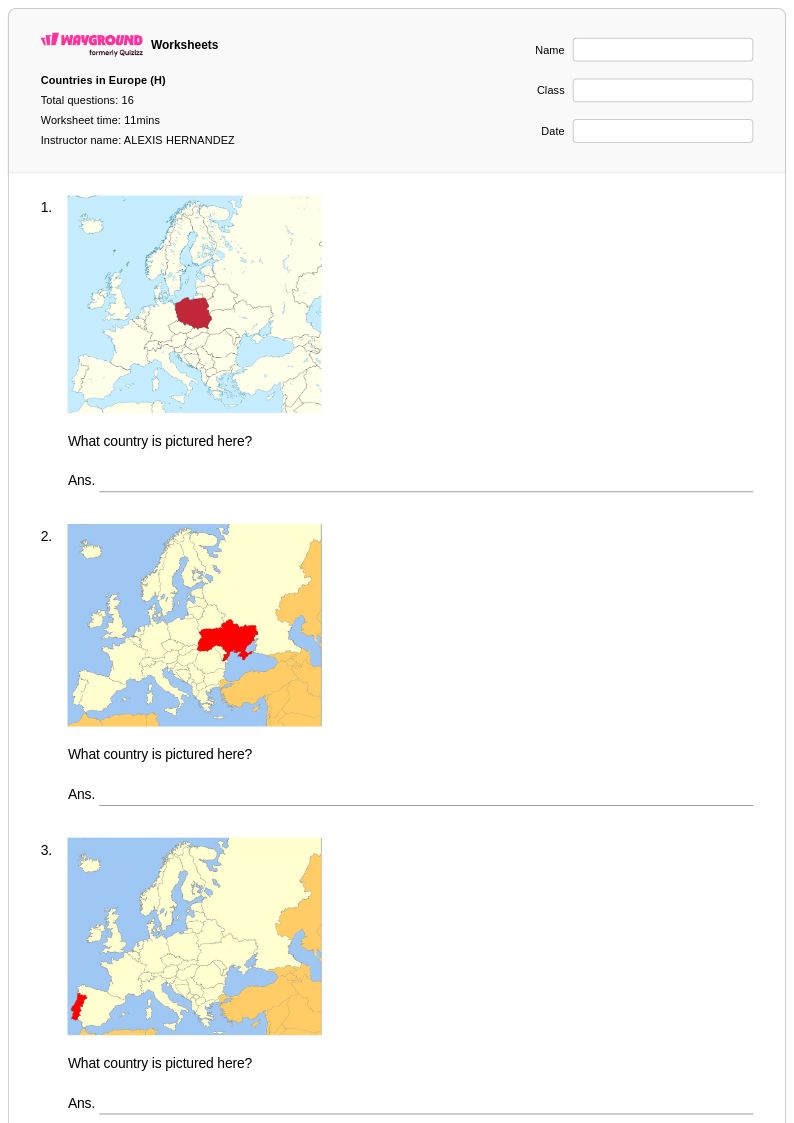
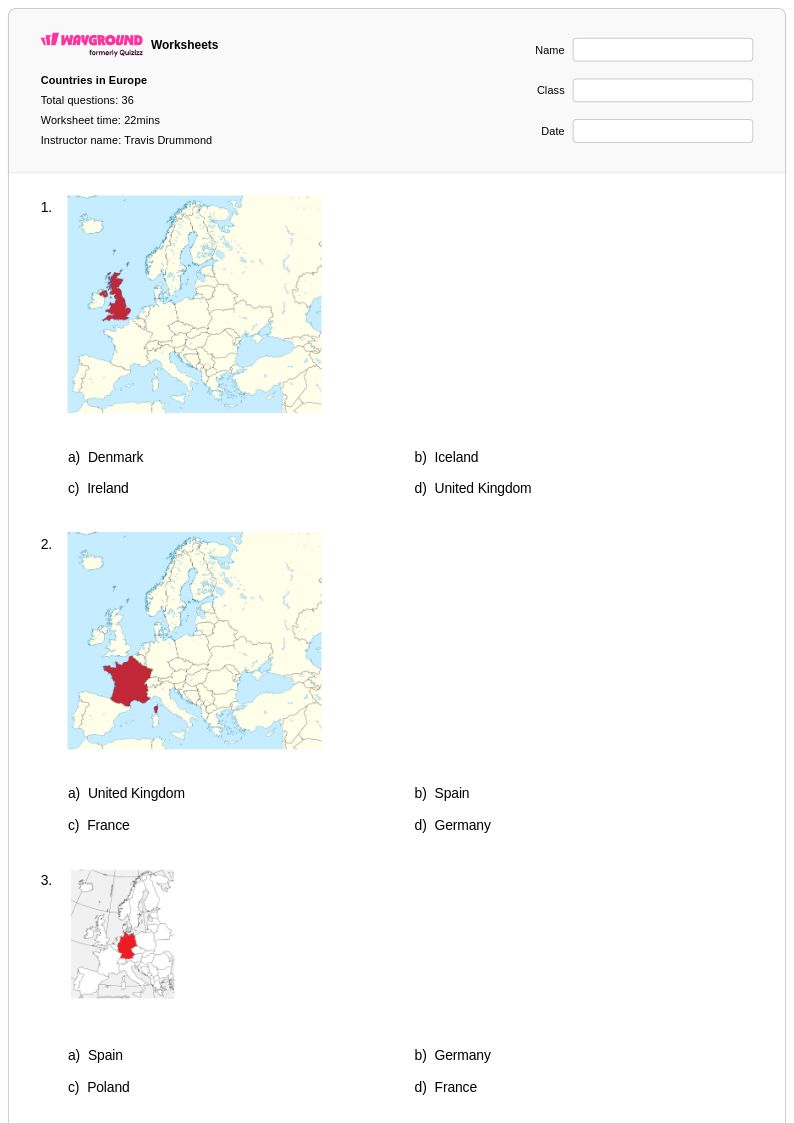
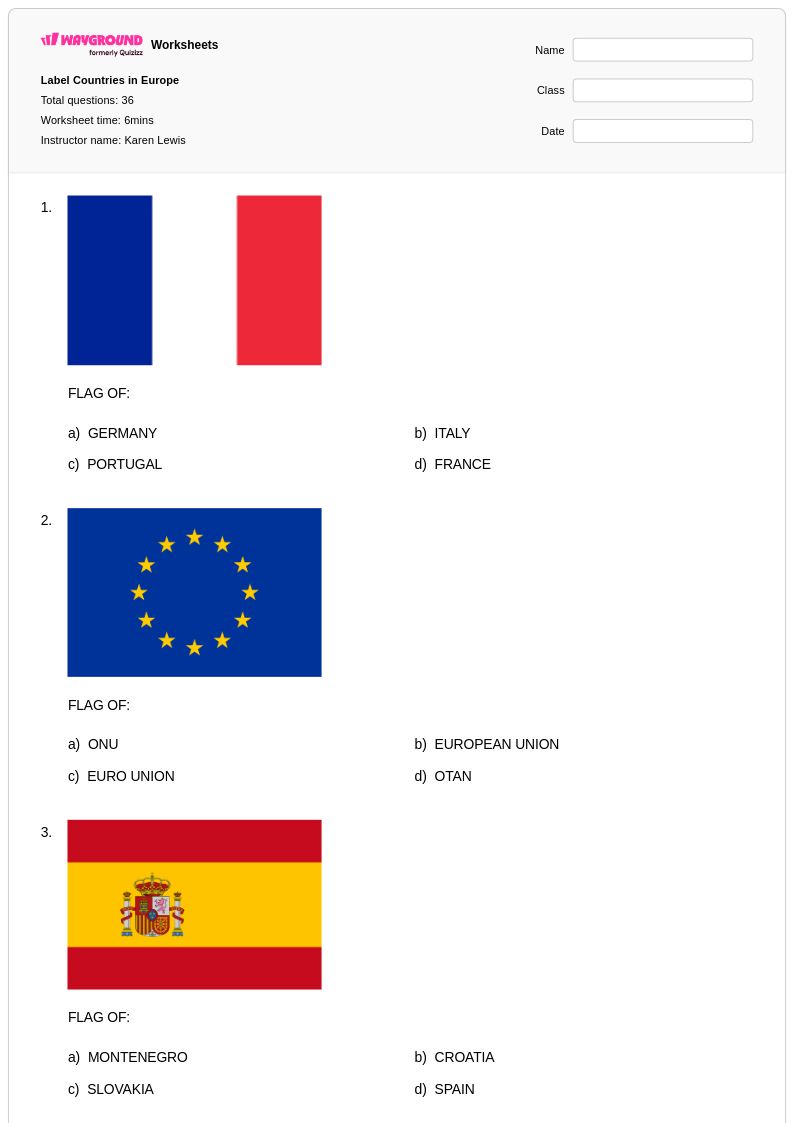
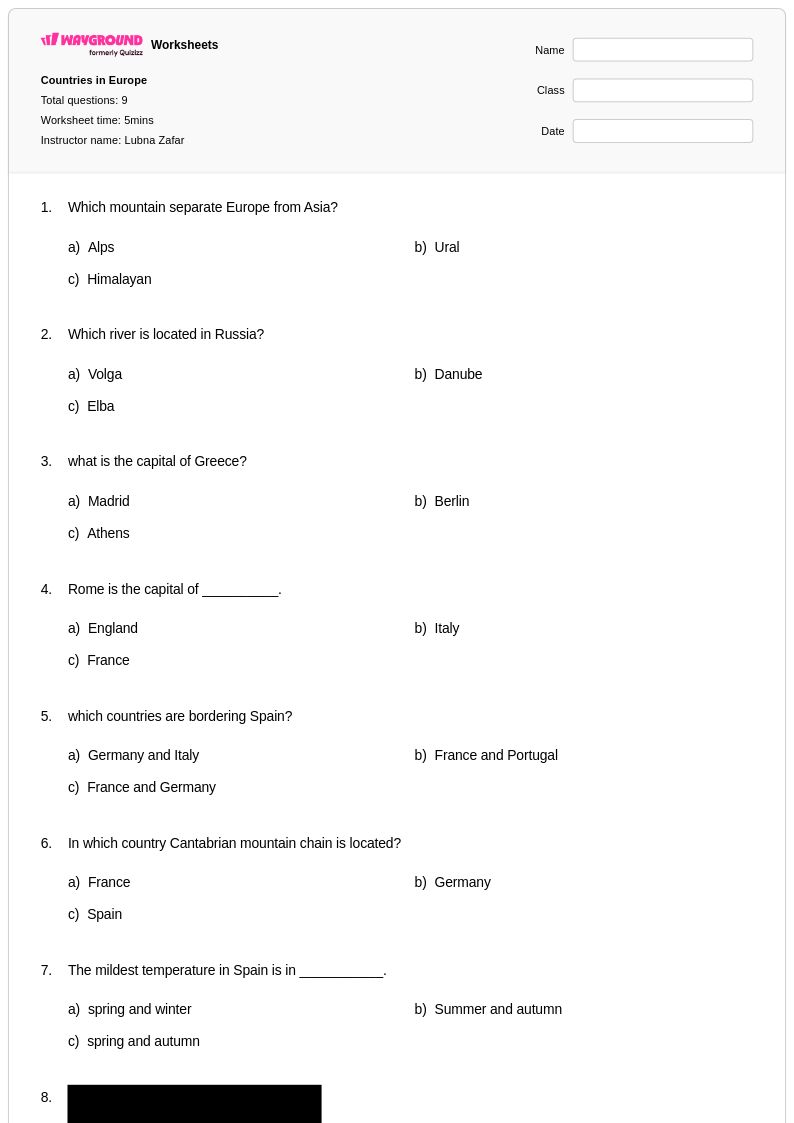
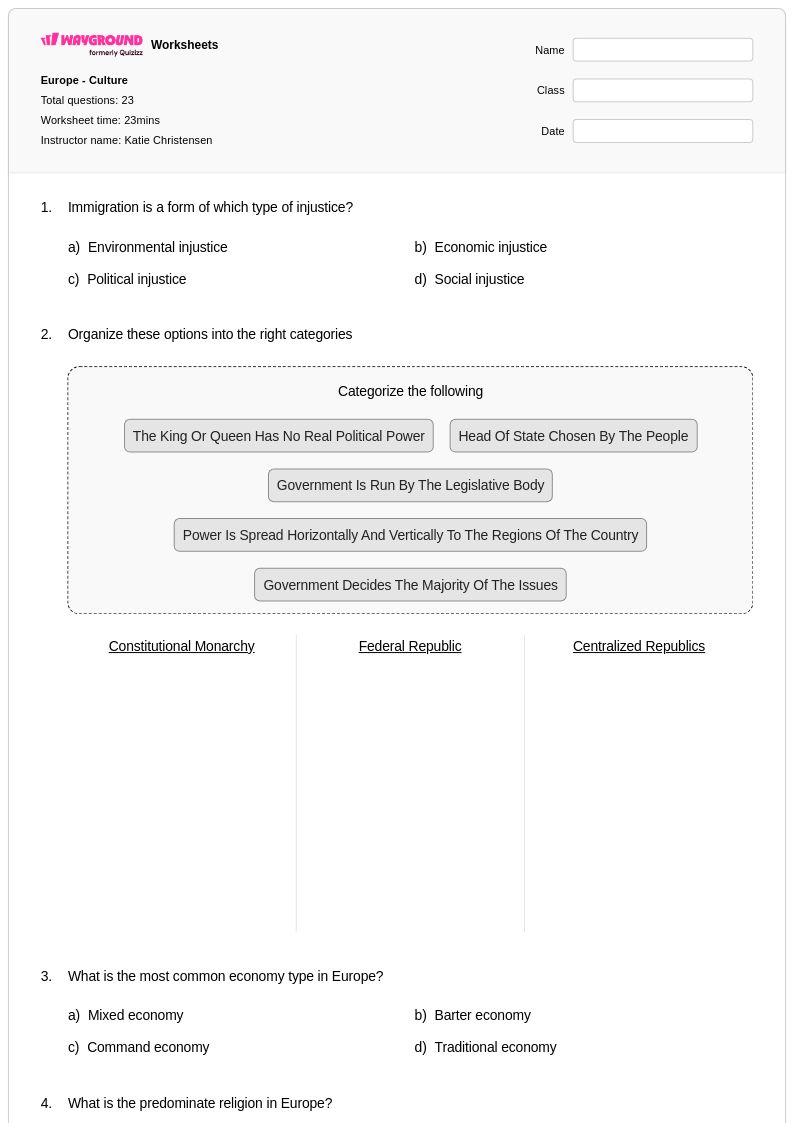
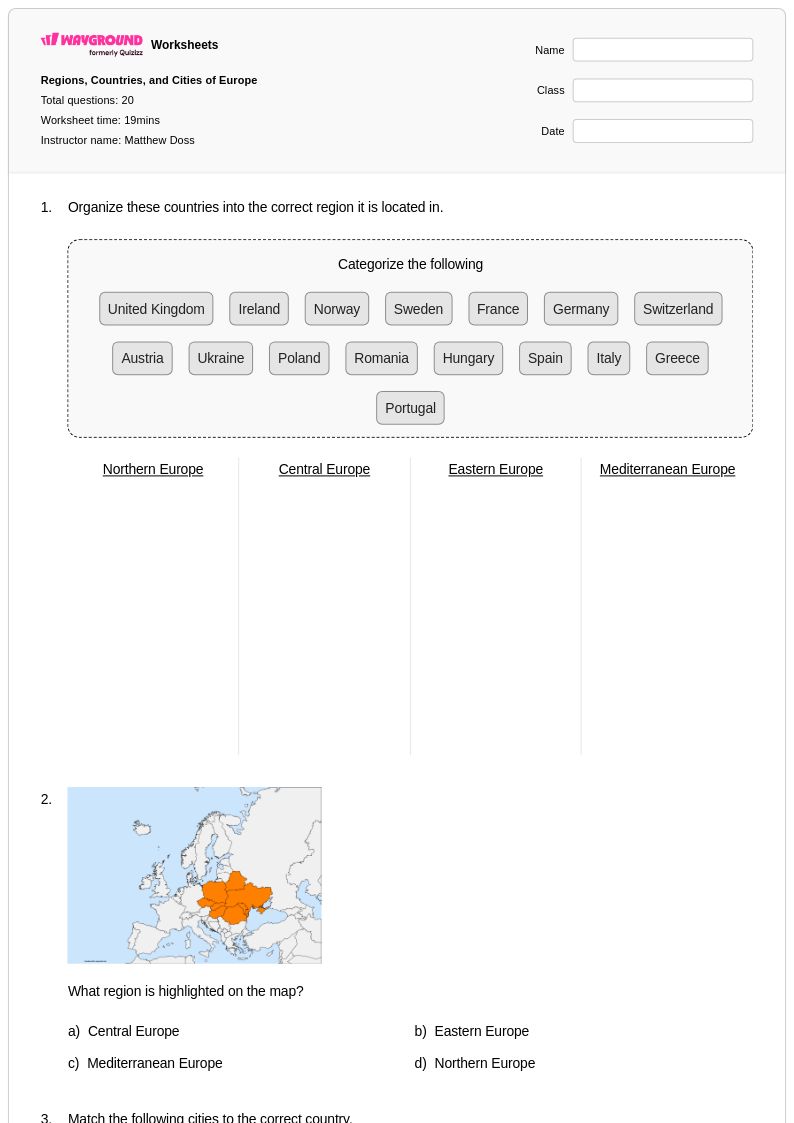
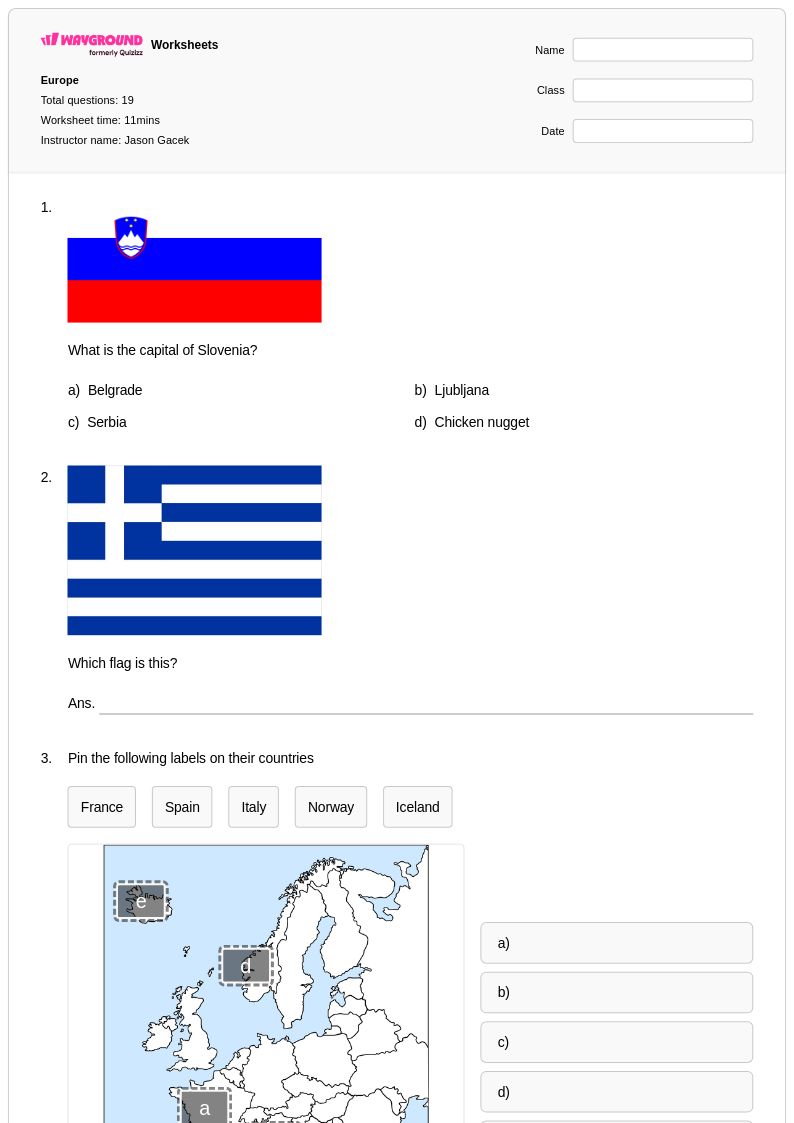
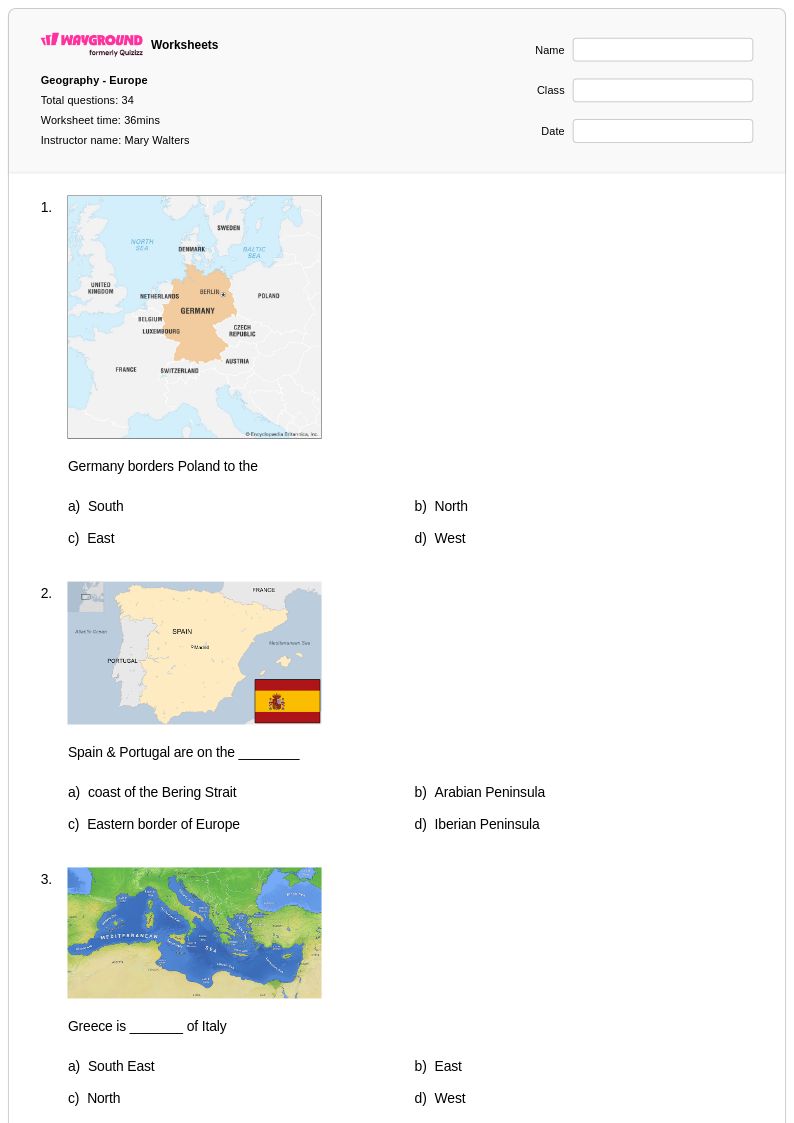
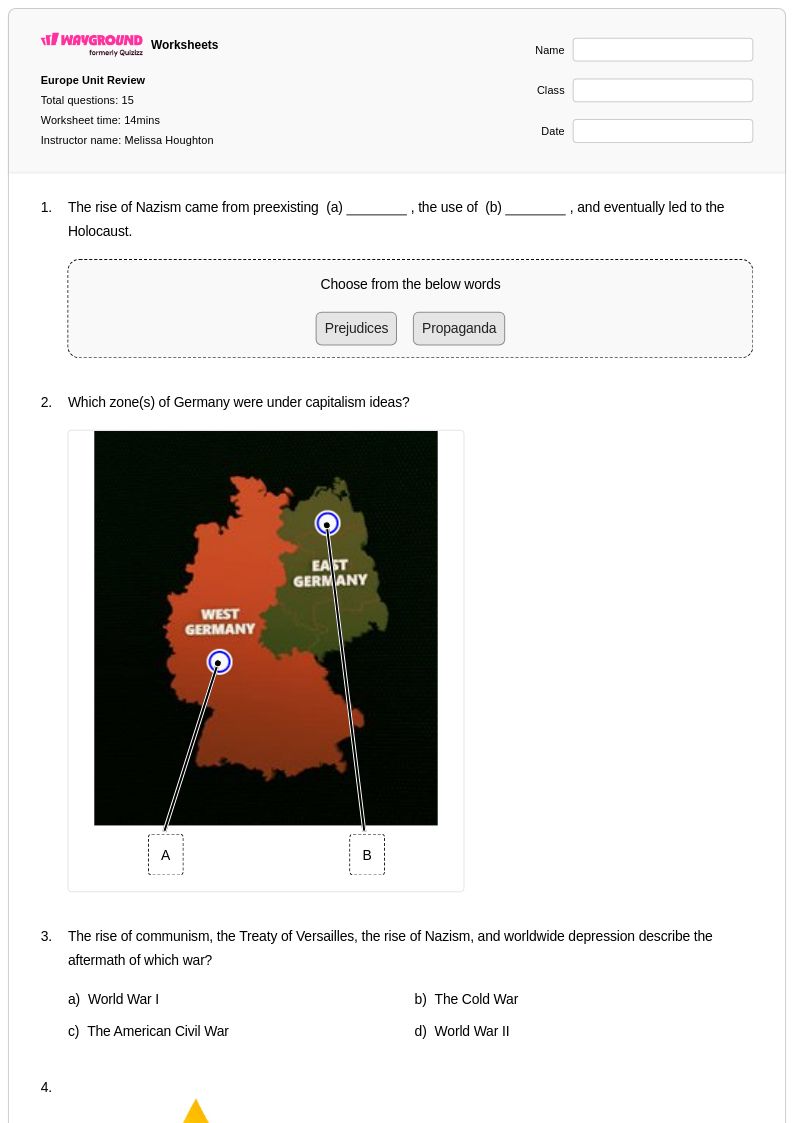
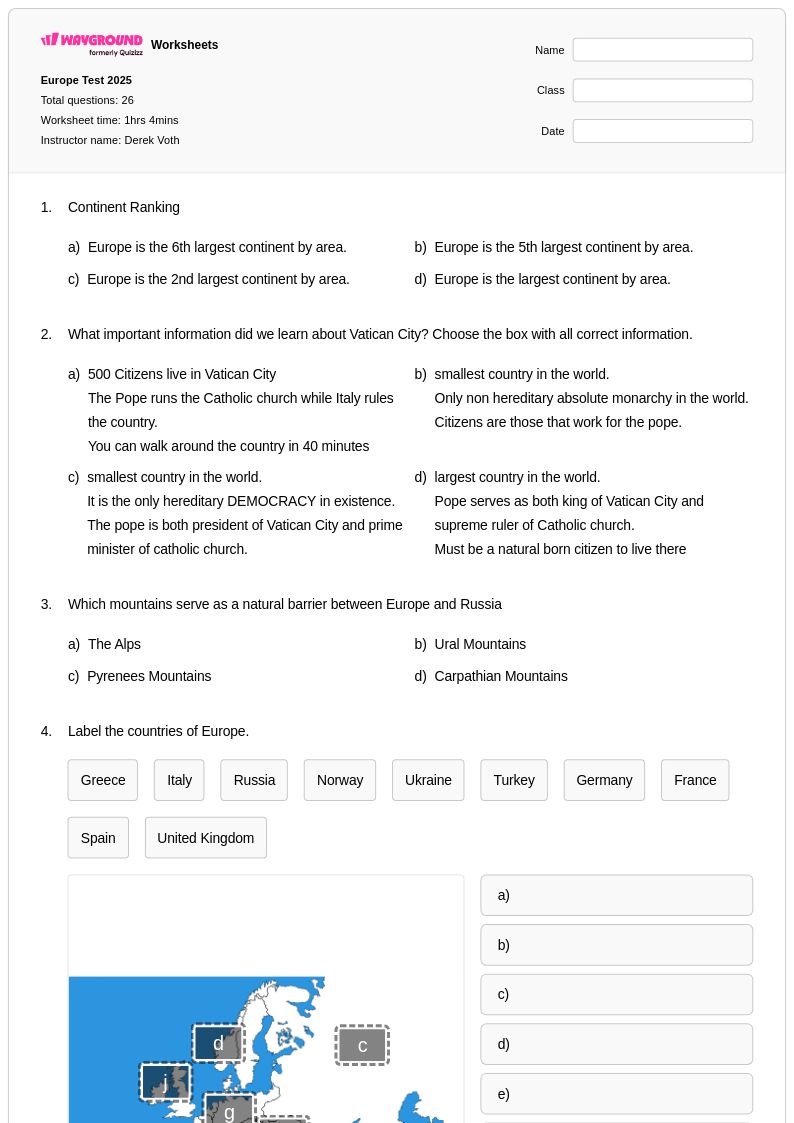
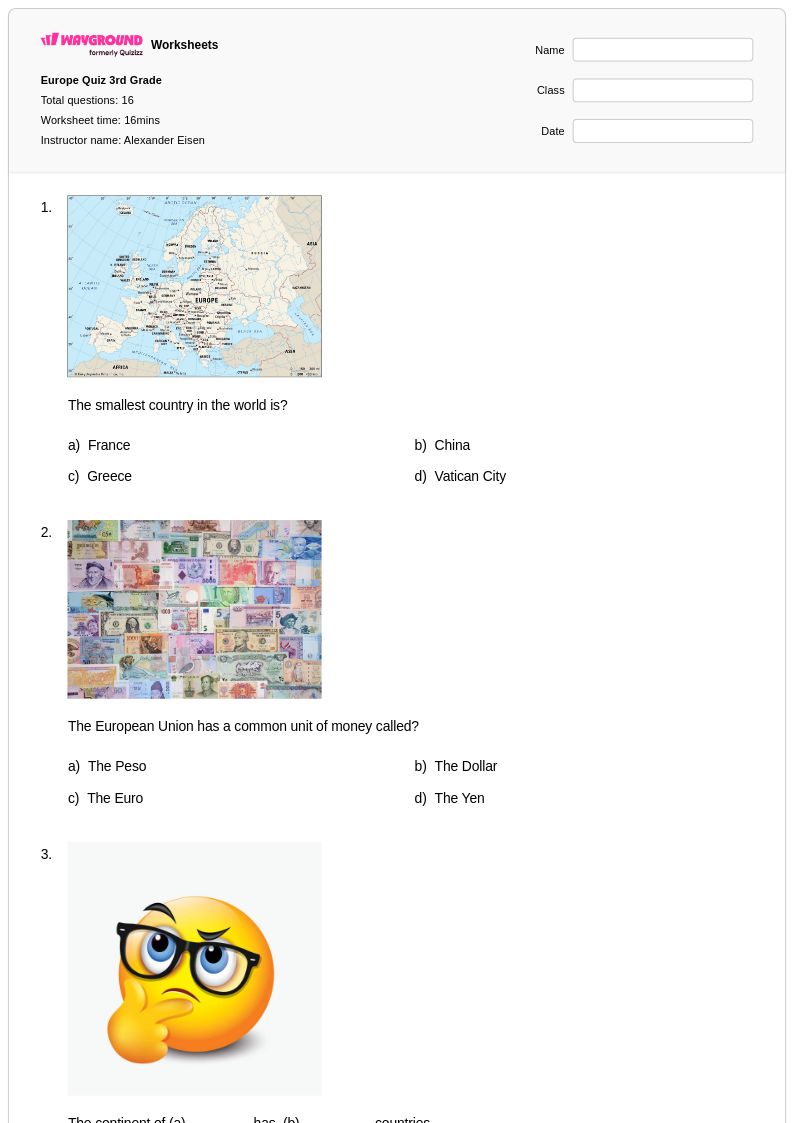
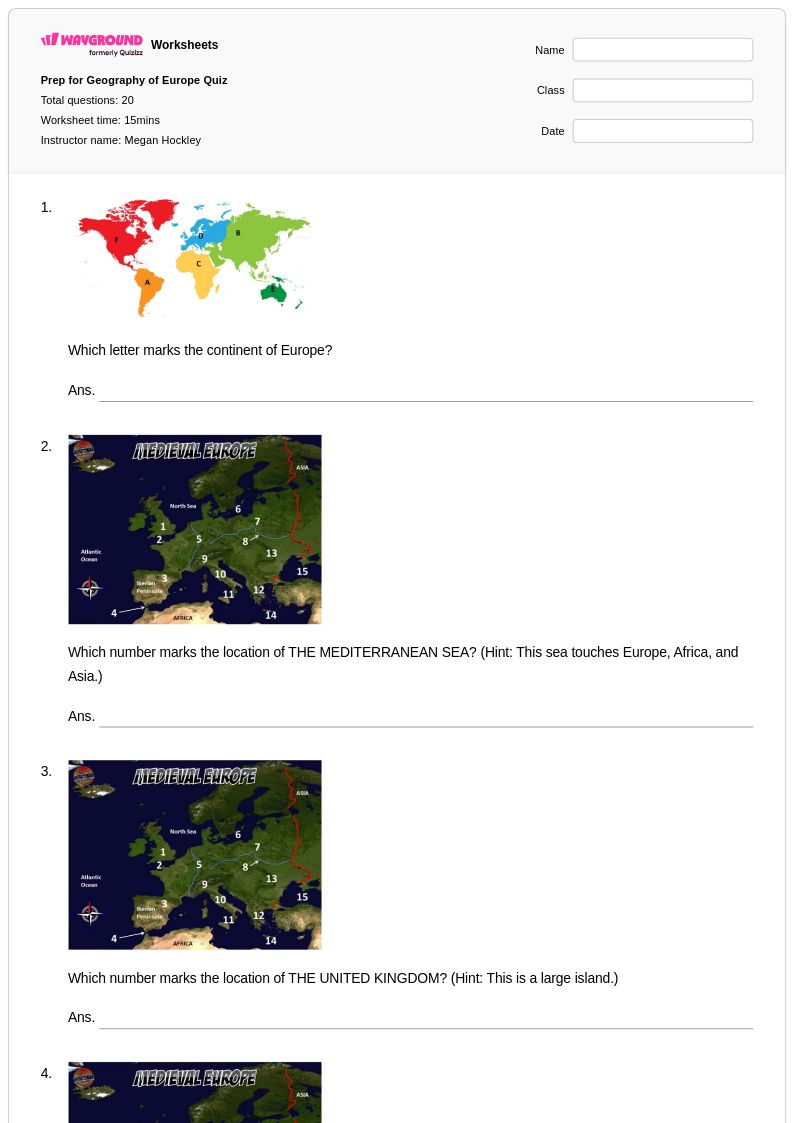
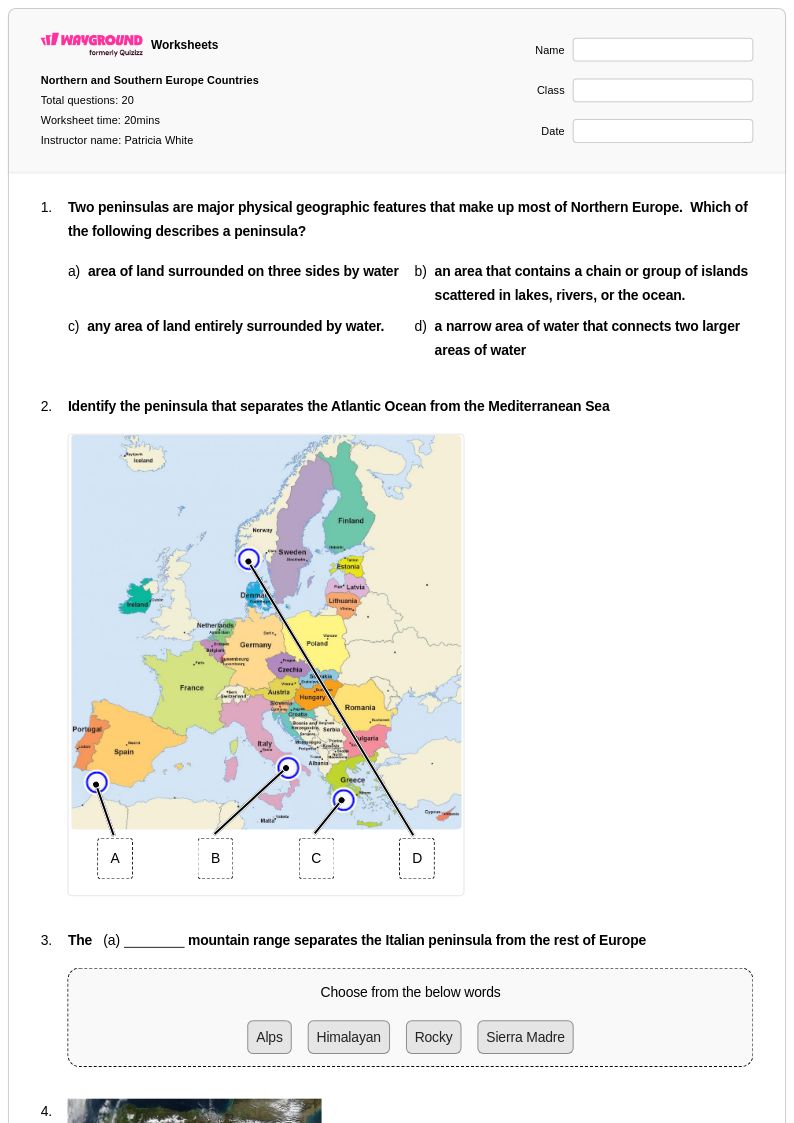
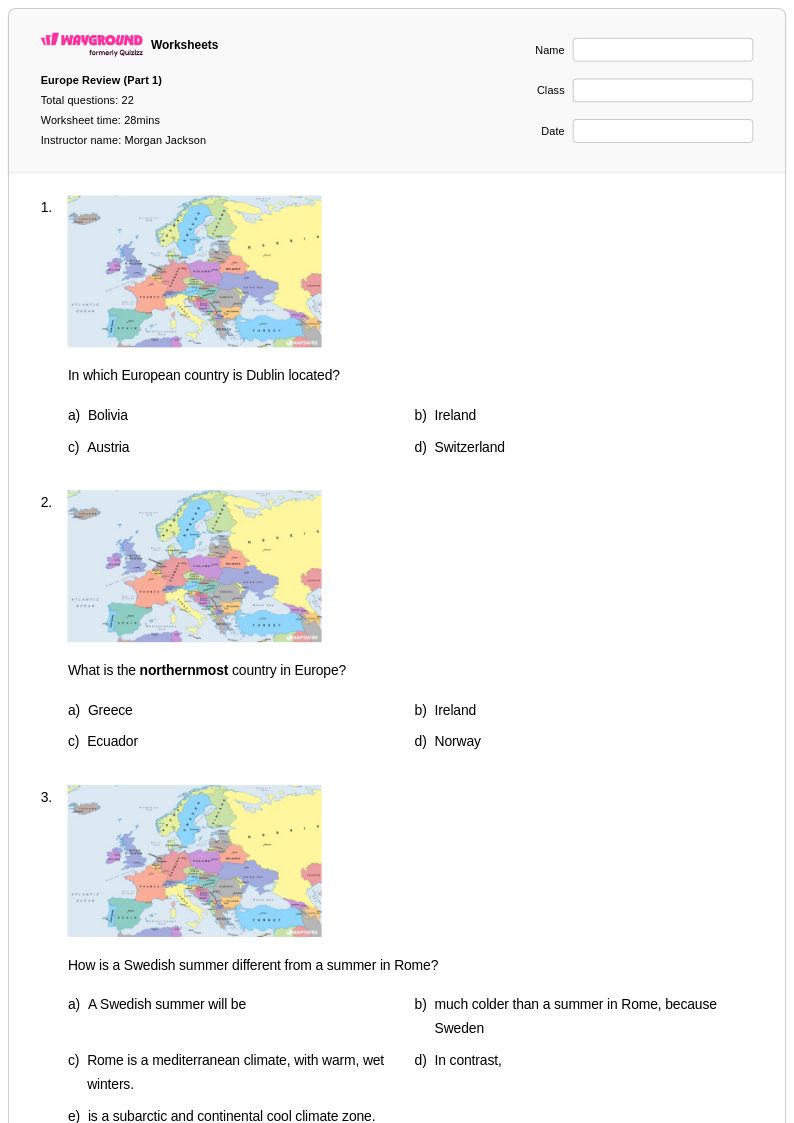
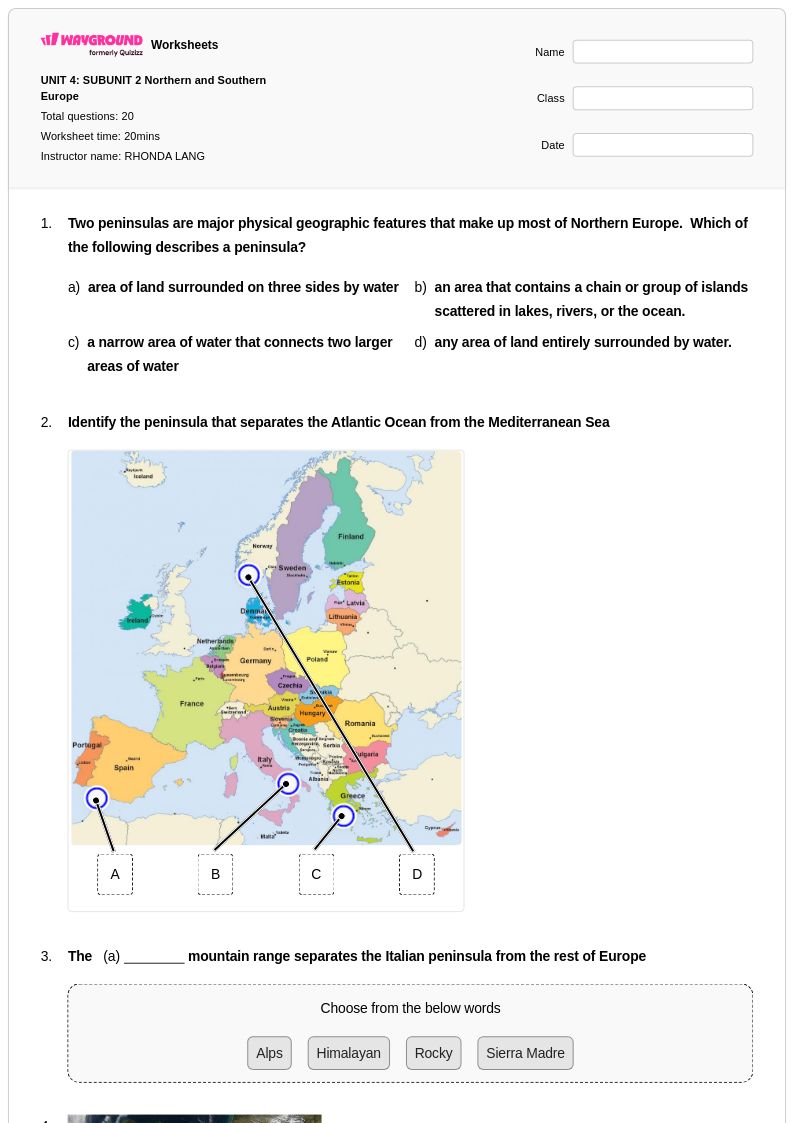
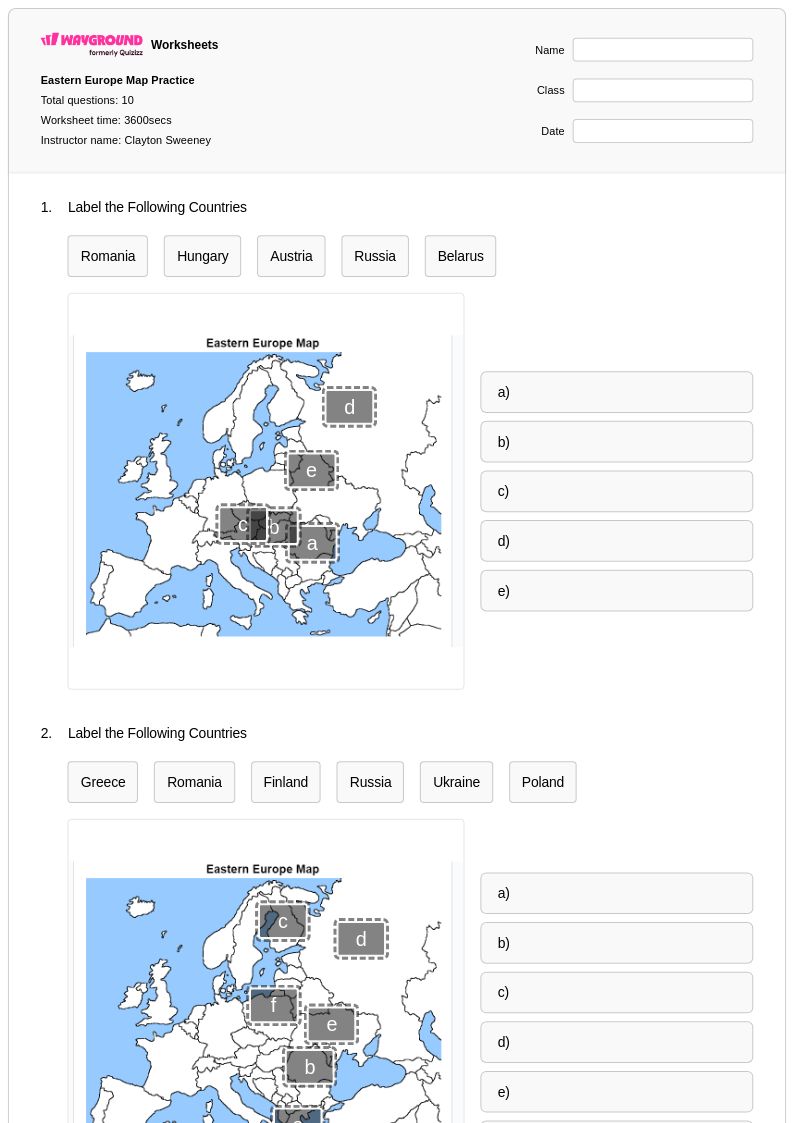
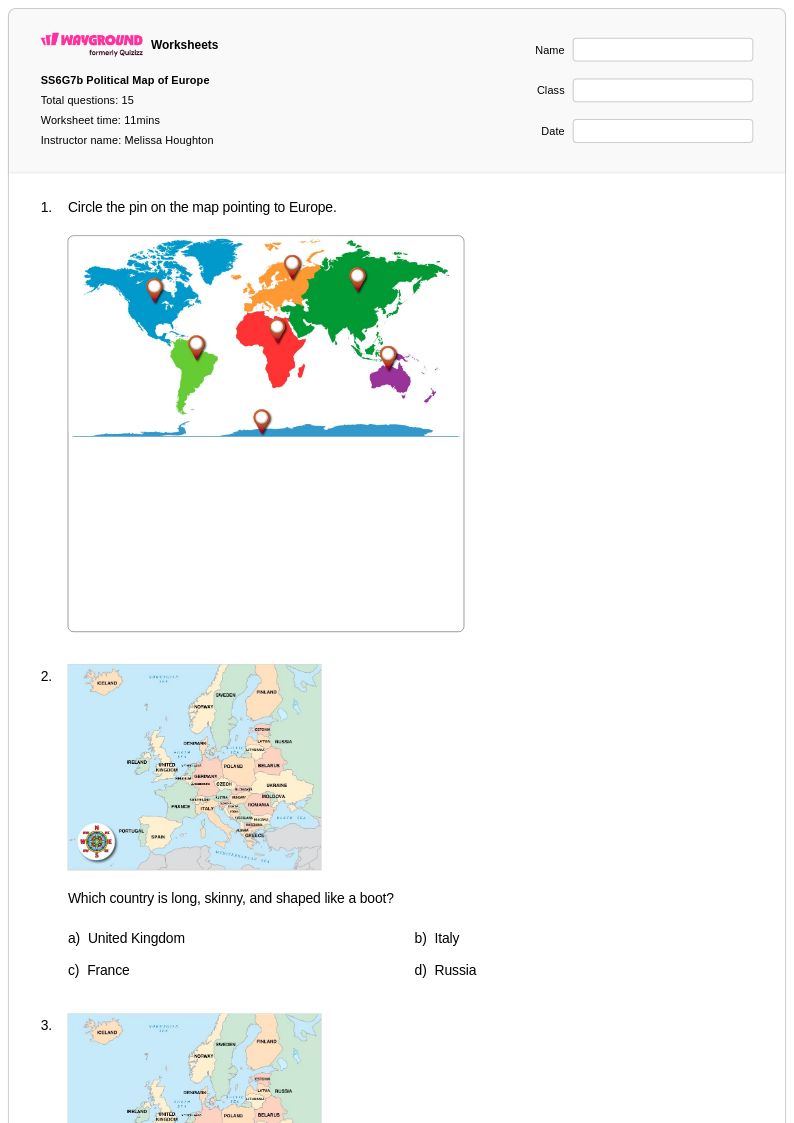
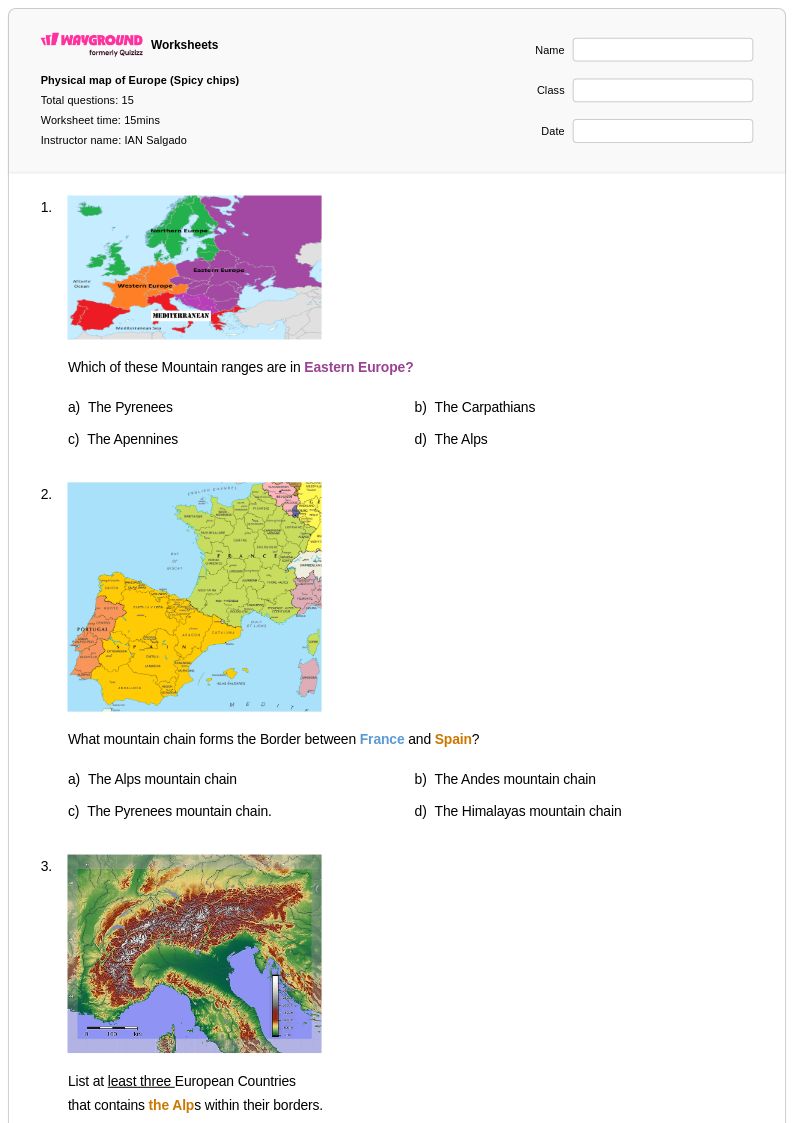
Explore Wayground's free printable worksheets and practice problems focusing on countries in Europe, complete with answer keys to help students master European geography through engaging PDF resources.
Countries in Europe worksheets available through Wayground (formerly Quizizz) provide comprehensive educational resources designed to strengthen students' geographical knowledge and spatial reasoning skills across multiple grade levels. These expertly crafted materials help learners identify European nations, understand their locations, capitals, borders, and distinctive characteristics while developing essential map-reading and geographical analysis abilities. The collection includes diverse practice problems ranging from basic country identification exercises to complex comparative studies of European regions, with each worksheet featuring detailed answer keys to support both independent learning and classroom instruction. Teachers can access these free printables in convenient PDF format, making it easy to distribute materials for homework assignments, quiz preparation, or in-class activities that reinforce fundamental geographical concepts.
Wayground's extensive platform empowers educators with millions of teacher-created resources specifically focused on European geography, supported by robust search and filtering capabilities that allow instructors to locate precisely the right materials for their curriculum needs. The platform's standards alignment features ensure that worksheets meet educational requirements while offering differentiation tools that help teachers customize content for diverse learning levels and abilities. These flexible resources are available in both printable and digital formats, including downloadable PDFs, enabling seamless integration into various teaching environments and learning management systems. Whether used for lesson planning, targeted remediation, enrichment activities, or regular skill practice, these comprehensive worksheet collections provide teachers with reliable tools to enhance student understanding of European countries while building critical geographical literacy that serves as a foundation for broader social studies learning.
FAQs
How do I teach students to identify countries in Europe?
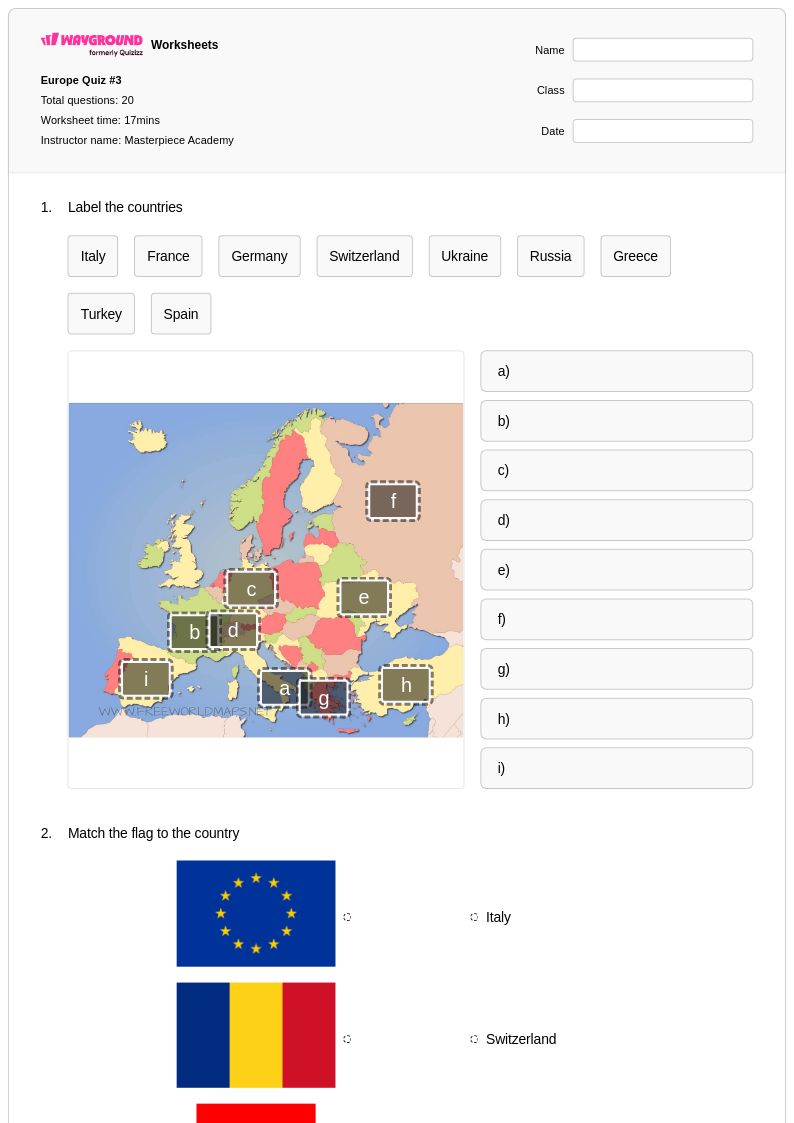
Start by introducing Europe's major regions — Western, Eastern, Northern, Southern, and Central — and anchor country identification to landmarks, borders, and capitals rather than isolated memorization. Using labeled and blank map exercises progressively builds spatial awareness, so students first locate countries with visual support before working independently. Pairing map work with brief country profiles that highlight capitals, borders, and distinctive characteristics gives students multiple memory hooks for each nation.
What exercises help students practice locating countries in Europe?
Blank map fill-in exercises are among the most effective tools for practicing European country identification because they require active recall rather than passive recognition. Comparative exercises that ask students to identify shared borders, group countries by region, or match capitals to nations deepen spatial reasoning beyond simple labeling. Repeated low-stakes practice through varied formats — such as map quizzes, country-matching tasks, and region-sorting activities — reinforces retention over time.
What mistakes do students commonly make when learning European countries?
Students frequently confuse geographically close countries with similar shapes, such as Austria and Switzerland, or conflate the Baltic states — Estonia, Latvia, and Lithuania. Another common error is misidentifying capitals, particularly for smaller or less frequently studied nations like Slovenia or Moldova. Students also tend to underestimate the number of countries in Europe and may group regions incorrectly, placing Eastern European nations into Central Europe or vice versa.
How can I differentiate European geography instruction for mixed-ability learners?
For students who need additional support, begin with a limited set of larger or more recognizable countries before expanding to the full continent, and provide partially labeled maps as scaffolding. For advanced learners, extend tasks to include comparative analysis of regions, border changes over time, or connections between geography and culture. On Wayground, teachers can apply accommodations such as reduced answer choices or read-aloud support to individual students, allowing differentiated practice within the same assignment without disrupting the rest of the class.
How do I use Countries in Europe worksheets from Wayground in my classroom?
Wayground's Countries in Europe worksheets are available as printable PDFs for traditional classroom use and in digital formats for technology-integrated environments, giving teachers flexibility for homework, in-class review, or quiz preparation. Digital worksheets can also be hosted as a quiz directly on Wayground, enabling real-time tracking of student responses. Each worksheet includes a complete answer key, which supports both self-paced independent learning and efficient teacher-led correction.
How do I help students remember European capitals alongside country locations?
Teaching capitals in context — paired with the country's location on a map — is more effective than memorizing them as a separate list. Associative strategies, such as connecting a capital's name to a memorable word or linking it to a geographic feature nearby, help students retain information longer. Regular mixed-format practice that alternates between identifying countries and their capitals reinforces both skills simultaneously and prevents students from learning them as disconnected facts.