Free Printable Countries Involved in World War 2 worksheets
Explore Wayground's free printable worksheets and practice problems focusing on countries involved in World War 2, helping students learn about major Allied and Axis powers through engaging activities with answer keys.
Explore printable Countries Involved in World War 2 worksheets
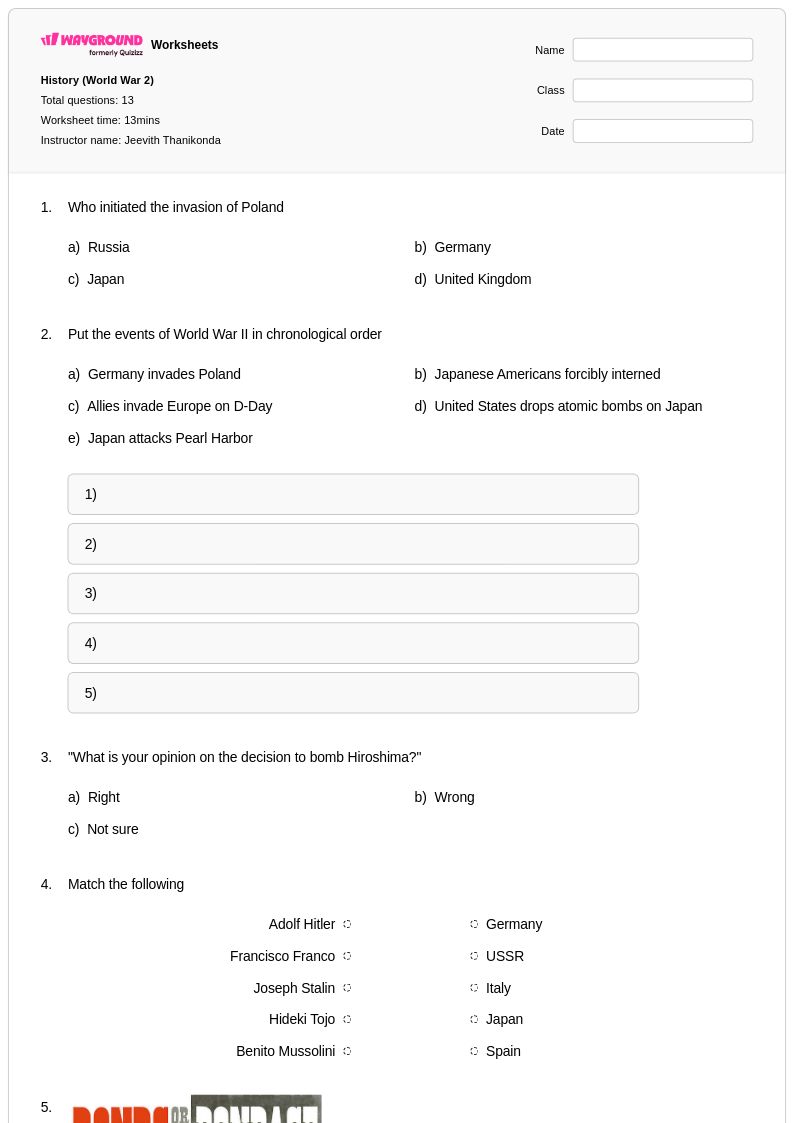
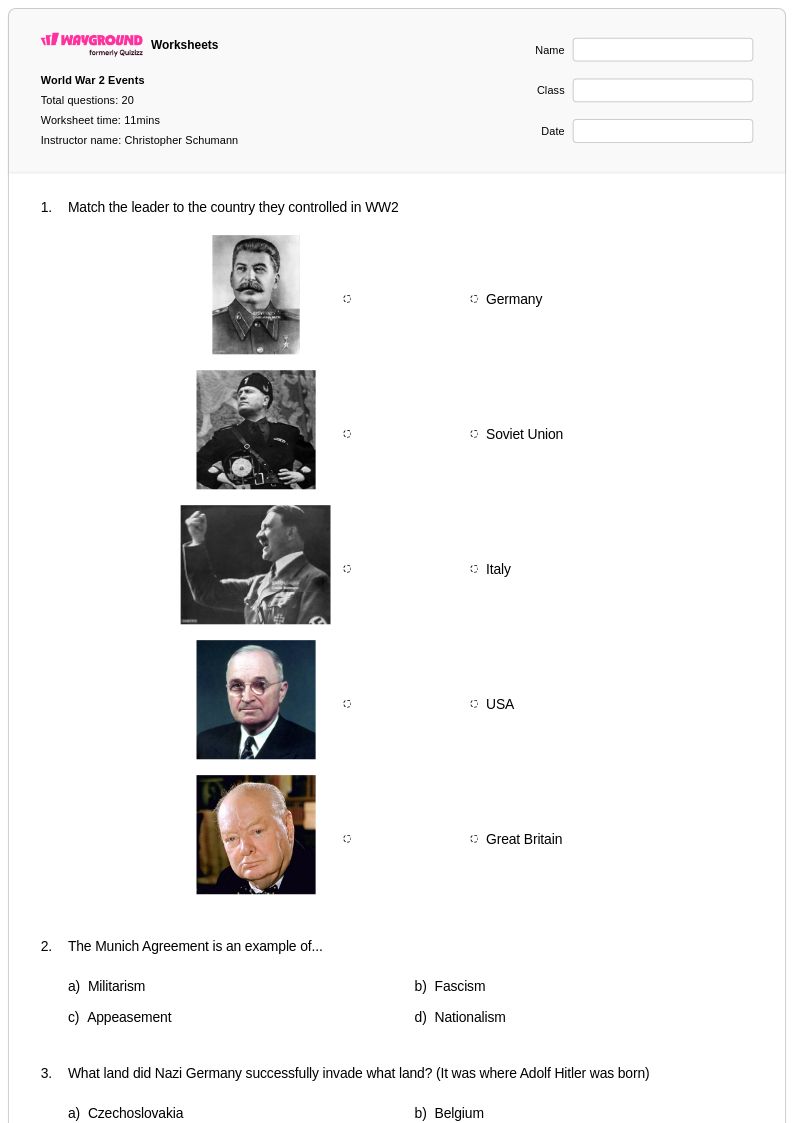
Countries Involved in World War 2 worksheets available through Wayground provide comprehensive coverage of the major Allied and Axis powers that shaped this pivotal global conflict. These educational resources help students identify and analyze the roles of key nations including the United States, Soviet Union, Great Britain, Germany, Japan, and Italy, while exploring how geographical, political, and economic factors influenced each country's participation in the war. The worksheets strengthen critical thinking skills by encouraging students to examine primary sources, compare military strategies, and evaluate the impact of alliances on wartime outcomes. Each resource includes detailed answer keys and practice problems that reinforce learning, with free printables available in convenient pdf format to support both classroom instruction and independent study.
Wayground's extensive collection of World War 2 worksheet resources supports educators through millions of teacher-created materials that can be easily accessed using robust search and filtering capabilities. Teachers can locate standards-aligned content that matches their specific curriculum requirements while utilizing differentiation tools to meet diverse student needs across all ability levels. The platform's flexible customization options allow instructors to modify existing worksheets or create targeted assignments for remediation and enrichment activities. Available in both printable and digital formats including downloadable pdfs, these resources streamline lesson planning while providing multiple opportunities for skill practice that deepens students' understanding of the complex international dynamics that defined World War 2.
FAQs
How do I teach students about the countries involved in World War 2?
Start by establishing the two main alliances — the Allied powers (including the United States, Soviet Union, and Great Britain) and the Axis powers (Germany, Japan, and Italy) — before examining why each nation entered the conflict. Help students connect geographical, political, and economic factors to each country's decision to join the war, using primary sources such as political speeches, treaties, and propaganda posters to ground the analysis in evidence. Comparing the motivations and military strategies of key nations gives students a framework for understanding how alliances shaped wartime outcomes.
What exercises help students practice identifying and understanding the Allied and Axis powers?
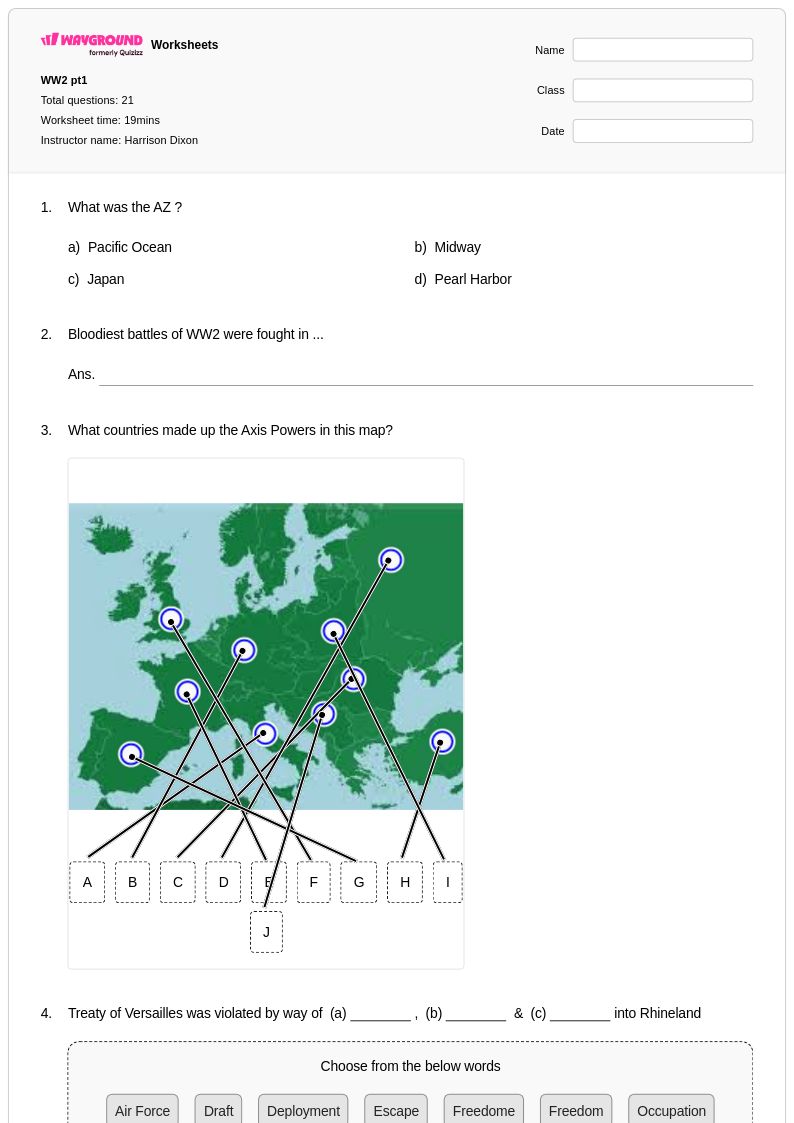
Map-based activities that ask students to color-code Allied and Axis nations and annotate key theaters of war are highly effective for building geographic literacy alongside content knowledge. Matching and sorting exercises that pair countries with their leaders, motivations, or major military contributions reinforce factual recall, while structured comparison charts push students toward deeper analysis of how different nations' roles evolved over the course of the war. Short constructed-response prompts asking students to evaluate why a specific country's participation was strategically significant can further develop critical thinking.
What misconceptions do students commonly have about which countries were involved in World War 2?
A frequent misconception is that World War 2 was primarily a conflict between the United States and Germany, which underrepresents the Soviet Union's enormous military role on the Eastern Front and overlooks the Pacific Theater entirely. Students also commonly conflate Italy's early Axis alignment with its later switch to the Allied side in 1943, which can be clarified by examining how political and military pressures drove that change. Another common error is assuming all nations had a clear ideological reason for joining, when in reality economic pressure, colonial ties, and geographic vulnerability also drove many countries' participation.
How can I differentiate World War 2 country-role lessons for students at different ability levels?
For struggling learners, reduce the number of countries examined at once and provide graphic organizers that scaffold the comparison between Allied and Axis nations with sentence frames and word banks. Advanced students can be challenged to analyze primary source documents, evaluate the strategic importance of specific alliances, or write argumentative pieces on how a different alliance structure might have changed the war's outcome. On Wayground, teachers can apply accommodations such as reduced answer choices, read aloud support, and extended time to individual students, ensuring every learner engages with the material at an appropriate level of challenge.
How can I use Countries Involved in World War 2 worksheets in my classroom?
These worksheets are available as printable PDFs for traditional classroom use and in digital formats for technology-integrated learning environments, making them flexible enough for whole-class instruction, small group work, or independent study. Teachers can also host them as a quiz directly on Wayground, which adds an interactive assessment layer to the material. The included answer keys make it straightforward to use these resources for guided practice, homework assignments, or as exit tickets to check for understanding at the end of a lesson.
How do I help students understand why certain countries joined the Axis or Allied powers?
Frame the question around the specific pressures each nation faced rather than treating alliance membership as an obvious or inevitable choice — Germany's post-WWI resentments, Japan's imperial ambitions in Asia, and Italy's nationalist politics each tell a different story. For the Allied powers, examine how the Soviet Union's entry followed the Nazi invasion of 1941 and how the United States shifted from neutrality to active combat after Pearl Harbor, demonstrating that entry into the war was rarely voluntary or ideologically simple. Encouraging students to examine each country's perspective individually before synthesizing across nations helps prevent oversimplification.