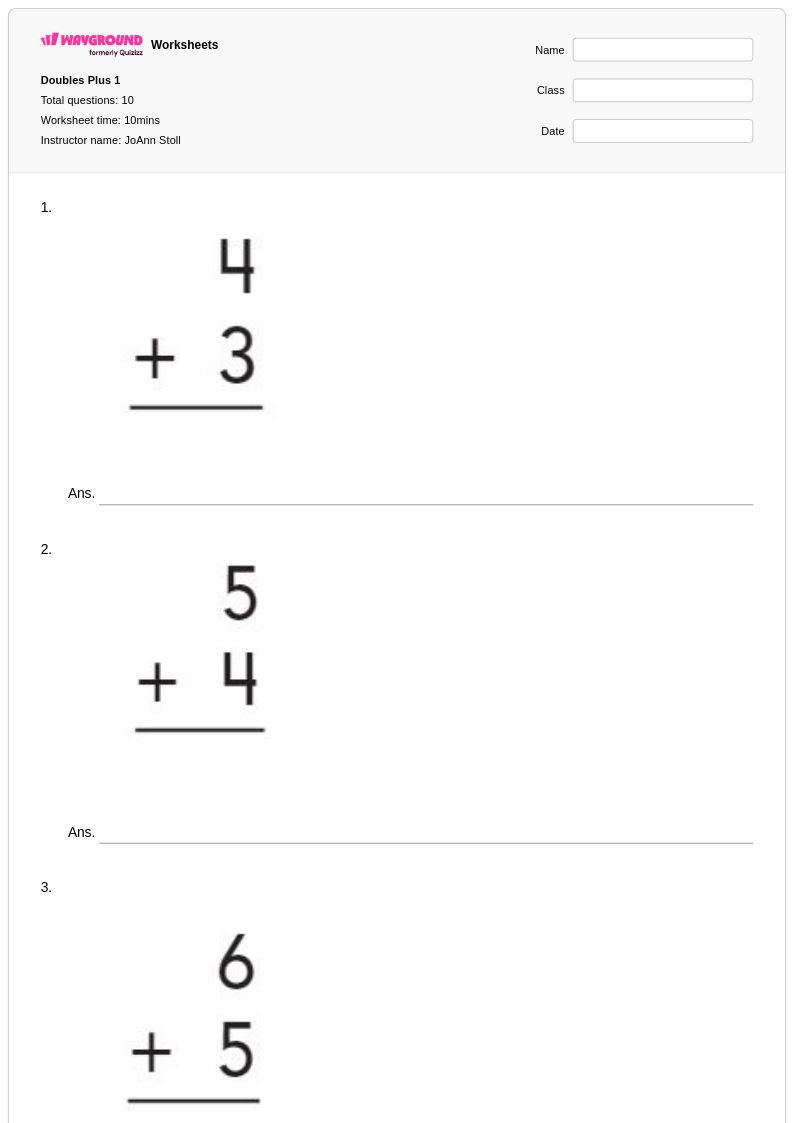
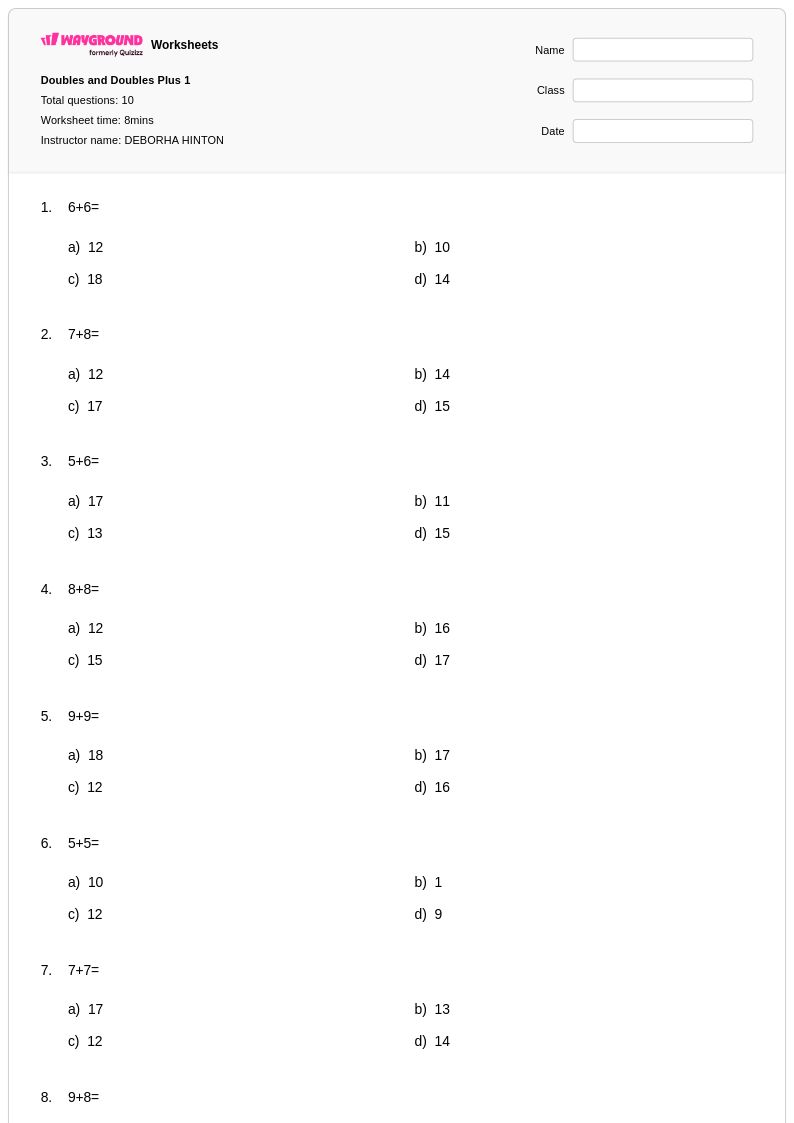
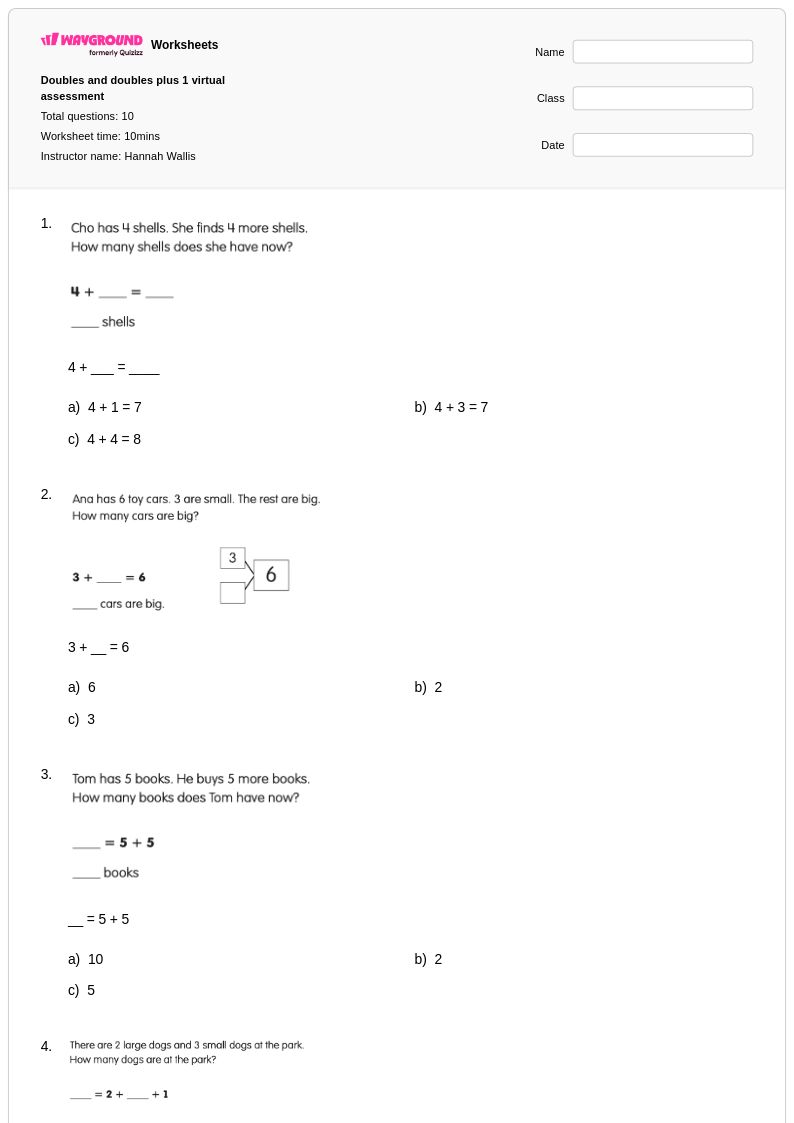
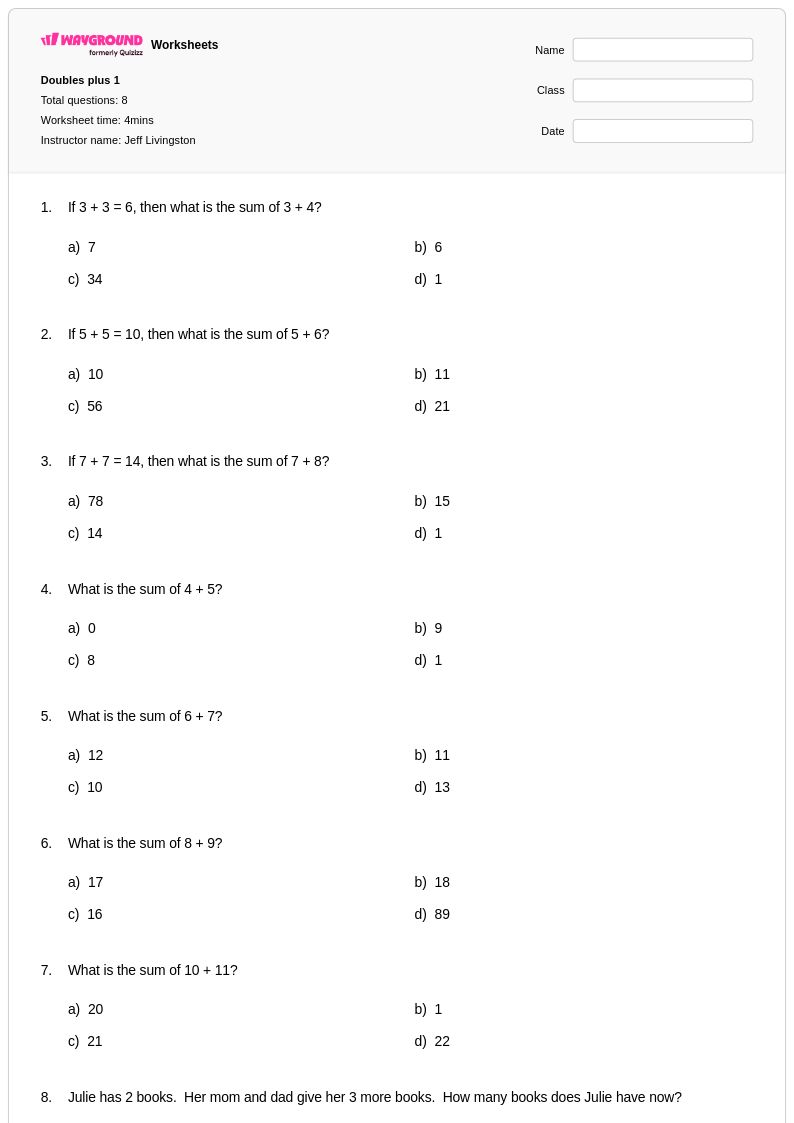
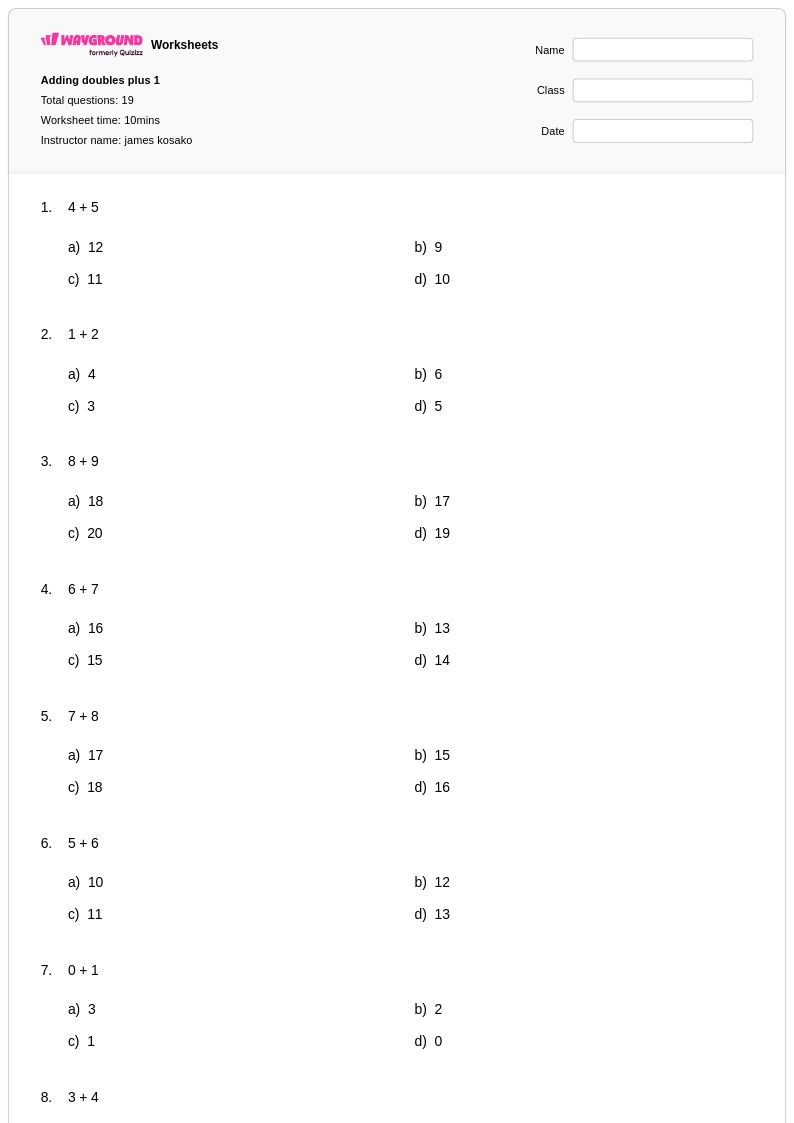
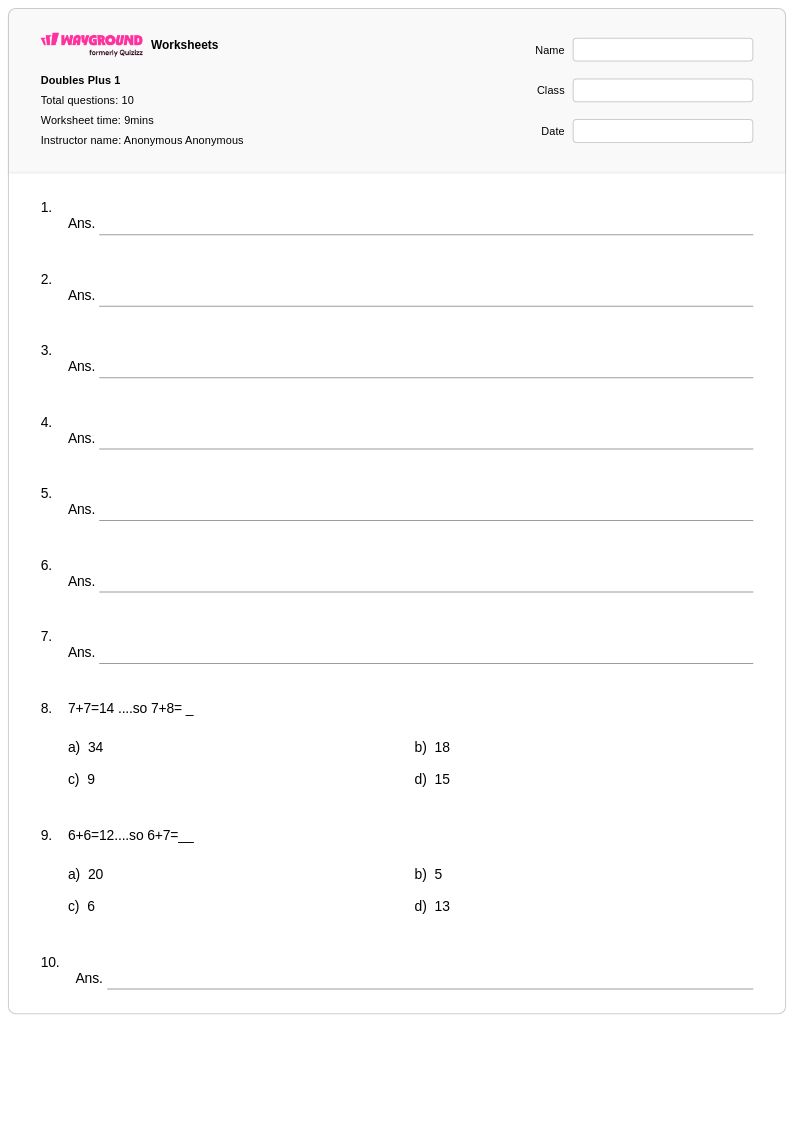
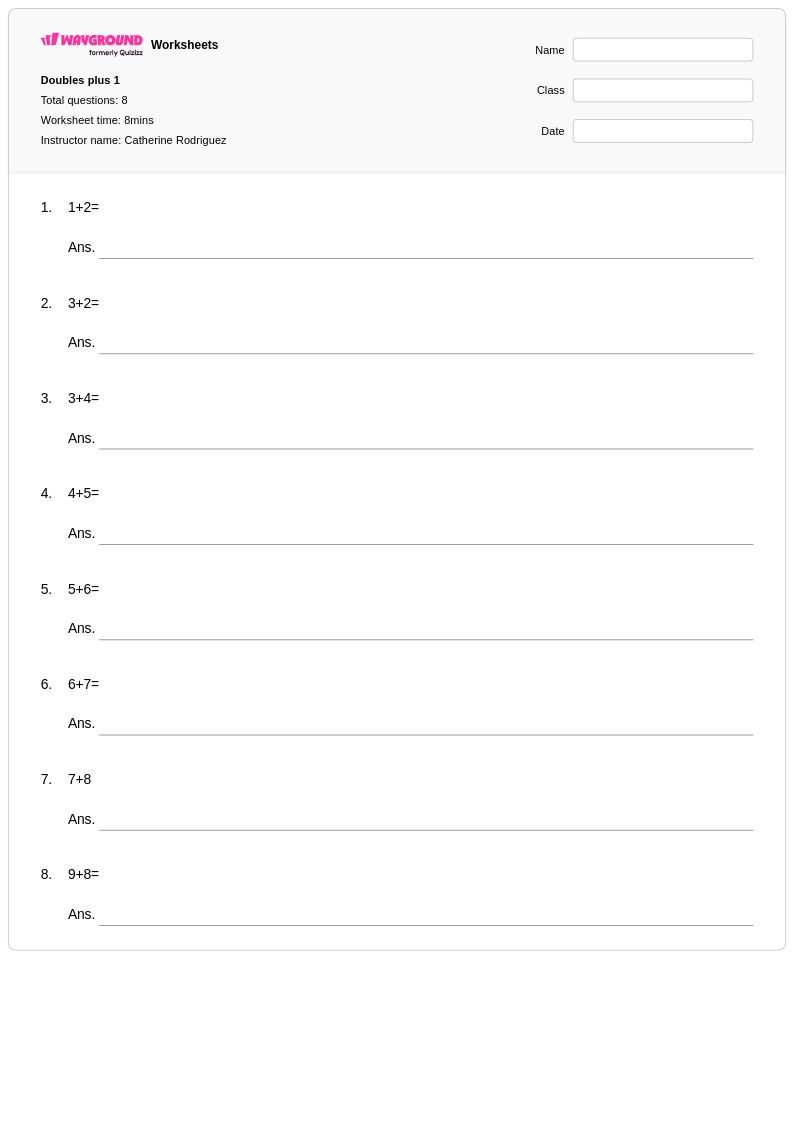
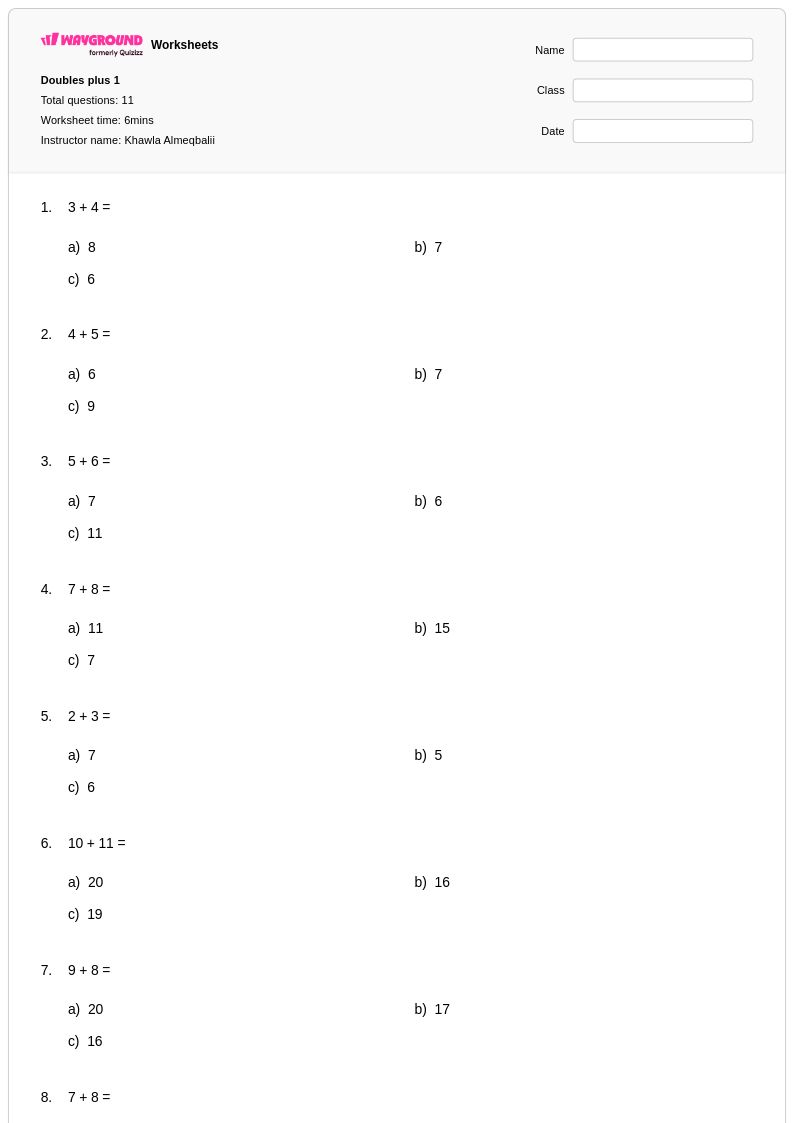
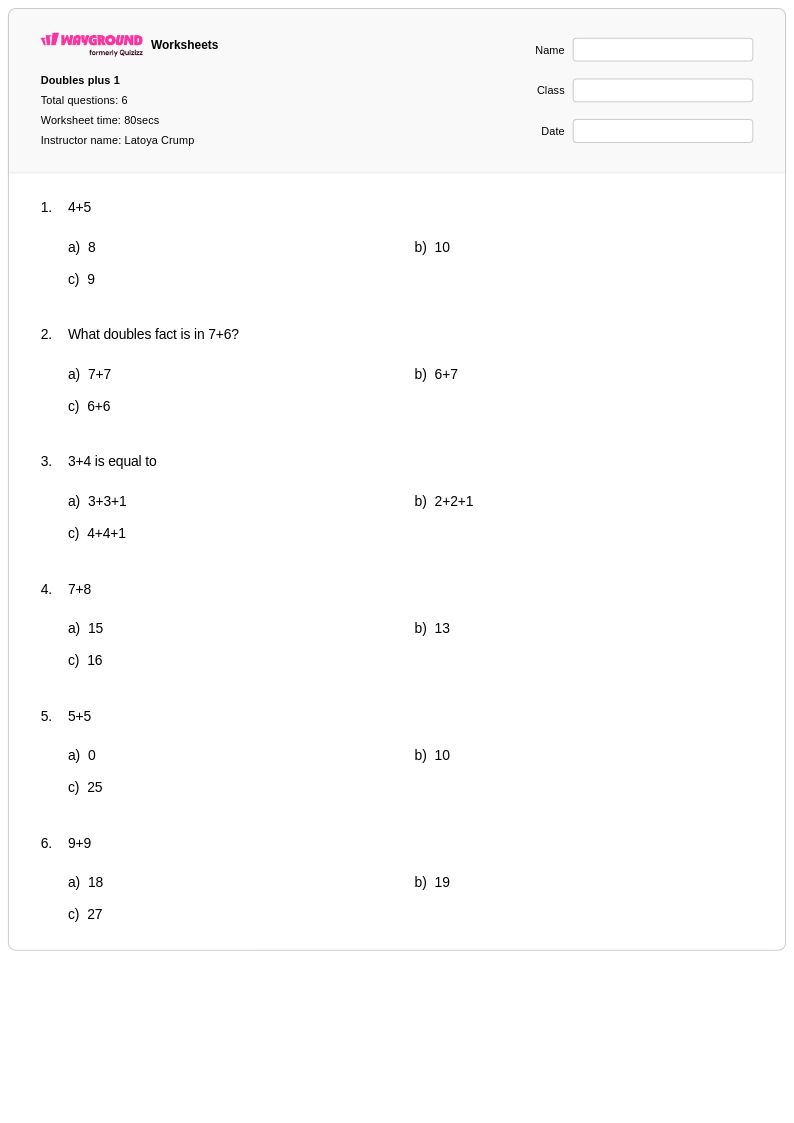
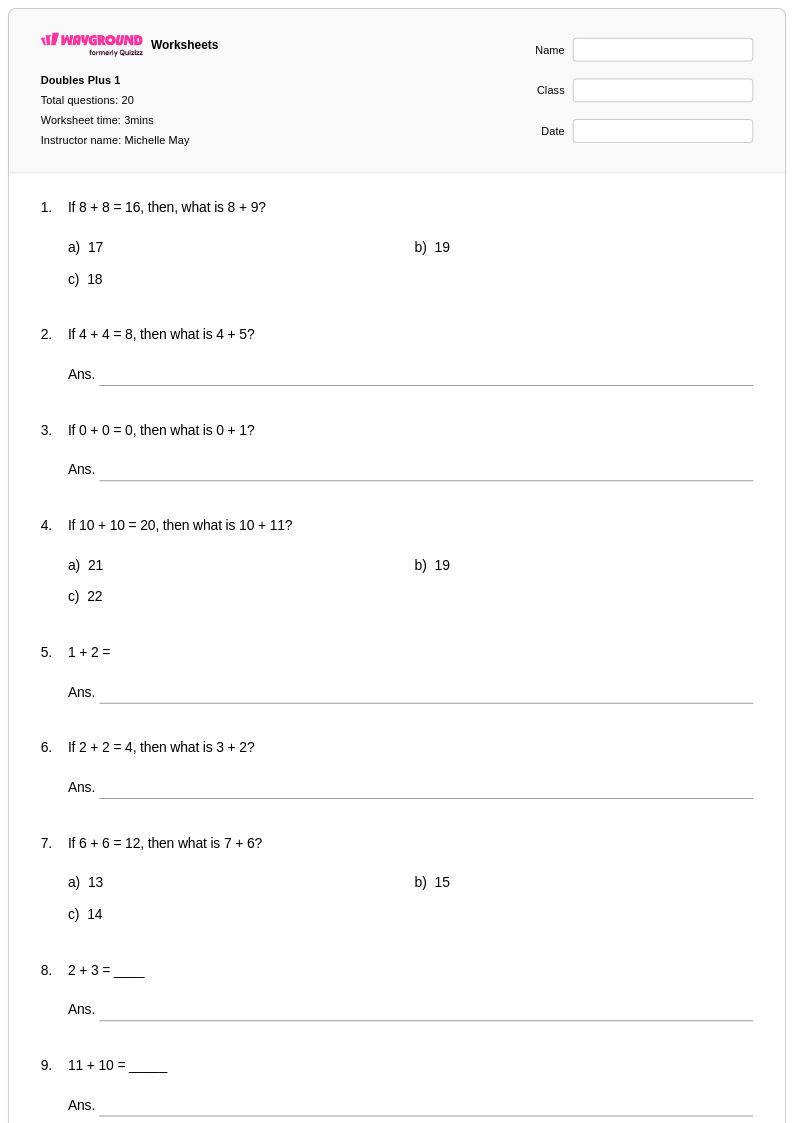
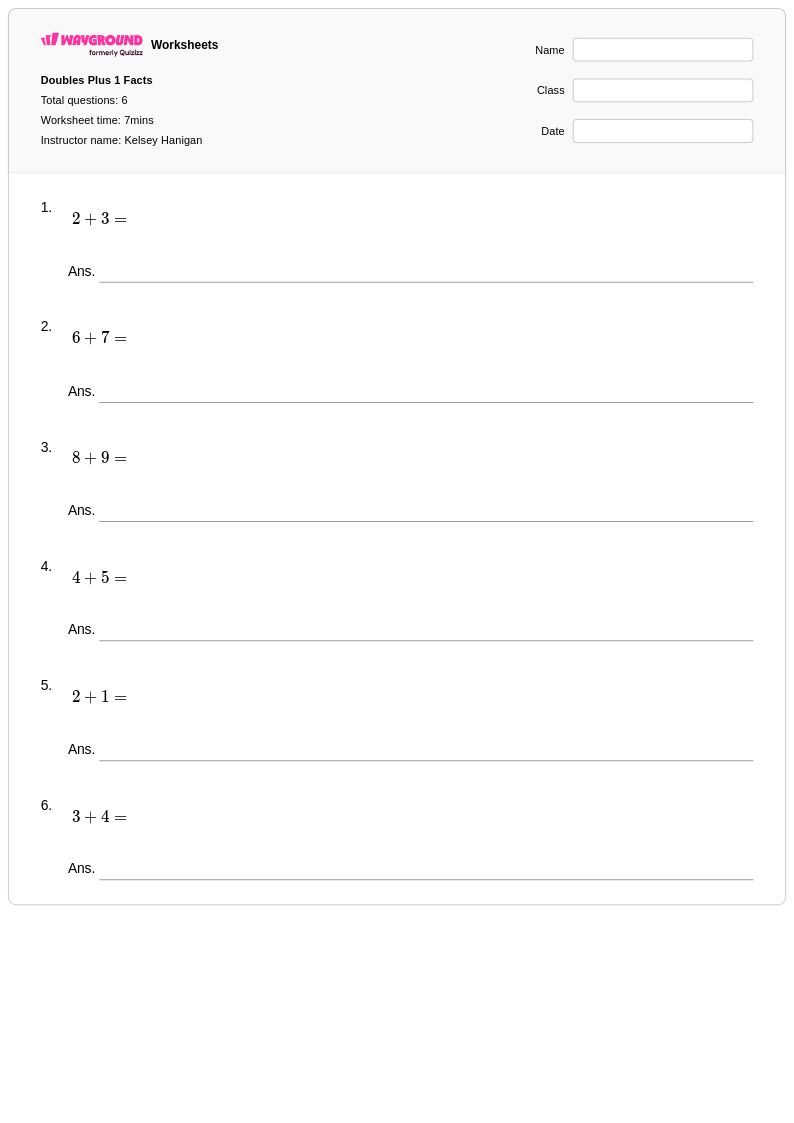
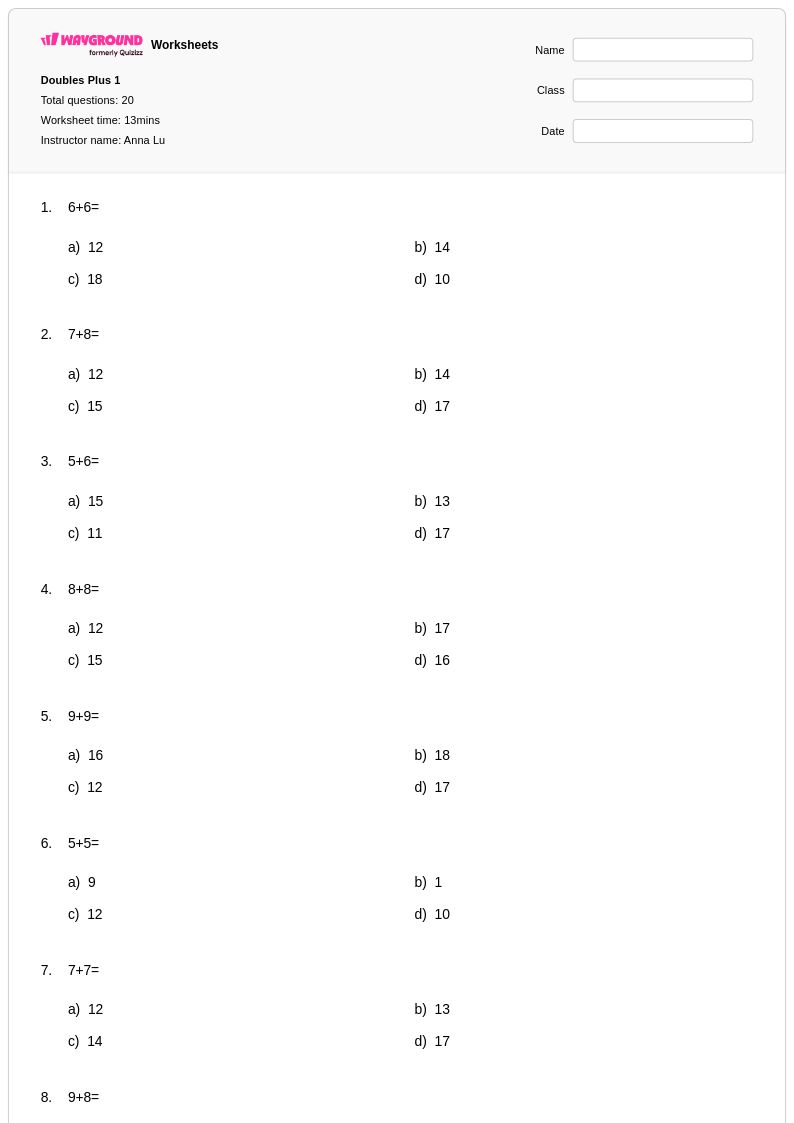
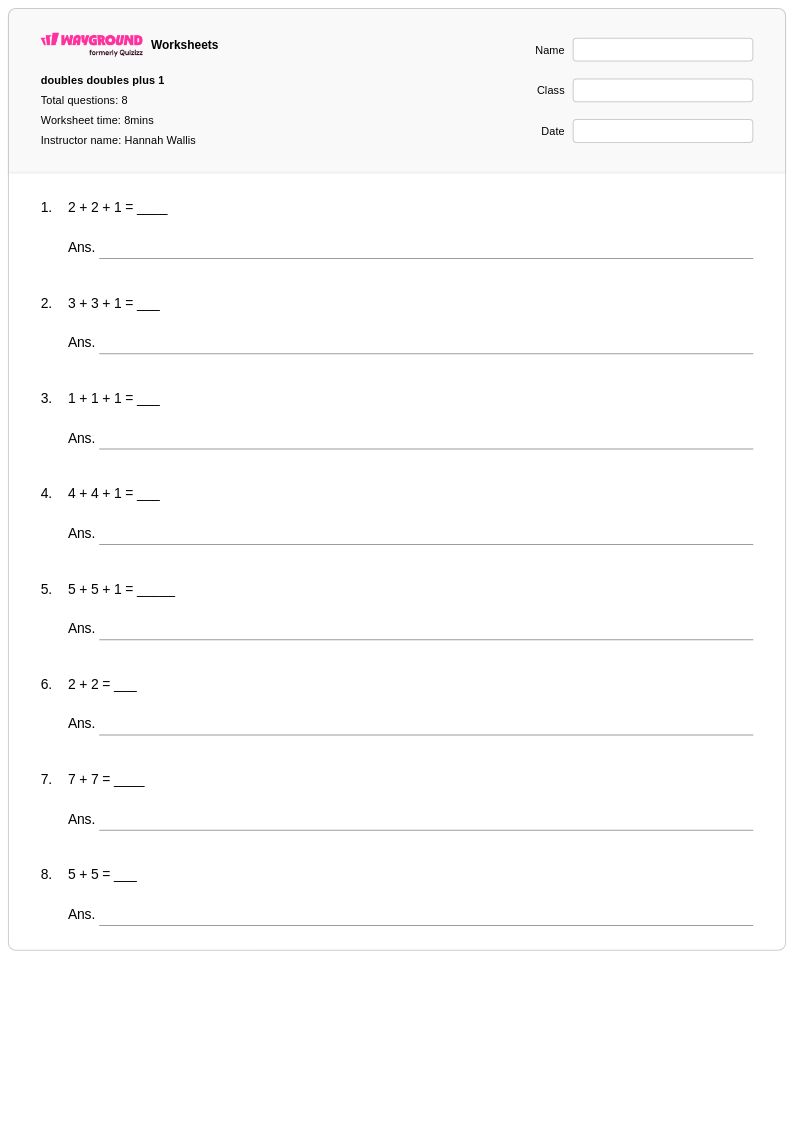
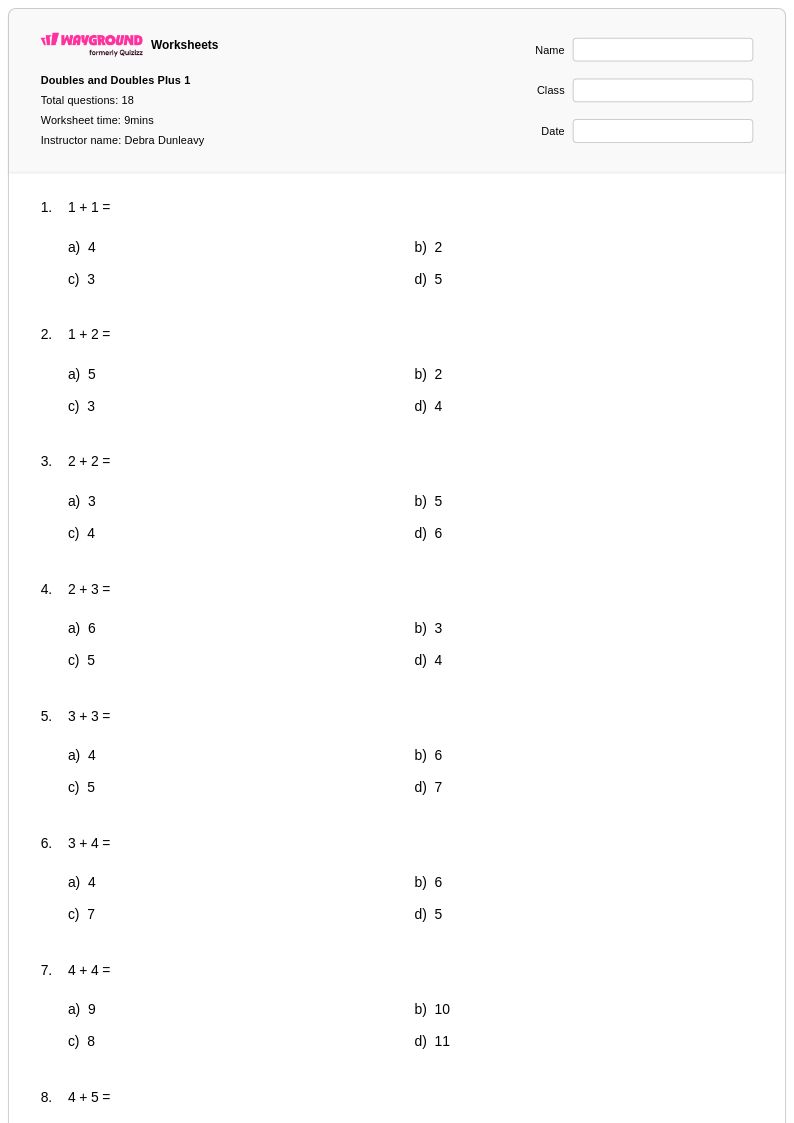
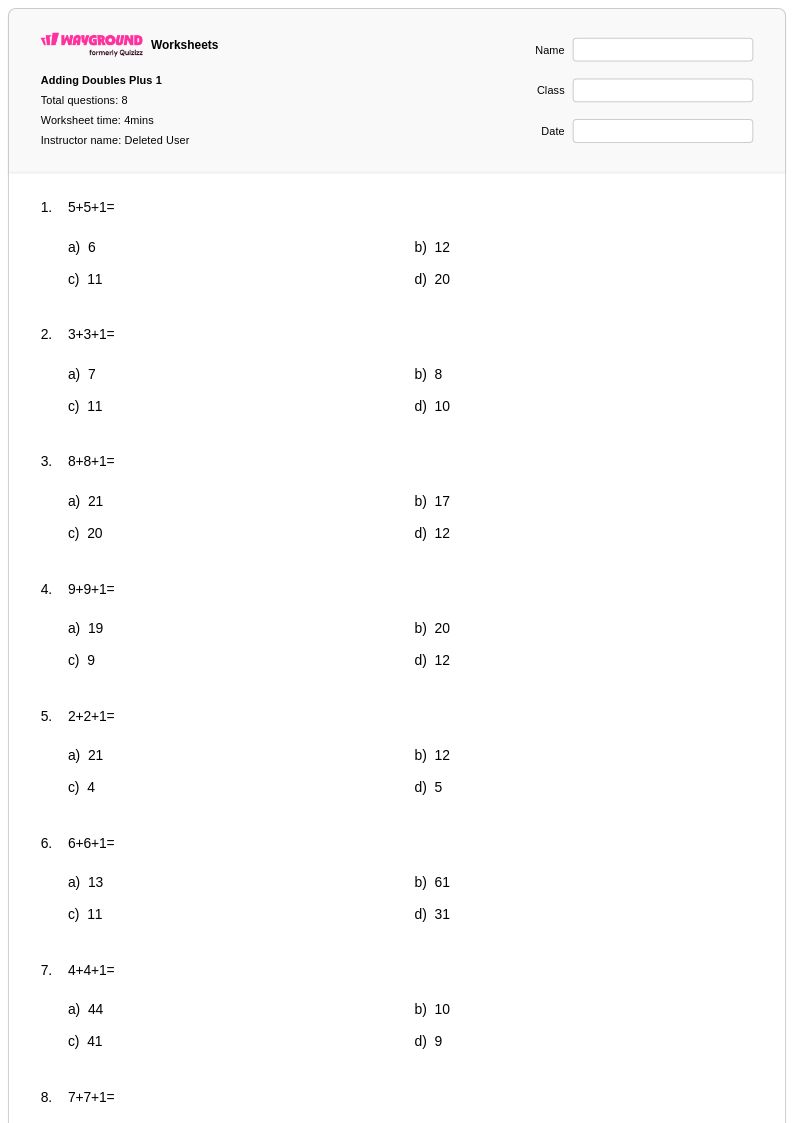
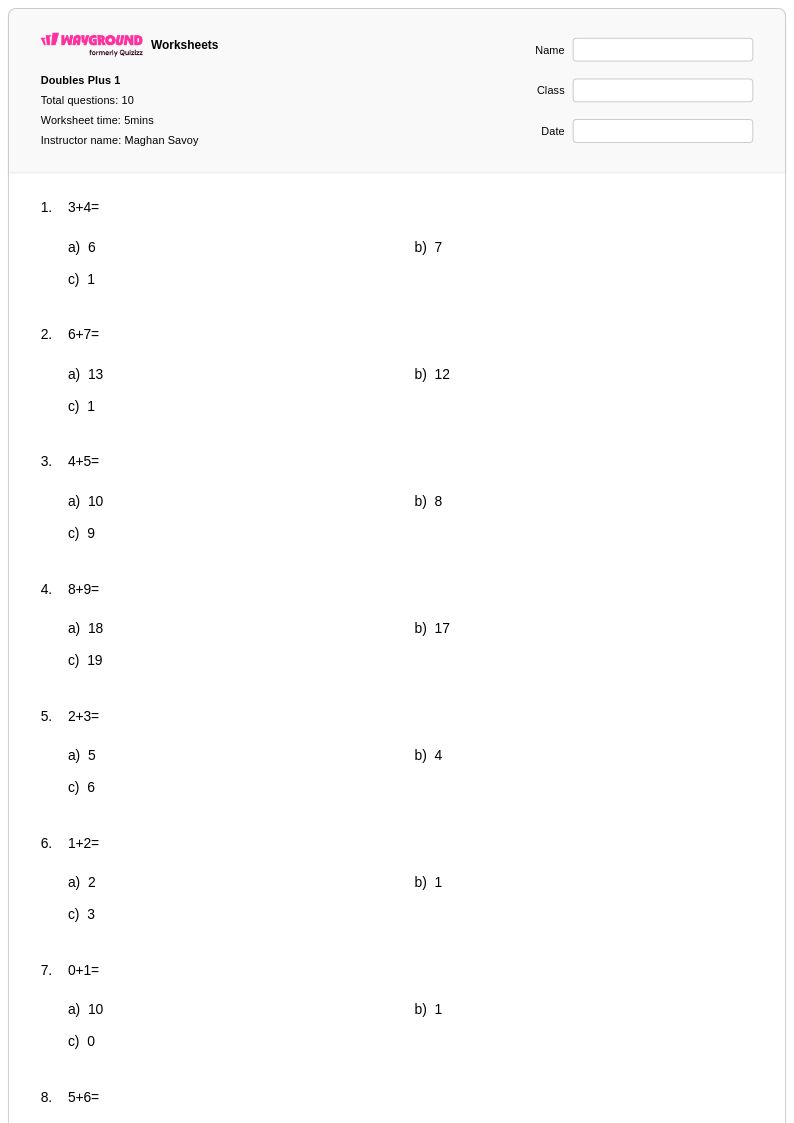
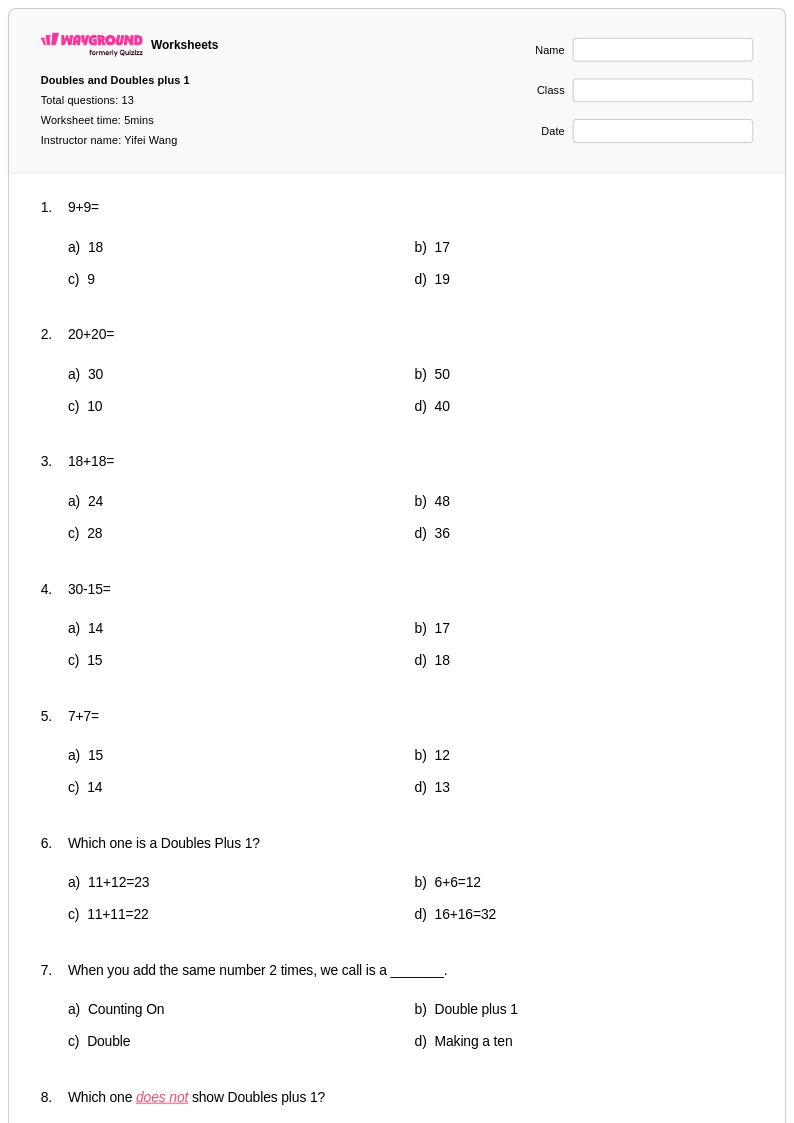
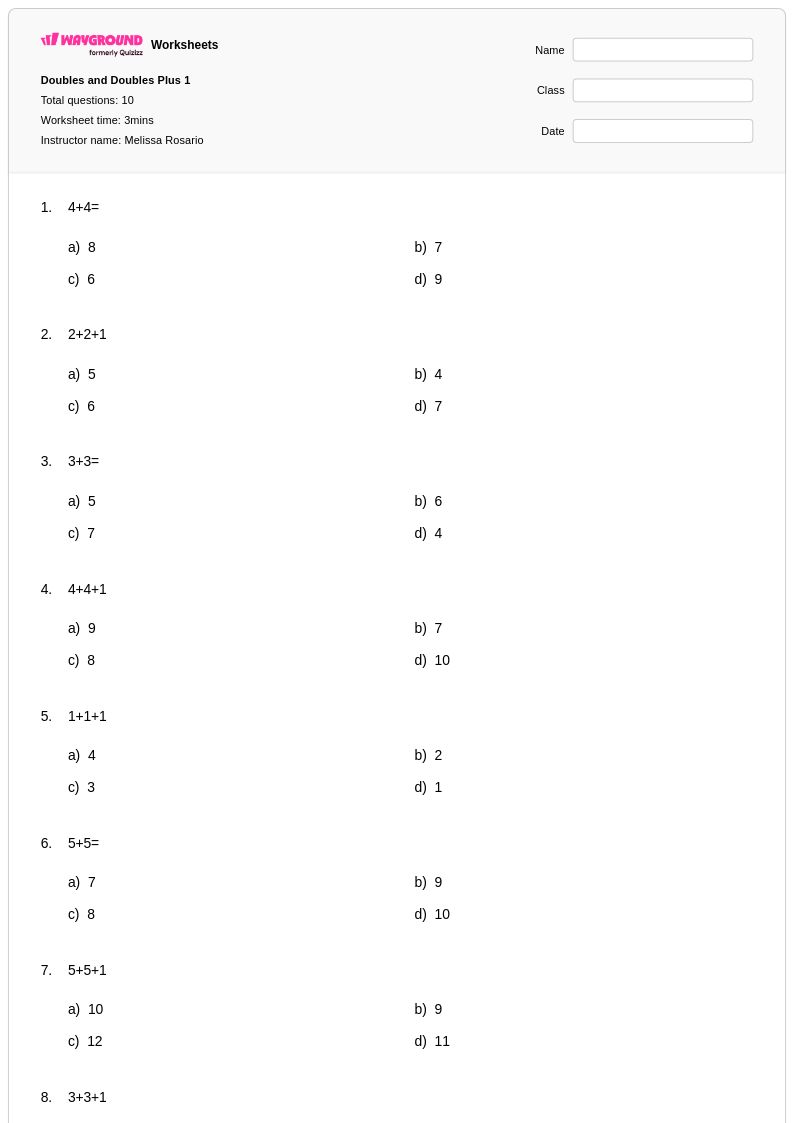
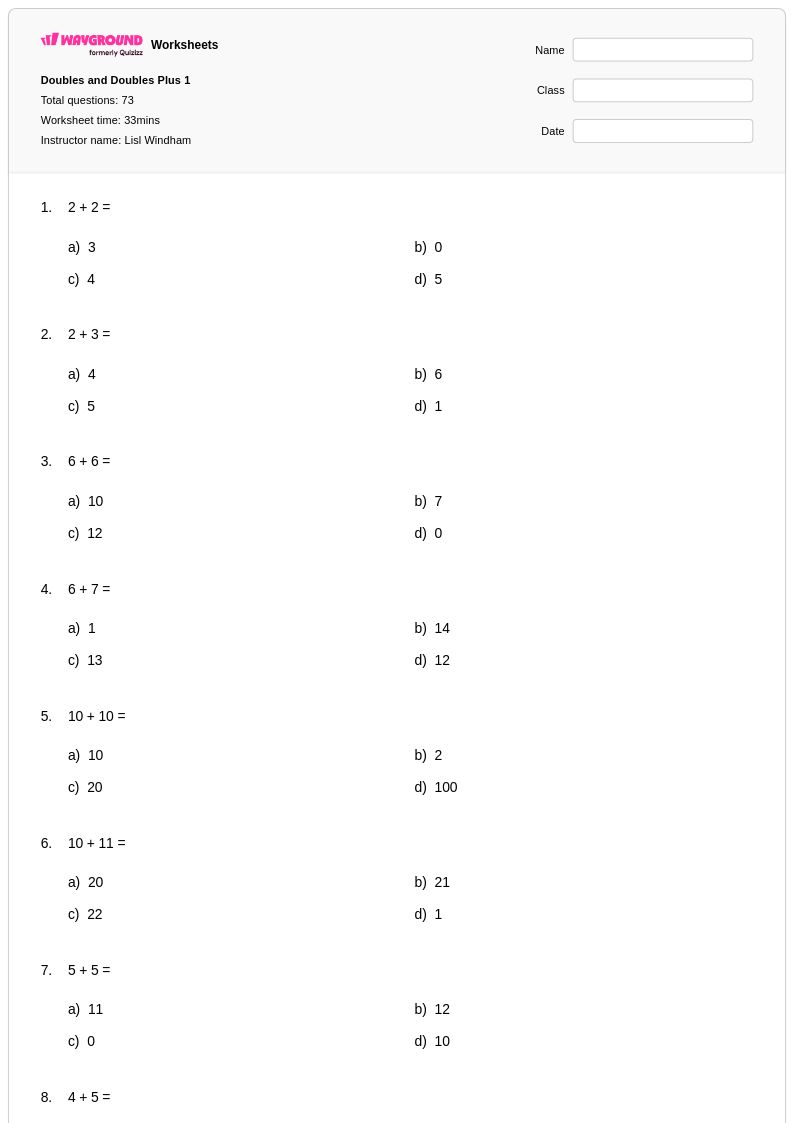
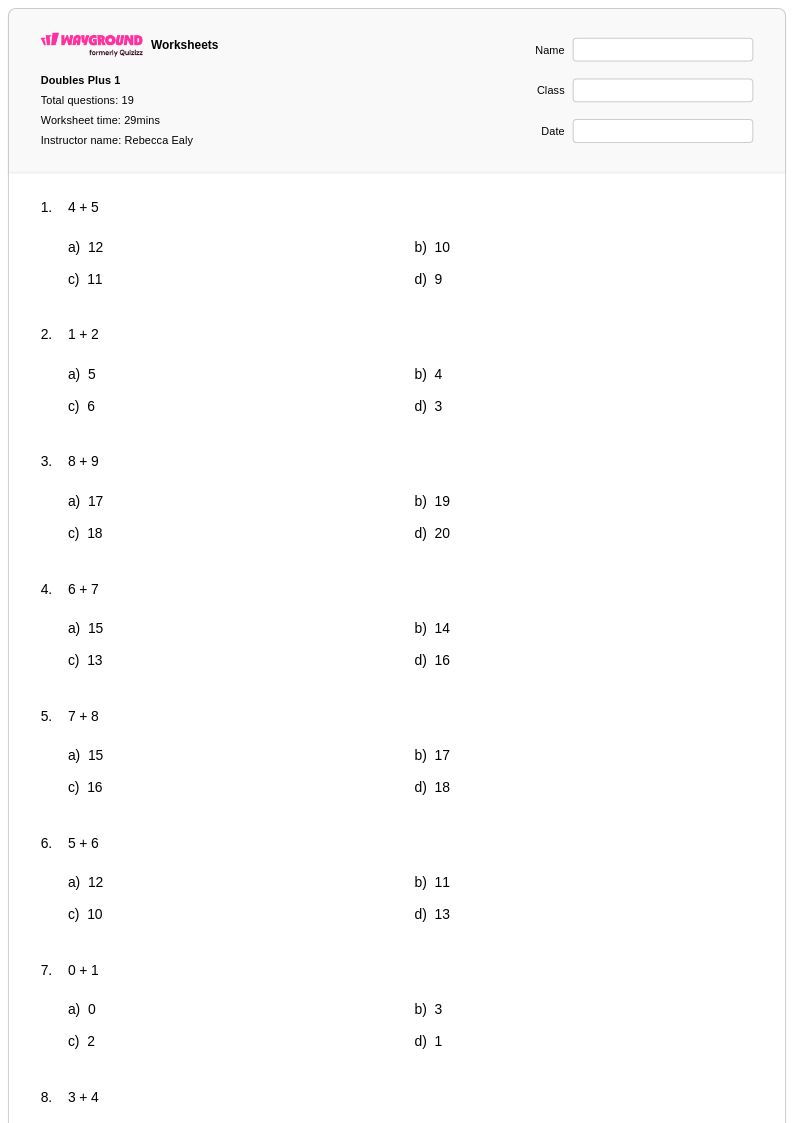
Discover free printable worksheets and practice problems focused on doubles plus 1 addition strategies, complete with answer keys to help students master this fundamental math concept through engaging PDF activities.
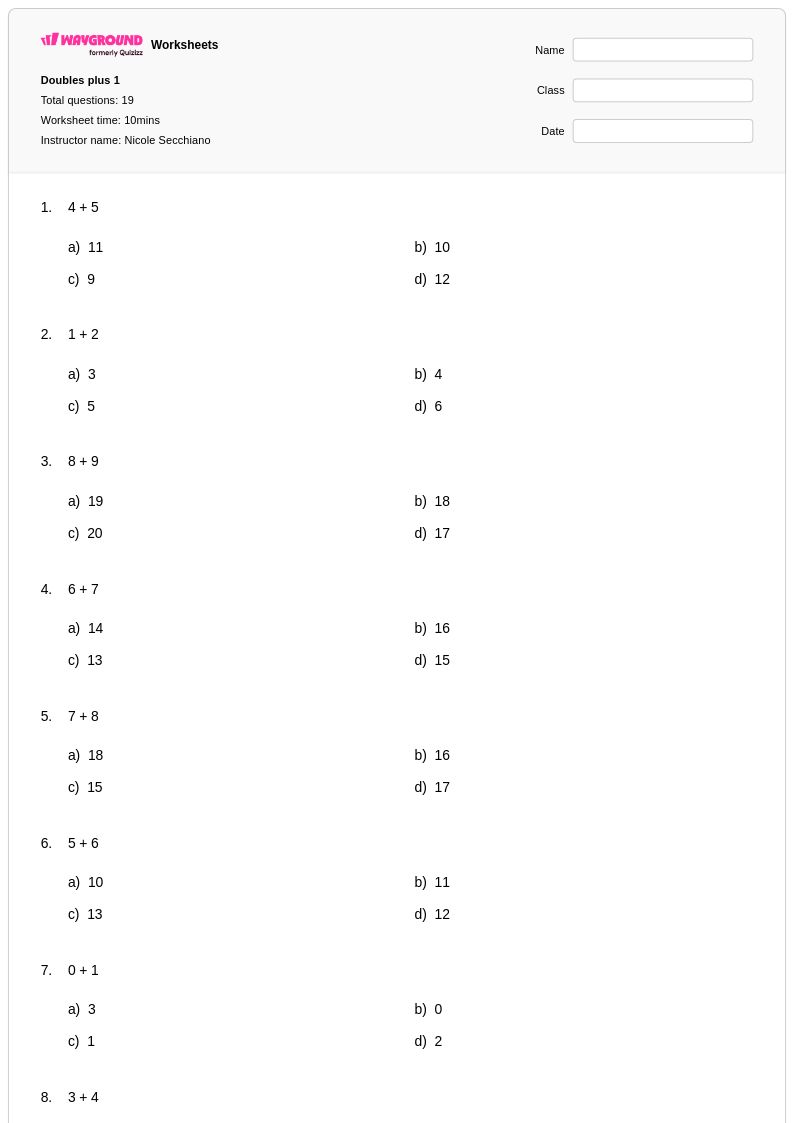
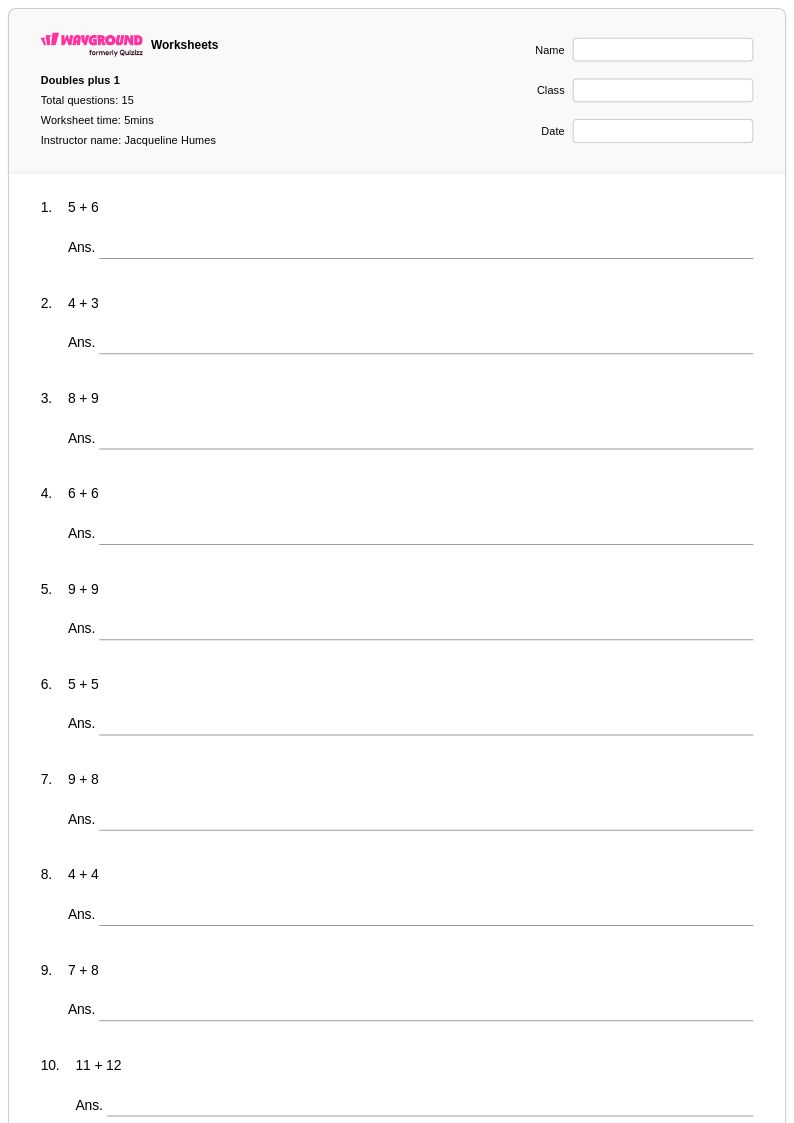
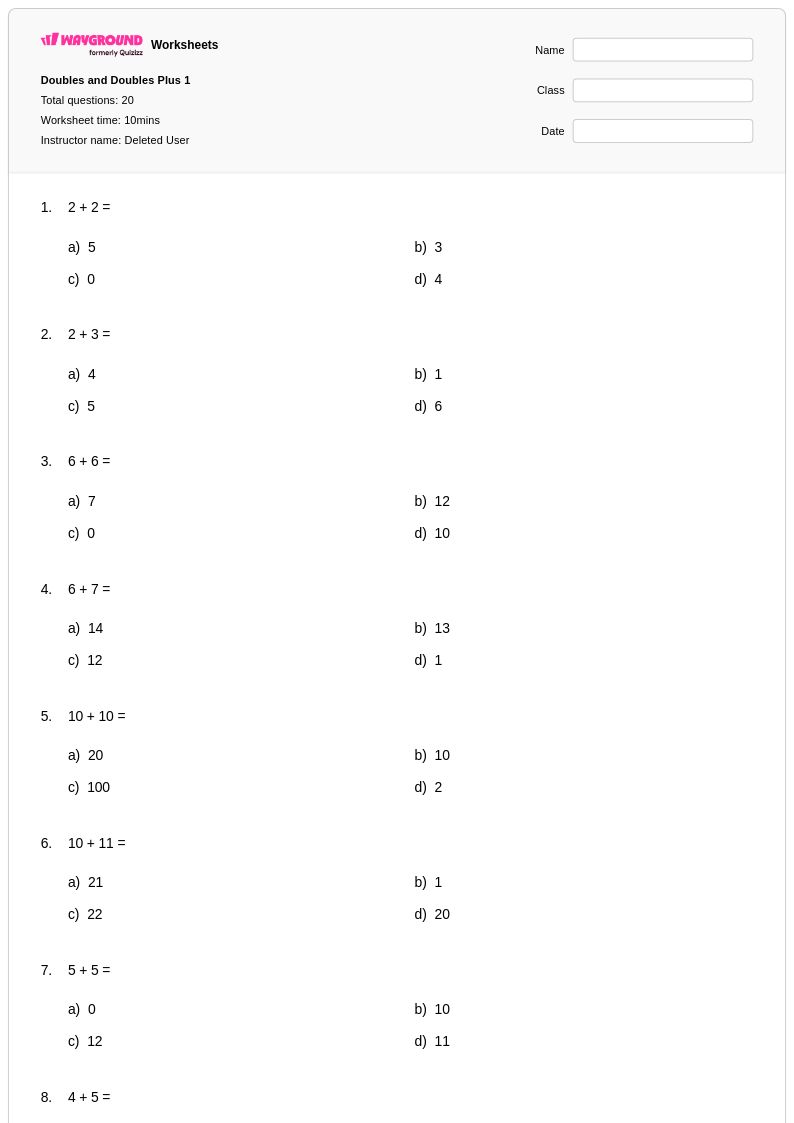
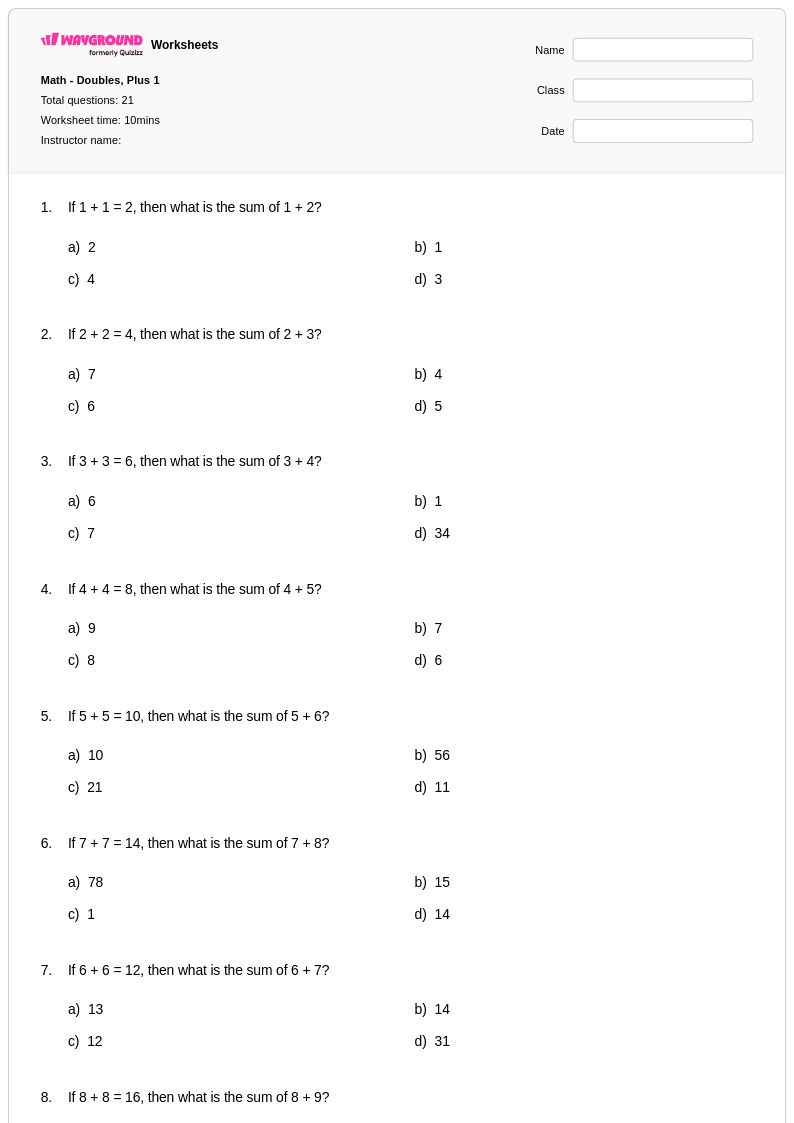
Doubles Plus 1 worksheets available through Wayground (formerly Quizizz) provide students with systematic practice in one of the most fundamental addition strategies in elementary mathematics. These carefully designed printables focus on helping students recognize and apply the pattern where they can solve problems like 6+7 by thinking "6+6=12, plus one more makes 13." The worksheets strengthen mental math fluency, number sense, and automaticity with basic addition facts through engaging practice problems that build from concrete doubles facts to the slightly more complex doubles plus one concept. Each worksheet collection includes comprehensive answer keys and free pdf downloads, making them accessible resources for both classroom instruction and independent practice.
Wayground's extensive collection of teacher-created Doubles Plus 1 resources offers educators millions of professionally developed materials with robust search and filtering capabilities to quickly locate age-appropriate content. The platform's standards alignment ensures that worksheets meet curriculum requirements, while differentiation tools allow teachers to modify difficulty levels and problem types to support diverse learning needs. These flexible resources are available in both printable and digital formats, including downloadable pdfs, enabling seamless integration into lesson planning whether for whole-class instruction, small group remediation, or enrichment activities. Teachers can customize worksheet collections to target specific skill gaps, provide spiral review, or offer extended practice, making these Doubles Plus 1 resources invaluable tools for developing students' computational fluency and mathematical confidence.
FAQs
How do I teach doubles plus 1 to elementary students?
Start by making sure students have solid recall of their doubles facts — 6+6, 7+7, and so on. Once those are automatic, introduce doubles plus 1 as a shortcut: if you already know 6+6=12, then 6+7 is just one more, so 13. Use a think-aloud to model the reasoning, then have students practice identifying which double is hiding inside a near-doubles problem before solving. The goal is for students to internalize the pattern, not just follow a procedure.
What exercises help students practice doubles plus 1?
The most effective practice moves from recognition to application. Start with matching exercises where students pair a near-doubles problem (5+6) with its anchor double (5+5). Then move to fill-in problems where they complete the reasoning: "5+5=10, so 5+6=___". Finally, mix near-doubles into a set of regular addition facts so students practice identifying when the strategy applies — that transfer step is where fluency actually develops.
What mistakes do students commonly make with doubles plus 1?
The most common error is adding one to the wrong number — for example, solving 6+7 as 6+6+1=13 correctly, but then writing 14 because they added the extra 1 to the sum a second time. Students also sometimes misidentify which double to anchor to, especially when the larger addend is listed first (7+6 instead of 6+7). A quick diagnostic: ask students to explain their reasoning out loud. If they can't name the anchor double, the strategy isn't yet internalized.
How do I use Wayground's doubles plus 1 worksheets in my classroom?
You can run these worksheets as a digital quiz hosted on Wayground — students work through problems on-screen and results come back to you automatically. If you prefer paper, download the printable PDF and assign it by hand; every worksheet includes a complete answer key, and you can grade submitted work using the Wayground for Teachers app by scanning or capturing student responses. Both routes work with the same content, so the format choice comes down to what fits your lesson.
Is doubles plus 1 aligned to Common Core standards?
Yes. Common Core expects students in Kindergarten and Grade 1 to add within 20 using strategies based on known facts, and doubles plus 1 is one of the named near-doubles strategies that supports this. The progression moves from counting-on in Kindergarten to applying fact-based strategies fluently by the end of Grade 1, with the expectation that students can explain why the strategy works — not just produce the answer.
How can I differentiate doubles plus 1 practice for mixed-ability students?
For students still building doubles recall, Wayground's reduced answer choices accommodation lowers the cognitive load so they can focus on the reasoning rather than the retrieval. For students who struggle with reading the problems, the Read Aloud feature handles that automatically. On the worksheet side, you can generate a version with a dyslexia-friendly font or larger text for students who need it — same problems, adjusted presentation — without creating a separate assignment from scratch.
What grade level is doubles plus 1 typically taught?
Doubles plus 1 is introduced in Kindergarten and developed through Grade 1, where it becomes a core mental math strategy for adding within 20. It often appears as review or fluency practice in Grade 2. By Grade 3, students who haven't yet automated these facts may revisit them, but the strategy itself is primarily a K–2 skill.