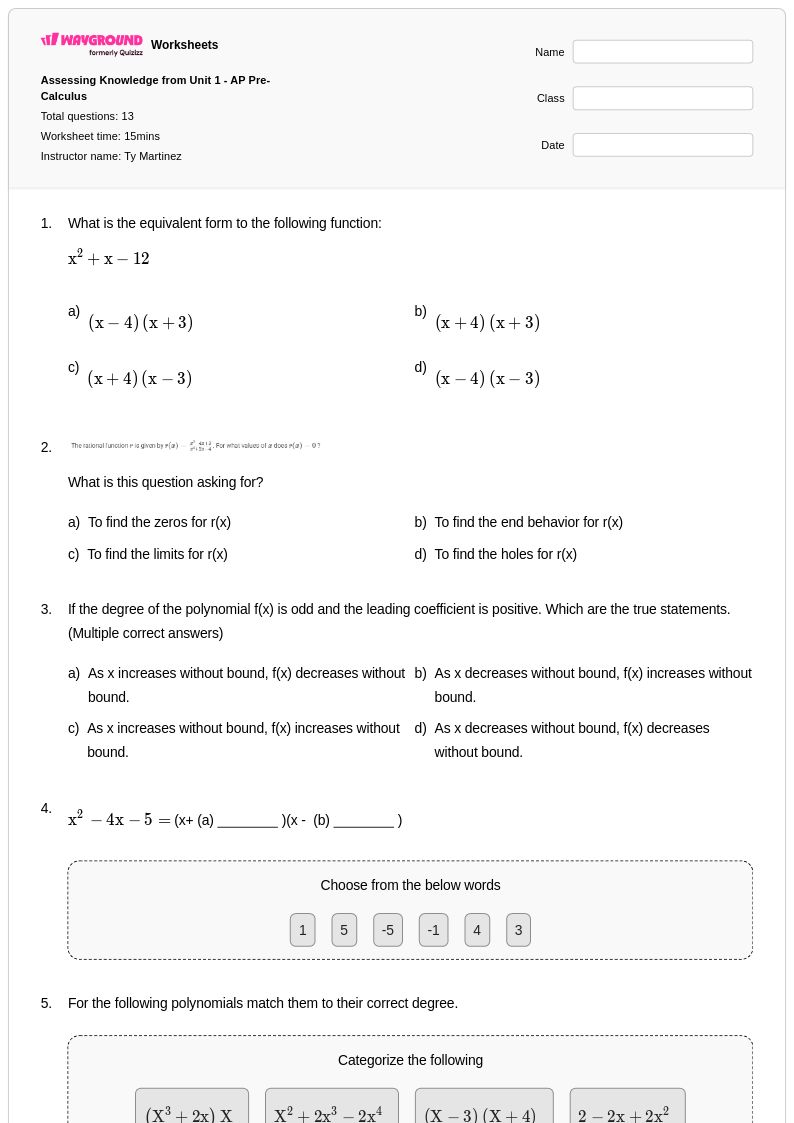
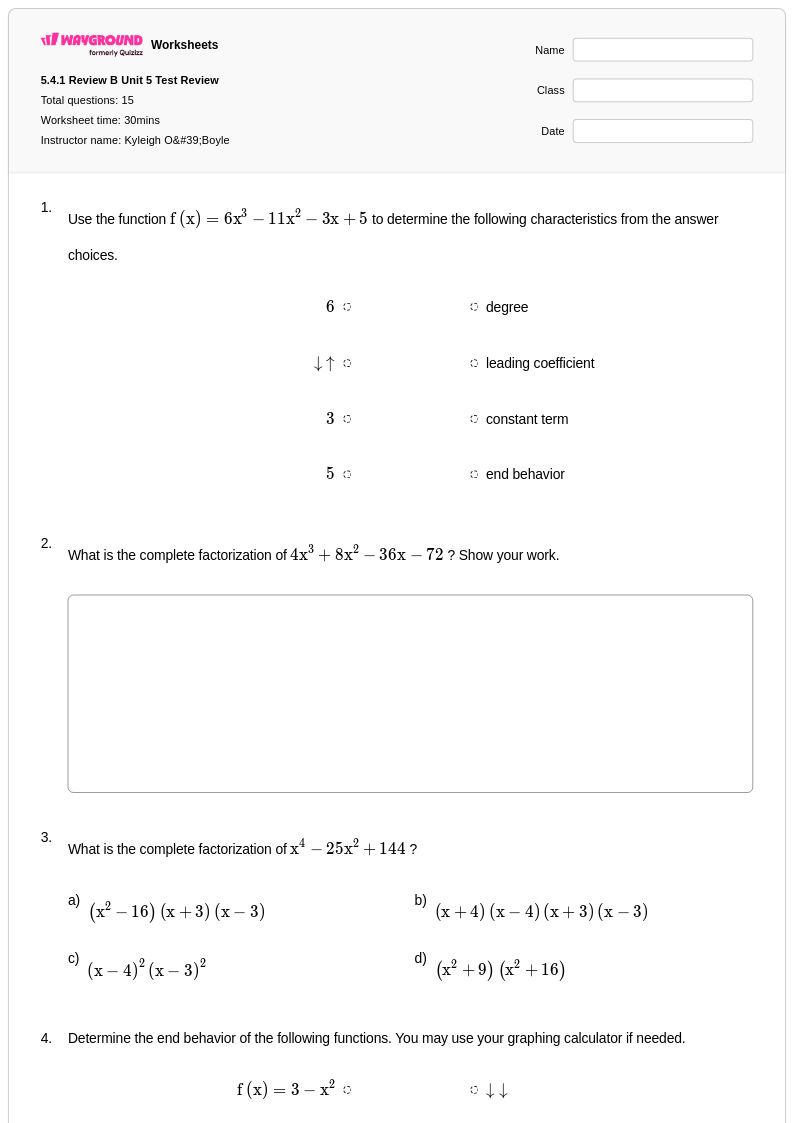
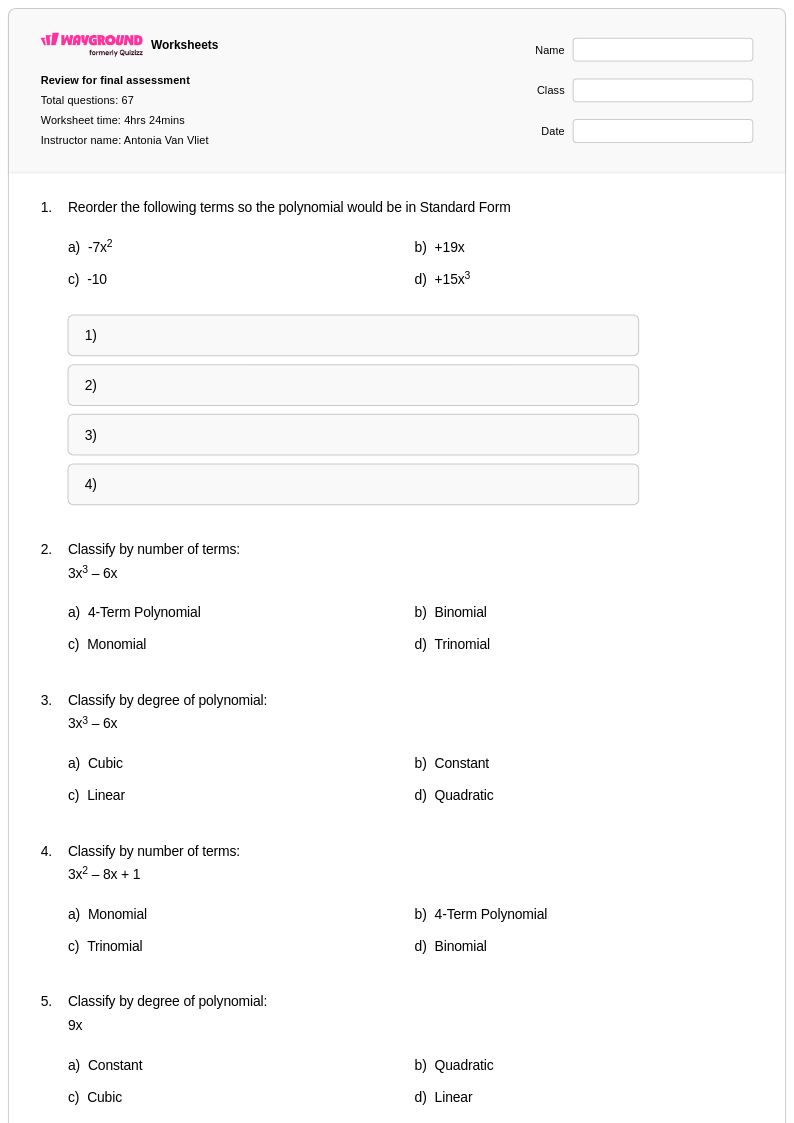
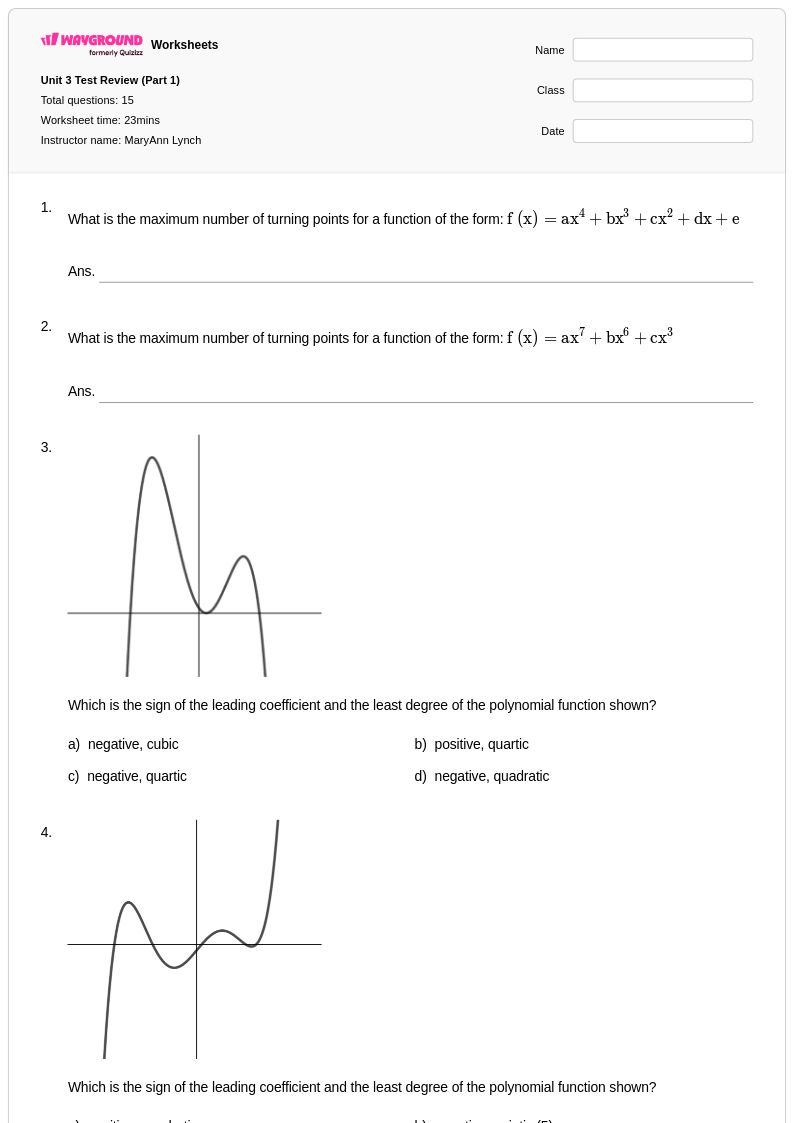
Free Printable End Behavior of Polynomials Worksheets for Class 12
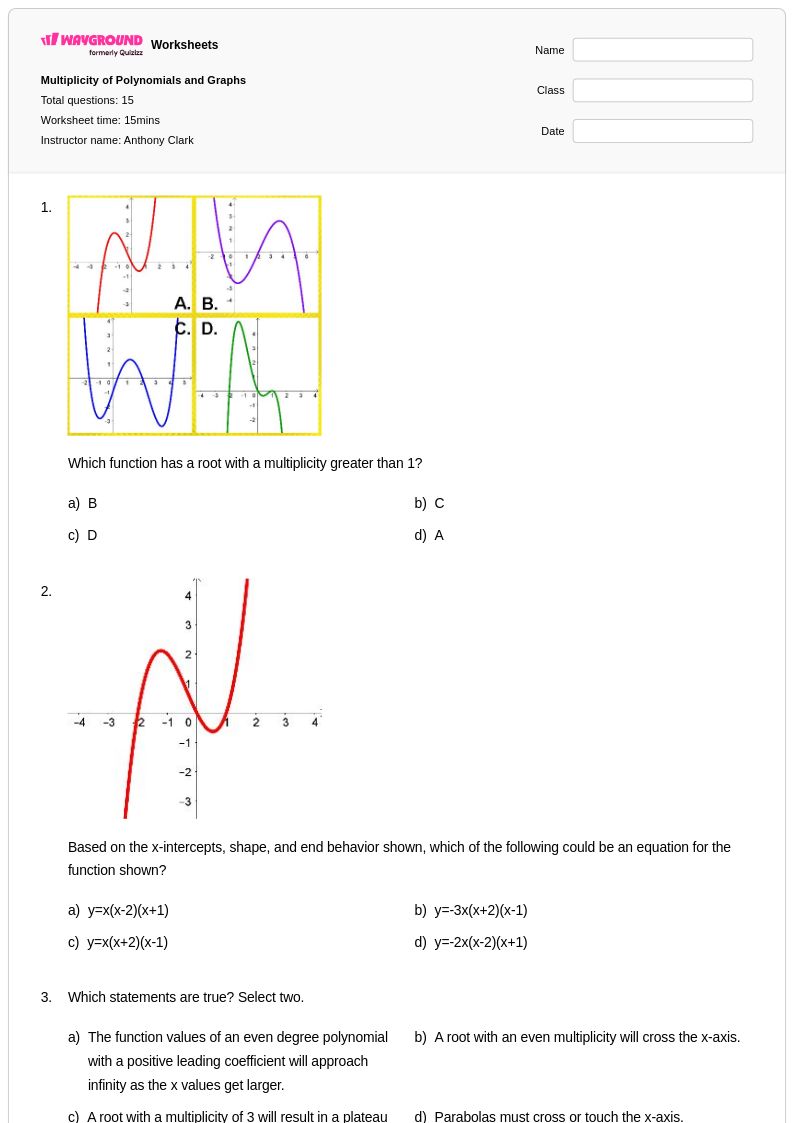
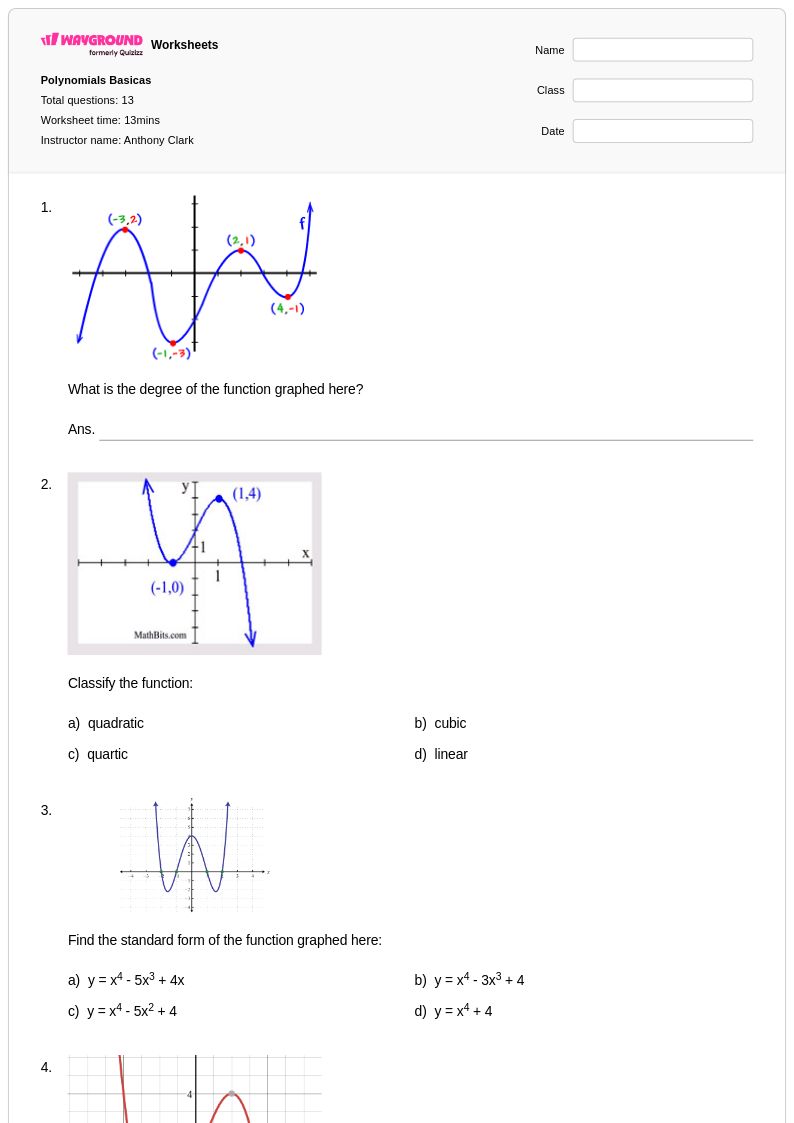
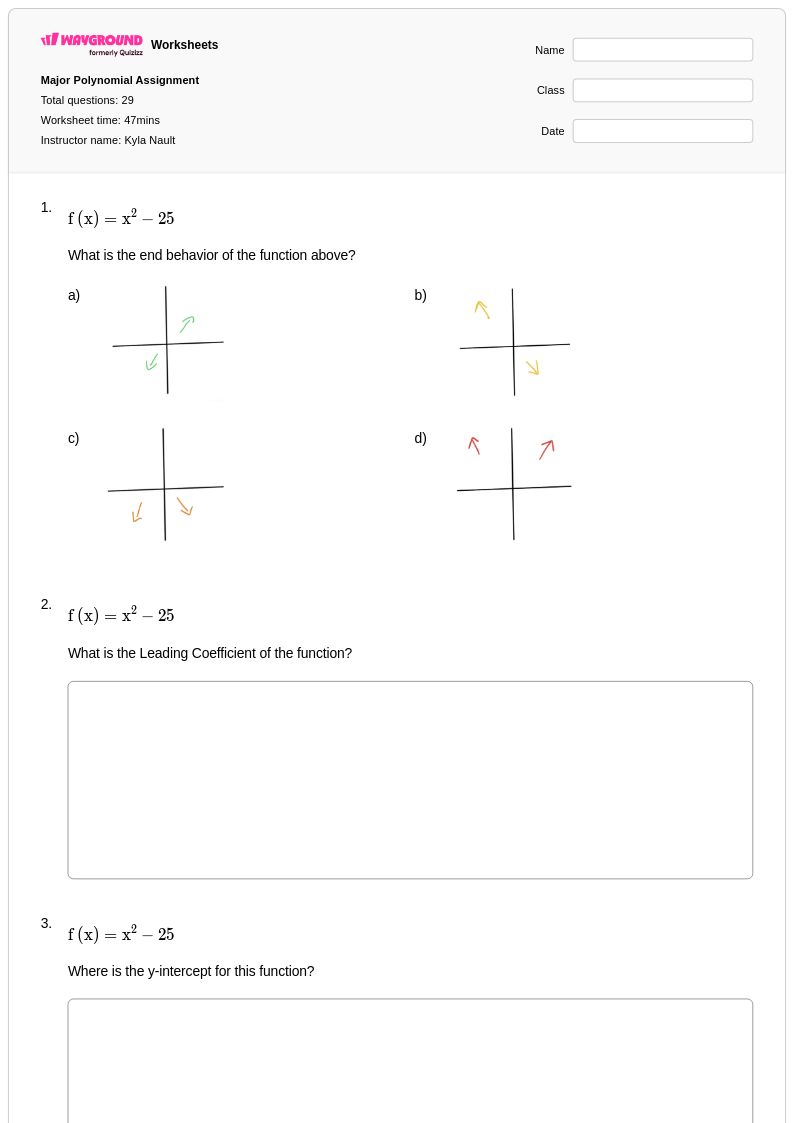
Class 12 end behavior of polynomials worksheets from Wayground provide comprehensive practice problems and answer keys to help students master polynomial function analysis through engaging printables and free PDF resources.
Explore printable End Behavior of Polynomials worksheets for Class 12
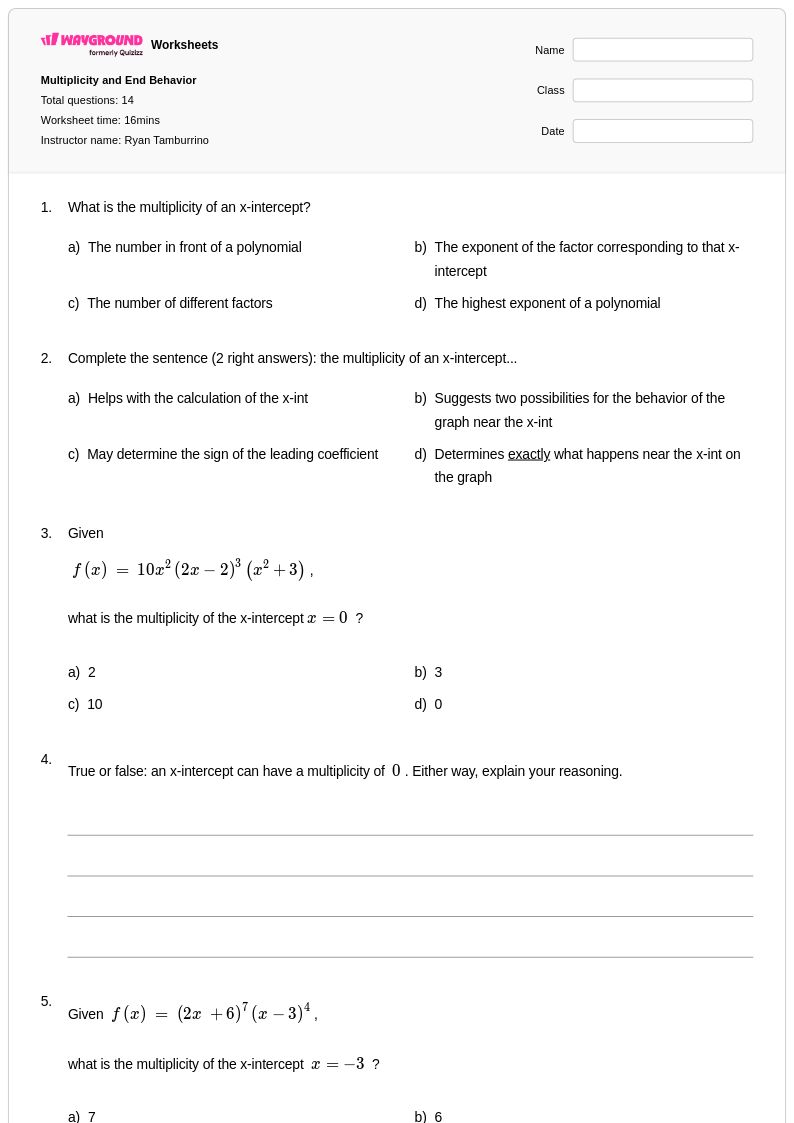
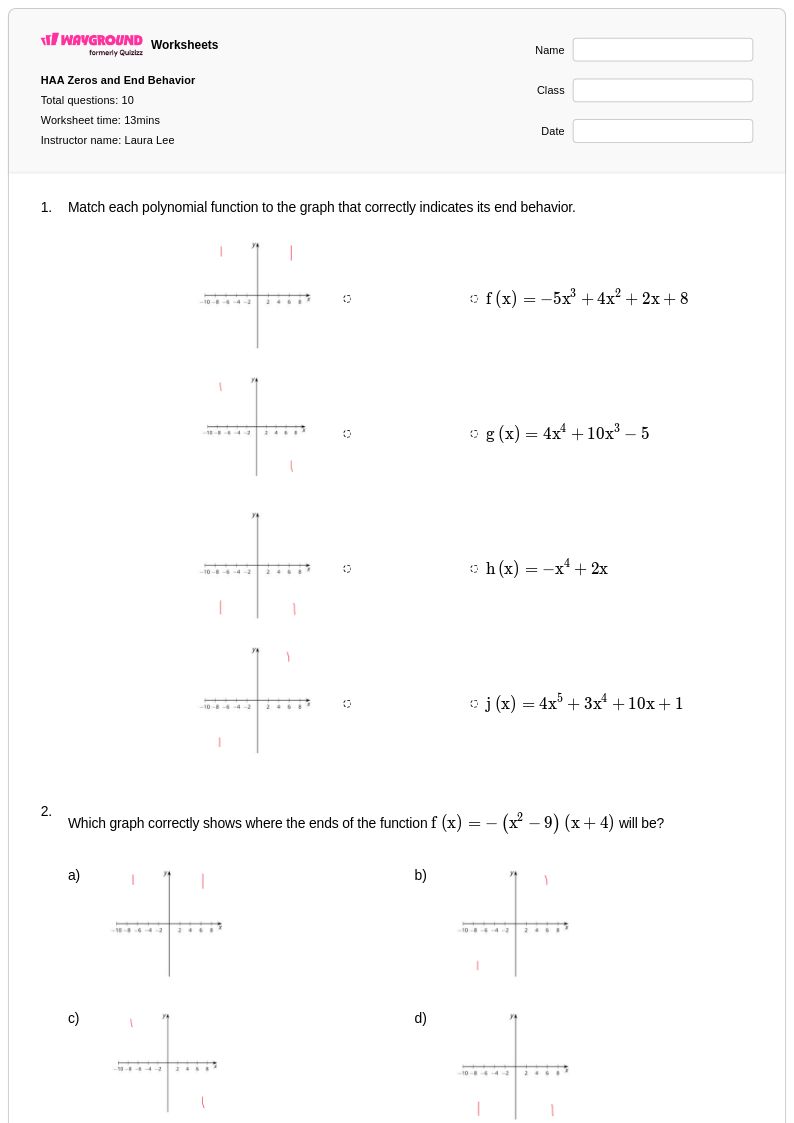
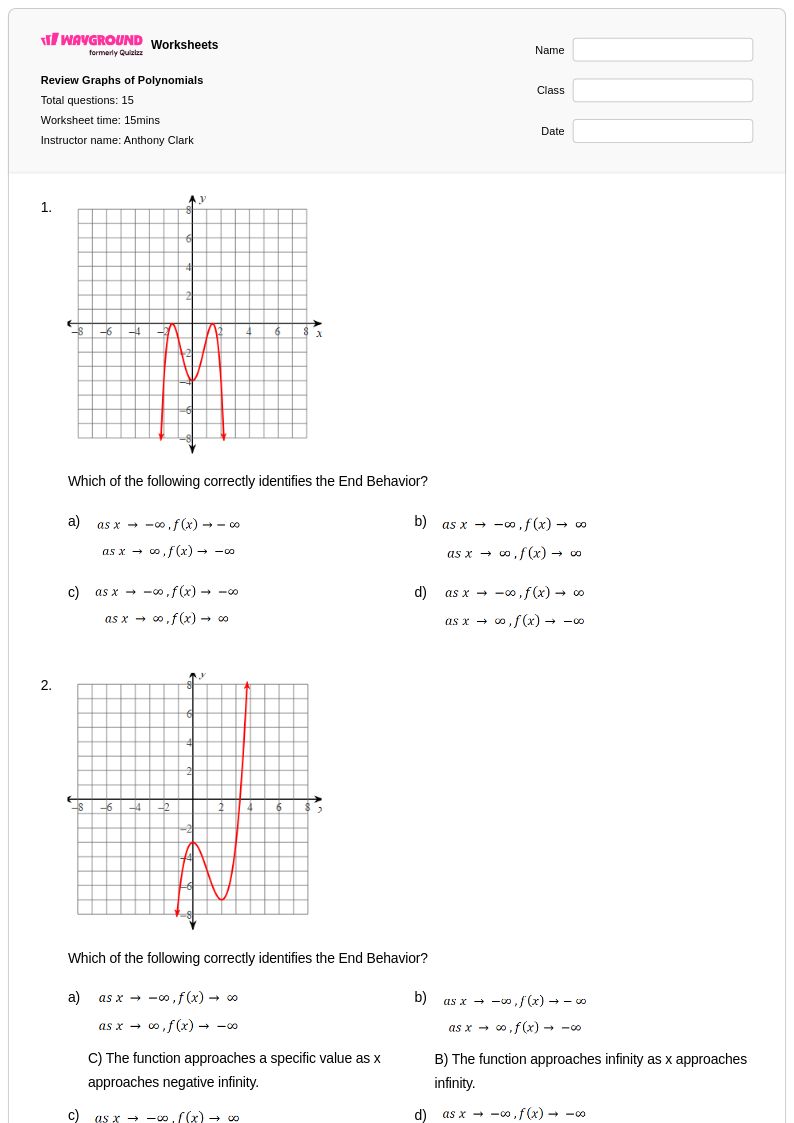
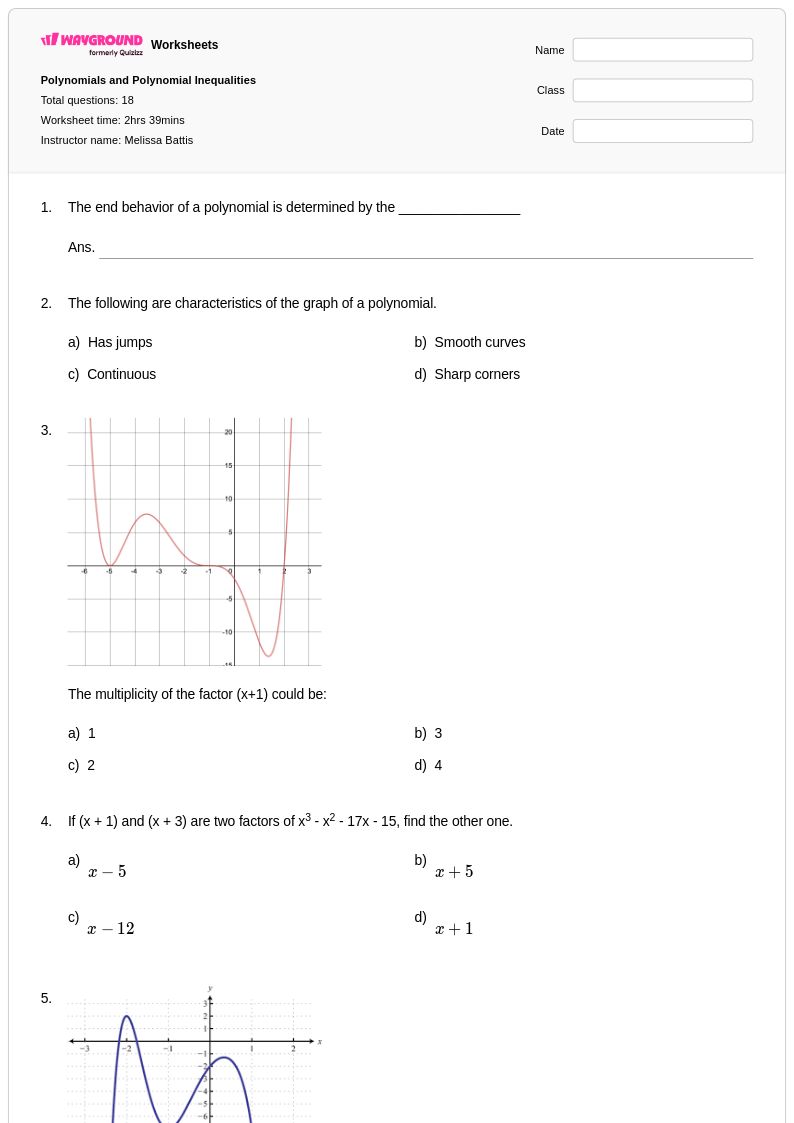
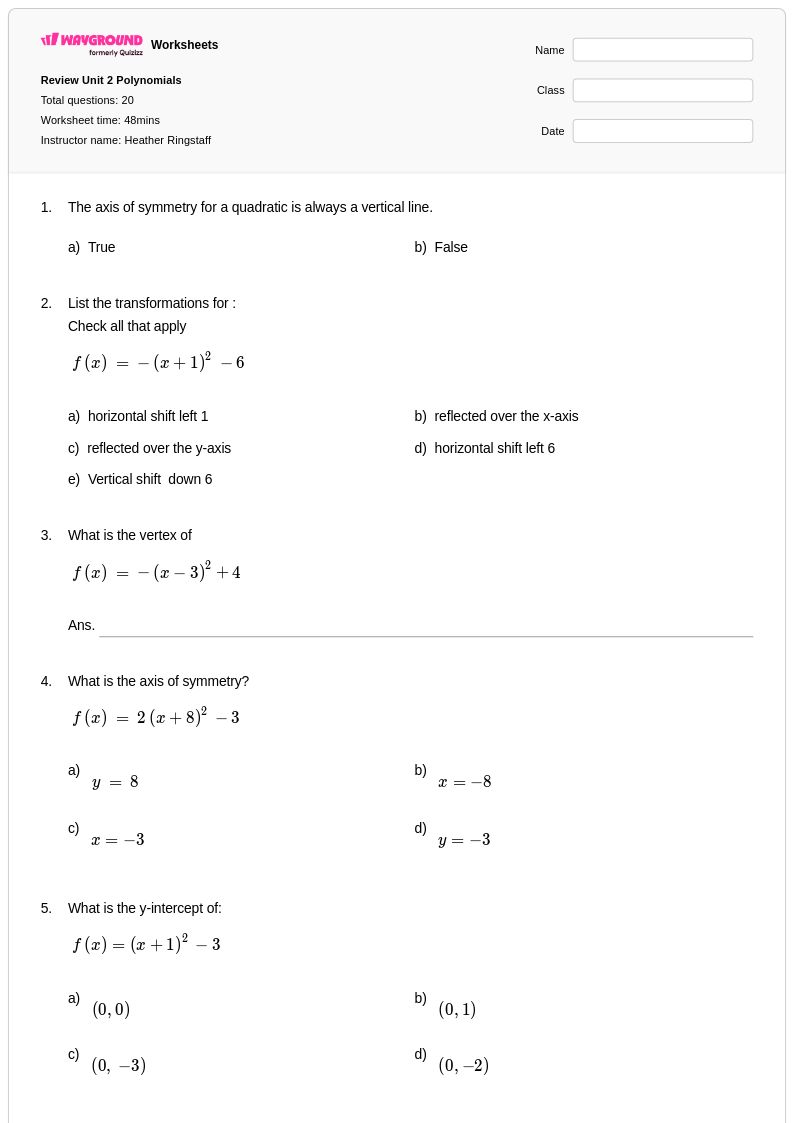
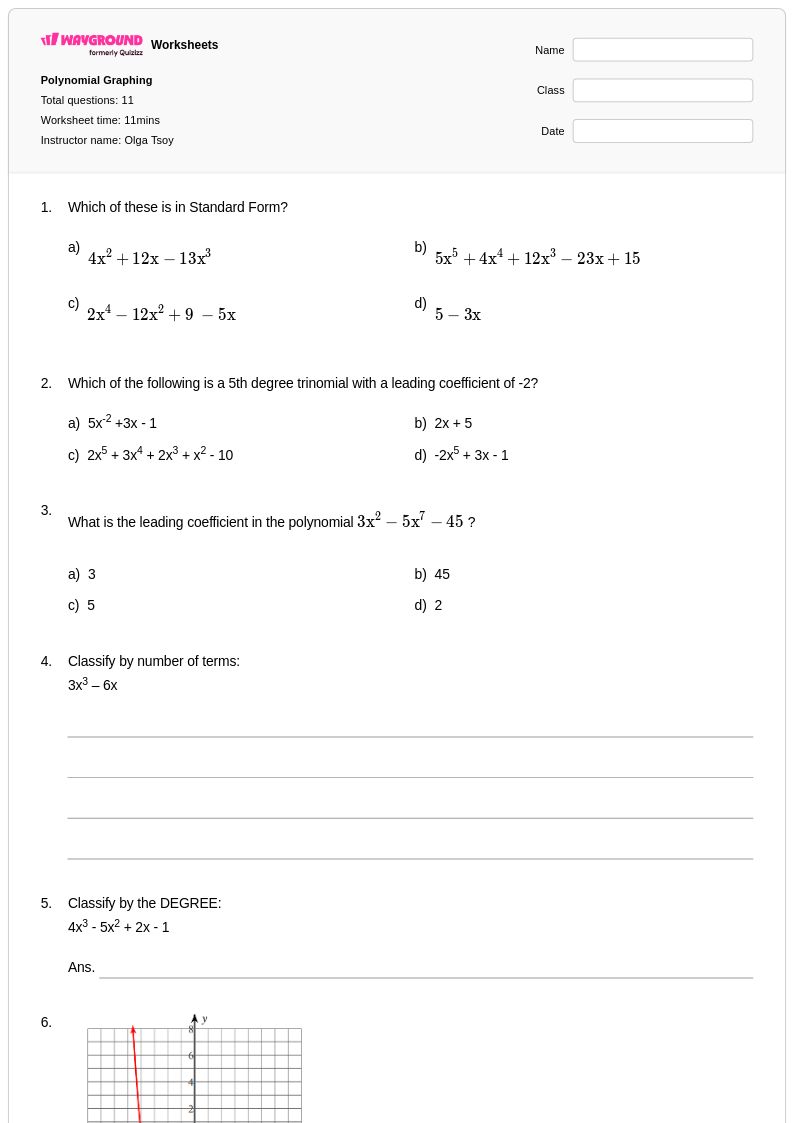
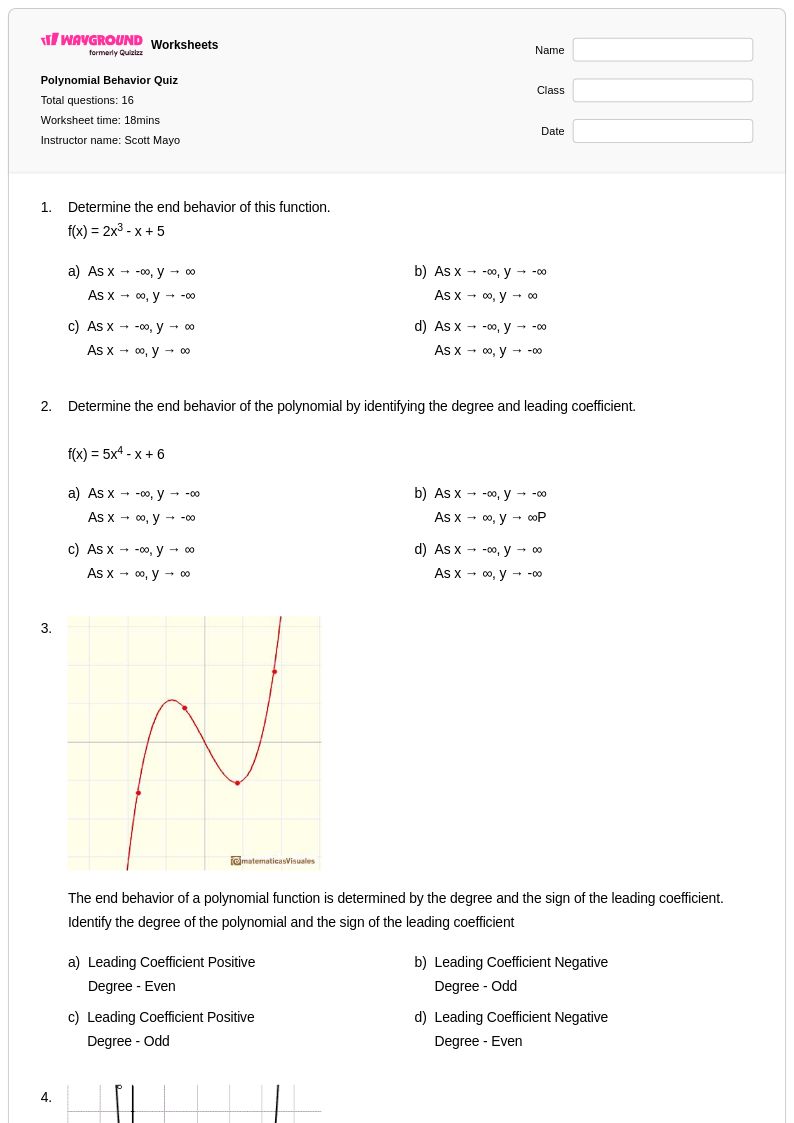
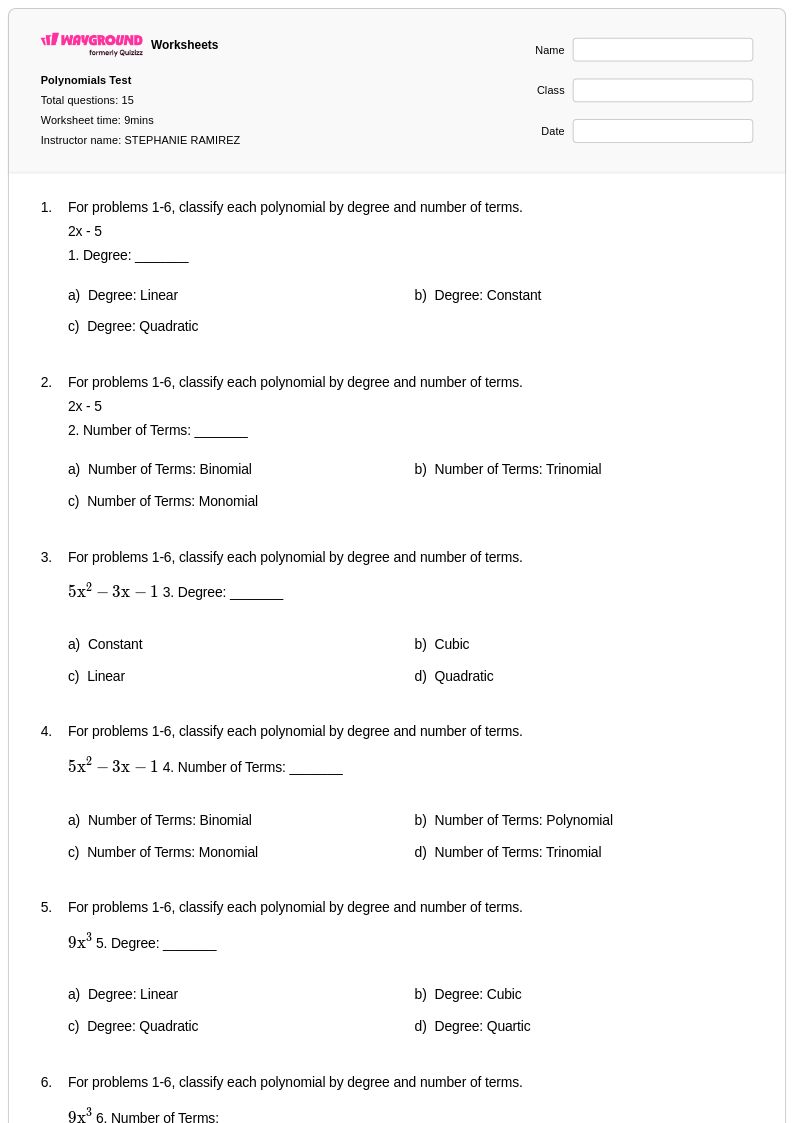
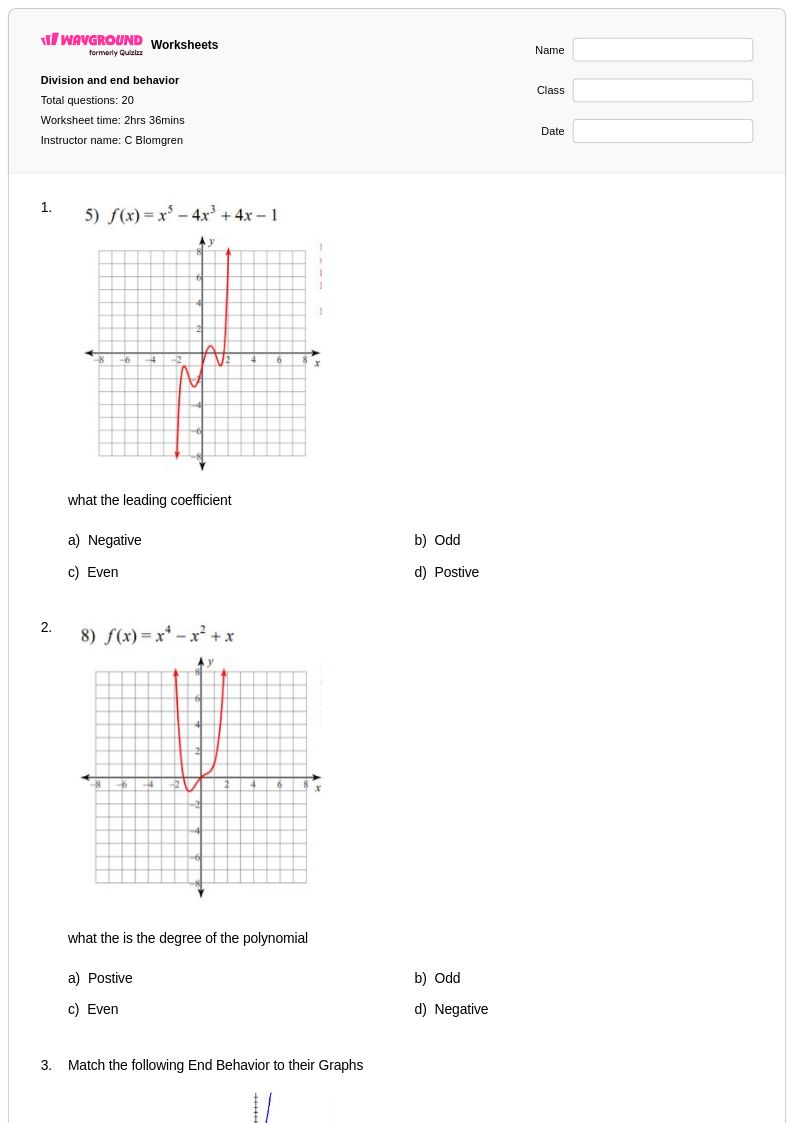
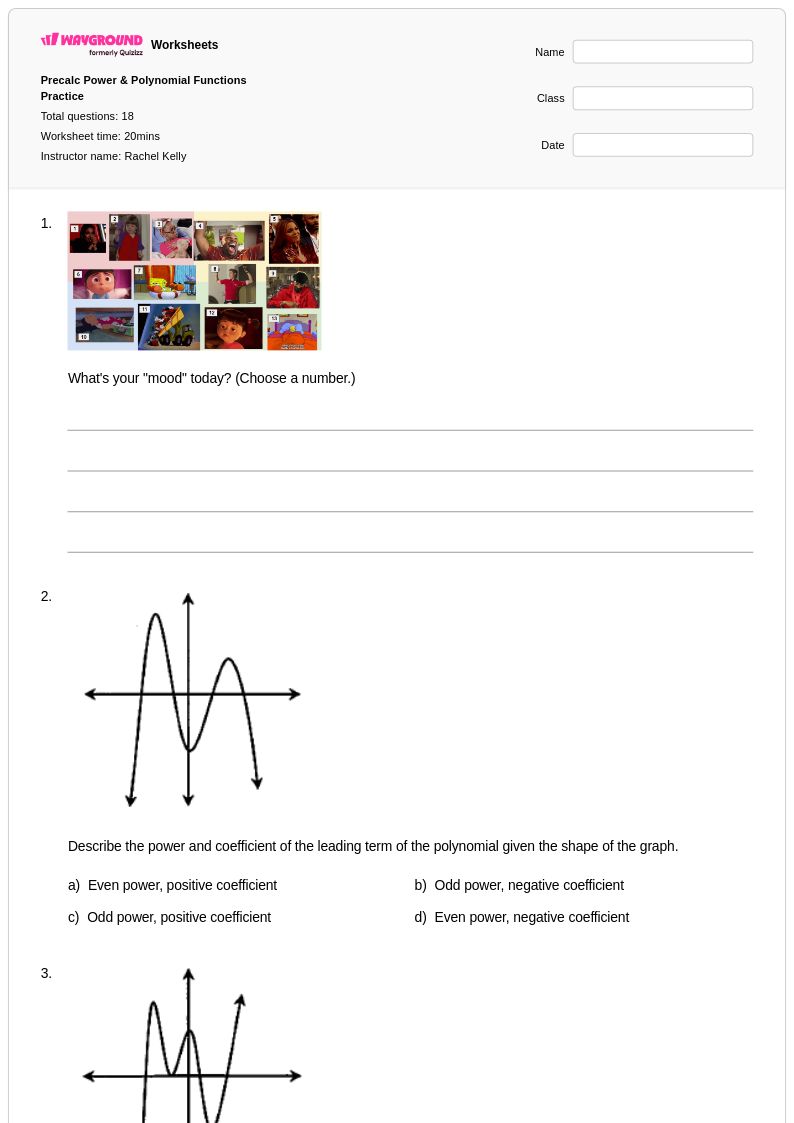
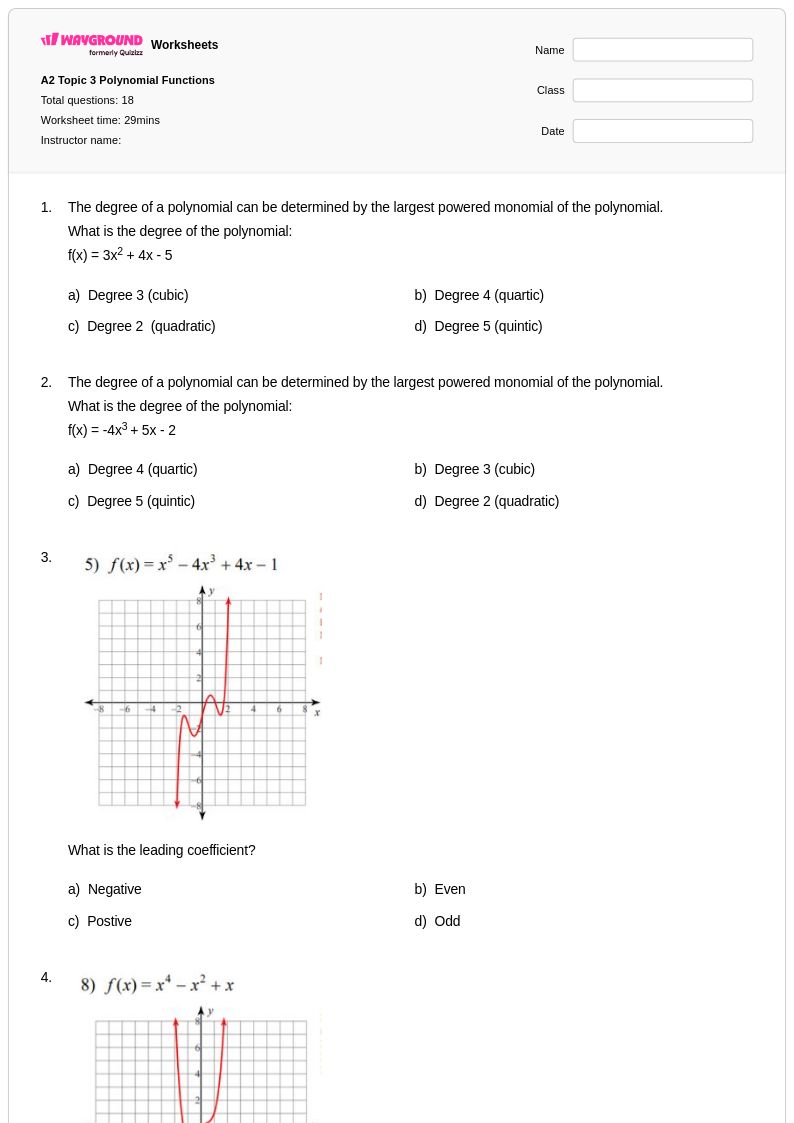
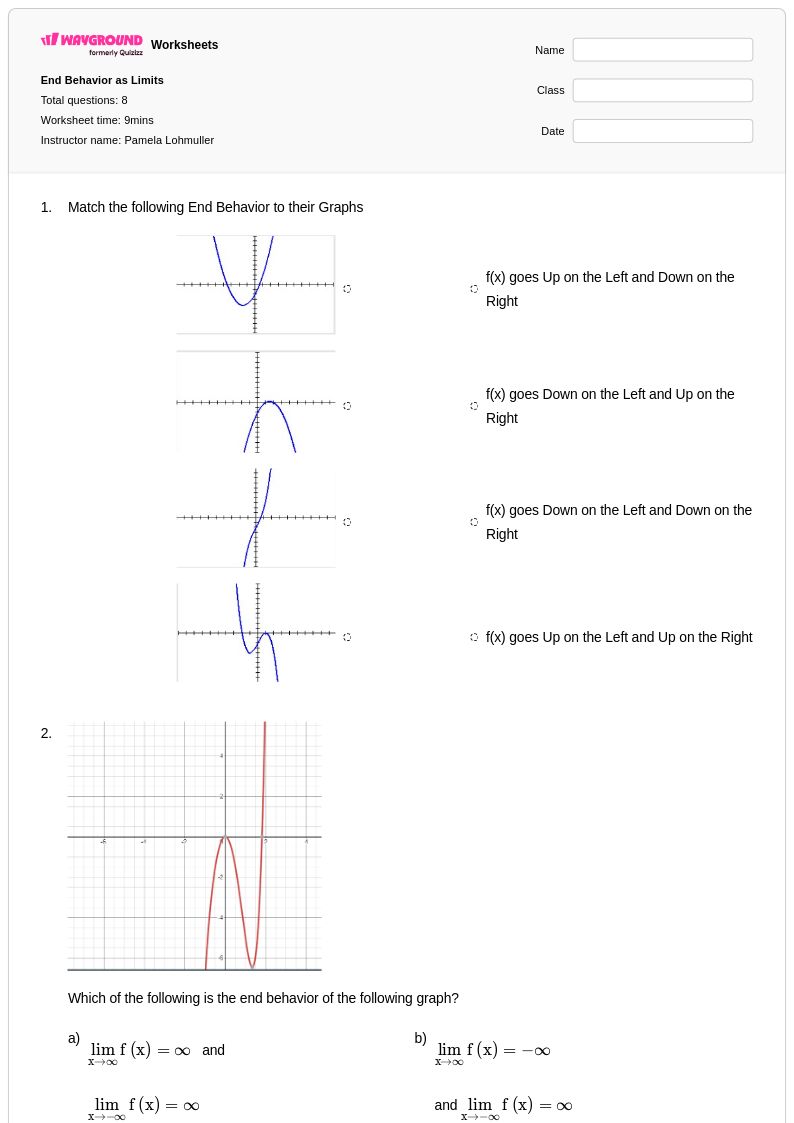
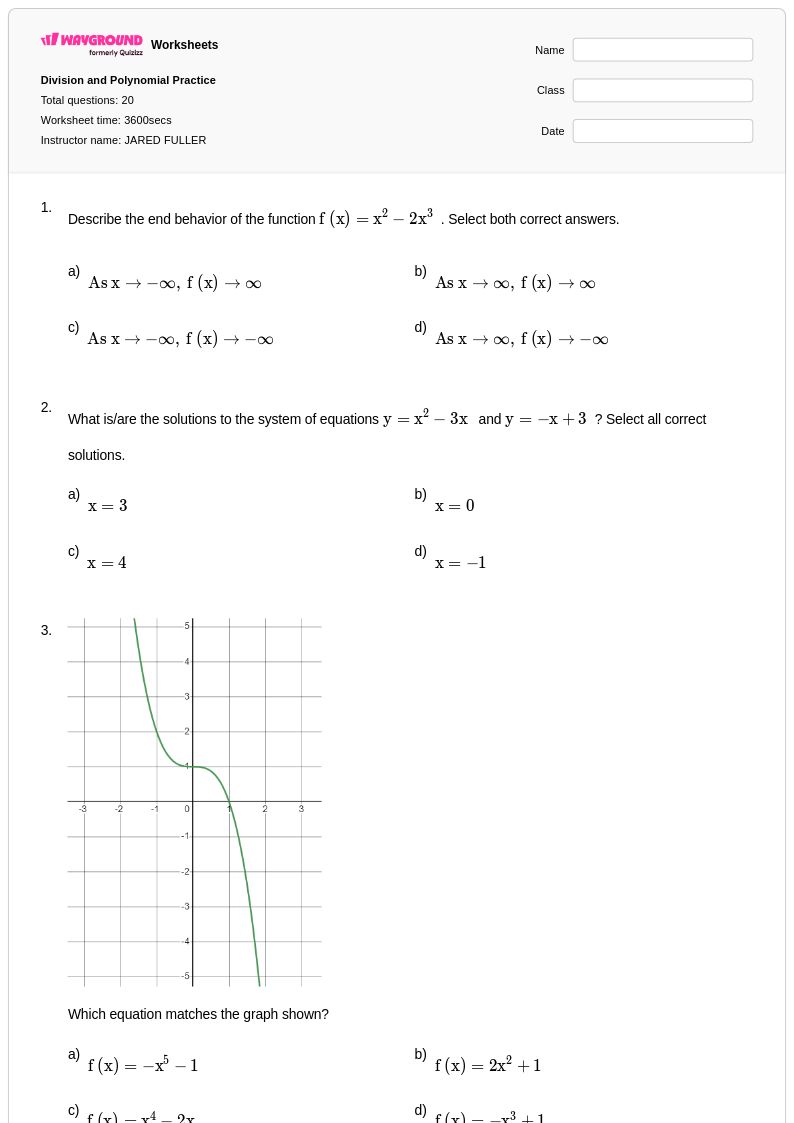
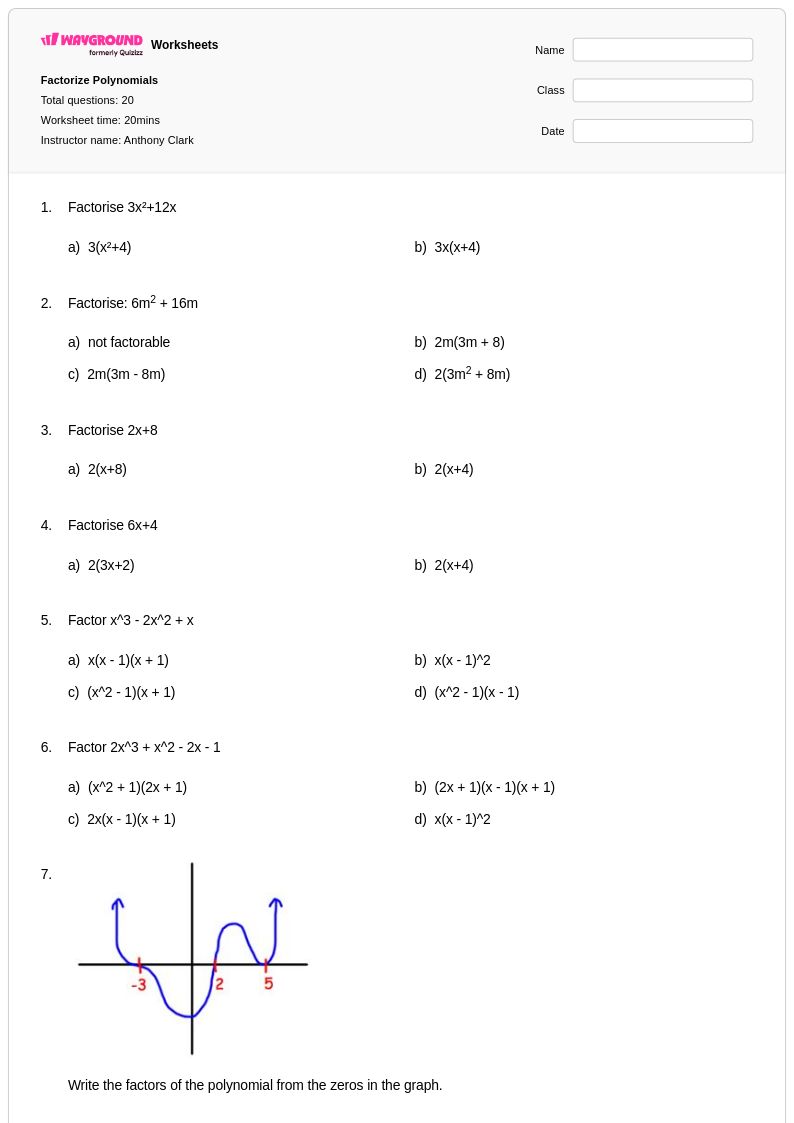
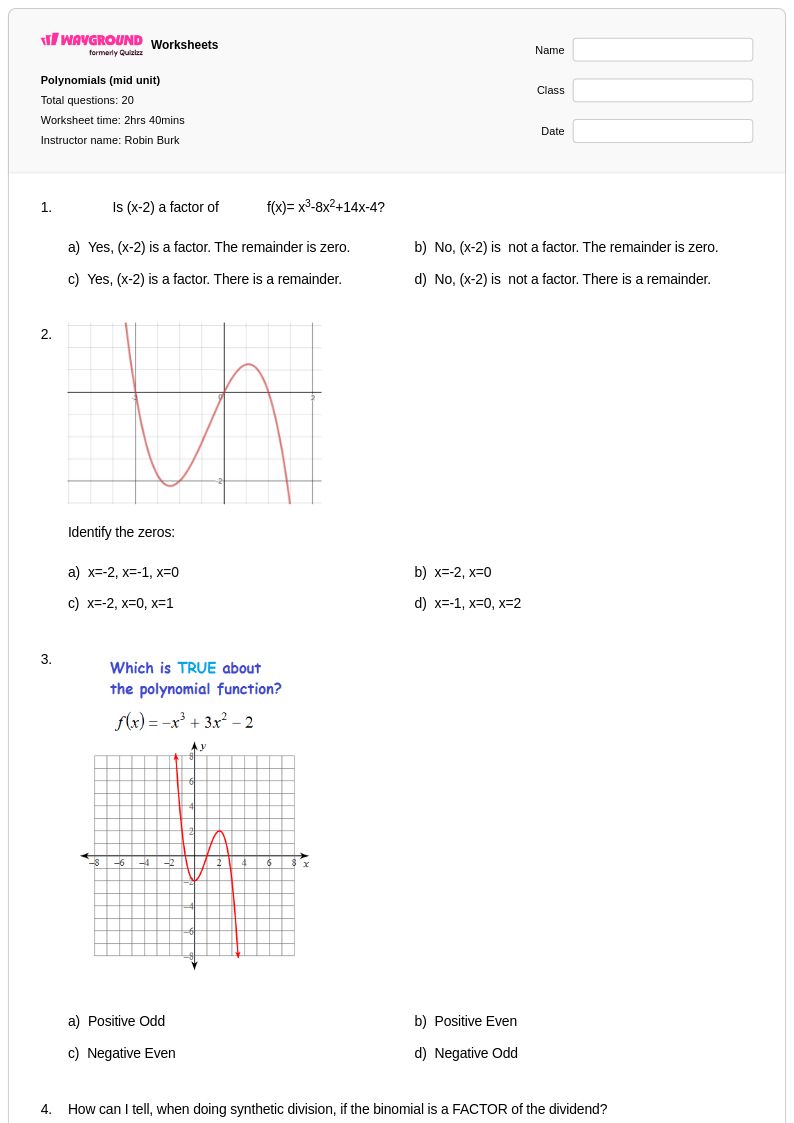
End behavior of polynomials represents a fundamental concept in Class 12 algebra that requires students to analyze how polynomial functions behave as their input values approach positive and negative infinity. Wayground's comprehensive worksheet collection focuses specifically on this critical algebraic skill, providing students with structured practice problems that guide them through identifying leading coefficients, determining degrees, and predicting end behavior patterns. These expertly crafted worksheets strengthen students' ability to connect algebraic expressions with their graphical representations, building essential foundations for calculus readiness. Each worksheet comes complete with detailed answer keys and is available as free printable resources, allowing students to work through polynomial end behavior scenarios systematically while developing the analytical thinking skills necessary for advanced mathematical reasoning.
Wayground's extensive library of teacher-created resources supports educators in delivering effective instruction on polynomial end behavior through millions of carefully curated materials that can be easily searched and filtered by specific algebraic concepts. The platform's robust differentiation tools enable teachers to customize worksheets based on individual student needs, whether for remediation of foundational polynomial concepts or enrichment activities that challenge advanced learners. These resources maintain strong alignment with mathematical standards while offering flexible formatting options, including both digital interactive versions and traditional pdf printables that seamlessly integrate into existing lesson plans. Teachers can efficiently plan comprehensive units on polynomial functions, using these targeted worksheets to reinforce classroom instruction, assess student understanding, and provide focused skill practice that builds confidence in analyzing complex algebraic relationships.
FAQs
How should I teach end behavior of polynomials to Grade 12 students preparing for calculus?
At Grade 12, end behavior is best taught as an informal introduction to limits at infinity. Instead of just asking students to state that a function goes to positive infinity, ask them to describe what's happening to the y-values as x grows without bound — and why the leading term dominates all others. This framing makes the transition to limit notation in calculus much smoother. Students who understand end behavior as a rate-of-growth argument, not just a rule about degree and sign, are far better prepared for what comes next.
What practice problems prepare Grade 12 students to apply end behavior in calculus?
Focus on three types: analyzing end behavior of rational functions by comparing the degree of numerator and denominator (a natural extension of polynomial end behavior), sketching complete polynomial graphs using end behavior alongside zeros and multiplicity, and interpreting end behavior in applied contexts where x represents a real quantity like time or population. These problems push students to use end behavior as an analytical tool rather than a classification exercise, which is the level of fluency calculus will demand.
What errors do Grade 12 students still make with polynomial end behavior?
The most common residual error at this level is mishandling polynomials in non-standard form — particularly factored form, where students forget to sum the exponents across factors to find the true degree. A subtler issue is students who can state end behavior correctly but can't explain why the leading term dominates: they've memorized the rule without the reasoning, which becomes a problem when the same logic needs to transfer to rational functions or limits. Asking students to justify their answer in one sentence — not just state it — surfaces this gap quickly.
How do I use Wayground's Grade 12 end behavior worksheets in my class?
Each worksheet includes a complete answer key, making it practical for self-directed review or pre-calculus preparation work. For in-class use, hosting the worksheet as a digital quiz on Wayground gives you scoring data immediately — useful when you're trying to identify which students need a targeted review before moving into calculus-level function analysis. The printable PDF works well for paper-based practice; you can grade submissions using the Wayground for Teachers app by scanning student work, which keeps the workflow efficient even without devices in students' hands.
How does end behavior of polynomials connect to calculus readiness in Grade 12?
End behavior is the conceptual precursor to limits at infinity. When a Grade 12 student can look at a polynomial and explain that as x → ∞ the function grows without bound because the leading term outpaces all others, they're already doing informal limit reasoning. Common Core's high school functions standards build toward exactly this kind of structural analysis — understanding why a polynomial behaves the way it does, not just what it does. Students who arrive in calculus with that understanding find limits at infinity far less abstract than students who only memorized the four end behavior cases.
How can I differentiate end behavior practice for Grade 12 students with varying calculus readiness?
For students who are calculus-bound and ready to be pushed, pair end behavior problems with introductory limit notation so they're building the bridge explicitly. For students who are still consolidating the core concept, Wayground's reduced answer choices accommodation keeps the task focused on the reasoning without the added pressure of distinguishing between four similar-looking options. If you have English language learners in a senior math class, the worksheet translation feature ensures the language barrier isn't what's standing between them and demonstrating what they know about polynomial behavior.