Free Printable Metallic Bonding Worksheets for Class 9
Explore Class 9 metallic bonding worksheets and printables through Wayground that help students master electron sea theory, metallic properties, and chemical bonding concepts with practice problems, free PDFs, and complete answer keys.
Explore printable Metallic Bonding worksheets for Class 9
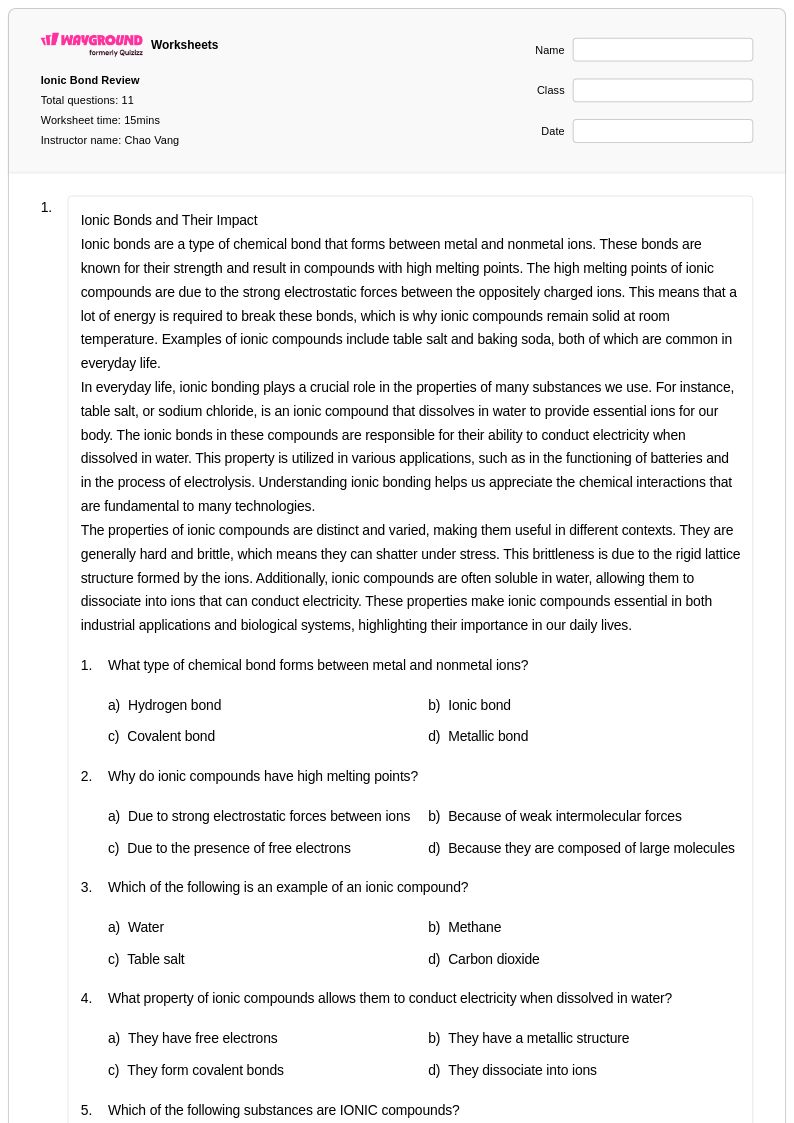
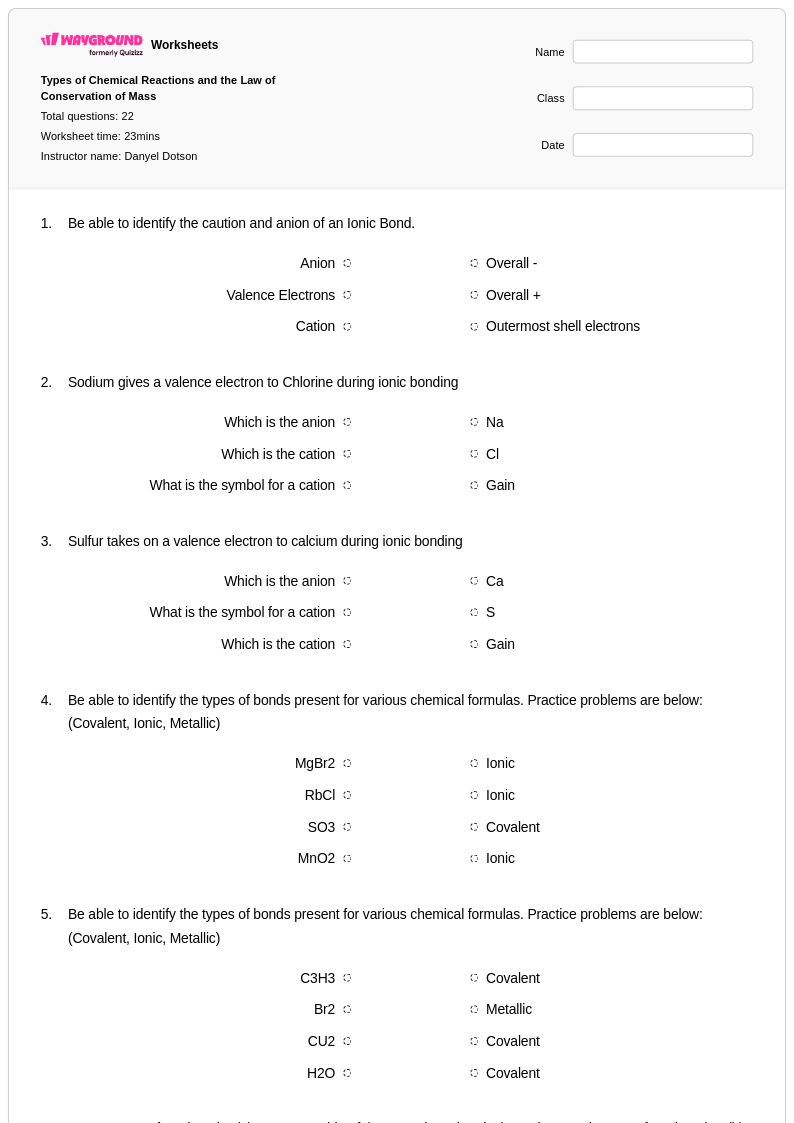
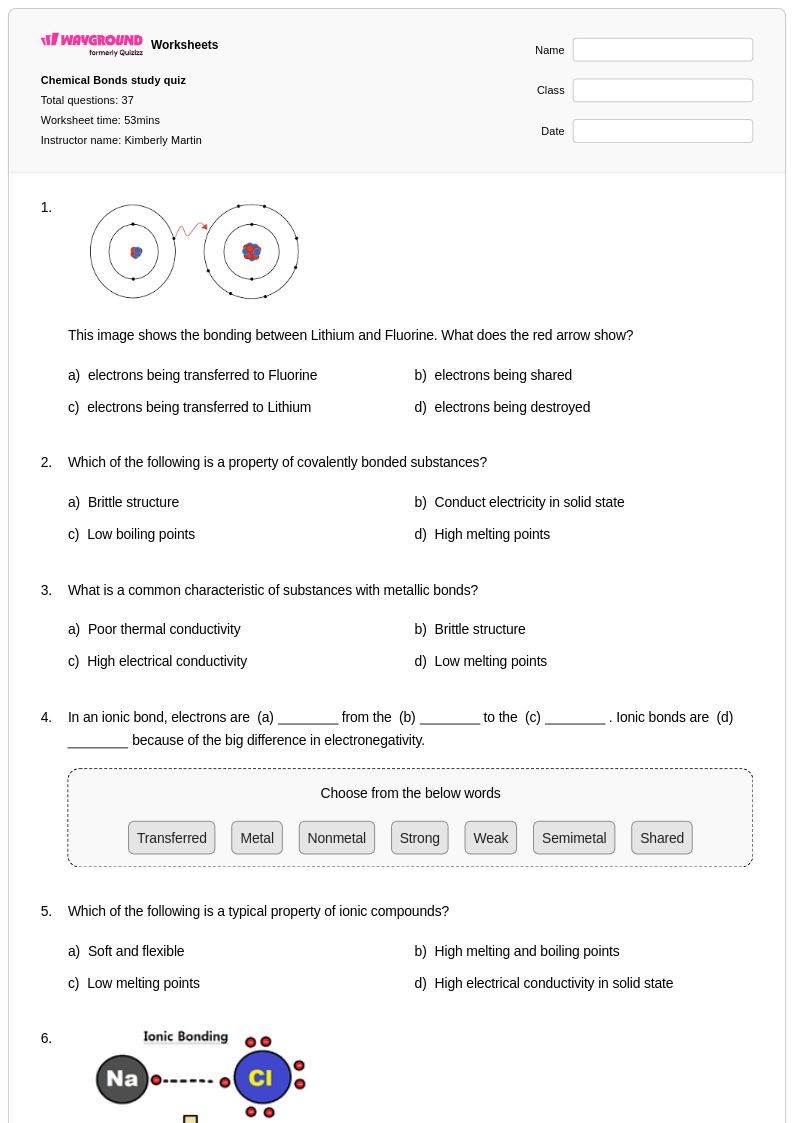
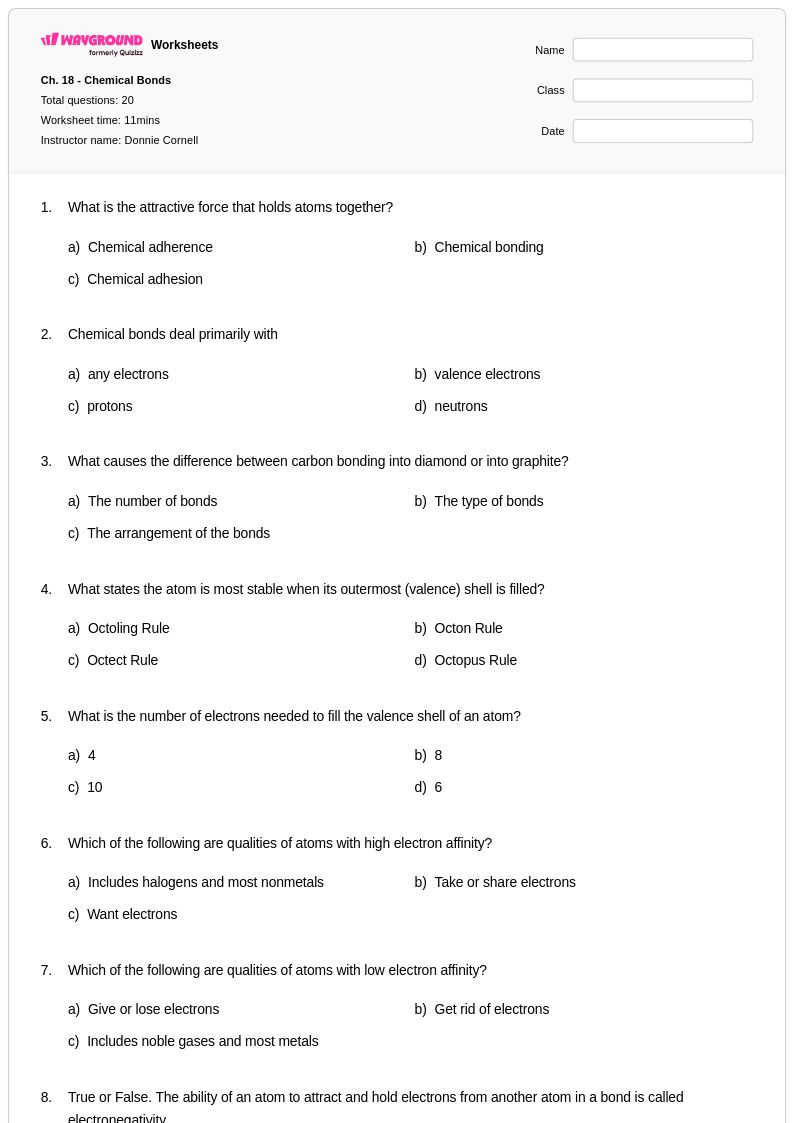
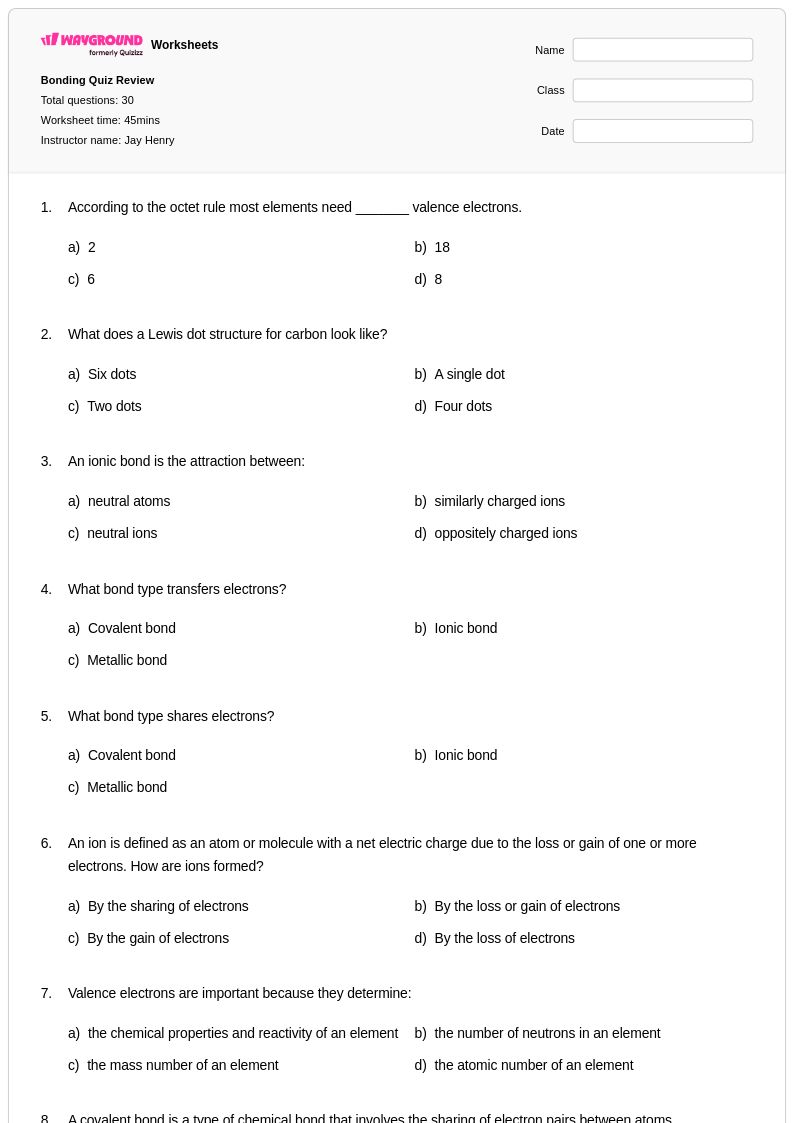
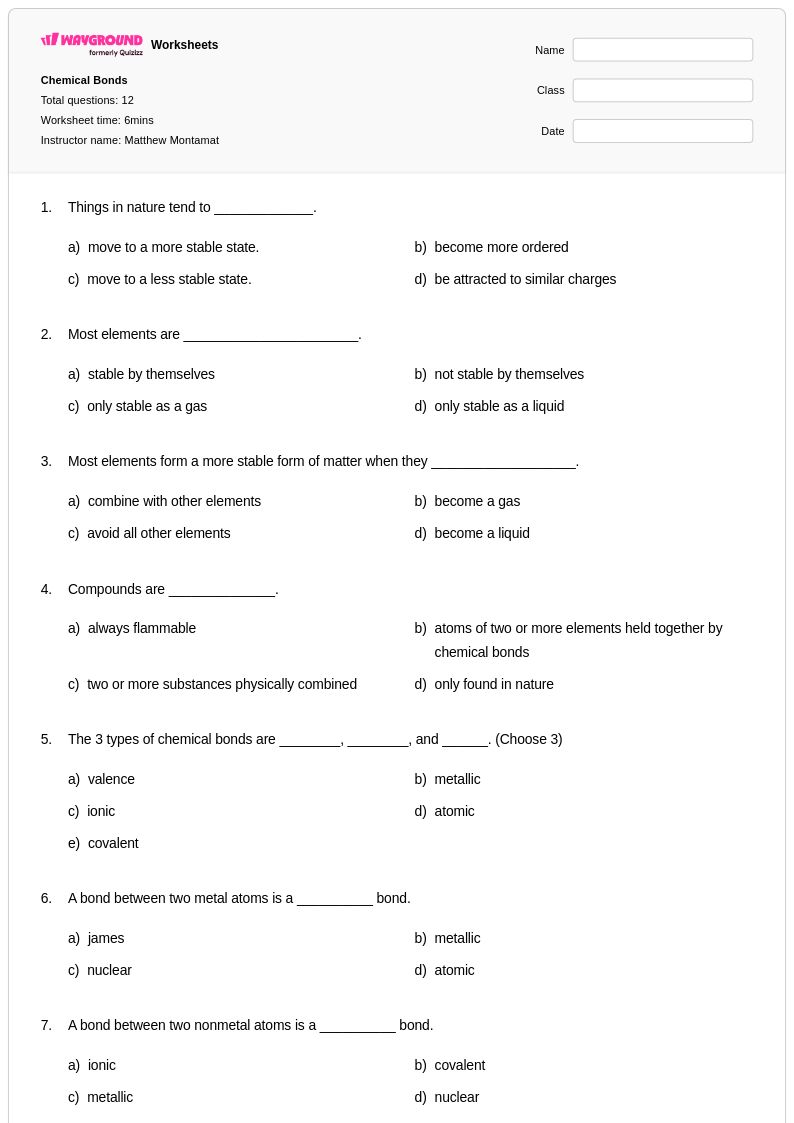
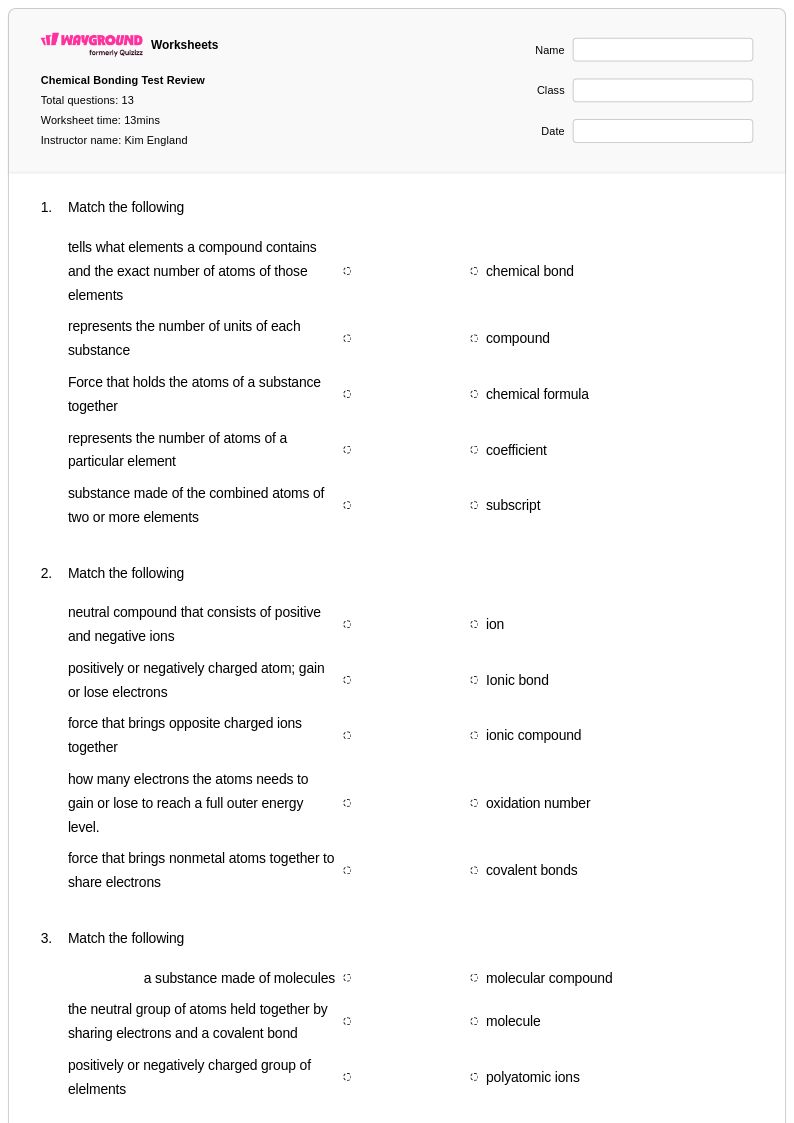
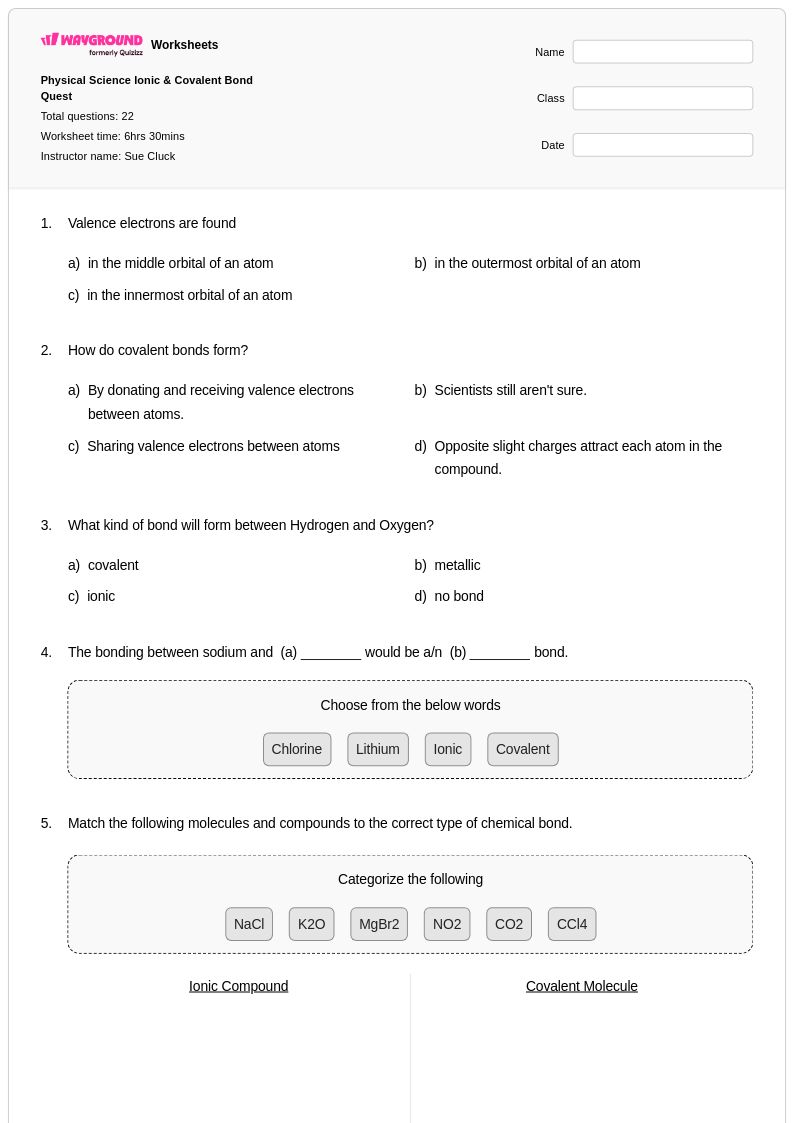
Metallic bonding worksheets for Class 9 students available through Wayground provide comprehensive coverage of this fundamental chemistry concept that explains how metal atoms share electrons in a "sea of electrons" model. These carefully designed practice problems help students understand the unique properties of metals including electrical conductivity, malleability, ductility, and luster that result from metallic bonding structures. Students work through exercises that explore how delocalized electrons create the characteristic behaviors of metallic substances, while answer key materials support independent learning and self-assessment. The free printable resources include both foundational concepts and challenging applications, allowing students to build confidence with electron mobility concepts, metallic crystal structures, and the relationship between bonding theory and observable metallic properties through structured pdf worksheets.
Wayground's extensive collection of teacher-created metallic bonding resources draws from millions of educational materials specifically developed by chemistry educators who understand Class 9 learning objectives and curriculum standards. The platform's advanced search and filtering capabilities enable teachers to quickly locate worksheets that match specific learning goals, whether focusing on basic electron sea models or more complex applications involving alloys and metallic property predictions. Standards alignment features ensure that selected materials support district requirements, while differentiation tools allow educators to modify content complexity for diverse learners. Teachers can access these resources in both printable and digital formats, including downloadable pdf versions, making lesson planning more efficient and providing flexible options for classroom instruction, homework assignments, remediation sessions, and enrichment activities that deepen student understanding of metallic bonding principles.
FAQs
How do I teach metallic bonding to high school chemistry students?
Start by grounding students in atomic structure before introducing the electron sea model, which explains how metal atoms release their valence electrons into a shared, delocalized 'sea' that holds the lattice together. Use visual diagrams showing metal cations surrounded by free-moving electrons, then connect this model directly to observable properties like electrical conductivity, malleability, and luster. Building from structure to property is the most effective sequence because it gives students a mechanistic explanation rather than a list of facts to memorize.
What exercises help students practice metallic bonding concepts?
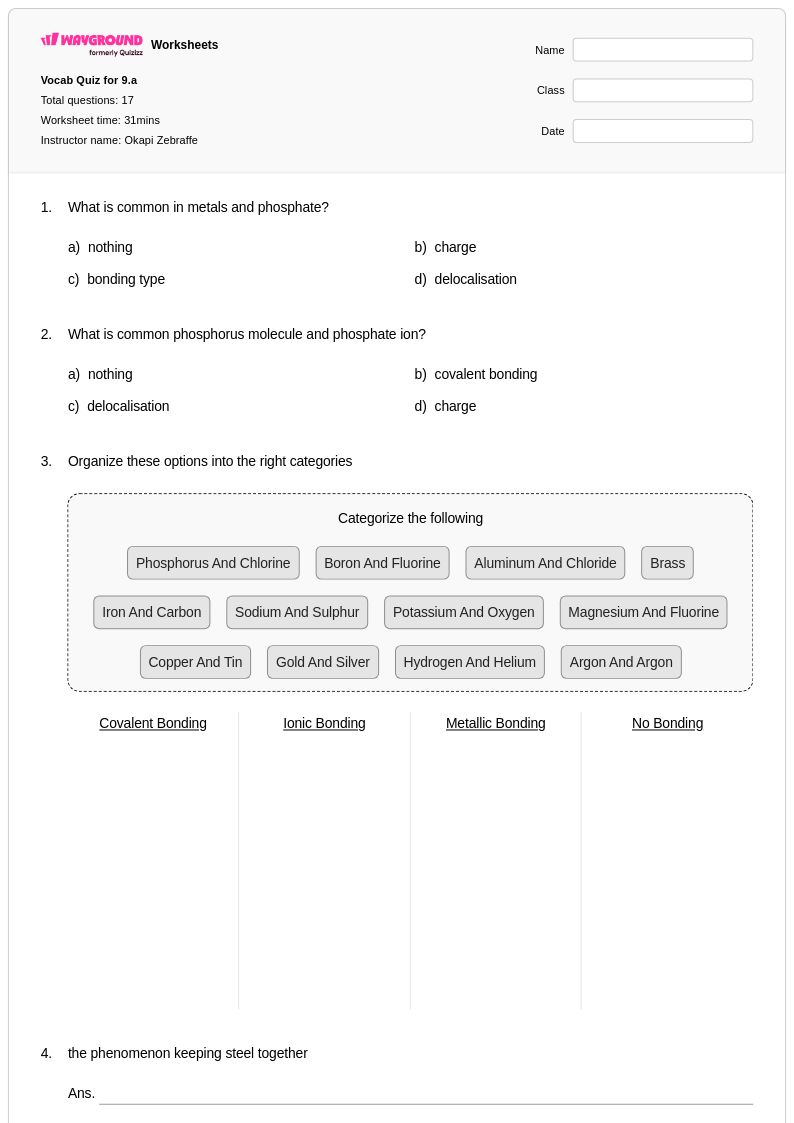
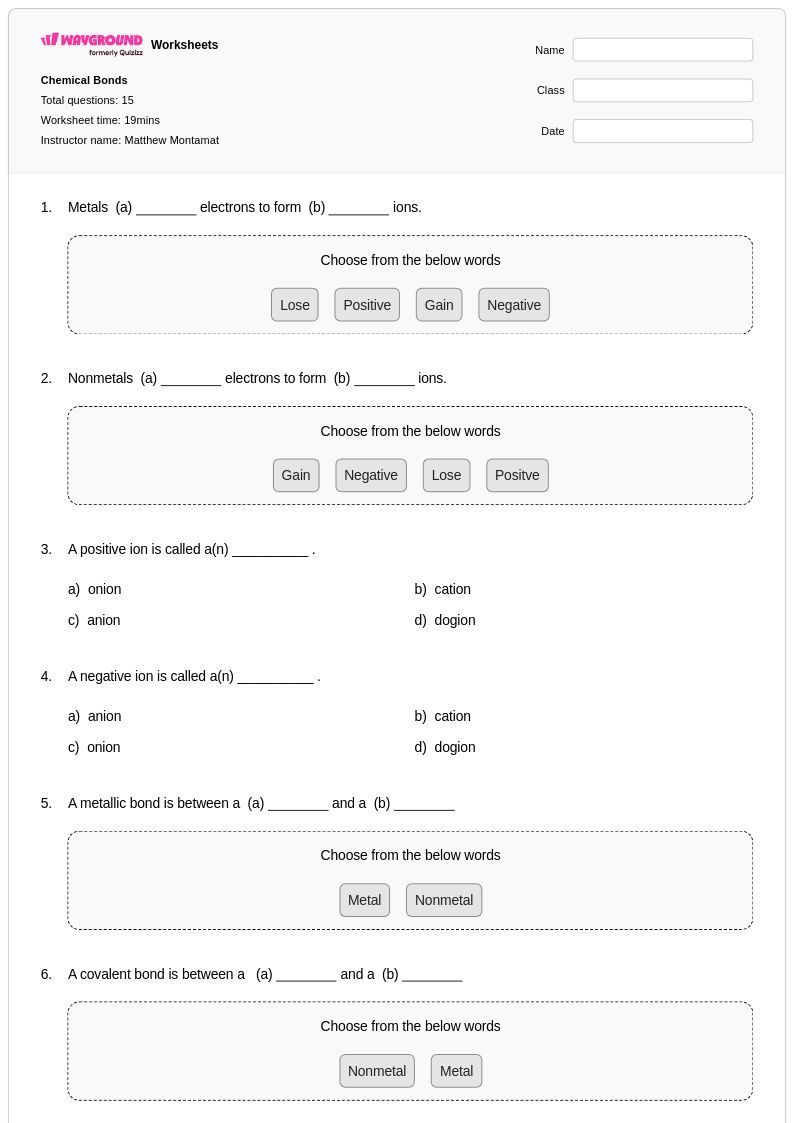
Effective practice exercises include labeling diagrams of the electron sea model, comparing metallic bonding to ionic and covalent bonding in structured tables, and answering short-answer questions that require students to explain a specific metallic property in terms of delocalized electrons. Prediction tasks, such as asking why metals can be drawn into wires while ionic compounds cannot, push students to apply the model rather than recall it. Metallic bonding worksheets on Wayground offer practice problems that cover electron sea theory, delocalized electrons, and the properties that result from this bonding type.
What mistakes do students commonly make when learning about metallic bonding?
The most common misconception is that metallic bonding works like ionic bonding, with electrons transferred to a specific atom rather than shared collectively across the entire lattice. Students also frequently struggle to explain why metals conduct electricity using the electron sea model, often describing conductivity without referencing the free movement of delocalized electrons. A third error is conflating malleability with weakness — students need to understand that the non-directional nature of the electron sea allows layers to slide without breaking the bond, which is fundamentally different from the rigid lattice of an ionic compound.
How does metallic bonding explain the physical properties of metals?
Metallic bonding explains physical properties through the electron sea model: the pool of delocalized electrons allows charge to move freely, which accounts for electrical and thermal conductivity. Because the bonding is non-directional, metal cation layers can shift position relative to one another without disrupting the overall bond, which explains malleability and ductility. The strength of metallic bonds also increases with the number of delocalized electrons per atom, which is why transition metals with more valence electrons tend to have higher melting points than alkali metals.
How can I use metallic bonding worksheets in my classroom?
Metallic bonding worksheets on Wayground are available as printable PDFs for traditional classroom use and in digital formats for technology-integrated environments, including the option to host them as a quiz directly on Wayground. Printable versions work well for guided notes, homework assignments, or lab follow-up activities, while digital formats allow for immediate feedback during class or remote learning sessions. Both formats include comprehensive answer keys, so teachers can use the same resource for direct instruction, independent practice, or formative assessment without additional preparation.
How do I differentiate metallic bonding instruction for students at different skill levels?
For foundational learners, focus on the visual electron sea diagram and have students match properties to their explanations before asking them to generate explanations independently. Advanced students can be challenged with comparative tasks, such as ranking metals by bond strength based on electron configuration or explaining anomalies like mercury's liquid state at room temperature. Wayground's differentiation tools allow teachers to customize worksheets for varying skill levels, and platform accommodations such as read aloud and reduced answer choices can be applied to individual students who need additional support.