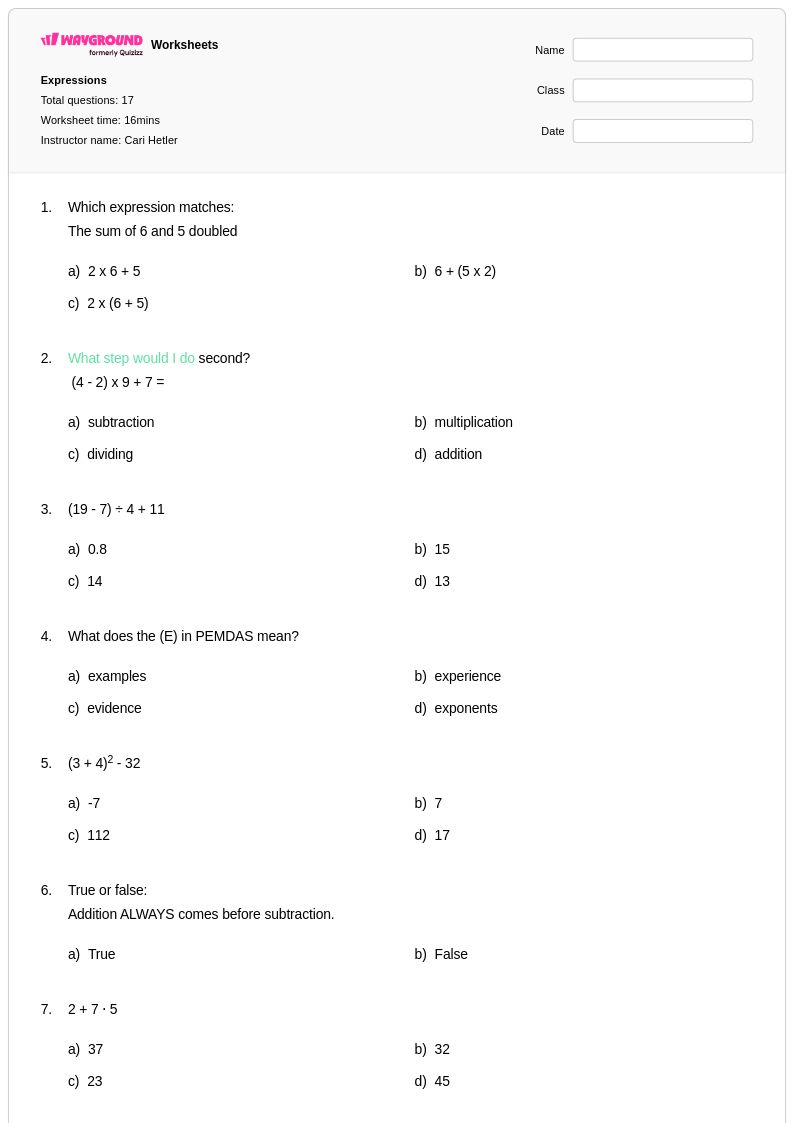
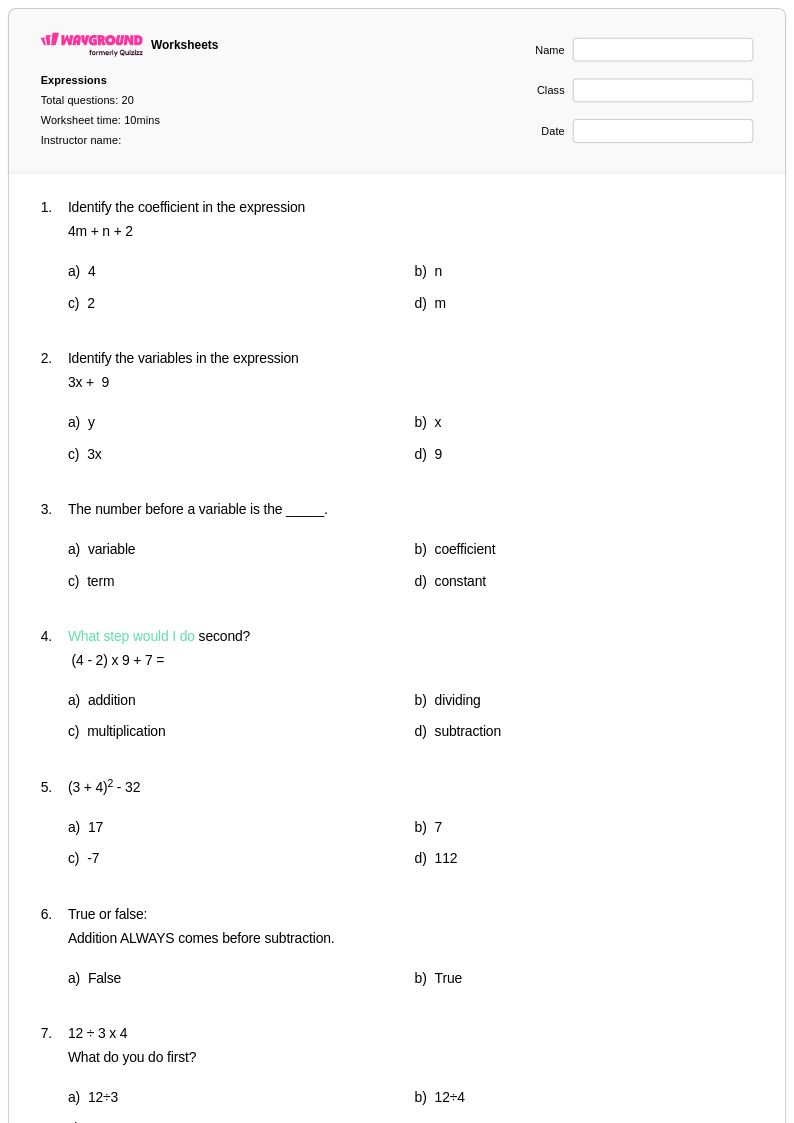
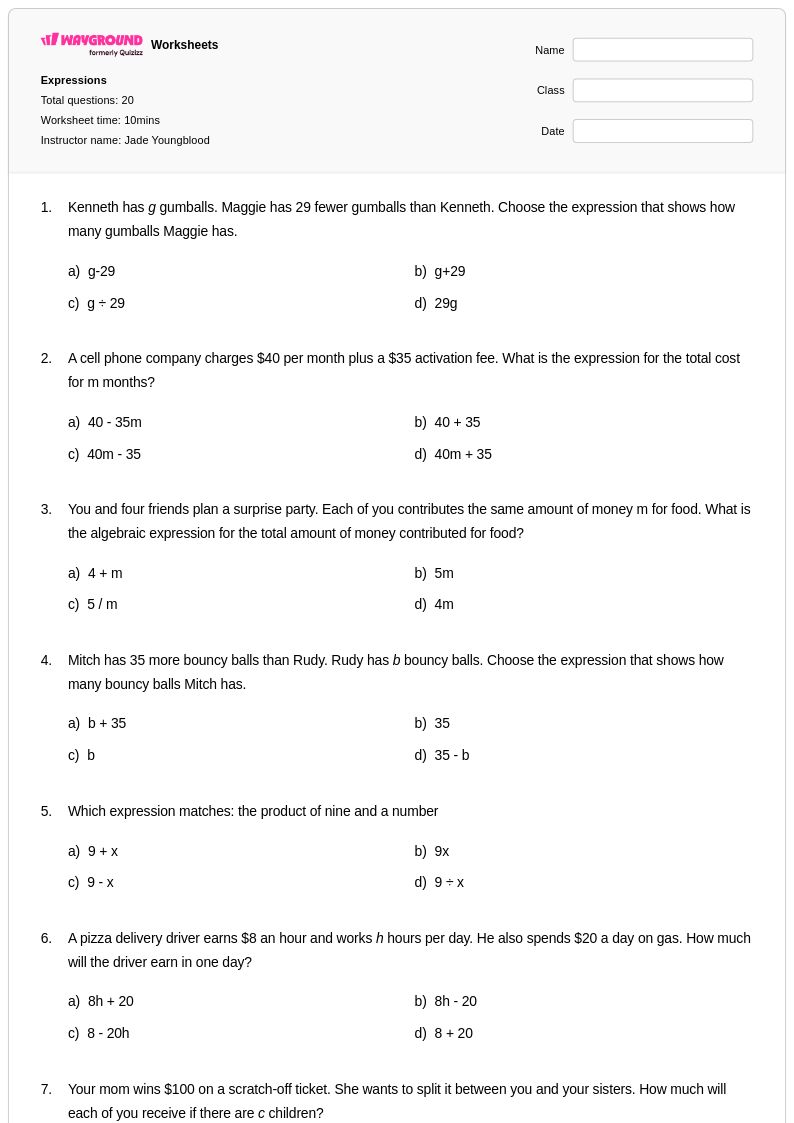
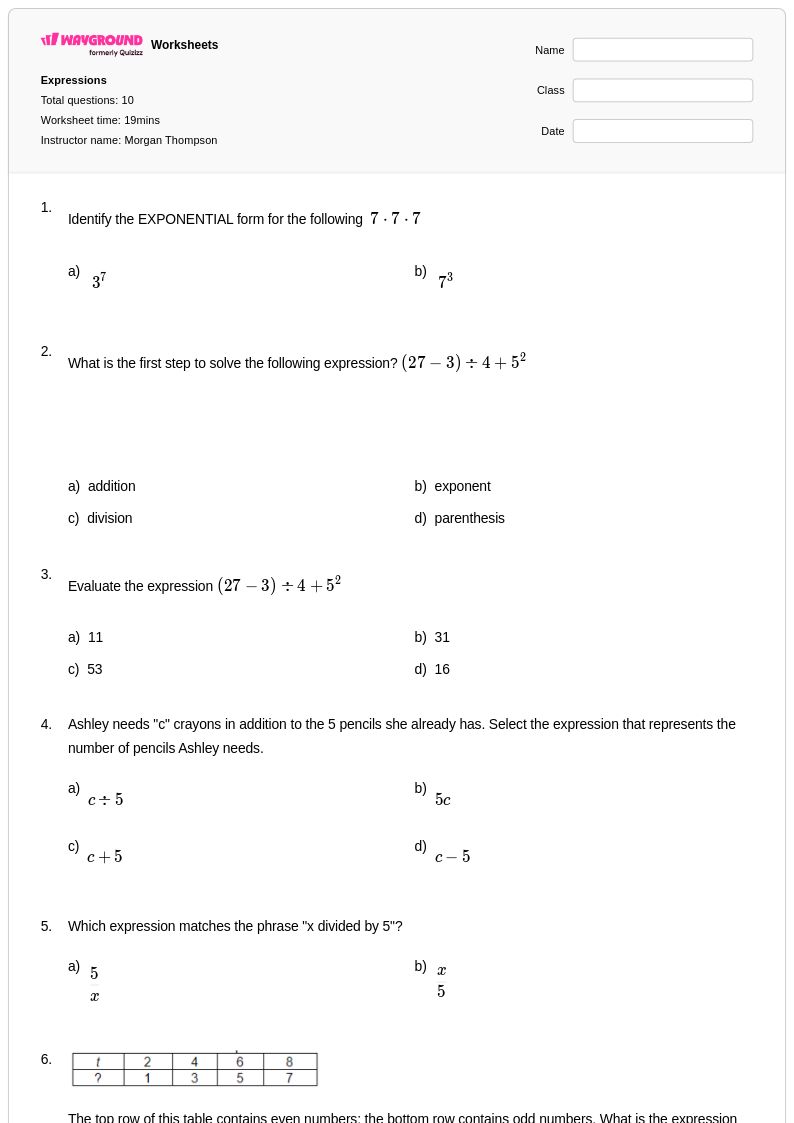
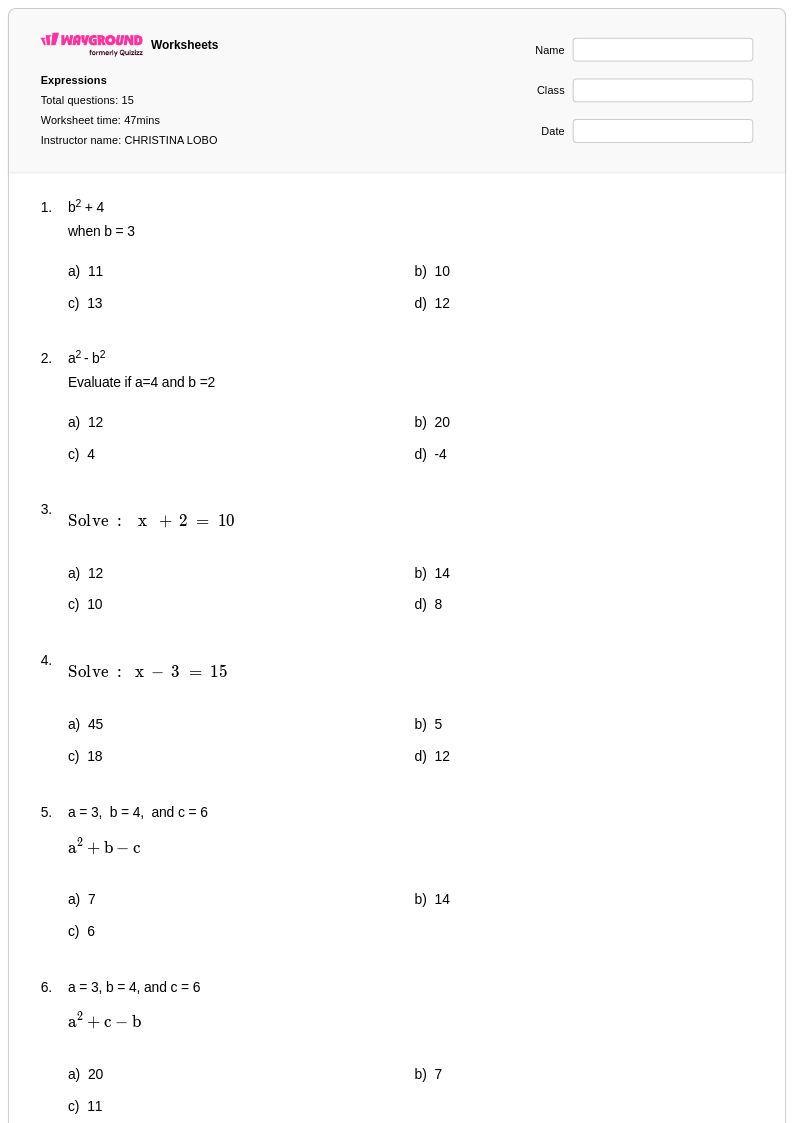
Enhance student understanding of algebraic expressions with Wayground's comprehensive collection of free worksheets, featuring printable PDFs with practice problems and answer keys to build essential algebra skills.
Expressions worksheets available through Wayground (formerly Quizizz) provide comprehensive practice opportunities for students to master the fundamental building blocks of algebraic thinking. These carefully designed resources help students develop essential skills in writing, simplifying, and evaluating algebraic expressions, including working with variables, coefficients, constants, and various mathematical operations. The worksheets feature a diverse range of practice problems that progress from basic variable identification to complex multi-step expression manipulation, ensuring students build confidence through systematic skill development. Each worksheet comes with detailed answer keys and is available in convenient pdf format, making them accessible as free printables for classroom use or independent study sessions.
Wayground (formerly Quizizz) empowers mathematics educators with an extensive collection of millions of teacher-created expression worksheets that streamline lesson planning and differentiated instruction. The platform's robust search and filtering capabilities allow teachers to quickly locate materials aligned with specific learning standards and customize content to match individual student needs and varying skill levels. These versatile resources are available in both printable pdf formats for traditional classroom settings and digital formats for technology-enhanced learning environments. Teachers can effectively utilize these worksheets for targeted remediation to address learning gaps, enrichment activities for advanced learners, and regular skill practice to reinforce algebraic concepts, while the customization tools enable seamless adaptation of difficulty levels and problem types to support diverse learning objectives.
FAQs
How do I teach algebraic expressions to students who are new to variables?
Start with the concrete before the abstract. Have students describe real situations in words first — "three more than a number" — then show how that phrase maps directly to x + 3. Once they can move between language and symbols fluently, introduce coefficients and constants as named parts of an expression rather than mysterious notation. Keeping the vocabulary explicit (term, coefficient, constant, variable) from day one prevents the confusion that compounds later when expressions get more complex.
What kinds of practice problems help students get better at working with expressions?
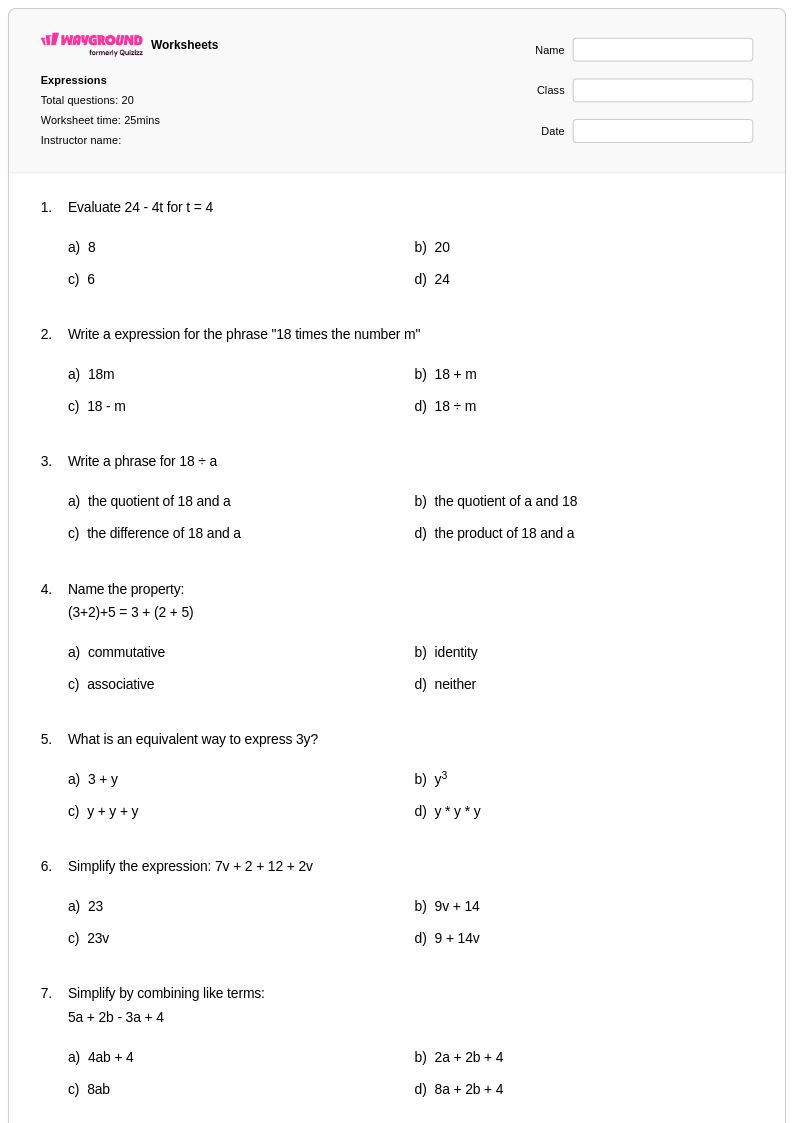
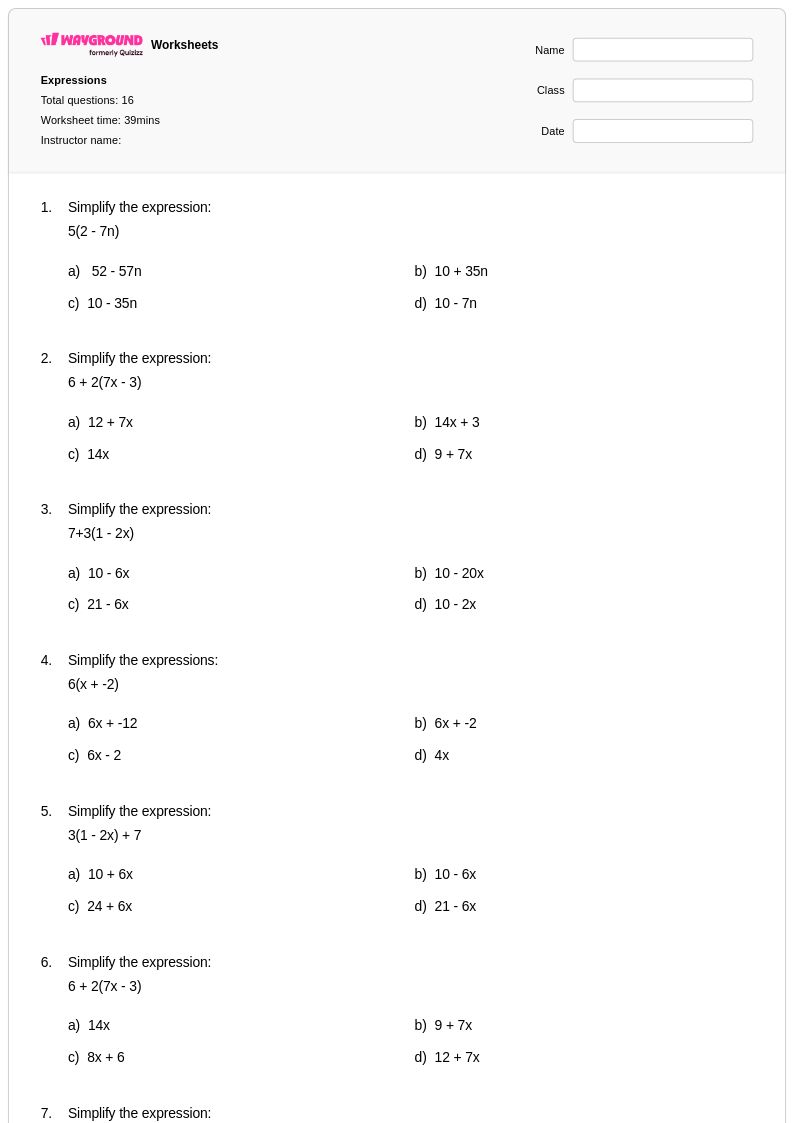
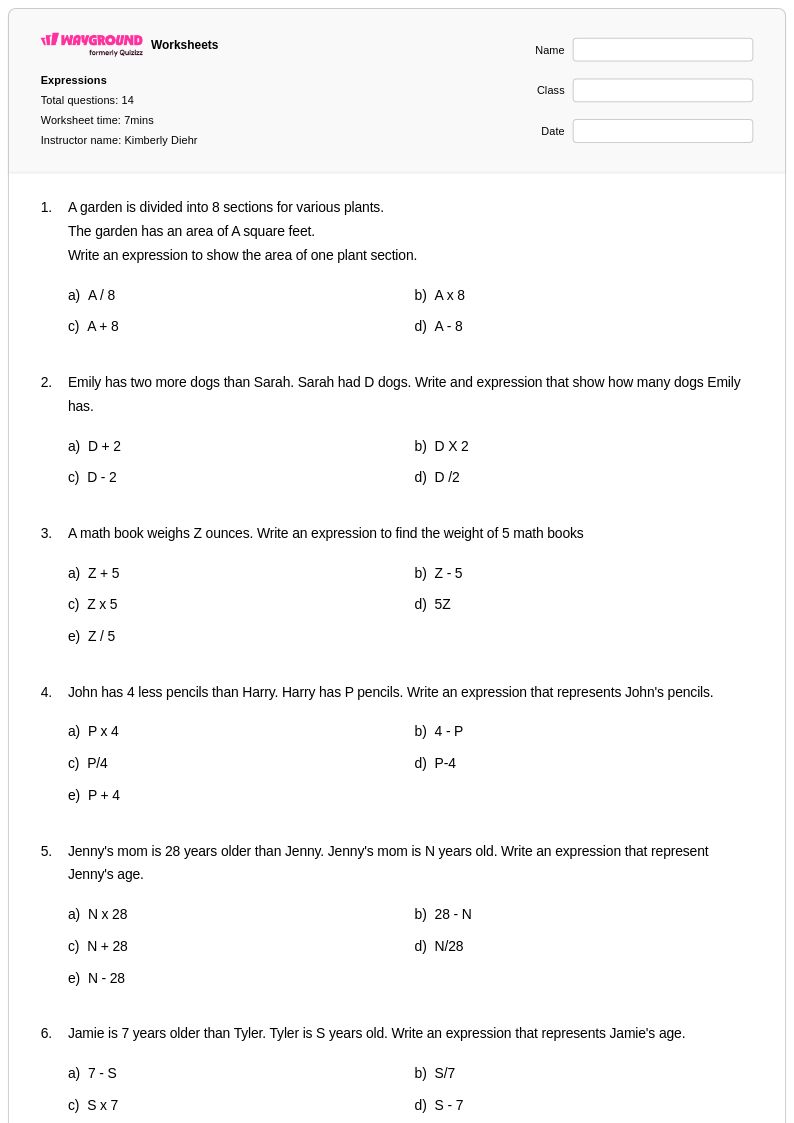
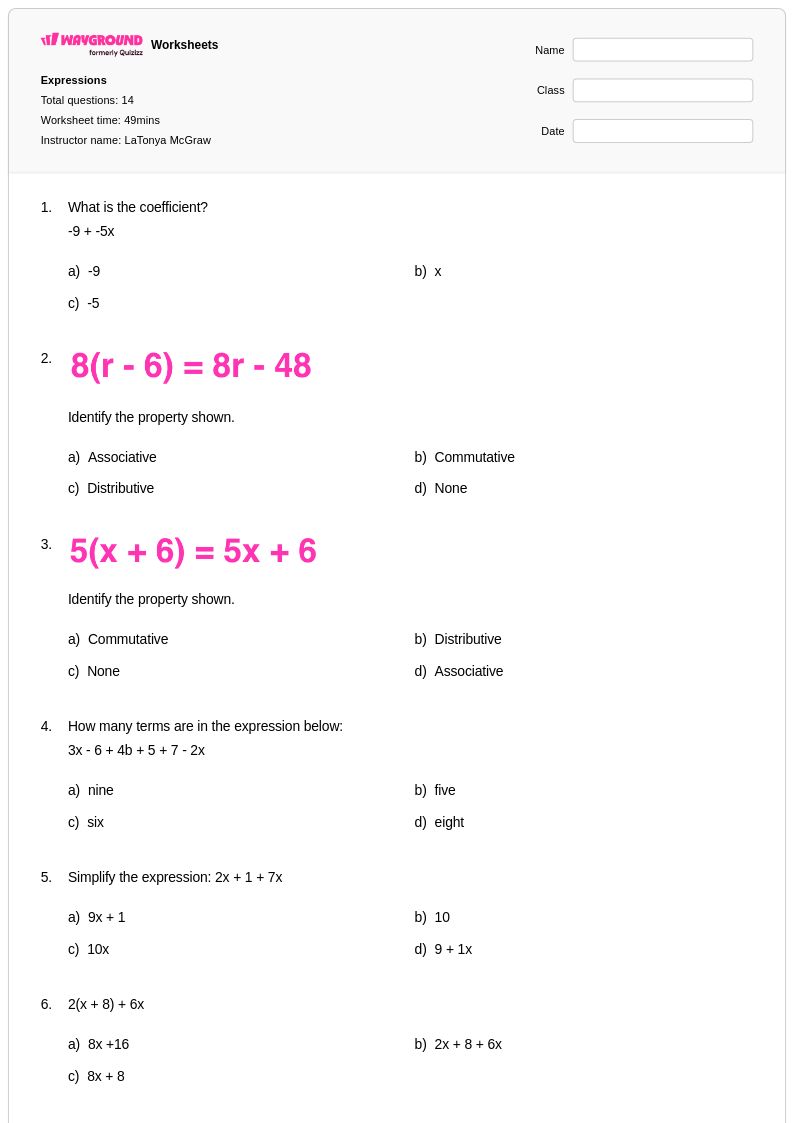
The most effective practice mixes three types: evaluating expressions by substituting given values, writing expressions from word phrases, and simplifying by combining like terms. Wayground's expressions worksheets cover all three, progressing from basic variable identification to multi-step manipulation — so students build on each skill rather than practicing in isolation.
What mistakes do students commonly make with algebraic expressions?
Three errors come up constantly. First, students treat the variable as a label rather than a quantity — writing "3a + 2a = 5a²" instead of 5a because they think combining terms means multiplying. Second, they confuse expressions with equations and try to "solve" for x when no equals sign is present. Third, when evaluating, they substitute incorrectly with negative numbers — forgetting to apply the negative to the entire term. Targeted practice on each of these, with immediate feedback, closes the gaps faster than general review.
How do I use Wayground's expressions worksheets in my classroom?
Every worksheet on Wayground includes a complete answer key, so you can assign it either way: host it as a digital quiz students complete on their devices, or download the PDF and hand it out on paper. If you go the printable route, the Wayground for Teachers app lets you scan or capture student work to grade it without re-entering anything manually. Both formats contain the same problems, so the choice comes down to what fits your classroom setup that day.
How are algebraic expressions sequenced in the Common Core math curriculum?
Common Core introduces expressions in the upper elementary grades, where students write and interpret simple expressions involving whole numbers without evaluating them — the focus is on understanding structure, not computation. By sixth grade, students apply properties of operations to generate equivalent expressions and begin working with variables in earnest. Seventh grade extends this to rational number coefficients and the distributive property, and eighth grade transitions from expressions to equations and functions. The progression is deliberately slow at first: students need to read and write expressions fluently before they manipulate them.
How can I differentiate expressions practice for students at different skill levels?
Wayground lets you create alternate versions of the same worksheet by adjusting font size, spacing, or applying a dyslexia-friendly font — useful when the barrier is readability rather than math ability. For students who need cognitive support, the platform's reduced answer choices accommodation limits the number of options displayed, which helps struggling learners focus without changing the underlying problem. Advanced students can be routed to multi-step expression problems (like multiplying binomials) while others consolidate evaluating simple expressions — same platform, different entry points.
What is an algebraic expression, and how is it different from an equation?
An algebraic expression is a combination of numbers, variables, and operations — like 4x + 7 — with no equals sign. An equation sets two expressions equal to each other, like 4x + 7 = 19, and can be solved for the variable. Students often conflate the two, so making this distinction explicit early prevents persistent confusion throughout algebra.