wayground logo

Free Printable Worksheets

NEW

Font size

S
M
L
XL
Worksheets

End of Chem

Total questions: 60

Worksheet time: 41mins

Name
Class
Date
1.
Another name for a row in the periodic table is
a)
column
b)
family
c)
group
d)
period
2.
The slow reaction of oxygen with any metal is
a)
complete combustion
b)
incomplete combustion
c)
corrosion
d)
rusting
3.
The fast reaction of oxygen with fuel is
a)
combustion
b)
corrosion
c)
reduction
d)
none of the above
4.
The number of protons in an atom is equal to the
a)
atomic mass
b)
atomic number
c)
atomic weight
d)
mass number
5.
The atomic mass rounded to the nearest whole number is called the
a)
atomic number
b)
number of neutrons
c)
mass number
d)
rounded mass
6.
The modern periodic table is organized according to the
a)
atomic number
b)
number of neutrons
c)
atomic mass or size
d)
state at room temperature
7.
Who organized all the elements in the periodic table?
a)
Rutherford
b)
Bohr
c)
Empidocles
d)
Mendeleev
8.
Who said matter is made up of indivisible parts called "atoms"
a)
Democritus
b)
Aristotle
c)
Nagaoka
d)
Emopedocles
9.
Who compared the model of the atom to planets orbiting the sun?
a)
Thompson
b)
Rutherford
c)
Bohr
d)
Nagaoka
10.
Who compared the atom to a raisin bun, plum pudding or a watermelon?
a)
Aristotle
b)
Dalton
c)
Thompson
d)
Bohr
11.
Who saw similarities between atoms and beehives since electrons orbit like bees around the nucleus
a)
Aristotle
b)
Thompson
c)
Rutherford
d)
Bohr
12.
Who said atoms have no protons, neutrons, or electrons (they were just balls!)
a)
Aristotle
b)
Dalton
c)
Thompson
d)
Nagaoka
13.

What is the modern model of the atom associated with?

a)

a cloud of electrons

b)

a cherry pit

c)

earth, air, fire and water

d)

the solar system

14.
What is the charge and location of an electron?
a)
negative and in nucleus
b)
negative and orbiting nucleus
c)
positive in nucleus
d)
neutral and orbiting around nucleus
15.
What is the charge and location of a proton?
a)
negative in the nucleus
b)
neutral in nucleus
c)
positive in nucleus
d)
positive orbitting nucleus
16.
What is the charge and location of a neutron?
a)
negative in nucleus
b)
negative orbiting nucleus
c)
neutral in nucleus
d)
neutral orbiting nucleus
17.
What is the mass of a neutron relative to a proton?
a)
0
b)
1
c)
2
d)
1/1000
18.
What is the mass of an electron relative to a proton?
a)
0
b)
1
c)
2
d)
-1
19.
Which of the following lists contain only compounds?
a)
O2, CO2, H20, NaCl
b)
CO2, H20, NaCl
c)
NaCl & H20, H2
d)
O2
20.
Which of the following is incorrectly named?
a)
H20 - water  
b)
NaCl - sodium chloride
c)
O2 - dioxide
d)
CO2 - carbon dioxide
21.
What did Rutherford's experiment consist of?
a)
positive particles, atoms of thin gold foil, screen with slit
b)
negative particles, atoms of thin gold foil, screen with slit
c)
positive particles, thick gold foil, screen with no slit
d)
neutral particles, atoms of thin gold foil, screen with slit
22.
What did Rutherford predict would happen?
a)
+ve particles would go straight through, some being slowed/deflected at very small angles
b)
+ve particles would go straight through without slowing or deflecting at all
c)
some +ve particles would go straight through, but some would be slowed/deflected at very large angles
d)
+ve particles would go straight through, some being quickened/deflected at very small angles
23.
What actually happened in Rutherford's experiment?
a)
+ve particles went straight through, some slowed/deflected at very small angles
b)
most particles passed through unaffected but a small number were deflected at very large angles
c)
most particles passed through unaffected by some deflected by very small angles
d)
particles were not able to go through the screen with a slit in it.
24.
How did the Thomson model of the atom change as a result of Rutherford's experiment?
a)
centre("nucleus") of atom had a positive charge, surrounded by cloud of -ve electrons & most of atom is empty space
b)
centre ("nucleus") of atom had negative charge, surrounded by cloud of +ve electrons
c)
centre ("nucleus") of atom had negative charge, surrounded by cloud of +ve protons
d)
centre ("nucleus") of atom had positive charge surrounded by cloud of neutral electrons
25.
What particle was eventually proposed as part of the atom based on Rutherford's experiment?
a)
proton
b)
neutron
c)
electron
d)
nucleus
26.
Which of the following is always a metalloid?
a)
mercury
b)
aluminum
c)
silicon
d)
carbon
27.
Which of the following is a transition metal?
a)
aluminum
b)
mercury
c)
lead
d)
calcium
28.
Why does ice have a lower density than water?
a)
the orientation of the bonds within the water molecule cause molecules to push further apart, lowering density
b)
most elements when frozen have a lower density than in liquid form
c)
it doesn't..... it has an equal density so appears to float but is equal
d)
orientation of bonds between water molecules cause molecules to push farther apart lowering the density
29.
What state of matter are the alkali metals at room temperature?
a)
solid
b)
liquid
c)
gas
d)
plasma
30.
What state of matter are the alkaline earth metals at room temperature?
a)
solid
b)
liquid
c)
gas
d)
plasma
31.
How many electrons are in the outer orbit/shell of alkali metals?
a)
0
b)
1
c)
2
d)
it varies
32.
How many electrons are in the outer orbital/shell of alkaline earth metals?
a)
0
b)
1
c)
2
d)
it varies
33.
A potassium atom has how many orbitals?
a)
1
b)
2
c)
3
d)
4
34.
A phosphorus atom has how many orbitals?
a)
1
b)
2
c)
3
d)
4
35.
A sulfur atom has how many orbitals?
a)
1
b)
2
c)
3
d)
4
36.
A sodium atom has how many orbitals?
a)
1
b)
2
c)
3
d)
4
37.
If there are 20 electrons in an atom, how many would each orbital contain?
a)
2,8,8,2
b)
8,8,4
c)
2,8,10
d)
2,8,2,8
38.
If an atom has 14 electrons, how many electrons would be in each orbital?
a)
2,8,4
b)
2,8,2,2
c)
8,6
d)
2,6,6
39.
If a glowing splint ignites, what gas most likely is present?
a)
hydrogen
b)
oxygen
c)
carbon dioxide
d)
water vapour
40.
If a burning splint goes out, what gas is most likely present?
a)
hydrogen
b)
oxygen
c)
carbon dioxide
d)
water vapour
41.
If a burning splint "pops" (explodes) what gas is most likely present?
a)
hydrogen
b)
oxygen
c)
carbon dioxide
d)
water vapour
42.
Within what period would you find an atom that has 2 orbitals?
a)
1
b)
2
c)
3
d)
unable to determine without knowing the number of protons
43.
What does the family tell you about the atom?
a)
how many protons are present in the orbitals
b)
how many electrons are present 
c)
how many electrons are present in the outermost orbital
d)
what row the element is located in the periodic table
44.
What is the trend/pattern with respect to # electrons in the outermost orbital as you move L to R across a row?
a)
it goes up by one
b)
it goes up by different values each step
c)
it goes down
d)
there is no pattern
45.
What is the trend/pattern with the atomic radius (size) as you move down a column?
a)
it decreases
b)
it increases
c)
it stays the same size
d)
there is no pattern
46.
What is the pattern/trend with respect to the number of electrons in the outermost orbital/shell as you move down a column?
a)
it increases
b)
it decreases
c)
it stays the same
d)
there is no pattern
47.

How many valence electrons does carbon have?

a)

2

b)

3

c)

4

d)

14

48.

How many lone pairs of valence electrons does nitrogen have in the molecule of ammonia?

a)

1

b)

2

c)

3

d)

0 (none)

49.

What is true about ionic compounds?

a)

metals accept electrons from nonmetals

b)

non-metals share electrons with other metals

c)

nonmetals share electrons with metals

d)

metals donate electrons to nonmetals

50.

When calcium binds with bromine, how many atoms of each element are needed?

a)

1 calcium and 1 bromine

b)

1 calcium and 2 bromine

c)

2 calcium and 1 bromine

d)

1 calcium and 3 bromine

51.

What is the chemical formula for methane?

a)

CH

b)

C2H

c)

CH4

d)

C3H8

52.

Which of the following chemical formulas is false?

a)

glucose is C6H12O6

b)

table salt is NaCl

c)

water is H2O

d)

acetic acid is CH3COH

53.

How many atoms of each element does baking soda (sodium bicarbonate) have?

a)

1 Na, 1 H, and 1 CO2

b)

1 Na, 1 H, 1 C, and 2 O

c)

1 NaH, 1 CO2

d)

1 Na, 1 H, 1 C, 3 O

54.

How do molecular compounds form?

a)

a metal donates its valence electrons to a nonmetal

b)

a metal shares valence electrons with a nonmetal

c)

2 metals share valence electrons

d)

2 nonmetals share valence electrons

55.

Molecules differ from compounds in what way?

a)

compounds need 2 or more different elements but molecules can have 2 of the same element

b)

molecules need 2 or more different elements but compounds can have 2 of the same element

c)

molecules have one metal and one nonmetal

d)

all molecules are compounds but not all compounds are molecules

56.

Which of the following are metalloids (or semi-metals)?

a)

B, Si, Ge, As, Sb, Te

b)

C, B, S, Ge, As, Sb, Te

c)

He, Ne, Ar, Kr, Xe, Rn

d)

Cr, Mn, Fe, Co, Ni, Cu

57.

What is true for the element potassium?

a)

19 protons, 19 electrons, 39 neutrons

b)

19 protons, 19 electrons, 20 neutrons

c)

19 protons, 20 electrons, 19 neutrons

d)

15 protons, 15 electons, 16 neutrons

58.

Which element is found in period 3 group 15?

a)

phosphorus

b)

potassium

c)

arsenic

d)

none of the above

59.

What is the mass of 25 mL of a mystery liquid with a density of 50 g/mL?

a)

2 g

b)

0.5 g

c)

1250 g

d)

25 g

60.

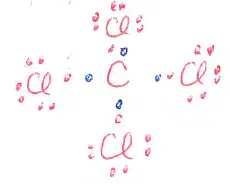
What is this a diagram of?

a)

Cl4C

b)

CCl4

c)

A Bohr-Rutherford diagram

d)

an ionic compound