
 Worksheets
AP Ecology
Total questions: 60
Worksheet time: 2hrs 56mins
Name
Class
Date
1.
A group of interbreeding individuals occupying the same area is best called
a)
community
b)
population
c)
ecosystem
d)
symbiotic relationship
2.
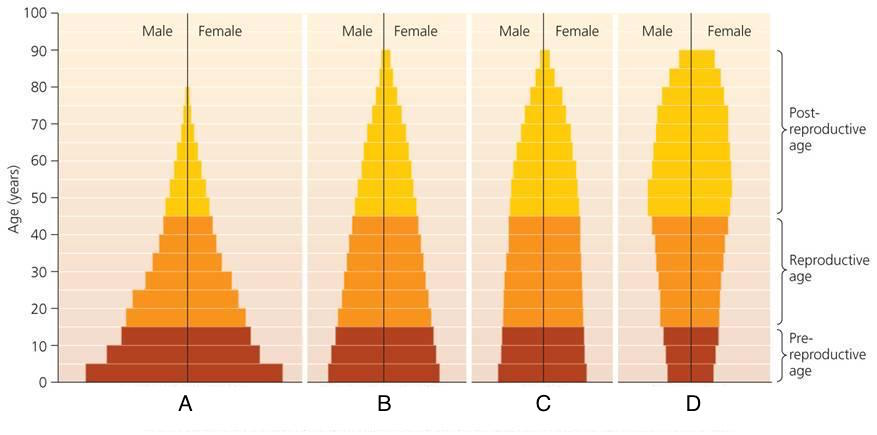
Which of these populations is experiencing the fastest growth?
a)
A
b)
B
c)
C
d)
D
3.
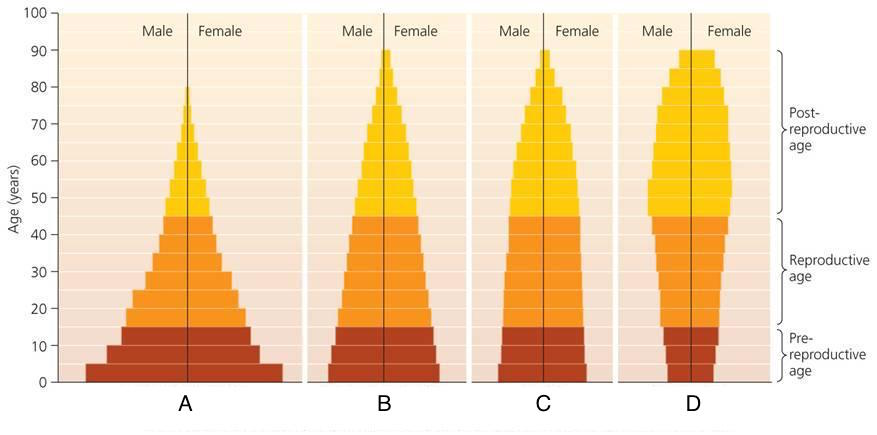
Which of these populations is most nearly experiencing zero population growth over the time period represented in the diagram?
a)
A
b)
B
c)
C
d)
D
4.
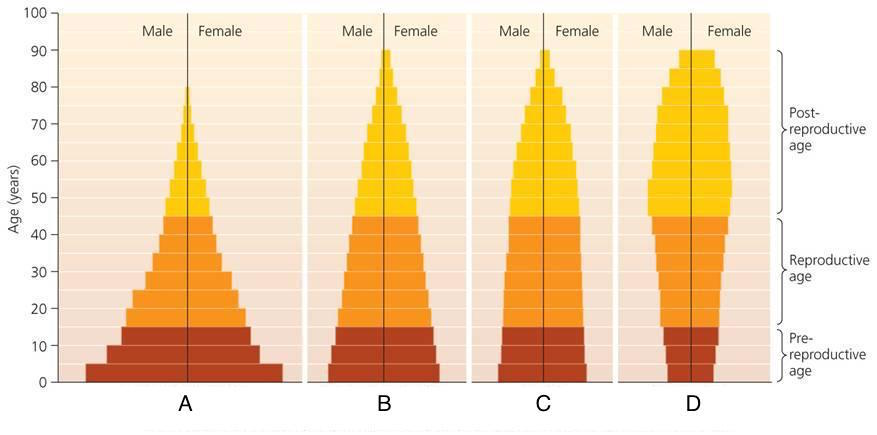
Which of these populations is experiencing the effect of severe limiting factors.
a)
A
b)
B
c)
C
d)
D
5.
All of the following populations would likely result in a uniform dispersion pattern EXCEPT:
a)
nesting penguins on a small beach
b)
perennial shrubs (of a given species) growing in a desert habitat
c)
tropical trees (of a given species) in a tropical rainforest
d)
lions on the savanna
6.
Refer to a population of 500 that experiences 55 births and 5 deaths during a one year period.
What is the reproductive rate for the population during the one year period?
What is the reproductive rate for the population during the one year period?
a)
0.01/year
b)
0.05/year
c)
0.1/year
d)
50/year
7.
Refer to a population of 500 that experiences 55 births and 5 deaths during a one year period.
If the population maintains the current growth pattern, a plot of its growth would resemble which of the following?
If the population maintains the current growth pattern, a plot of its growth would resemble which of the following?
a)
exponential growth
b)
fluctuating growth
c)
K-selected growth
d)
logistic growth
8.
Which of the following represents Burr-bearing seeds that are dispersed by clinging to the fur of certain mammals do not harm or help the mammals?
a)
commensalism
b)
mutualism
c)
batesian mimicry
d)
mullerian mimicry
9.
Which of the following represents the monarch and viceroy butterflies both have orange wings with the same distinctive black markings? When the monarch caterpillar feeds on milkweed, a toxic plant, it stores the toxins, making both the monarch caterpillar and butterfly unpalatable and toxic. The viceroy caterpillar feeds on nontoxic plants.
a)
commensalism
b)
mutualism
c)
batesian mimicry
d)
mullerian mimicry
10.
Which of the following represents oxpeckers that are birds that ride rhinoceroses and other ungulates and eat various skin parasites, such as ticks?
a)
commensalism
b)
mutualism
c)
batesian mimicry
d)
mullerian mimicry
11.
Which of the following represents several species of poisonous snakes bearing bright colors of red, black, and yellow?
a)
commensalism
b)
mutualism
c)
batesian mimicry
d)
mullerian mimicry
12.
Which of the following represents several species of brightly colored, harmless snakes looking like poisonous coral snakes?
a)
commensalism
b)
mutualism
c)
batesian mimicry
d)
mullerian mimicry
13.
All of the following kinds of plants or animals characterize the initial stages of succession EXCEPT
a)
r-selected species
b)
species with good dispersal ability
c)
species that can tolerate poor growing conditions
d)
species that invest large amounts of resources or time into development of progeny
14.
Primary succession would occur on a
a)
meadow destroyed by flood
b)
meadow destroyed by overgrazing
c)
newly created volcanic island
d)
section of a forest destroyed by an avalanche
15.
All of the following increases the concentration of CO2 in the atmosphere EXCEPT
a)
photosynthesis
b)
slash and burn clearing of tropical rainforests
c)
burning of fossil fuels
d)
burning of wood for cooking and heating
16.
Nitrogen becomes available to plants by all of the following processes EXCEPT
a)
ammonification
b)
denitrification by denitrifiying bacteria
c)
nitrification by nitrifying bacteria
d)
nitrogen fixation in plant nodules
17.
Food chain: Diatoms --> Oysters --> Humans
In the above food chain, oysters represent
In the above food chain, oysters represent
a)
detritivores
b)
herbivores
c)
primary carnivores
d)
secondary consumers
18.

In which trophic level would the biological magnification of the pesticide DDT be most evident?
a)
oak tree
b)
caterpillar
c)
bluetit
d)
sparrowhawk
19.
The maximum population size for a species based on the environmental factors is called
a)
ecological footprint
b)
carrying capacity
c)
population growth
d)
environmental capacity
20.
Which of the following is not a density-dependent factor?
a)
emigration
b)
predation
c)
competition
d)
geographic isolation
21.
Which of the following groups of organisms is most likely the primary producer in a tundra biome?
a)
conifer forests
b)
small shrubs
c)
fleshy succulents
d)
subterranean fungi
22.
All of the following could be a top predator in a food chain except a
a)
tiger
b)
reticulated phython
c)
great white shark
d)
squid
23.
According to scientists, the Earth's ozone layer is being depleted primarily by which of the following?
a)
greenhouse gases
b)
acid rain
c)
UV rays from the sun
d)
CFC (chlorofluorocarbon) molecules
24.
Which of the following is not an important part of the nitrogen cycle?
a)
nitrogen-fixing bacteria
b)
herbivores
c)
oxygen
d)
denitrifying bacteria
25.
A biome that experiences all four seasons -- winter, spring, summer, and fall -- and is characterized by warm, moist springs and summers is the
a)
tropical deciduous forest
b)
taiga
c)
temperate deciduous forests
d)
chapparal
26.
Photoperiod (day length) is a critical factor for many plants and animals, as it regulates metabolic and growth processes. In northern alpine forests, many species show a variation in their metabolic response to changes in day length. Northern species are genetically programmed to slow down their metabolism more quickly than southern species as day length shortens and winter approaches. This geographic variation is known as
a)
cline
b)
gametic disequilibrium
c)
genetic drift
d)
selective photoperiodism
27.
Which of the following is the complementary reaction of the carbon cycle?
a)
the citric acid cycle
b)
fermentation
c)
respiration
d)
the electron transport chain
28.
Which of the following represents the history of the descent of a group of organisms from common ancestors?
a)
clade
b)
hybrid zone
c)
phylogeny
d)
ecological niche
29.
Which of the following represents a region in which genetically distinct populations come into contact with each other and produce some offspring of mixed ancestry?
a)
clade
b)
hybrid zone
c)
phylogeny
d)
ecological niche
30.
Which of the following represents the combination of all relevant environmental variables in which a species or population lives?
a)
clade
b)
hybrid zone
c)
phylogeny
d)
ecological niche
31.
Which of the following represents the set of species descended from a particular ancestral species?
a)
clade
b)
hybrid zone
c)
phylogeny
d)
ecological niche
32.
The total of all the abiotic factors is called a(n)
a)
population
b)
habitat
c)
ecosystem
d)
community
33.
As it moves through the various food web, energy
a)
is lost
b)
is gained
c)
stays the same
d)
none of these
34.
The high level of pesticides in birds of prey is an example of
a)
the principle of exclusion
b)
cycling of nutrients by decomposers
c)
exponential growth
d)
biological magnification
35.
Which of the following best explains why there are usually no more than five trophic levels in a food chain?
a)
there are not enough organisms to fill more than five levels
b)
there is too much competition among the organisms at the lower levels to support more animals at higher levels
c)
the statement is not true; there can be unlimited amount of trophic levels
d)
energy is lost at each trophic level
36.
Which of the following is NOT an important characteristic of marine biome?
a)
the largest biome
b)
provides most of the earth's food
c)
temperatures vary tremendously
d)
the largest source of oxygen
37.
The most important factors affecting the distribution of biomes are
a)
temperature and rainfall
b)
amount of sunlight and human population size
c)
latitude and longitude
d)
altitude and water supply
38.
Which of the following is NOT an abiotic factor?
a)
air
b)
water
c)
decomposers
d)
temperature
39.
Which of the following encompases all the others?
a)
ecosystem
b)
community
c)
population
d)
individual
40.
Which of the following lists the biomes as they appear as you move from the equator to the North Pole in the northern hemisphere?
a)
tropical rain forest; desert; temperate deciduous forest; taiga; tundra
b)
desert; tundra; taiga; temperate deciduous forest; tropical rain forest
c)
taiga; temperate deciduous forest; tundra; desert; tropical rain forest
d)
tundra; taiga; temperate deciduous forest; desert; tropical rain forest
41.

Refer to the diagram of the survivorship curve.
Which best describes a K-strategist?
Which best describes a K-strategist?
a)
A
b)
B
c)
C
d)
this is not a survivorship curve
42.

Refer to the diagram of the survivorship curve.
Which best describes starfish?
Which best describes starfish?
a)
A
b)
B
c)
C
d)
this is not a survivorship curve
43.
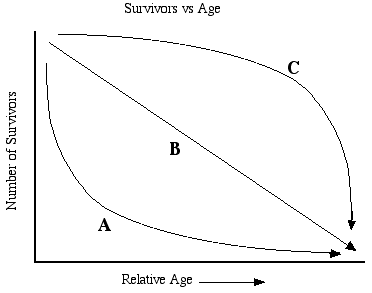
Refer to the diagram of the survivorship curve.
Which best describes an organism that fertilizes externally?
Which best describes an organism that fertilizes externally?
a)
A
b)
B
c)
C
d)
this is not a survivorship curve
44.

Refer to the diagram of the survivorship curve.
Which curve best describes an organism that invests a lot of energy in parenting?
Which curve best describes an organism that invests a lot of energy in parenting?
a)
A
b)
B
c)
C
d)
this is not a survivorship curve
45.
A species described as r-strategist would definitely NOT have which of the following characteristics?
a)
clumped population pattern
b)
much parenting
c)
many offspring
d)
random population pattern
46.
Which of the following is a density-independent factor limiting human population growth?
a)
famine
b)
disease
c)
competition for food
d)
naturally occurring in fires
47.
What would most likely be the cause of bushes of one species growing in one area in a uniform spacing pattern?
a)
random distribution of seeds
b)
interaction among individuals in a population
c)
chance
d)
the varied nutrient supplies in that area
48.
Animals from two different species utilize the same source of nutrition in one area It is most accurate to say that the animals
a)
will learn to get along
b)
will compete for food
c)
will die because there will not be enough food for both of them
d)
will learn to eat different foods
49.
Two animals live together in close association. One benefits, while the other is unaware of the first animal. The relationship is best described as
a)
Parasitism
b)
Mutualism
c)
Commensalism
d)
Predation
50.

Which species is the producer?
a)
A
b)
B
c)
C
d)
D
51.

A toxic pollutant would be found in highest concentrations in which species?
a)
A
b)
B
c)
C
d)
D
52.

Which would have the greatest biomass?
a)
A
b)
B
c)
C
d)
D
53.

Which would have the smallest biomass?
a)
A
b)
B
c)
C
d)
D
54.

Which letter shows a mature, well-established population in favorable conditions?
a)
A
b)
B
c)
C
d)
D
55.
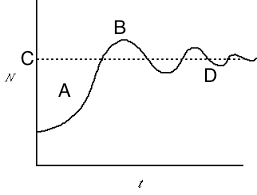
Which letter shows the the exponential growth of a population?
a)
A
b)
B
c)
C
d)
D
56.

Which letter shows the carrying capacity of the population?
a)
A
b)
B
c)
C
d)
D
57.
Many poisonous animals are brightly colored (red or orange) as a warning to predators. The special coloration is called
a)
Mullerian mimicry
b)
Batesian mimicry
c)
aposematic coloration
d)
mutualistic coloration
58.

What type of pyramid is this?
a)
Pyramid of biomass
b)
Pyramid of Energy
c)
Pyramid of Numbers
d)
Pyramid of Statistics
59.
Which of the following is an example of a K-selected species?
a)
mice
b)
fruit flies
c)
kangaroos
d)
fish
60.
Which of the following biomes is the most diverse biome with multiple species from all domains with constant temperatures and high amounts of rainfall?
a)
deciduous forest
b)
tropical rain forest
c)
dessert
d)
taiga
100 %

