
 Worksheets
Genetics Review
Total questions: 88
Worksheet time: 2hrs 13mins
Name
Class
Date
1.
Having two of the same genes for the trait (TT, tt); Both dominant or both recessive.
a)
homozygous or purebred
b)
heterozygous or hybrid
c)
twin offspring
d)
pairs of chromosomes
2.
Which of the following alleles is homozygous (purebred) recessive?
a)
Tt
b)
tt
c)
TT
d)
t
3.
Dominant alleles are represented by a:
a)
Male gene
b)
lowercase letter
c)
recessive trait
d)
capital letter
4.
Which of the following is a phenotype?
a)
Aa
b)
red hair
c)
heterozygous genes
d)
mutated DNA
5.
Aa is
a)
homozygous (purebred)
b)
heterozygous (hybrid)
6.
B=brown eyes
b= blue eyes
What is true about these two brothers that have brown eyes:
One has genotype BB the other Bb.
b= blue eyes
What is true about these two brothers that have brown eyes:
One has genotype BB the other Bb.
a)
they have same phenotype and genotype
b)
they have different genotypes and phenotypes
c)
they have same phenotype but different genotypes
d)
they have same genotype but different phenotypes
7.
In a heterozygous genotype, the ___________ allele takes over in the phenotype.
a)
recessive
b)
dominant
c)
lower case letter
d)
both
8.
G = green, g = yellow
The genotype for a yellow plant is...
The genotype for a yellow plant is...
a)
GG
b)
Gg
c)
gg
d)
all of the choices result in yellow
9.
T = tall an t = short
TT and Tt would result in the following phenotype
TT and Tt would result in the following phenotype
a)
short
b)
tall
c)
medium sized
d)
neither tall or short
10.
What gender has an X and a Y chromosome?
a)
male
b)
female
c)
transgender
d)
all of the above
11.
What is the cause of some traits "skipping" a generation?
a)
dominant traits
b)
recessive traits
c)
mutations
d)
natural selection
12.

Who is considered the "father of genetics"?
a)
Gregor Mendel
b)
Reginald Punnett
c)
James Watson
d)
Justin Bieber
13.
If one stronger trait "covers" up another weaker trait, the trait that covers the other is said to be:
a)
Dominant
b)
Heterozygous
c)
Recessive
d)
Hidden
14.
What is a phenotype?
a)
The expression of a trait; physical appearance.
b)
refers to the genetic makeup of an individual
c)
An organism that has the same genes for a trait (ex. TT or tt)
d)
the passing of traits from parent to offspring
15.
An allele whose trait only shows up when no dominant allele is present.
a)
hidden allele
b)
dominant allele
c)
recessive allele
d)
present allele
16.
Two heterozygous (Tt)tall pea plants are crossed. Which describes their offspring?
a)
50% tall and 50% short
b)
75%tall and 25% short
c)
100%short
17.
A human usually has _____ total chromosomes.
a)
6
b)
22
c)
4
d)
46
18.
Which of the following alleles is homozygous recessive?
a)
Tt
b)
tt
c)
TT
d)
T
19.

This type of inheritance pattern is a MIXTURE of both traits.
a)
incomplete dominance
b)
co-dominance
c)
complete dominance
d)
recessive pattern
20.

Colorblindness is a recessive, X chromosome sex-link disorder. Cross the parents to figure out which percentage of their offspring will be colorblind.
a)
25%
b)
0%
c)
75%
d)
50%
21.

This type of inheritance pattern shows BOTH traits in possible offspring
a)
complete dominance
b)
incomplete dominance
c)
co-dominance
d)
dominant pattern
22.
What type of chromosomal abnormality do people with Down Syndrome have?
a)
trisomy 21
b)
monosomy 21
c)
recessive inheritance
d)
dominant inheritance
23.
In fruit flies eye color is carried on the X chromosome. RED is dominant to WHITE. What is the sex and color of the following: XrY
a)
female red
b)
female white
c)
male red
d)
male white
24.
In fruit flies eye color is carried on the X chromosome. RED is dominant to WHITE. What is the sex and color of the following: XRXR
a)
female red
b)
female white
c)
male red
d)
male white
25.
What determines gender in humans?
a)
the X and Y chromosome
b)
chromosome 21
c)
codominance
d)
epistasis
26.

In humans, skin tone is caused by 3 genes, each with 2 alleles. This is an example of
a)
codominance
b)
incomplete dominance
c)
polygenic inheritance
d)
multiple alleles
27.
How many alleles (letters) do each person carry for a trait?
a)
1
b)
2
c)
3
d)
4
28.
How many alleles (letters) does a child get from each parent for each trait?
a)
1
b)
2
c)
3
d)
4
29.
Dominant alleles are represented by a:
a)
Male gene
b)
lowercase letter
c)
recessive trait
d)
capital letter
30.
Aa, DD, bB, yy are all examples of
a)
genotypes
b)
phenotypes
31.
In a heterozygous genotype, the ___________ allele takes over in the phenotype.
a)
recessive
b)
dominant
c)
lower case letter
d)
both
32.

What you see, or the physical appearance.
a)
Genotype
b)
Phenotype
c)
Homozygous
d)
Heterozygous
33.
Aa is
a)
homozygous
b)
heterozygous
34.

What ratio of the offspring from the cross shown will be homozygous recessive for the trait of tallness?
a)
0 in 4
b)
1 in 4
c)
2 in 4
d)
4 in 4
35.
Which of the following genotypes is homozygous dominant?
a)
A
b)
Aa
c)
AA
d)
aa
36.
Which of the following genotypes is heterozygous?
a)
Bb
b)
BB
c)
bb
d)
B
37.

In a pedigree, what shape represents a male?
a)
circle
b)
square
c)
triangle
d)
diamond
38.
What gender has an X and a Y chromosome?
a)
male
b)
female
c)
transgender
d)
all of the above
39.

Which genetic disorder is shown in this karyotype?
a)
Edward Syndrome
b)
Downs Syndrome
c)
Patau Syndrome
d)
Tay-Sachs Dyndrome
40.

How many male are represented in this image?
a)
6
b)
7
c)
9
d)
9
41.

What do you call the non-Mendelian inheritance pattern that states that neither trait is dominant and the traits appear to blend together?
a)
Codominance
b)
Incomplete dominance
c)
Polygenic traits
42.

What do you call the non-Mendelian inheritance pattern that states that both traits are dominant and both appear in the organism and neither trait is masked?
a)
Codominance
b)
Incomplete dominance
c)
Polygenic traits
43.
If a gene is found only on the X chromosome and not the Y chromosome, it is said to be what?
a)
sex-linked trait
b)
polygenic trait
c)
codominant trait
d)
incomplete dominance trait
44.

How many people in the pedigree are carriers for the disorder?
a)
6
b)
8
c)
2
d)
9
45.
An example of polygenic inheritance is...
a)
Skin Color
b)
hitch hikers thumb
c)
blood types
46.
Incomplete dominance means that there traits are
a)
expressed equally
b)
dominant
c)
recessive
d)
blended
47.
Blood types consist of 4 different alleles.
a)
false
b)
true
48.

Looking at this pedigree, how many family members have the disease?
a)
4
b)
7
c)
All
d)
None
49.

In the second generation-how many people have the disease or display the physical trait?
a)
2
b)
4
c)
5
d)
6
50.

In the second generation-how many people are carriers of the trait?
a)
2
b)
3
c)
5
d)
6
51.

How many kids did the mother and father from the first generation have?
a)
2
b)
4
c)
5
d)
6
52.
Nondisjunction is related to a number of serious human disorders. How does nondisjunction cause these disorders?
a)
alters the number of zygotes
b)
alters the chromosome structure
c)
alters the number of gametes
d)
alters the number of chromosomes
53.
Which term(s) best describes the inheritance of human blood types?
a)
incomplete dominance and multiple alleles
b)
codominance and epistasis
c)
codominance and multiple alleles
d)
incomplete dominance and codominance
54.
Which of the following disorders can be observed in a human karyotype?
a)
colorblindness
b)
Trisomy 21
c)
cystic fibrosis
d)
sickle cell disease
55.
Which of the following disorders is a direct result of nondisjunction?
a)
Turner's Syndrome
b)
sickle cell disease
c)
Huntington's disease
d)
Cystic fibrosis
56.
Disorder when blood cells are misshapen, resulting in a decrease of oxygen and caused by a defective allele for a polypeptide in hemoglobin
a)
Duschenne's muscular dystrophy
b)
Turner's Syndrome
c)
sickle cell anemia
d)
Down Syndrome
57.

What do half colored symbols represent?
a)
The individual is a carrier.
b)
The individual expresses the trait.
c)
The individual has both recessive alleles.
d)
The individual has both dominant alleles.
58.
A picture of a person’s chromosomes in order is called:
a)
Pedigree
b)
Punnett Square
c)
Karyotype
59.
Chromosomes that do not control the sex of the offspring are called
a)
sex chromosomes
b)
somatic chromosomes
c)
autosomal chromosomal
60.

What blood type would an individual have if this was one of the cells seen under a microscope?
a)
Type A
b)
Type B
c)
Type AB
d)
Type O
61.
The inherited disease in which hemoglobin molecules clump into long fibers, changing the shape of blood cells.
a)
Cystic fibrosis
b)
Sickle Cell Disease
c)
Huntington's Disease
d)
Klinefelter's Disease
62.
Which of the following is caused by a dominant allele?
a)
Huntington's Disease
b)
Colorblindness
c)
Cystic fibrosis
d)
Sickle Cell Disease
63.
Chart that shows the relationships within a family
a)
Pedigree
b)
Karyotype
c)
T chart
d)
Key
64.
Error in meiosis in which homologous chromosomes fail to separate
a)
nondisjunction
b)
sex-linked recessive
c)
autosomal dominant
d)
autosomal recessive
65.
If a man does not have hemophilia (X linked trait), what percentage of his daughters will have hemophilia?
a)
100%
b)
75%
c)
50%
d)
0%
66.
A boy who is colorblind inherited the disorder from his
a)
Mother
b)
Father
c)
Either Parent
d)
None of the above
67.
Karyotypes are useful for detecting _______.
a)
Missing or extra chromosomes
b)
All genetic disorders
c)
Cystic Fibrosis
d)
Huntington's Disease
68.
How are the X and Y chromosomes different?
a)
Only one is an autosome
b)
The X is smaller than the Y
c)
The Y carries fewer genes than the X
d)
Only females have Y
69.
The failure of chromosomes to separate properly during meiosis is called _______________.
a)
Nondisjuction
b)
X-chromosomes inactiviation
c)
Turner's syndrome
d)
Down syndrome
70.
Which of the following combinations of sex chromosomes represent a female?
a)
XY
b)
XXY
c)
XX
71.
Which of the following combinations of sex chromosomes represents a male?
a)
XY
b)
XYY
c)
XX
72.
The chromosomes that determine a person’s gender are called:
a)
Autosomes
b)
Sex Linked Genes
c)
Sex Chromosomes
73.
The chromosomes that determine all traits, except gender are called:
a)
Karyotypes
b)
Autosomes
c)
Sex Chromosomes
74.
In a pedigree, what does a circle represent?
a)
Male
b)
Female
c)
Offspring
75.
In a pedigree, what does a darken shape represent?
a)
Affected (have disorder)
b)
Unaffected (doesn't have disorder)
c)
Carrier
76.
In a pedigree, what does a shape that's half shaded?
a)
Affected (have disorder)
b)
Unaffected (doesn't have disorder)
c)
Carrier
77.

This pedigree shows cystic fibrosis. What is the genotype of person #4?
a)
NN
b)
Nn
c)
N?
d)
nn
78.

The pedigree shows colorblindness in a family. What is the genotype of person #2?
a)
XNY
b)
XNX?
c)
XNXn
d)
XnXn
79.

The pedigree shows colorblindness in a family. What is the genotype of person #1?
a)
XNY
b)
XnY
c)
XNYn
d)
XNXn
80.
What causes genetic variation in meiosis?
a)
chromosomes lining up
b)
crossing over of chromosomes
c)
separation of chromosomes
d)
chromosomes pulling apart
81.
Unlike mitosis, meiosis in male mammals results in the formation of
a)
one haploid gamete
b)
three diploid gametes
c)
four diploid gametes
d)
four haploid gametes
82.

When an area of a chromatid is exchanged with the matching area on a chromatid of its homologous chromosome, _________________ occurs
a)
crossing over
b)
mutagenesis
c)
hybridization
d)
fertilization
83.

Which process and type of resulting cells are represented?
a)
mitosis, gametes
b)
mitosis, body cells
c)
meiosis, gametes
d)
meiosis, body cells
84.
A male shark has 40 chromosomes in each of its sex cells. How many would be present in its body cells?
a)
20
b)
40
c)
80
d)
160
85.
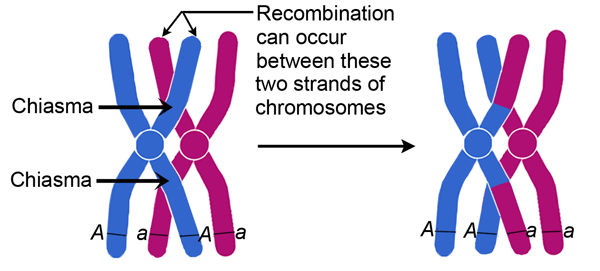
This image shows chromosomes during Prophase 1. Which of the following correctly describes the process shown?
a)
segregation of sister chromatids
b)
condensation and segregation of alleles
c)
mutationin which the DNA content of the gene is altered
d)
crossing - over in which alleles are exchanged
86.
products of meiosis are genetically
a)
different
b)
identical
87.
Law of Segregation is when...
a)
alleles separate individually from each other
b)
genes for each trait separate individually from each other
c)
one allele masks the presence of another allele
d)
homologous chromosomes pair with other genes
88.
Which of Mendel's laws states that alleles are separated during meiosis?
a)
Law of Dominance
b)
Law of Segregation
c)
Law of Independent Assortment
d)
Law of Meiosis
100 %

