
 Worksheets
Core 1 HSC
Total questions: 39
Worksheet time: 37mins
Name
Class
Date
1.

what are the 4 P's and a C used to identifty priority health issues
a)
Social Justice principles, Priority population groups, prevalence, prevention and early intervention, cost to the individual and the community
b)
Epidemiology, Priority population groups, prevalence, prevention and early intervention, cost to the individual and the community
c)
Mortality, infant mortality, prevalence, incidence, priority population groups
d)
perseverance, priority groups, potential, principles, penalties
2.

The social justice principles are.....
a)
Equity, diversity, access
b)
equity, diversity, supportive environments, access
c)
Environmental, sociocultural and socioeconomic determinants
d)
infant mortality, mortality, morbidity, life expectancy
3.

The largest cause of cancer related deaths is due to which of the following
a)
Lung
b)
Breast
c)
Bowel
d)
Skin
4.

Measures of epidemiology include....
a)
morality, trends, extent, incidence
b)
infant mortality, mortality, morbidity, life expectancy
c)
prevalence and incidence
d)
trends, life expectancy, mortality, morbidity
5.

prevalence is.......
a)
the way we measure epidemiology
b)
the number of new cases in a period of time
c)
epidemiological data that shows current trends
d)
existing cases in a defined population at a given time
6.
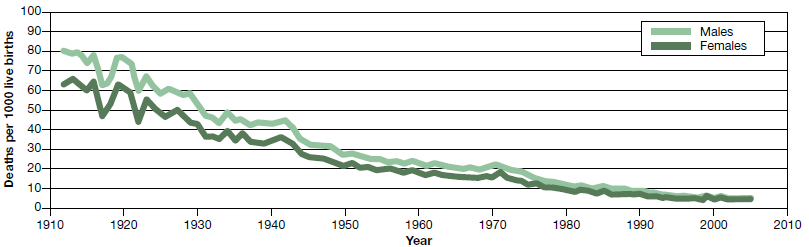
The following is a graph showing
a)
Morbidity rates that are declining
b)
mordidity rates that are increasing
c)
infant mortality rates which are decreasing
d)
infant mortality rates which are increasing
7.

Aboriginal and Torres Strait Islander peoples are a group experiencing health inequities because....
a)
they have higher rates of mortality and morbidity compared to everyone else
b)
have a low rate of chronic disease and illesss such as diabetes and CVD
c)
lack access to services and facilities as well as are socioeconoically challeneged
d)
none of the above
8.

Smoking is a risk factor for which of the following.....
a)
lung cancer
b)
skin cancer
c)
heart disease
d)
all of the above
9.

sun exposure is a risk factor for which of the following
a)
lung cancer
b)
skin cancer
c)
prostate cancer
d)
breast cancer
10.

an individual attending a mothers group is an example of the role of addressing a health inequity in which of the following
a)
individual
b)
community
c)
government
d)
none of the above
11.

which of the following is an example of a protective factor for skin cancer
a)
applying sunscreen
b)
minimising sun exposure
c)
having regular skin check
d)
all of the above
12.

What was the leading cause of death in 2016?
a)
Cancer
b)
Ischaemic heart disease
c)
Breast Cancer
d)
Obesity
13.

morbidity can be defined as
a)
the incidence or level of illness or sickness in a given population
b)
refers to the number of infant deaths in the number of deaths in the first year of life, per 1000 live births
c)
refers to the number of deaths in a given population from a particular cause and/or over a period of time
d)
refers to the average number of years of a life remaining to a person at a particular age, based on the current death rates
14.

Mortality can be defined as
a)
the incidence or level of illness or sickness in a given population
b)
refers to the number of infant deaths in the number of deaths in the first year of life, per 1000 live births
c)
refers to the number of deaths in a given population from a particular cause and/or over a period of time
d)
refers to the average number of years of a life remaining to a person at a particular age, based on the current death rates
15.

life expectancy can be defined as
a)
the incidence or level of illness or sickness in a given population
b)
refers to the number of infant deaths in the number of deaths in the first year of life, per 1000 live births
c)
refers to the number of deaths in a given population from a particular cause and/or over a period of time
d)
refers to the average number of years of a life remaining to a person at a particular age, based on the current death rates
16.

infant mortality can be defined as
a)
the incidence or level of illness or sickness in a given population
b)
refers to the number of infant deaths in the number of deaths in the first year of life, per 1000 live births
c)
refers to the number of deaths in a given population from a particular cause and/or over a period of time
d)
refers to the average number of years of a life remaining to a person at a particular age, based on the current death rates
17.

What do we need to know about a growing and ageing population?
a)
healthy ageing, availability of carers and volunteers
b)
increased population living with chronic disease and disability
c)
demand for health services and workforce shortages
d)
all of the above
18.

Australia is spending money on.......
a)
more early intervention and prevention measures rather than curative measures in health care
b)
has started to increase their expenditure on early intervention and prevention measures, but are still spending the large majority of funding on curative measures in health care
c)
early intervention and prevention measures at the same rate as curative measures (approx 50/50 split)
d)
only early intervention and prevention measures and little on curative measures
19.

Australia’s growing and ageing population is a product of
a)
increased life expectancy, and decreased birth rates
b)
Increased ability to deal with morbidity and decrease mortality rates
c)
Increased life expectancy and decreased morbidity rates
d)
none of the above
20.

People living in rural and remote areas have less access to health facilities and services. Which of the following is a government implemented to enable equal access to health services
a)
royal flying doctors, E-health records, telehealth, local hospital networks
b)
royal flying doctors, transport schemes, travelling doctors
c)
telehealth, travelling doctors, transport schemes
d)
none of the above
21.

ATSI also have poorer access to health facilities and services because they:
a)
face long waiting times, cost, unavailable services, and culturally inappropriate services
b)
have less access to ATSI facilities and trained medical physicians
c)
have poor health literacy
d)
have poor education
22.

The biggest action by the government for equity of access to health facilities and services was the introduction of
a)
comparison websites to aid in choices for insurances such as private health and life
b)
Medicare and the Pharmaceutical Benefits Scheme
c)
royal flying doctors, telehealth and the e health record
d)
culturally sensitive facilities and services
23.

Who is primarily responsible for funding community health centres
a)
the standing council of health ( federal government body)
b)
The state/territory health departments
c)
local/regional councils
d)
individual towns/city suburbs
24.

Medicare is funded through
a)
Taxing private institutions
b)
reorienting health services
c)
the tax system and the Medicare levy
d)
the medicare levy
25.

The many health services provided in Australia can be divided into 2 categories: institutional and non-institutional. Which one is an example of an Institution?
a)
Nursing homes
b)
Medical services (GP)
c)
Research organisations (NHMRC)
d)
None Shown
26.

When is Life expectancy commonly calculated?
a)
Middle Age
b)
At Birth
c)
Old Age
d)
Teenage Years
27.

Which of the following is a Social Justice Principle of health?
a)
Provide a wide range of services such as private hospitals, dentists, etc.
b)
Potential for prevention and early intervention
c)
Promoting inclusiveness of diversity
d)
Equal Employment Opportunities
28.

Who has a higher life expectancy as of 2016 in Australia?
a)
Males
b)
Females
c)
Equal
d)
Dogs
29.

Which of the following is an example of eliminating inequity in health?
a)
Plan B
b)
Close the Gap
c)
Towards Zero
d)
None Shown
30.

Where does the majority of health funding come from?
a)
Local Government
b)
Commonwealth Government
c)
State/Territory Government
d)
Thin Air
31.

Which of the following is an example of an environmental determinant of health?
a)
Income
b)
Access
c)
Education
d)
Weather
32.

Meditation techniques are used by some patients while undergoing chemotherapy for cancer. What type of approach to treatment is this?
a)
Diversionary
b)
Pain management
c)
Alternative health care
d)
Complementary health care
33.

In which action area of the Ottawa Charter does the Pharmaceutical Benefits Scheme (PBS) belong?
a)
Developing personal skills
b)
Reorienting health services
c)
Building healthy public policy
d)
Strengthening community action
34.

Which of the following is an example of reorienting health services as specified in the Ottawa Charter?
a)
Redirecting services from cure to prevention
b)
Redirecting services from private to public health care
c)
Allowing health service professionals to focus on curing ill health
d)
Supporting individuals to identify personal networks and services
35.

What was the 2nd leading cause of Death in 2016?
a)
Dementia, including Alzheimer's disease
b)
Cancer of the trachea
c)
Chronic lower respiratory diseases
d)
Cerebrovascular diseases
36.

Which risk factor has been linked to both Heart Disease and Cancer?
a)
Obesity
b)
Mental Illness
c)
Osteoporosis
d)
Hypertension
37.

How can volunteer organisations reduce the impact of an ageing population on the public health system?
a)
By subsidising prescription medicines
b)
Transporting the aged to health services
c)
helping aged to remain in their own homes
d)
by adding more health professionals
38.

Which of the following is a modifiable risk factor for CVD?
a)
Age
b)
Diet
c)
Gender
d)
Heredity
39.

In which CVD condition is plaque most likely to form on the inner lining of the arteries?
a)
Angina
b)
Heart Attack
c)
Atherosclerosis
d)
Peripheral vascular disease
100 %

