
 Worksheets
Characteristics of Life, Variables, Pro vs. Euk Cells
Total questions: 90
Worksheet time: 2hrs 38mins
Name
Class
Date
1.
Living things need energy to survive.
a)
True
b)
False
2.
All living things are composed of cells.
a)
True
b)
False
3.
Living things do all of the following except:
a)
Respond to stimulus
b)
Grow and develop
c)
maintain homeostasis
d)
They do not change
4.
The release or use of chemical energy involves:
a)
condensation
b)
metabolism
c)
photosynthesis
d)
cooperation
5.
Living things respond to heat, light, and sound. This means they respond to:
a)
stimuli/ environment
b)
suction
c)
Dr. Suess
d)
digestion
6.
During ___________ conditions inside our body are kept stable (the same)
a)
homeopathic
b)
Homo sapian
c)
homeostasis
d)
homologous
7.
An example of homeostasis includes maintaining :
a)
oxygen level
b)
body temperature
c)
blood sugar level
d)
all of these levels
8.
What does reproduce mean?
a)
They grow
b)
They are living things
c)
Organisms make other organisms
9.
What is a living thing?
a)
reproduction
b)
organism
c)
development
d)
homeostasis
10.
If you were testing how well different dish soap cleaned grease, the independent variable would be the:
a)
dish soap
b)
amount of grease
11.
Students are growing plants in the dark or in the light to see which grows better. They put 3 seeds in the dark and 5 seeds in the light because they know seeds are more likely to dry out in the light.
How could it be improved?
How could it be improved?
a)
Put all the plants in the dark.
b)
Put all the plants in the light.
c)
Plant 3 seeds in each pot.
d)
Water both plants more.
12.
Students put two different types of plants in the sun. Plant A is in the sun for 10 minutes. Plant B is in the sun for 1 hr. Students decide that plant B is better at photosynthesis. This is wrong because...
a)
They need to research photosythesis more.
b)
They are changing too many variables.
c)
There is no dependent variable.
d)
There are no constants.
13.
The main source of energy for all living things is
a)
the Earth
b)
the sun
c)
the moon
d)
food
14.
All of the following are characteristics of all living things EXCEPT
a)
Respond to stimulus
b)
Grow and develop
c)
maintain homeostasis
d)
Movement
15.
A gazelle running away from a hunting lion is an example of ____________.
a)
homeostasis
b)
responding to stimuli
c)
growing and developing
d)
reproducing
16.
Plants get energy from the sun while animals get energy from
a)
condensation
b)
eating food
c)
photosynthesis
d)
sleeping
17.
Living things respond to heat, light, and sound. This means they respond to:
a)
stimuli/ environment
b)
suction
c)
Dr. Suess
d)
digestion
18.
Multicellular means
a)
made of many cells
b)
made of one kind of cell
c)
made of only one cell
19.
Which of these is not one of the characteristics of living things?
a)
all living things are made of cells
b)
all living things reproduce
c)
all things eat
d)
all things respond to their environment
20.
The smallest unit of life is a(n)
a)
atom
b)
cell
c)
snail
21.
________ is passed down from generation to generation
a)
DNA
b)
RNA
c)
CNA
d)
TNA
22.
Which macromolecule is made of simple and complex sugars?
a)
lipids
b)
proteins
c)
carbohydrates
d)
nucleic acids
23.
Which macromolecule stores energy, insulates us, and makes up the cell membrane?
a)
lipids
b)
proteins
c)
carbohydrates
d)
nucleic acids
24.
This is one job proteins do NOT have in the body
a)
insulation
b)
structure for tissues and organs
c)
speed up chemical reactions
d)
transport things through cell membrane
25.
DNA and RNA are examples of...
a)
proteins
b)
nucleic acids
c)
carbohydrates
d)
lipids
26.
Another name for fats and oils
a)
proteins
b)
sugar
c)
lipids
d)
nucleic acids
27.
What is the function of nucleic acids?
a)
Stores energy
b)
Stores genetic information
c)
Movement
d)
Physical structure
28.
What is the monomer of proteins?
a)
amino acids
b)
polypeptides
c)
nucleotides
d)
monosaccharides
29.
What are the four macromolecules?
a)
proteins, nucleic acids, carbohydrates, and lipids
b)
monosaccharides, lipids, polysaccaharides, and proteins
c)
RNA, DNA, proteins, and carbohydrates
d)
proteins, DNA, RNA, and steroids
30.
Most enzymes:
a)
speed up the chemical reaction
b)
have no effect on the rate of the chemical reaction
c)
slow the rate of the chemical reaction
d)
keep the rate of the chemical reaction the same
31.
All organic compounds contain the element
a)
carbon
b)
nitrogen
c)
phosphorus
d)
sulfur
32.
What is the function of carbohydrates?
a)
store genetic information
b)
store energy (long-term)
c)
store energy (short-term)
d)
build skin, hair, nails, muscles
33.
What molecule is used for LONG term energy storage?
a)
carbohydrates
b)
lipids
c)
protiens
d)
nucleic acid
34.
Enzymes are considered to be
a)
Lipids
b)
Carbohydrate
c)
Protein
d)
Nucleic Acid
35.
The monomer is glucose
a)
protein
b)
lipid
c)
carbohydrate
d)
nucleic acid
36.
The monomer is amino acids
a)
protein
b)
lipid
c)
carbohydrate
d)
nucleic acid
37.
Which biomolecule is responsible for insulation and energy storage?
a)
Protein
b)
Nucleic Acid
c)
Lipid
d)
Carbohydrate
38.
1. What organelle is responsible for letting things in and out of the cell?
a)
Cell membrane
b)
Mitochondria
39.
what organelle controls the cell.
a)
Lysosome
b)
Nucleus
c)
Nucleolus
d)
Chromosomes
40.
This type of cell needs a cell wall and chloroplasts
a)
Plant cell
b)
Animal Cell
c)
Bacteria
41.
Bacteria cells are this type of cell.
a)
Eukaryote
b)
Prokaryote
42.
Which organism listed below is a prokaryote?
a)
dog
b)
human
c)
sunflower
d)
bacterial cell
43.
A tiny cell structure that carries out a specific function within a cell.
a)
organelle
b)
cell
c)
nucleus
d)
ribosomes
44.
The basic unit of structure and function in a living things.
a)
chloroplast
b)
nucleus
c)
cell
d)
cell membrane
45.
Which of the following does a bacteria cell NOT have in common with a plant cell?
a)
cytoplasm
b)
cell membrane
c)
genetic material (DNA)
d)
nucleus
46.
In what organelle is the genetic material found inside?
a)
Endoplasmic Reticulum
b)
Golgi Complex
c)
Nucleolus
d)
Nucleus
47.
a single celled organism is called
a)
multicellular
b)
bicellular
bicellular
bicellular
c)
polycellular
d)
unicellular
48.

Is this made of plant cells or
animal cells?
animal cells?
a)
Plant
b)
Animal
c)
Neither
49.
Tiny cell structures that carry out specific functions within the cell.
a)
membranes
b)
nucleus
c)
organelles
d)
animalicules
50.

What type of cells are humans made up of?
a)
Prokaryotic
b)
Eukaryotic
c)
Plant
51.
Plants and animal cells are examples of ___ cells
a)
prokaryotic cells
b)
eukaryotic cells
52.
What is multicellular?
a)
one cell
b)
no cells
c)
many cells
d)
no nucleus
53.
When you step out into the cold, your body shivers in order to keep its temperature at 98.6F.
a)
All living things use energy
b)
All living things contain cells
c)
All living things maintain homeostasis
d)
All living things grow
54.
Green plants produce their own food through the process of photosynthesis.
a)
All living things use energy
b)
All living things contain cells
c)
All living things maintain homeostasis
d)
All living things grow
55.
A baby song bird hatches from its egg with both parent songbirds watching.
a)
All living things reproduce
b)
All living things maintain homeostasis
c)
All living things use energy
d)
All living things grow
56.
A pill bug (roly poly) eats a carrot.
a)
All living things contain cells
b)
All living things use energy
c)
All living things maintain homeostasis
d)
All living things grow
57.
A camel has eyelashes that work to keep the dust and sand out of its eyes.
a)
All living things adapt to their environment
b)
All living things grow
c)
All living things have cells
d)
All living things use energy
58.
A caterpillar hibernates in a cocoon and emerges as a butterfly.
a)
All living things adapt to their environment
b)
All living things use energy
c)
All living things respond to their environment
d)
All living things grow
59.
An amoeba is a unicellular organism. Which characteristic of life is this?
a)
All living things use energy
b)
All living things contain cells
c)
All living things respond to their environment
d)
All living things grow
60.
A tulip opens in the morning at sunrise and closes in the evening at sunset.
a)
All living things have cells
b)
All living things use energy
c)
All living things respond to their environment
d)
All living things grow
61.
Over three years, Tim's height has increased from 5'4" to 5'11".
a)
All living things contain cells
b)
All living things maintain homeostasis
c)
All living things use energy
d)
All living things grow
62.
A sea worm drops its tail and the tail becomes a new worm.
a)
All living things contain cells
b)
All living things grow
c)
All living things have different levels of organization
d)
All living things reproduce
63.
An adult hydra is producing its offspring through budding.
a)
All living things use energy
b)
All living things reproduce
c)
All living things contain cells
d)
All living things grow
64.
The roots of a plant grow towards a source of ground water.
a)
All living things use energy
b)
All living things reproduce
c)
All living things respond to their environment
d)
All living things grow
65.
Over many hundreds of years, a population of rabbits living in the woods adapts to its surrounding with brown fur.
a)
All living things adapt to their environment
b)
All living things grow
c)
All living things use energy
d)
All living things have cells
66.
YOU are a multi-celled organism but an amoeba is a single celled organism.
a)
All living things have cells
b)
All living things grow
c)
All living things use energy
d)
All living things respond to their environment
67.
Which is NOT a characteristic that all living organisms share?
a)
Ability to reproduce
b)
Ability to grow
c)
Ability to respond to their environment
d)
Ability to dominate an ecosystem
68.
Which of the following is not a characteristic of a Prokaryotic cell?
a)
unicellular
b)
floating DNA
c)
very small
d)
complex
69.
Eukaryotic cells are complex.
a)
true
b)
false
70.
Prokaryotic cells include bacteria.
a)
True
b)
False
71.
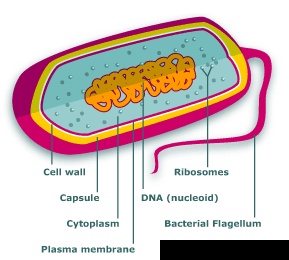
Which type of cell?
a)
Prokaryote
b)
Eukaryote
72.
Has membrane bound organelles
a)
Prokaryote
b)
Eukaryote
c)
both
73.
Which of the following is found inside a prokaryote?
a)
cytoplasm
b)
DNA
c)
ribosomes
d)
all of these
74.
Cells can only be seen with the help of a...
a)
hand lens
b)
magnifying glass
c)
3D glasses
d)
microscope
75.
All cells come from other...
a)
cells
b)
plants
c)
nucleus
d)
microscopes
76.
Plants and animal cells are examples of ___ cells
a)
prokaryotic cells
b)
eukaryotic cells
77.
These cells have DNA surrounded by a nuclear membrane...
a)
Eukaryotic
b)
Prokaryotic
c)
Neither
d)
Both prokaryotic and eukaryotic
78.
Animal, fungi, plant, and protista cells are all examples of which type of cell?
a)
Eukaryotic
b)
Prokaryotic
c)
Both prokaryotic and eukaryotic
79.

What type of graph is this?
a)
Bar Graph
b)
Line Plot
c)
Pictograph
d)
Tally Chart
80.

How many people liked Mickey Mouse best?
a)
4
b)
10
c)
5
d)
6
81.
An experiment is performed on plants to see how different liquids affect plant growth. Each plant in the experiment is given a different liquid; water, apple juice, or milk. Each plant has the same amount of soil, sunlight, and listens to the same music. In this investigation, the independent variable is ...
a)
The type of plant
b)
The amount of sunlight
c)
The type of music
d)
The type of liquid
82.
An experiment is performed on plants to see how different liquids affect plant growth. Each plant in the experiment is given a different liquid; water, apple juice, or milk. Each plant has the same amount of soil, sunlight, and listens to the same music. In this investigation, the independent variable is ...
a)
The type of plant
b)
The amount of sunlight
c)
The type of music
d)
The type of liquid
83.
An experiment is performed on plants to see how different liquids affect plant growth. Each plant in the experiment is given a different liquid; water, apple juice, or milk. Each plant has the same amount of soil, sunlight, and listens to the same music. In this investigation, what are the controlled variables?
a)
Type of plant, amount of music, and sunlight
b)
Water, apple juice, milk
c)
Plant growth
84.
A student is planning an experiment to find out how the height from which he drops a ball affects how high the ball bounces. The dependent variable is the _____.
a)
Diameter of the ball
b)
Force acting on the ball
c)
Height that the ball bounces
d)
Height from which the ball is dropped
85.
A student is planning an experiment to find out how the height from which he drops a ball affects how high the ball bounces. What is the control variable?
a)
The ball used
b)
The height the ball bounces
c)
Height of the ball being dropped
86.
Mr. S set up an experiment to see how the mass of a ball affects the distance it rolls off a ramp. Identify the independent variable.
a)
Distance traveled by the ball
b)
Height of the ramp
c)
Mass of the ball
87.
Mr. S set up an experiment to see how the mass of a ball affects the distance it rolls off a ramp. What is the dependent variable?
a)
Distance traveled by the ball
b)
Height of the ramp
c)
Mass of the ball
88.
Mr. S set up an experiment to see how the mass of a ball affects the distance it rolls off a ramp. What is the controlled variable?
a)
Distance traveled by the ball
b)
Height of the ramp
c)
Mass of the ball
89.
Mr. S normally uses praise as a reward to train his dog. He wants to know the best way to train his dog, so he sets up an experiment to find out if there is a better way to get his dog to respond to commands. What is his independent variable?
a)
Type of reward
b)
Praise
c)
Type of dog
d)
Amount of time the dog follows commands
90.
Mr. S normally uses praise as a reward to train his dog. He wants to know the best way to train his dog, so he sets up an experiment to find out if there is a better way to get his dog to respond to commands. What is his dependent variable?
a)
Type of reward
b)
Praise
c)
Type of dog
d)
Amount of time the dog follows commands
100 %

