wayground logo

Free Printable Worksheets

Font size

S
M
L
XL
Worksheets

Reproduction, Genetics and Heredity

Total questions: 88

Worksheet time: 3hrs 14mins
Name
Class
Date
1.
When a starfish grows a new body off a broken arm, what kind of reproduction is this?
a)
Sexual
b)
Differentiation
c)
Asexual 
d)
Specialization
2.
Where does an off spring get its traits in asexual reproduction?
a)
From both parents
b)
From only one parent
c)
From neither parent
d)
There are no traits handed down
3.
What percentage of chromosomes are handed down by a sperm cell?
a)
75%
b)
25%
c)
50%
d)
100%
4.
Sexual reproduction requires _____ parents and asexual reproduction requires ___ parents
a)
1,1
b)
2,2
c)
2,1
d)
1,2 
5.
What is an advantage of sexual reproduction?
a)
Allows genetic variation
b)
Only needs one parent
c)
Happens very quickly
d)
Offspring are exact copies of parent
6.
What is one disadvantage of sexual reproduction?
a)
Only one parent needed
b)
Off spring are exact copies of parents
c)
Happens very quickly
d)
Needs two parents
7.
Which is a type of Asexual Reproduction
a)
Sexual 
b)
Binary fission
c)
Cells 
d)
organism 
8.

All of the offspring of an organism have the same genetic material, which is identical to the parent organism. From this, we can conclude that this organism -

a)

makes its own food

b)

is unicellular

c)

live in a marine habitat

d)

reproduces asexually

9.
When comparing the offspring of sexually and asexually reproducing organisms, we would expect the genetic material (DNA) of the sexually reproducing organism to -
a)
contain fewer mutations
b)
be lesser in quantity
c)
be simpler overall
d)
show more variation
10.
What are some of the facts about sexual reproduction?
a)
Takes two mates to reproduce and takes a longer time to reproduce
b)
Takes one mate to reproduce and takes a shorter amount of time to reproduce
c)
Takes two mates to reproduce and takes a shorter amount of time to reproduce
d)
Takes one mate to reproduce and takes a shorter amount of time to reproduce
11.
What are some of the facts about asexual reproduction?
a)
Takes only one mate to reproduce and takes a longer time to reproduce
b)
Takes a shorter amount of time to reproduce and it takes two mates to reproduce
c)
Reproduces diverse offspring and takes a longer time to reproduce
d)
Takes only one mate to reproduce and takes a shorter time to reproduce
12.

The joining of a sperm cell and an egg cell is called __________.

a)

fertilization

b)

labor

c)

asexual reproduction

d)

magic

13.

If a body cell in a butterfly contains 24 chromosomes, a butterfly egg would contain _________ chromosomes.

a)

3

b)

6

c)

12

d)

24

14.

Genetic variation is observed within a species. What is another term for variation?

a)

difference

b)

trouble

c)

similarity

d)

illness

15.
The offspring from asexually reproduced organisms are?
a)
Different than their parents
b)
Identical to parents
c)
Like a combination from both parents
d)
A different species
16.

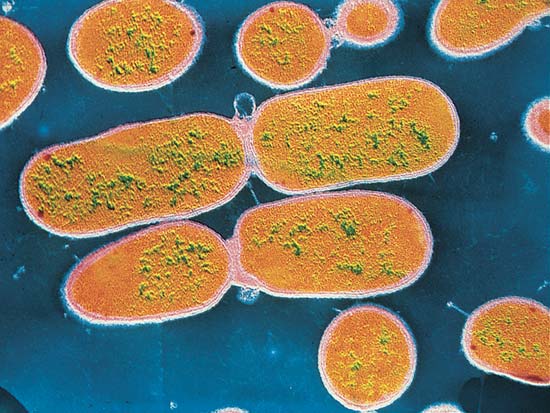
Classify this as asexual or sexual reproduction: (if asexual give the type)

a)

Sexual

b)

Asexual, Binary Fission

c)

Asexual, Budding

d)

Asexual, Fragmentation

17.

This is an example of.......

a)

Binary Fission

b)

Fragmentation

c)

Regeneration

d)

Budding

18.
Structure (a) is a ____.
a)
chromosome
b)
chromatid
c)
centromere
19.
A human usually has xx amount of chromosomes.
a)
6
b)
22
c)
4
d)
46
20.
Why does sexual reproduction result in more genetic diversity than asexual reproduction? 
a)
Traits from two parents are combined. 
b)
More organisms reproduce this way. 
c)
Offspring grow in different environments. 
d)
Offspring come from identical parents. 
21.
Organisms that reproduce asexually generally have offspring that are 
a)
unicellular. 
b)
multicellular. 
c)
genetically varied. 
d)
genetically identical. 
22.
In order to grow two of the exact same plants, a person would reproduce them asexually because the
a)
genetic diversity is greater. 
b)
offspring would be genetically identical. 
c)
recessive traits would emerge. 
d)
negative traits are suppressed. 
23.
When an egg and sperm form an embryo, the offspring that is formed will have genetic traits that are 
a)
inherited from only one parent. 
b)
created by the environment. 
c)
passed on from two parents. 
d)
learned from siblings. 
24.

When organism reproduce sexually which is true about their offspring?

a)

The offspring will get 100% genes from dad

b)

The offspring will get 100% genes from mom

c)

The offspring will get 25% of genes from mom and 75% of genes from dad

d)

The offspring will get 50% of genes from mom and 50% of genes from dad

25.

For an organism to have genetic variation it must be the result

a)

Sexual reproduction

b)

Asexual reproduction

c)

extinction

d)

gravity

26.

Binary fission, Fragmentation and budding are examples of?

a)

Asexual reproduction

b)

Sexual reproduction

c)

Photosynthesis

d)

Radiant energy

27.

Which of the following is an advantage of reproducing asexually?

a)

have no diversity in their DNA

b)

Reproduce slowly

c)

Reproduce rapidly

d)

all have the same weakness

28.

Which of the following is an advantage or reproducing asexually?

a)

Require two parents

b)

Require only one parent

c)

Have no diversity

d)

Same weakness

29.

Which of the following are examples of gametes(reproductive cells)?

a)

Sperm cell and egg cells

b)

Sperm cells only

c)

Egg cells only

30.

When 2 gametes unite it is knows as

a)

asexual reproduction

b)

Fertilization

c)

Egg

d)

chemical digestion

31.

Organism that reproduce sexually can survive different types or change in the environment.

a)

True

b)

False

32.
Heredity is the passing of traits from _____________________ to _____________________
a)
predators to prey
b)
water to rain
c)
parents to offspring
d)
fungi to protists
34.
___________________________ is the study of how traits are passed on, or inherited.
a)
dominant traits
b)
ratio
c)
phenotype
d)
genetics
34.
___________________________ is the study of how traits are passed on, or inherited.
a)
dominant traits
b)
ratio
c)
phenotype
d)
genetics
35.
Why did Mendel choose to study pea plants in order to learn how traits are passed from parent to offspring?
a)
Pea plants grow quickly
b)
Pea plants are ultraviolet
c)
Pea plants are rare and expensive
d)
Pea plants are take years to grow
36.
If a child has red hair, they inherited a certain _______________ from their parents.
a)
ratio
b)
trait
c)
probability
d)
sex chromosome
37.
One trait that is ALWAYS present and causes the other traits to disappear is a ________________________
a)
recessive trait
b)
aggressive trait
c)
absent trait
d)
dominant trait
38.
True or False:  Recessive traits are ALWAYS present 
a)
True
b)
False
39.
Offspring receives two sets of _____________ (one from each parent)
a)
blue jeans
b)
genes
c)
machines
d)
pedigree
40.
_____________________ is the appearance of an organism, or how it looks
a)
phenotype
b)
ratio
c)
recessive trait
d)
heredity
41.
A ________________________ is used to predict the possible genotype from certain parents
a)
Mendel Grid
b)
Genetic Tic Tac Toe
c)
Punnett Square
d)
Pedigree Plot
42.
______________________ is the mathematical chance that something will happen
a)
division
b)
selective breeding
c)
ratio
d)
probability
43.
_____________________ are cells that join to make offspring
a)
speed cells
b)
sex cells
c)
pea cells
d)
pedigree cells
44.
True or False:  Sex Chromosomes carry genes that determine the skin color and hair color of a child.
a)
True
b)
False
45.
Emily has brown hair. Which is most likely a true statement about Emily?
a)
Emily’s favorite color is brown.
b)
Emily has a parent with brown hair.
c)
Emily’s older brother has brown hair. 
46.
A litter of kittens have traits that are similar to both the mother cat and the father cat. Which best explains this situation?
a)
The kittens are provided the same kind of milk from their mother as they grow.
b)
The kittens inherit some of their traits from their mother and some from their father.
c)
The kittens are kept at the same temperatures by their mother when they are first born.
d)
The kittens are taught by their parents to have similar traits.
47.
What should students use to identify the percent chance of a trait being passed down from a parent to its offspring?
a)
a graph
b)
a flow chart
c)
a data table
d)
a Punnett square
48.
Dominant or recessive?
tt
a)
Dominant 
b)
Recessive
49.
Dominant or recessive?
Dd
a)
Dominant
b)
recessive
c)
neither
d)
homozygous
50.
one of the alternative forms of a gene that governs a characteristic, such as hair color
a)
allele
b)
gene
c)
trait
d)
DNA
51.
Homozygous or heterozygous?
BB
a)
Homozygous
b)
Heterozygous
52.
Which of the following is heterozygous?
a)
Hh
b)
gg
c)
HH
d)
GG
53.
Jackie is homozygous recessive  for having dimples (D). What is her genotype?
a)
pp
b)
Dd
c)
dd
d)
DD
54.
having two of the same genes for the trait (sometimes called purebred).
a)
homozygous
b)
hetrozygous
c)
protein
d)
chromosome
55.
He is known as the father of modern day genetics.
a)
Gregory Mendel
b)
Greg Mendel
c)
Gregor Mendel
d)
Grace Mendel
56.
Dominant alleles are represented by a:
a)
Male gene
b)
lowercase letter
c)
recessive trait
d)
capital letter
57.
Heterozygous is when...
a)
the alleles are the same
b)
the alleles are different
c)
the alleles are absent
d)
the alleles are present
58.
In a heterozygous genotype, the ___________ allele takes over in the phenotype.
a)
recessive
b)
dominant
c)
lower case letter
d)
both 
59.
T - tall and t = short
In the punnett square below, what belongs in the missing square
a)
tt
b)
Tt
c)
Bb
d)
TT
60.
G = green, g = yellow
The genotype for a yellow plant is...
a)
GG
b)
Gg
c)
gg
d)
all of the choices result in yellow
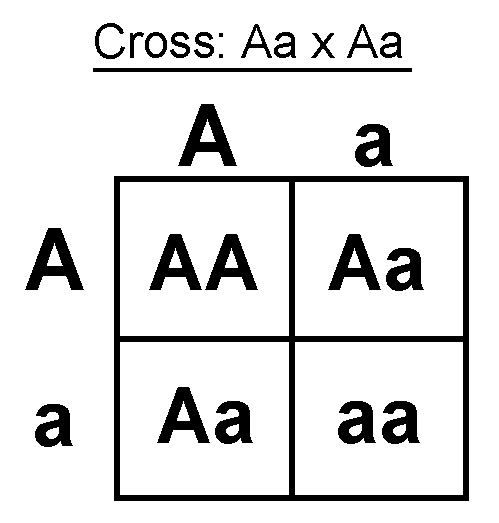
61.
B = brown fur  b = white fur
In the punnett square, what is the probability for white fur? 
a)
0%
b)
25%
c)
50%
d)
75%
62.
In plants, tall (T) is dominant to short (t). Perform the following cross: Tt x Tt. What is the probability of producing a short plant?
a)
0%
b)
25%
c)
50%
d)
75%
63.
Which of the following alleles is homozygous (purebred) recessive?
a)
Tt
b)
tt
c)
TT
d)
t
64.
Each one of the boxes on the Punnett Square represents what probability of an offsprings' genotype?
a)
25%
b)
1%
c)
10%
d)
0%
65.
AA and Aa always show up as
a)
dominant
b)
recessive
66.
Aa, DD, bB, yy are all examples of
a)
genotypes
b)
phenotypes
67.
Which of the following genotypes is homozygous dominant?
a)
A
b)
Aa
c)
AA
d)
aa
68.
Which of the characteristics is a lion least likely to pass on to its offspring?
a)
fur color
b)
length of tail
c)
scars on leg
d)
body size
69.
What you see, or the physical appearance.
a)
Genotype
b)
Phenotype
c)
Homozygous
d)
Heterozygous
70.
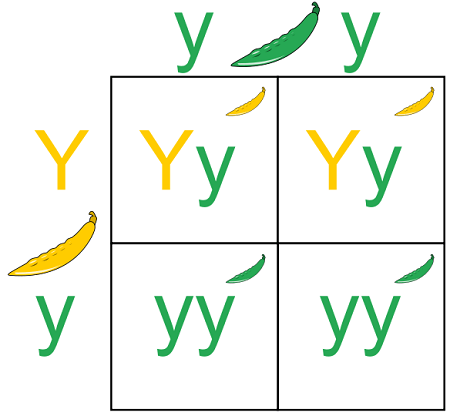
Which choice best represents the genotype of this cross?
a)
1 Yy: 2 yy: 0 YY
b)
2 Yy: 2 yy: 0 YY
c)
3 Yy: 1 yy: 0 YY
d)
1 Yy: 3 yy: 0 YY
71.
What is the phenotype of the offspring? (A-Brown hair; a-blond hair) 
a)
50 % Brown Hair and 50% Blond Hair 
b)
25 % Brown Hair and 75% Blond Hair 
c)
75 % Brown Hair and 25% Blond Hair 
d)
0% Brown Hair and 100% Blond Hair 
72.
A green pea plant (GG) is being crossed with a green pea plant (Gg). What is the phenotype?
a)
100 % rainbow 
b)
50% yellow and 50% green 
c)
100% green
d)
100% yellow 
73.
A red flower (Rr) is crossed with a white flower (rr). What is the genotype?
a)
0 RR; 0 Rr: 4 rr
b)
2 RR; 0 Rr: 2 rr
c)
4 RR; 0 Rr: 0 rr
d)
0 RR; 2 Rr: 2 rr
74.
A tall plant (TT) is crossed with a tall plant (Tt).  What is the genotype?
a)
2 TT: 2 Tt: 0 tt
b)
1 TT: 2 Tt: 1 tt
c)
2 TT: 1 Tt: 1 tt
d)
0 TT: 0 Tt: 4 tt
75.
Two heterozygous red flower (white flowers are recessive) are crossed. What is the phenotype?
a)
75% red and 25% white
b)
25% red and 75% white
c)
100 White 
d)
50% red 50% red 
76.
A homozygous dominant brown mouse is crossed with a heterozygous brown mouse (tan is the recessive color). 
a)
100 % tan
b)
100 % brown 
c)
50 % brown and 50% tan 
d)
75 % brown and 25 % tan 
77.
If you have a male with large wings (DD) and a female with small wings (dd). What allele stands for large wings? 
a)
D
b)
d
c)
Dd
d)
dd
78.
Where is DNA
a)
Inside the mitochondria
b)
Inside the nucleus
c)
Inside the chloroplast
d)
Inside the ribosomes
79.
Which words means the characteristic of an organism?
a)
Trait
b)
Allele
c)
Heredity
d)
Genetics
80.
What is DNA?
a)
The energy maker of the cell
b)
The organelle that controls movems
c)
All the information for the cell?
d)
A living thing
81.
Where do you get your traits from?
a)
Your brother
b)
Your sister
c)
Your parents
d)
No one
82.
Which word means the traits you get from your parents?
a)
Trait
b)
Allele
c)
Heredity
d)
Genetics
83.
What is Gregor Mendel's nick name?
a)
"Mr. Heredity"
b)
"Greggy"
c)
"Gene Finder"
d)
"Father of Genetics"
84.
What did Gregor Mendel find out?
a)
Traits do not blend
b)
Traits can be hidden
c)
Genes make traits
d)
All are correct
85.
Genes are a small part of what?
a)
Skin
b)
DNA
c)
Hair
d)
Eyes
86.
For every gene, how many alleles do you have?
a)
1
b)
2
c)
3
d)
4
e)
5
87.

Where do you get your alleles from?

a)

2 from your mom

b)

2 from your dad

c)

1 from your mom AND 1 from your dad

88.
If you have 2 recessive alleles, which trait will you have?
a)
The dominant trait
b)
The recessive trait
c)
A blend of the two