
 Worksheets
Punnett Square Review
Total questions: 37
Worksheet time: 2hrs 54mins
Name
Class
Date
1.
G = green, g = yellow
The genotype for a yellow plant is...
The genotype for a yellow plant is...
a)
GG
b)
Gg
c)
gg
d)
all of the choices result in yellow
2.
T = tall an t = short
TT and Tt would result in the following phenotype
TT and Tt would result in the following phenotype
a)
short
b)
tall
c)
both tall and short
d)
neither tall or short
3.

T - tall and t = short
In the punnett square below, what belongs in the missing square
In the punnett square below, what belongs in the missing square
a)
tt
b)
Tt
c)
Bb
d)
TT
4.

B = brown fur b = white fur
In the punnett square, what is the probability for white fur?
In the punnett square, what is the probability for white fur?
a)
0%
b)
25%
c)
50%
d)
75%
5.
Two brown eyed parents (Bb) have a baby. What is the chance the baby is blue eyed?
a)
0 %
b)
25%
c)
50%
d)
75%
6.
A person heterozygous for wet earwax (Ww) mates with a person homozygous recessive for dry earwax. What is the chance their baby is heterozygous?
a)
0%
b)
25%
c)
50%
d)
100%
7.
Two brown eyed parents (Bb) have a baby. What is the chance the baby is blue eyed?
a)
0 %
b)
25%
c)
50%
d)
75%
8.

If T=Tall & t=short, what is the genotypic ratio?
a)
1:3
b)
3:1
c)
1:2:1
d)
2:2
9.
In some carnations, flower color exhibits codominance. When crosses, Red (R) and white (W) flowers make speckled flowers (RW) that show both colors.
Complete a cross between A speckled flower and a red flower. Find the phenotype ratio.
Complete a cross between A speckled flower and a red flower. Find the phenotype ratio.
a)
2 red: 2 speckled: 0 white
b)
4 red: 0 speckled: 0 white
c)
0 red: 4 speckled: 0 white
d)
0 red: 2 speckled: 2 white
10.
A man has blood type A (heterozygous) and a woman has blood type B (heterozygous). What are the possible blood types of their kids?
a)
A or B only
b)
AB only
c)
A, B, AB only
d)
A, B, AB, or O
11.

This flower is showing what kind of exception to mendelian traits?
a)
Incomplete dominance
b)
Codominance
c)
Mixed dominance
d)
Partial dominance
12.

How many children of individuals I-1 and I-2 have Falconi anemia?
a)
1
b)
2
c)
3
d)
4
13.

Colorblindness is a recessive, X chromosome sex-link disorder. Cross the parents to figure out which percentage of their offspring will be colorblind.
a)
25%
b)
0%
c)
75%
d)
50%
14.
W=white hair
w= non-white hair
If you cross a horse with WW and a horse with ww what fraction of the offspring would be expected to have white hair?
w= non-white hair
If you cross a horse with WW and a horse with ww what fraction of the offspring would be expected to have white hair?
a)
none
b)
3/4
c)
1/2
d)
all
15.
What is a possible phenotype of a child that results from a woman with type AB blood and a man with type A blood?
a)
OO
b)
type O
c)
AA
d)
type A
16.

Both parents in this Punnet square
a)
are homozygous dominant
b)
are homozygous recessive
c)
are heterozygous
d)
have blue eyes
17.

Brown is dominant to green. What is the probability of these parents having green offspring?
a)
1/4
b)
2/4
c)
3/4
d)
4/4
18.
A woman heterozygous for A blood marries a man heterozygous for B blood. What is the probability that they will produce offspring with AB blood?
a)
0%
b)
25%
c)
50%
d)
75%
19.
What is the chance of two parents with blood types AB and O producing an offspring with blood type O?
a)
0%
b)
25%
c)
50%
d)
100%
20.
Genetic crosses involving a particular type of flower exhibit complete dominance with respect to petal color. Red (R) is dominant to white (r). Using the Punnett square, what is the expected percentage of offspring that will have white flowers from a cross of parent flowers with a genotype of Rr.
a)
0%
b)
25%
c)
50%
d)
100%
21.
Red-green color blindness is an X-linked recessive trait. A red-green color-blind woman and a red-green color-blind man have a son. What is the probability that the son is also red-green color-blind?
a)
0%
b)
25%
c)
50%
d)
100%
22.
Tay-Sachs disease is a lethal, autosomal recessive genetic disorder. If both parents are heterozygous carriers of the disease, what are the chances of them having a child who is also a heterozygous carrier for Tay-Sachs?
a)
0%
b)
25%
c)
50%
d)
75%
23.
In certain species of plants, purple flowers (P) are dominant to white flowers (p). If two heterozygous plants are crossed, what will be the phenotype of the offspring?
a)
100% purple flowers
b)
100% white flowers
c)
75% white flowers, 25% purple flowers
d)
25% white flowers, 75% purple flowers
24.

The visual representation of an individual's chromosomes is a
a)
phenotype
b)
genotype
c)
karyotype
d)
stereotype
25.
Hemophilia is a recessive x-linked disorder.
Which genotype represents a female who is a carrier for hemophilia?
Which genotype represents a female who is a carrier for hemophilia?
a)
XHXh
b)
XhXh
c)
XHXH
d)
XhY
26.
Hemophilia is a recessive x-linked disorder.
Which genotype represents a male with hemophilia?
Which genotype represents a male with hemophilia?
a)
XHXh
b)
XhXh
c)
XHY
d)
XhY
27.
____ are chromosomes that contain genes for characteristics unrelated to sex.
a)
autosomes
b)
microsomes
c)
cosmos
d)
inheritance
28.
Females have ____ and males have _____ chromosomes.
a)
XX, XY
b)
XY, XX
c)
XX, XX
d)
XY, XY
29.
which is heterozygous ?
a)
Tt
b)
TT
30.

Which individual in the first generation is a carrier?
a)
The male
b)
The female
c)
individual 1
d)
None of the above
31.

Looking at this pedigree, how many female family members are carriers?
a)
1
b)
3
c)
10
d)
7
32.

What percentage of the female offspring will be a carrier for this recessive disease?
a)
0%
b)
50%
c)
100%
d)
25%
33.
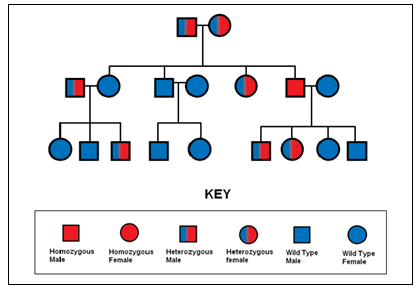
In a pedigree, what shape represents a male?
a)
circle
b)
square
c)
triangle
d)
diamond
34.

What do half colored symbols represent?
a)
The individual is a carrier (heterozygous).
b)
The individual expresses the trait.
c)
The individual has both recessive alleles.
d)
The individual has both dominant alleles.
35.

This is an example of ___________?
a)
Incomplete dominance
b)
Co-Dominance
36.
What are the blood types of the possible children that a woman (type O) and man (type AB) can have?
a)
O and AB
b)
O and A
c)
O and B
d)
A and B
37.
Coat color in labs is an example of:
a)
Polygenic Traits
b)
Epistasis
c)
X-Chromosome Inactivation
d)
X-linked traits (same as sex-linked)
100 %

