
 Worksheets
Biology Semester 1 Final Review
Total questions: 73
Worksheet time: 18hrs 1mins
Name
Class
Date
1.
Which biomolecule includes fats, such as triglycerides, oils, waxes, and steroids (cholesterol); insoluble in water; provides energy storage, insulation, part of cell membrane, and hormones
a)
Nucleic Acid
b)
Lipids
c)
Carbohydrate
d)
Protein
2.
Which organic macromolecules are composed of chains of amino acids that join to form the structural components of organisms.
a)
Carbohydrates
b)
Proteins
c)
Amino Acids
d)
Lipids
3.

What are the monomers for the molecules shown in the diagram?
a)
Amino Acids
b)
Fatty Acids
c)
Nucleotides
d)
Monosaccharides
4.
In passive transport, molecules move from an area of __________ concentration to an area of __________ concentraiton
a)
high, low
b)
low, high
c)
water, salt
d)
active, passive
5.
In which solution will water move into a cell?
a)
Hypertonic
b)
Hypotonic
c)
Isotonic
d)
Equilibrium
6.

What type of transport is this?
a)
Diffusion
b)
Osmosis
c)
Facilitated Diffusion
d)
Active Transport
7.

What type of transport is this?
a)
Endocytosis
b)
Facilitated Diffusion
c)
Active Transport Pump
d)
Osmosis
8.
A HYPERTONIC solution has a _____ concentration of solute than the interior of the cell and a cell will ______ when placed into this solution.
a)
lower; shrink
b)
lower; swell
c)
higher; shrink
d)
higher; swell
9.

Fruit fly body cells have 8 chromosomes. After mitosis, you would expect a resulting fruit fly daughter cell to have ...
a)
16 chromosomes.
b)
46 chromosomes.
c)
8 chromosomes.
d)
4 chromosomes.
10.

Structure (b) is a ____.
a)
chromosome
b)
chromatid
c)
centromere
11.

Name the phase:
a)
Anaphase
b)
Telophase
c)
Metaphase
d)
Prophase
12.

Name the previous phase.
a)
Prophase
b)
Metaphase
c)
Anaphase
d)
Telophase
13.
which is a waste product of photosynthesis?
a)
carbon dioxide
b)
glucose
c)
oxygen
d)
water
14.

Look at the diagram. Which reaction is taking place between 1 and 3?
a)
ammonification
b)
glycolysis
c)
photosynthesis
d)
respiration
15.
Where does cellular respiration take place in the cell?
a)
Cell Membrane
b)
Nucleus
c)
Mitochondria
d)
Vacuole
16.
Which of the following is the correct equation for PHOTOSYNTHESIS?
a)
6CO2 + 6H2O --> 6O2 + C6H12O6
b)
6CO2 + C6H12O6 + 6H2O --> O2
c)
6O2 + 6H2O --> 6CO2 + C6H12O6
d)
C6H12O6 + 6O2 ---> 6H2O + 6CO2
17.
Groups of cells that divide and form masses within the body are called
a)
biopsies
b)
carcinogens
c)
tumors
d)
generalized cancer
18.
Cancer can be defined as
a)
uncontrolled growth of abnormal cells
b)
a group of hereditary diseases
c)
a virus that destroys healthy cells
d)
a contagious disease
19.

Based on the graph, what temperature does this enzyme work best?
a)
15 C
b)
40 C
c)
30 C
20.
Enzymes will make a reaction go _______ and use ______ energy.
a)
faster, less
b)
faster, more
c)
slower, less
d)
slower, more
21.
What is the first step in protein synthesis?
DNA -> mRNA
DNA -> mRNA
a)
transcription
b)
translation
c)
replication
d)
mutation
22.
This is a DNA strand. Which is the complimentary DNA strand that would be made through DNA Replication?
TACGAA
a)
ATGCTT
b)
GCATCC
c)
ATGCTT
d)
TACGAA
23.
During what phase of the cell cycle does DNA replication take place
a)
G1 Phase
b)
S Phase
c)
G2 Phase
d)
Mitosis
24.

Which of these is responsible for the different morphologies of these cells?
a)
Metabolism
b)
Replication
c)
Gene Expression
d)
None of these account for the different morphologies
25.
Which of the following units are repeatedly joined together to form a strand of DNA?
a)
amino acids
b)
nucleotides
c)
fatty acids
d)
polysaccharides
26.
What are the 4 nitrogen bases?
a)
adenine, thymine, cytoplasm, and guanine
b)
adenine, thymine cytosine, and guanine
c)
adenine, thymine, cytosine, and gylcerol
d)
adenine, thymine, cytosine, and glucose
27.

Nitrogenous bases are joined by which type of bond?
a)
polar bonds
b)
ionic bonds
c)
covalent bonds
d)
hydrogen bonds
28.
What are the three components of a nucleotide?
a)
sugar, hydrogen, nitrogen base
b)
sugar, oxygen, nitrogen base
c)
sugar, phosphate, nitrogen base
d)
sugar, phosphate, protein
29.

Which organelle is only found in a plant cell?
a)
nucleus
b)
chloroplast
c)
mitochondria
d)
cell membrane
30.

This organelle converts organic material (food) to ATP (cell energy).
a)
Nucleus
b)
Ribosome
c)
Mitochondria
d)
ER
31.
You are made up of...
a)
eukaryotic cells
b)
prokaryotic cells
c)
plant cells
d)
bacterial cells
32.
Which of these would be found in an animal cell?
a)
cell wall
b)
mitochondria
c)
chloroplast
d)
large central vacuole
33.
Has membrane bound organelles
a)
Prokaryote
b)
Eukaryote
c)
both
34.
One example of a prokaryote is a...
a)
fungus
b)
bacteria
c)
animal
d)
plant
35.
Which of the following provide evidence for the hypothesis that prokaryotes evolved before eukaryotes.
a)
prokaryotes are more complex
b)
prokaryotes have no nucleus and fewer genes
c)
eukaryotes are multicellular which makes them simpler
d)
prokaryotes grow into eukaryotes
36.
Viruses are...
a)
prokaryotic
b)
eukaryotic
c)
non-living
d)
endospores
37.

What process is this?
a)
phagocytosis
b)
lytic cycle
c)
lysogenic cycle
d)
formation of antibodies
38.
What happens in the lysogenic cycle?
a)
Virus goes in and leaves the host cell
b)
Virus quickly kills the host cell
c)
Virus inject the nucleic acid into the host cell, and the nucleic acid integrates into the host cell DNA, and stay dormant for a long time
d)
Bacteria injects DNA into a host cell
39.
What happens in the lytic cyle?
a)
Virus goes in and leaves the host cell
b)
Virus quickly kills the host cell
c)
Virus sleeps inside of the host cell
d)
Virus stay dormant for a long time
40.

What is shown here?
a)
Lysogenic Cycle
b)
Lytic Cycle
c)
Binary Fission
d)
Conjugation
41.
A group of tissues that perform a similar function is called_____.
a)
cells
b)
tissues
c)
organs
d)
organ system
42.
When many organ systems work together it can form...
a)
organ
b)
cells
c)
organ system
d)
organism
43.
What is the correct order of organization
a)
tissues-cells-organs-organ systems-organism
b)
cell-tissue-organs-organ systems-organism
c)
organism-cells-tissues-organ systems-organism
d)
tissues-cells-organs-organ sytems-organism
44.
The theory of Endosymbiosis explains
a)
The origin of eukaryotes
b)
How species develop
c)
How bacteria live
d)
Why cells rely on one another
45.
____________ & _________________ are organelles that definitely arose from endosymbiosis.
a)
Rough ER & Smooth ER
b)
Mitochondria & Flagellum
c)
Chloroplast & Mitochondria
d)
Chloroplast and Golgi apparatus
46.
Which of the following need a host cell to reproduce?
a)
Virus
b)
Bacteria
c)
Algae
d)
Protist
47.
Why do doctors suggest people get a flu vaccine every year?
a)
Flu viruses replicate more rapidly over time
b)
Flu viruses can mutate from year to year
c)
Vaccines are absorbed by the body after a year
d)
Vaccines get stronger over time
48.
Which of the following answers links a biomolecule with one of its proper functions?
a)
Lipids - Store genetic information
b)
Carbohydrates - short term energy storage
c)
Nucleic Acids - Catalyze reactions
d)
Proteins - long term energy storage
49.

The stages of mitosis in order
a)
Metaphase, Anaphase, Prophase, Telophase
b)
Prophase, Metaphase, Anaaphase, Telophase, Cytokinesis
c)
Prophase, Metaphase, Anaphase, Telophase
d)
Interphase, Prophase, Metaphase, Anaphase, Telophase
50.
How do photosynthesis and cellular respiration differ?
a)
photosynthesis uses food and cellular respiration produces food
b)
photosynthesis gives off oxygen and cellular respiration uses oxygen
c)
photosynthesis uses oxygen and cellular respiration uses carbon dioxide
51.
Which of the polymers below is NOT correctly paired with its monomer building blocks?
a)
proteins: amino acids
b)
lipids: fatty acids
c)
carbohydrates: monosaccharides
d)
nucleic acids: carbonic acids
52.

Which situation would use ATP because it would be active transport?
a)
substance "A" entering the cell
b)
substance "B" entering the cell
c)
both substances entering the cell
d)
neither substance entering the cell
53.
Complete the sentence:
Cells exposed to _____________ can develop ______________ & _________________
Cells exposed to _____________ can develop ______________ & _________________
a)
radiation, cancer, mutations
b)
atmospheric oxygen, mutations, increased mitochondria
c)
salt water, more cytoplasm, two nuclei
d)
less sunlight, extra genes, decreased mutations
54.

Which is in the correct order from largest to smallest?
a)
a.
b)
b.
c)
c.
d)
d.
55.

Which is the sequence in which the components are assembled to form a polypoptide that determines a trait?
a)
a.
b)
b.
c)
c.
d)
d.
56.

Which labels correctly identify the components of DNA?
a)
X-hydrogen bond
Y-nucleotide
Z-sugar/phosphate backbone
Y-nucleotide
Z-sugar/phosphate backbone
b)
X-nucleotide
Y-hydrogen bond
Z-sugar/phosphate backbone
Y-hydrogen bond
Z-sugar/phosphate backbone
c)
X-nucleotide
Y-sugar/phosphate backbone
Z-hydrogen bond
Y-sugar/phosphate backbone
Z-hydrogen bond
d)
X-sugar/phosphate bond
Y-nucleotide
Z-hydrogen bond
Y-nucleotide
Z-hydrogen bond
57.
Gene expression is regulated to control the development of an organism. At any given time, only a fraction of the total number of genes is expressed. How is gene transcription regulated?
a)
mRNA contains a special sequence of nucleotides called initiators that signal when to begin transcription
b)
A sequence of nucleotides is "dropped" from the DNA chain, signaling nRNA to begin transcription
c)
DNA polymerase unzips the part of the double helix to signal where to begin transcription
d)
RNA polymerase binds only to promoters on DNA that indicate where to begin transcription
58.

Based on the nutrition label above, what is the food item least likely to contribute to the cells in the body?
a)
increase immune function
b)
increase in immediately available energy
c)
increase in long term energy
d)
increased sugars that can be broken down by the mitochondria
59.

Which statement about the image is incorrect?
a)
Side I is hypotonic
b)
Side II contains more solute, so it is hypertonic
c)
The volume of side I will increase
d)
The net movement of water will be from side I to side II
60.
What is the function of a carbohydrate?
a)
Energy
b)
Movement
c)
Stores genetic information
d)
Speeds up reactions
61.

symbiotic relationship in which both organisms benefit
a)
competition
b)
Mutualism
c)
nitrogen fixation
d)
energy pyramid
62.

A living relationship between two species in which one organism is harmed is called...
a)
mutualism
b)
commensalism
c)
parasitism
d)
niche
63.
The amount of energy that usually transfers from one trophic level to the next...
a)
10%
b)
20%
c)
80%
d)
50%
64.
The nonliving aspects of an ecosystem.
a)
Abiotic factors
b)
Biotic factors
65.

All of the living and nonliving things in an area that interact with each other are called a/an ______.
a)
community
b)
habitat
c)
population
d)
ecosystem
66.

Organisms that look similar and can produce fertile offspring
a)
Species
b)
Fish
c)
Community
d)
Trees
67.

Which organism in this energy pyramid has the MOST energy?
a)
Palm tree
b)
Grasshopper
c)
Snake
d)
Hawk
68.
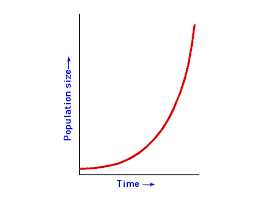
What type of growth is shown in the diagram?
a)
exponential growth
b)
logistic growth
c)
predator-prey cycle
d)
boom-bust curve
69.
Largest number of individuals of a population that the environment can support...
a)
carrying capacity
b)
population crash
c)
lag phase
d)
mutualism
70.
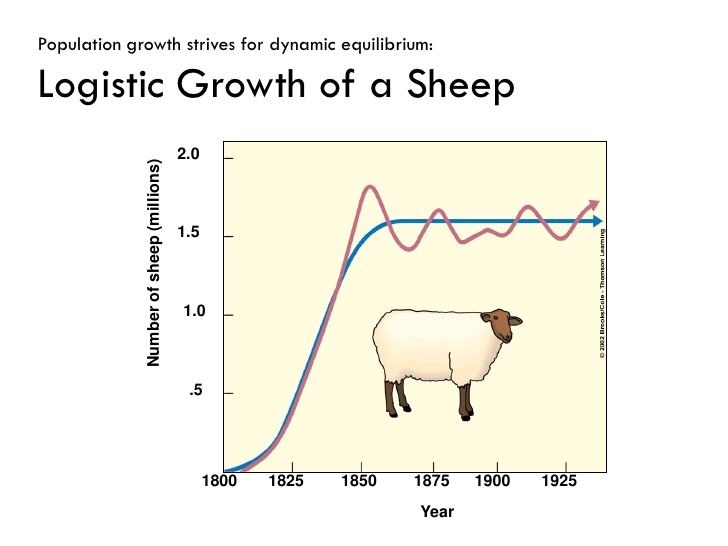
What is the carrying capacity for this sheep population?
a)
1.8 million
b)
1.25 million
c)
1.6 million
d)
1.o million
71.

What point on the graph represents the carrying capacity?
a)
A
b)
B
c)
C
d)
D
72.
Food, water, sunlight, shelter, and space are resources that are often __________.
a)
limiting factors
b)
wet
c)
messy
d)
found in rocks
73.

the process by which a new community forms where no community lived before
a)
resource
b)
invasive (non- native) species
c)
primary succession
d)
competition
100 %

