wayground logo

Free Printable Worksheets

NEW

Font size

S
M
L
XL
Worksheets

Biology Semester 1 Review

Total questions: 70

Worksheet time: 52mins

Name
Class
Date
1.
 Bob wants to see if red M&Ms melt faster than blue ones. Which hypothesis is he testing?
a)
If M&Ms are heated, the color will change melting time. 
b)
If M&Ms are heated, the size will change melting time
c)
If M&Ms are heated, the air temp will change melting time.
d)
If M&Ms are heated, the procedure will change melting time.
2.
What is treated the same , but not exposed to the manipulated variable?
a)
Dependent Variable
b)
Independent Variable
c)
Controlled Variable 
d)
None of the above
3.
 A farmer wants his chicks to gain weight faster. Which of these questions are most relevant?
a)
What is the average lifespan of a chick?
b)
How many steps a day do chickens take on average?
c)
What type of food causes maximum weight gain?
d)
What breed of chicken weighs more?
4.
A solution is a _________ in a ________.
a)
solvent; solute
b)
solute; solvent
5.
Which step typically comes first in the scientific method?
a)
graph your data
b)
ask a question
c)
analyze your data
d)
make a hypothesis
6.
What do macromolecules all have in common? 
a)
None of them contain phosphates.
b)
They all contain C, H O and N.
c)
They are all polymers made of monomers
d)
None of the above.
7.
. If people are given various amounts of vitamins, then those with more vitamins will live longer
a)
IV = how long the person lives
b)
IV= the amount of vitamin given 
c)
IV= age of the person
d)
IV= type of vitamin
8.
Lori is studying the water level changes over 10 yrs. What's the best way to display her data? 
a)
pie chart
b)
bar graph
c)
table
d)
line graph
9.
Which of the following is NOT correct?
a)
The IV is changed by the DV. 
b)
The DV is effected by the IV.
c)
The IV is manipulated so changes in the DV can be recorded.
d)
The IV is changed by the experimenter.
10.
A building block of DNA.
a)
amino acid
b)
nucleotide
c)
monosaccharide
d)
fatty acid
11.
Fats, oils, and waxes are examples of 
a)
carbohydrates
b)
lipids
c)
nucleic acids
d)
proteins
12.
Which of the following is an example of a protein?
a)
DNA
b)
enzyme
c)
saturated fat
d)
sugar
13.
 Which of the following comparisons between macromolecules is false?
a)
Carbohydrates and lipids both store energy.
b)
Proteins and nucleic acids both store information.
c)
Proteins and carbs both have roles in structural support.
d)
Nucleic acids and amino acids both contain monosaccharides.
14.
 Which of these is an example of a quantitativeobservation?
a)
Bob's style of shirt
b)
Jenna's breed of dog
c)
The names of people in your biology class.
d)
Sue's body temperature
15.
 Which of the following is NOT due to water's surface tension?
a)
Rain falling in drops.
b)
Spilt water forming a puddle.
c)
Water bugs walking on water
d)
Icebergs floating in the ocean.
16.
_________ bonds form between water molecules.
a)
Ionic
b)
Hydrogen
c)
Covalent
d)
No
17.
Replicate the following strand of DNA: 
AATCATGGA
a)
AATCATGGA
b)
TTAGTACCT
c)
UUAGUACCU
d)
GGATAUCUA
18.
DNA replication results in two DNA molecules,
a)
each one with two original strands
b)
each one with two new strands
c)
each one with one new strand and one original strand
d)
one with two new strands and the other with two original strands
19.
A scientist observes a base sequence of AGCTAGCTAGCT.  Which of the following would be the complimentary strand?
a)
TGCATGCATGCA
b)
TCGATCGATCGA
c)
TAGCTAGCTAGC
d)
TTAAGGCCTTCC
20.
The DNA nucleotide is composed of three parts. Which two components make up the nucleotide backbone?
a)
ribose sugar and base
b)
ribose sugar and phosphate group
c)
nitrogen base and deoxyribose sugar
d)
deoxyribose sugar and phosphate group
21.
What are the 4 nitrogen bases?
a)
adenine, thymine, cytoplasm, and guanine
b)
adenine, thymine cytosine, and guanine
c)
adenine, thymine, cytosine, and gylcerol
d)
adenine, thymine, cytosine, and glucose
22.
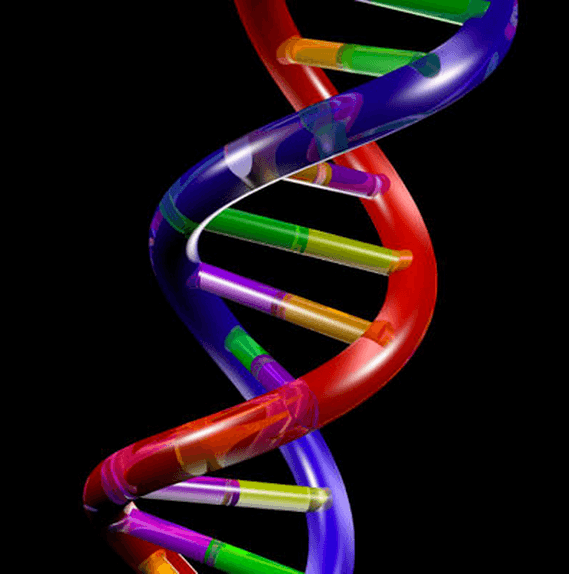
Describes the twisted ladder-like shape of a DNA molecule
a)
Nitrogen Base
b)
Hexagon
c)
Double Helix
23.
After analyzing a sample of DNA, a scientist recorded the data shown in the table. What percentage of the DNA sample is cytosine?
a)
22%
b)
25%
c)
28%
d)
56%
24.
Guanine bonds with ______________.
a)
Adenine
b)
Guanine
c)
Cytosine
d)
Thymine
25.
What determines the code, or information, of a DNA molecule?
a)
the shape (structure) of the nitrogen bases
b)
the order (sequence) of the nitrogen bases
c)
the color of the nitrogen bases
d)
the frequency (number) of nitrogen bases
26.
The following picture must be
a)
DNA because it's double stranded
b)
RNA because it's single stranded
c)
DNA because it's single stranded
d)
RNA because it's double stranded
27.
How does RNA differ from DNA?
a)
RNA contains uracil and deoxyribose
b)
RNA contains ribose and thymine
c)
RNA contains uracil and ribose
d)
RNA contains adenine and ribose
28.
How would the DNA sequence GCTATA be transcribed to mRNA?
a)
GCUAUA
b)
CGATAT
c)
CGAUAU
d)
GCUTUT
29.
The process by which the genetic code of DNA is copied into a strand of RNA is called
a)
translation
b)
transcription
c)
transformation
d)
replication
30.
Changes is DNA sequences that affect genetic information are known as
a)
replications
b)
mutations
c)
transformations
d)
translations
31.
Which of the following statements about the genetic code is true?
a)
A codon can specify more than one amino acid
b)
Every codon specifies a different amino acid
c)
Some codons specify the same amino acid
d)
Some codons have no function at all
32.
Which of the following molecules holds the code for ONE gene at a time?
a)
DNA
b)
RNA
33.
The offspring from asexually reproduced organisms are?
a)
Different than their parents
b)
Identical to parents
c)
Like a combination from both parents
d)
A different species
34.
Prokaryotes (bacteria) reproduce asexually via -
a)
spore formation
b)
bud creation
c)
vegetative propagation
d)
binary fission
35.

Fishermen work hard to catch and remove all the starfish that get into their “underwater farms” where they raise clams & oysters. In the past, they put the starfish into their boats, cut them up with knives, and then throw the pieces of starfish overboard. They thought this would kill the starfish. What they did not know was that each piece of starfish will grow into a whole new animal. What type of asexual reproduction is taking place?

a)

Fragmentation

b)

Vegetative propagation

c)

Budding

d)

Fission

36.

This is when a new organism grows by cell division on the body of its parent. The bud, or offspring is identical to the parent. The bud, when large enough, can break off of the parent and live on its own. An example of this is the hydra.

a)

Regeneration

b)

Vegetative propagation

c)

Fission

d)

Budding

37.
Osmosis is the movement of _____ across a membrane.
a)
food
b)
energy
c)
oxygen
d)
water
38.
Which is true about active transport?
a)
It requires energy
b)
it does not require energy
c)
It moves substances down the concentration gradient
d)
it moves material from high to low concentration
39.
This picture represents which type of cellular transport?
a)
passive transport
b)
endocytosis
c)
exocytosis
d)
osmosis
40.
Food is moved into the cell by ________________________.
a)
endocytosis
b)
pinocytosis
c)
exocytosis
d)
osmosis
41.
The cell below is in a _________ solution.
a)
Hypotonic
b)
Hypertonic
c)
Isotonic
42.
The cell below is in a _____________ solution.
a)
Hypertonic
b)
Hypotonic
c)
Isotonic
43.
What are two types of passive transport?
a)
endo and exocytosis 
b)
cookies and milk
c)
active and passive 
d)
Osmosis and diffusion
44.
Molecules diffusing with the concentration gradient through a protein channel is...
a)
Facilitated Diffusion
b)
Simple Diffusion
c)
Active Transport
d)
Osmosis
45.

Which do BOTH prokaryotes and eukaryotes contain?

a)

nucleus

b)

mitochondria

c)

ribosomes

d)

cell wall

46.
The haploid number of human chromosomes is
a)
11
b)
12
c)
23
d)
46
47.

Autosomes are

a)

chromosomes found in autotrophs, only

b)

chromosomes that automatically correct all errors in the DNA

c)

chromosomes that determine traits other than gender

d)

chromosomes that determine the gender of the individual

48.

Two identical copies of a single duplicated chromosome that are connected by a centromere.

a)

Chromatin

b)

Homologous chromosomes

c)

Sister chromatid

d)

Centromere

49.

An organism's reproductive cells, or sex cells, are called _____.

a)

bacteria

b)

prokaryotes

c)

gametes

d)

pathogens

50.

Chromosomes that are paired by size and content are called _______ chromosomes.

a)

homeostasis

b)

homologous

c)

matching

d)

sister

51.

Cells that contain 2 sets of chromosomes are called _________ (2n).

a)

diploid

b)

haploid

c)

triploid

d)

polyploid

52.

A _______ is an egg that has been fertilized by a sperm cell.

a)

gene

b)

chromosome

c)

zygote

d)

embryo

53.
During which phase of the cell cycle does the cell spend the most time?
a)
Mitosis
b)
Cytokinesis
c)
Interphase
54.
During which part of the cell cycle does the cell divide?
a)
Interphase
b)
Mitosis
c)
S phase
55.
During which part of the cell cycle is DNA copied?
a)
Mitosis
b)
Cytokinesis
c)
S phase
56.
What causes genetic variation in meiosis?
a)
chromosomes lining up
b)
crossing over of chromosomes
c)
separation of chromosomes
d)
chromosomes pulling apart
57.
What kind of cells are made in MEIOSIS?
a)
Haploid cells
b)
Diploid Cells
c)
Skin Cells
d)
Liver Cells
58.
Which cellular process is shown?
a)
meiosis
b)
endocytosis
c)
mitosis
d)
phagocytosis
59.
What phase is represented?
a)
metaphase 1
b)
metaphase 2
c)
anaphase 1
d)
anaphase 2
60.
products of meiosis are genetically
a)
different
b)
identical
61.
A human zygote should have _____ chromosomes inside.
a)
46
b)
23
c)
92
d)
64
62.

When the two alleles of a particular gene are different:

a)

heterozygous

b)

homozygous

c)

genotype

d)

phenotype

63.

The allele that is not expressed when the dominant corresponding allele is present:

a)

dominant

b)

heterozygous

c)

recessive

d)

homozygous

64.

When the two alleles of a particular gene are the same:

a)

homozygous

b)

genotype

c)

heterozygous

d)

phenotype

65.

A detectable trait or traits that result from the genotype such as color, shape, etc:

a)

genotype

b)

homozygous

c)

heterozygous

d)

phenotype

66.

What is a GENOTYPE?

a)

the genetic make-up of an organism

b)

the physical trait of an organism

c)

mitosis

d)

meiosis

67.

Which of the following represents alleles for the homozygous dominant genotype?

a)

Aa

b)

aa

c)

AA

68.

If A = red fur and a = white fur, what color fur would Aa be? (Assume Mendelian inheritance)

a)

red

b)

white

c)

purple

d)

blue

69.

If A = red fur and a = white fur, what color fur would aa be? (Assume Mendelian inheritance)

a)

red

b)

white

c)

purple

d)

blue

70.

If A = red fur and a = white fur, what are the PHENOTYPIC ratios of the offspring based on the Punnett Square?

a)

25% heterozygous

b)

50% purple

c)

75% red fur and 25% white fur

d)

25% homozygous recessive, 50% heterozygous, 25% homozygous dominant