
 Worksheets
Fall Semester Review
Total questions: 121
Worksheet time: 4hrs 5mins
Name
Class
Date
1.
Which particle contributes the negative charge to the atom?
a)
proton
b)
electron
c)
neutron
d)
nucleus
2.
Which particle does not contribute mass to the atom?
a)
Proton
b)
Neutron
c)
Electron
d)
Nucleus
3.
The three main subatomic particles are electrons, protons and ____________.
a)
photons
b)
neurons
c)
neutrons
d)
quarks
4.
What are the two main parts of the atom?
a)
nucleus and cytoplasm
b)
nucleus and electron cloud
c)
core and electron cloud
d)
protons and neutrons
5.
Most of the mass in an atom is made up of _____________________?
a)
protons and electrons
b)
protons and neutrons
c)
neutrons and electrons
d)
electrons and quarks
6.
What is the electrical charge of a proton?
a)
1+
b)
1-
c)
neutral
d)
2-
7.
All matter is composed of...
a)
Emoji
b)
bacteria
c)
matter
d)
Atoms
8.
All atoms of the same element have
a)
the same physical and chemical properties
b)
the same physical properties and different chemical properties
c)
different physical and chemical properties
d)
different physical properties but the same chemical properties
9.
What is the relative mass of an electron?
a)
1
b)
0
c)
2
d)
3
10.
What is the relative mass of an neutron?
a)
1
b)
0
c)
2
d)
3
11.
What is the relative mass of an proton?
a)
1
b)
0
c)
2
d)
3
12.
The atomic number is the number of...
a)
protons
b)
neutrons
c)
protons and neutrons
d)
atoms
13.
The atomic mass is the number of...
a)
protons
b)
neutrons
c)
protons and neutrons
d)
atoms
14.
how do you find the number of electrons?
a)
the atomic mass
b)
the number of neutrons
c)
the number of protons
d)
the column on the periodic table
15.

What element has 3 p+?
a)
nitrogen
b)
lithium
c)
beryllium
d)
carbon
16.

What is the mass number of this element?
a)
3
b)
6
c)
12
d)
18
17.

Is this atom neutral?
a)
Yes, because the protons = neutrons
b)
Yes, because the protons = electrons
c)
No, because the outside ring is not full
d)
No, it is missing electrons
18.

How many valence electrons are in this atom?
a)
3
b)
13
c)
14
d)
27
19.

What is the identity of this element based on this Bohr model?
a)
Magnesium (Mg)
b)
Aluminum (Al)
c)
Iron (Fe)
d)
Chromium (Cr)
20.

Where are protons located in an atom?
a)
nucleus
b)
electron cloud
c)
neutron
d)
who knows?
21.
Which element has 5 more protons than Oxygen (O)?
a)
Aluminum
b)
Lithium
c)
Chlorine
d)
Silicon
22.

How many protons does a carbon atom have?
a)
0
b)
2
c)
14
d)
6
23.
Which element has 31 protons ?
a)
Gallium
b)
Germanium
c)
Gadolinium
d)
Polonium
25.
Atoms are neutral because they have the same number of
a)
protons and neutrons
b)
protons and electrons
c)
electrons and neutrons
25.
Atoms are neutral because they have the same number of
a)
protons and neutrons
b)
protons and electrons
c)
electrons and neutrons
26.
The term "neutral" means
a)
having only a little bit of charge
b)
having a positive charge
c)
having a negative charge
d)
having no charge at all
27.
How many electrons does a neutral atom of phosphorus have?
a)
always 15
b)
usually 15
c)
31
d)
16
28.
How many neutrons does the average phosphorus atom have?
a)
15
b)
16
c)
31
d)
none of these
29.

The yellow atoms are called
a)
metals
b)
nonmetals
c)
metalloids
d)
noble gases
30.

The period for Bromine is ___________.
a)
3
b)
2
c)
4
31.
An element's identity is determined by the number of
a)
electrons.
b)
protons.
c)
neutrons.
d)
valence.
32.
The periodic table has __ periods.
a)
18
b)
8
c)
2
d)
7
33.

Beryllium is in group number______.
a)
Group 2
b)
Group 3
c)
Group 4
d)
Group 7
34.
Which is an alkali metal?
a)
Magnesium
b)
Iron
c)
Sodium
d)
Europium
35.
Metalloids can be described as...
a)
same as nonmetals
b)
bad conductors
c)
characteristics of metals and nonmetals
d)
same as metals
36.

In what section would Transition Metals be found?
a)
purple
b)
light blue
c)
yellow
d)
red
37.
In the modern periodic table elements are arranged by:
a)
atomic mass
b)
atomic number
c)
valence electrons
d)
number of isotopes
38.
Each column(up&down) in the periodic table is called a
a)
period
b)
group
c)
cluster
d)
unit
39.
The electrons that are available to be lost or gained are called
a)
ions
b)
d electrons
c)
valence electrons
d)
electron clouds
40.
Elements which are shiny, conduct electricity and heat are called
a)
metal
b)
nonmetal
c)
metalloid
d)
nonexistent
41.
The properties of an element can be predicted from...
a)
color
b)
location on Periodic Table
c)
educated guess
d)
atomic number
42.
Group 18 elements are known as the _____ and have full valence shells.
a)
royal gases.
b)
supreme solids.
c)
noble gases.
d)
legit liquids.
43.
Elements in the same ________ are more chemically similar.
a)
group
b)
period
c)
club
d)
table
44.

This is used to represent the number of each atom being represented.
a)
A Exponent
b)
The Coefficient
c)
A Molecule
d)
The Subscript
45.

This appears on the left side of a chemical formula, and represents how many molecules there are.
a)
An Atom
b)
The Subscript
c)
A Molecule
d)
The Coefficient
46.

How many molecules are in this chemical formula?
a)
4 Molecules
b)
6 Molecules
c)
2 Molecules
d)
5 Molecules
47.

How many hydrogen atoms are in this chemical formula:
a)
4 hydrogen atoms
b)
1 hydrogen atom
c)
2 hydrogen atoms
d)
3 hydrogen atoms
48.
A chemical change is?
a)
a shoe lace cut in half
b)
doesn't change anything
c)
changes the look of an object
d)
change that results in the formation of new chemical substances
49.
What is the left part of a chemical equation called?
H2 + O → H2O
H2 + O → H2O
a)
Reactants
b)
Products
c)
Yields
d)
Chemical Equation
50.
What is the right part of a chemical equation called?
H2 + O → H2O
H2 + O → H2O
a)
Reactants
b)
Products
c)
Yields
d)
Chemical Equation
51.
Is this balanced?
2HgO → 2Hg + O2
2HgO → 2Hg + O2
a)
Yes
b)
No
52.
Is this balanced?
Al + O2 → 2Al2O3
Al + O2 → 2Al2O3
a)
Yes
b)
No
53.
When materials combine to form new compounds it is a chemical change. Which example is a chemical change?
a)
baking powder fizzing
b)
water boiling
c)
ice melting
d)
sugar cube dissolving
54.

In chemical reactions, what does the principle of conservation of mass mean?
a)
matter is not created or destroyed
b)
the total mass of the reactants is greater than the total mass of the products
c)
the total mass of the reactants is less than the total mass of the products
d)
matter is not changed
55.

CaCO3 represents a chemical
a)
symbol
b)
formula
c)
subscript
d)
reaction
56.

In a chemical equation, numbers often appear in front of a chemical formula. These numbers tell you the
a)
number of atoms in each molecule in the reaction
b)
number of elements in the reaction
c)
number of molecules or atoms of each substance in the reaction
d)
number of molecules in each atom in the reaction
57.
Why is the following chemical equation not balanced?
H2 + O2 --> H2O
H2 + O2 --> H2O
a)
each side of the equation has a different number of oxygen atoms
b)
each side of the equation has a different number of hydrogen atoms
c)
each side has the same mass
d)
there is not enough information
58.

Are the forces acting on the sled in Section 1 balanced or unbalanced? The track is smooth and frictionless.
a)
Balanced
b)
Unbalanced
59.

Are the forces acting on the sled in Section 2 balanced or unbalanced? The track is smooth and frictionless.
a)
Balanced
b)
Unbalanced
60.

Are the forces acting on the sled in Section 3 balanced or unbalanced? The track is smooth and frictionless.
a)
Balanced
b)
Unbalanced
61.

Are forces balanced or unbalanced when plates at a transform fault move and cause an earthquake?
a)
Balanced
b)
Unbalanced
62.

Are the forces acting on the rope balanced or unbalanced?
a)
Balanced
b)
Unbalanced
63.
If there are two forces going in the same direction how would you find the net force?
a)
Subtract
b)
Add
c)
Neither
d)
Multiply
64.
Find the net force: 15 N to the right, and another 15 newtons to the right.
a)
0 N Right
b)
0 N Left
c)
30 N Left
d)
30 N Right
65.
8 N to the left , and 4 N to the right. Find the net force. Is this balanced?
a)
12 N Right No
b)
4 N Left No
c)
12 N Right Yes
d)
4 N Left Yes
66.
How are velocity and speed different?
a)
both are described by meters per second
b)
speed is how fast you are going and velocity is a change in speed
c)
speed always includes a direction but velocity doesn't
d)
velocity always has a direction but speed doesn't
67.
You and your dad are moving the couch from one side to another. Your dad pushes with a force of 35 N to the right and you push with a force of 25 N right. What is the net force on the couch?
a)
60 N right
b)
10 N left
c)
60 n right
d)
50 N left
68.

How far has the red runner gone in 3 seconds?
a)
40 yards
b)
10 yards
c)
30 yards
d)
20 yards
69.
Which of the following is a unit for acceleration?
a)
km/s
b)
m/s2
c)
mi/hr
d)
ft
70.
John took 90 minutes to bicycle to his grandmother's house, a total of six kilometers. What was his speed (pay attention to units)?
a)
540 km/hr
b)
.066 km/hr
c)
4 km/hr
d)
9 km/hr
71.
1. How far will a train moving at 5.7 km/min go in 45 minutes?
a)
256.5 km
b)
0.12 km
c)
7.89 km
73.

This graph shows the motion of a remote controlled car from the start of a race to the finish line 10 meters away. Which statement is the best explanation of the graph?
a)
The car is at rest for 4 seconds and then steadily increases in speed
b)
The car is at rest for 4 seconds and then steadily decreases in speed
c)
The car increases in speed for 4 seconds and then decreases in speed
d)
The car decreases in speed for 4 seconds and then increases in speed
73.
This graph shows the motion of a remote controlled car from the start of a race to the finish line 10 meters away. Which statement is the best explanation of the graph?
a)
The car is at rest for 4 seconds and then steadily increases in speed
b)
The car is at rest for 4 seconds and then steadily decreases in speed
c)
The car increases in speed for 4 seconds and then decreases in speed
d)
The car decreases in speed for 4 seconds and then increases in speed
74.
When a car goes around a corner at 20 mph, why do we say it accelerates?
a)
The car is accelerating because of the velocity is constant
b)
The car accelerates because it's going 20 mph
c)
Cars always accelerate when they are in motion
d)
The car is accelerating because it's changing direction
75.

a)
The boat came to a stop after it traveled for 10 minutes.
b)
The boat was at rest from 20 to 40 minutes.
c)
The boat traveled the fastest in the last 20 minutes.
d)
The boat traveled the shortest distance in the first 20 minutes.
76.

a)
Cars 1 and 2 traveled the same distance before coming to a stop.
b)
Car 2 traveled a greater distance in the first 4 seconds than Car 1.
c)
Car 1 traveled a greater distance in the first 4 seconds than Car 2.
d)
Cars 1 and 2 came to a stop after traveling for the same amount of time.
77.

Which runner won the race?
a)
A
b)
B
c)
C
78.

What is happening at D?
a)
Stationary
b)
Accelerating
c)
Fast steady speed; moving away from the starting position
d)
Slower steady speed; moving away from the starting position
79.

What does this graph represent?
a)
Constant Speed
b)
Acceleration
c)
Not moving
80.

Calculate the average speed (in meter/sec) if a cheetah runs 180 meters in 10 seconds.
a)
198 m/sec
b)
170 m/sec
c)
12 m/sec
d)
18 m/sec
81.

At 60 seconds, how far had this object traveled?
a)
0 m
b)
10 m
c)
20 m
d)
40 m
82.
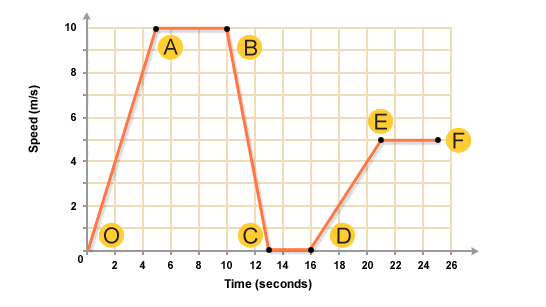
What is happening in this graph from point A to B?
a)
The object is accelerating.
b)
The object is not moving.
c)
The object is decelerating.
d)
The object is moving at a constant speed.
83.

When a heavy football player and a light one run into each other, who exerts more force?
a)
The heavy one
b)
The light one
c)
They are equal
d)
there is no such thing as force
84.
What is Newton's Third Law
a)
F=ma
b)
Every action has an equal and opposite reaction
c)
An object at rest stays at rest, an object in motion stays in motion.
d)
Friction
85.
What is Newton's First Law
a)
F=ma
b)
Every action has an equal and opposite reaction
c)
An object at rest stays at rest, an object in motion stays in motion.
d)
Friction
86.
If a 10 kilogram object accelerates suddenly at 15 m/s2, how much force was applied to the object?
a)
150 Newtons
b)
15 Newtons
c)
150 kilograms
d)
100 kilograms
87.
Which law best describes- A satellite orbiting the earth.
a)
Law of Inertia
b)
Law of Mass and Acceleration
c)
Law of Action Reaction
88.
What is Newton's Second Law?
a)
F=ma
b)
For every action there is an equal and opposite reaction.
c)
Law of Inertia
d)
An object has the tendency to remain in motion, at the same speed unless an outside force acts upon it.
89.

Pushing a child on a swing is easier than pushing an adult on the same swing.
a)
1st Law
b)
2nd Law
90.
Our balloon rocket experiment launched the balloon on the straw with air blowing out of the balloon and the balloon traveling in the opposite direction. Which of Newton's laws is this?
a)
first
b)
second
c)
third
d)
fourth
91.
According to Newton's First Law, an object's velocity will not change unless _____ acts upon it.
a)
a balanced force
b)
an unbalanced force
c)
zero force
92.
A ____ force is the total force felt by an object.
a)
sum
b)
net
c)
strong
d)
balanced
93.
____ is the rubbing force that acts against motion between two touching surfaces.
a)
Acceleration
b)
Normal force
c)
Momentum
d)
Friction
117.

When two air masses meet, there is a _____, or boundary.
a)
thunderstorm
b)
watch
c)
front
d)
cloud
95.

A _____ is a large, swirling, low-pressure system that forms over the Atlantic Ocean.
a)
blizzard
b)
cold front
c)
tornado
d)
hurricane
96.

a)
1st
b)
2nd
c)
3rd
97.

What does this symbol on a weather map indicate?
a)
High pressure system
b)
Low pressure system
c)
Cold front
d)
Warm front
98.
What role do oceans play in hurricane formation?
a)
they provide cool, dense water
b)
warm water supplies energy to hurricanes
c)
warm ocean water slows hurricane formation
d)
cold ocean water supplies energy to hurricanes
99.
____________ air rises because it is ____________dense.
a)
Cool, Less
b)
Warm, Less
c)
Cold, More
d)
Warm, More
100.

What does this symbol on a weather map indicate?
a)
High pressure system
b)
Low pressure system
c)
Cold front
d)
Warm front
101.

What does this symbol on a weather map indicate?
a)
High pressure system
b)
Low pressure system
c)
Cold Front
d)
Warm Front
120.
Cold air (RISES/ FALLS) _________.
a)
RISES
b)
FALLS
103.

What type of weather would you predict for Columbia, SC based on this weather map?
a)
Cooler and potential for storms
b)
Warm and clear
c)
Consistently hot and sunny
d)
Record highs
104.

name this front
a)
warm front
b)
cold front
c)
stationary front
d)
occluded front
105.
what kind of pressure predicts good weather?
a)
high
b)
low
c)
cold
d)
stationary
106.
This type of severe weather causes heavy flooding, high winds, and storm surge.
a)
Tornado
b)
Hurricane
c)
Blizzard
d)
Thunderstorm
108.
What causes wind to blow?
a)
Differences in longitude
b)
Shock waves from clouds
c)
Differences in air temperature and pressure
d)
The rotation of the earth
108.
What causes wind to blow?
a)
Differences in longitude
b)
Shock waves from clouds
c)
Differences in air temperature and pressure
d)
The rotation of the earth
109.

The Gulf Stream is a ______ current that carries water from the ______ to the North Atlantic Ocean.
a)
cold, Tropics
b)
warm, Tropics
c)
cold, Mexico
d)
warm, South America
110.
Due to the Coriolis Effect, water in the southern hemisphere moves
a)
clockwise
b)
counter-clockwise
c)
both
d)
neither
111.
Warm ocean currents generally come from
a)
The North Pole
b)
The South Pole
c)
The Equator
d)
Both A and B
112.
A strong surface current that runs along the east coast of the United States and carries warm water to Europe.
a)
California Current
b)
Global Conveyor Belt
c)
Gulf Stream
d)
Surface Current
113.

If the warm current was to change to cold (disrupted), what would happen?
a)
warmer than normal climate
b)
cooler than normal climate
c)
no change
d)
this is not possible
114.
What is the definition of CONDUCTION?
a)
The transfer of energy along electromagnetic waves
b)
The transfer of heat between objects that are in direct contact.
c)
Transfer of heat through a liquid or gas. As it heats, it rises and as it cools, it sinks.
d)
None of the above
115.
What is the definition for RADIATION?
a)
The transfer of energy along electromagnetic waves
b)
The transfer of heat between objects that are in direct contact.
c)
Transfer of heat through a liquid or gas. As it heats, it rises and as it cools, it sinks.
d)
None of the above
116.

Which of the following describes Southern Hemisphere ocean water circulation?
a)
back and forth
b)
clockwise
c)
north and south
d)
counterclockwise
117.
When two air masses meet, there is a _____, or boundary.
a)
thunderstorm
b)
watch
c)
front
d)
cloud
118.

During what month are hurricanes most likely? (Use graph to help)
a)
October
b)
September
c)
August
d)
May
120.
Cold air (RISES/ FALLS) _________.
a)
RISES
b)
FALLS
120.
Cold air (RISES/ FALLS) _________.
a)
RISES
b)
FALLS
121.
Which of the following is an example of convection?
a)
A hair dryer is drying up your hair.
b)
When the AC or heater changes the temperature.
c)
When a car engine turns hot after being turned on.
d)
When you are making soup and the water is rising and lowering.
100 %

