wayground logo

Free Printable Worksheets

Font size

S
M
L
XL
Worksheets

Genetics and Heredity

Total questions: 105

Worksheet time: 53mins

Name
Class
Date
1.
A homozygous dominant dog with brown fur is crossed with a heterozygous dog with brown fur. What are the percentages of the possible genotypes?
a)
100% BB
b)
75% BB and 25%Bb
c)
50 % BB and 50% Bb
d)
50% Bb and 50% bb
2.
The man who studied genetics and came up with genetics is
a)
Watson
b)
Crick
c)
Mendel
d)
Darwin
3.
What law states that in Tt the person will only show the dominant allele
a)
law of segregation
b)
law of independent assortment
c)
law of dominance
d)
law of punnett squares
4.
An offspring will receive how many alleles from each parent to determine a specific trait?
a)
one
b)
two
c)
three
d)
five
5.
Which of the following is a phenotype?
a)
BB
b)
Bb
c)
bb
d)
Blue eyes
6.
What is a phenotype
a)
The genetic make up (code)
b)
The physical trait
7.
having two of the same genes for the trait (sometimes called purebred).
a)
homozygous
b)
hetrozygous
c)
protein
d)
chromosome
8.
having two different genes for a trait (sometimes called hybrid).
a)
protein
b)
homozygous
c)
heterozygous
d)
genotype
9.
Magda is a tall, 11 year old drummer. She has a scar on her right cheek. She is good at swimming. Which of her traits did Magda most likely inherit?
a)
height
b)
the scar
c)
ability to swim
d)
ability to play drums
10.
G = green, g = yellow
The genotype for a yellow plant is...
a)
GG
b)
Gg
c)
gg
d)
all of the choices result in yellow
11.
An allele whose trait only shows up when no dominant allele is present.
a)
hidden allele
b)
dominant allele
c)
recessive allele
d)
present allele
12.
Two heterozygous (Tt) tall pea plants are crossed. Which describes their offspring?
a)
50% tall and 50% short
b)
75%tall and 25% short
c)
100%short
13.
Which of the following is a phenotype?
a)
Aa
b)
red hair
c)
heterozygous genes
d)
mutated DNA
14.
The larger of the two chromosomes associated with the genetic determination of sex is called the ________ chromosome.
a)
XX
b)
Y
c)
XY
d)
X
15.
A sudden change in the molecular structure of a gene, called a(n) ________, may occur spontaneously or may be caused by an environmental event such as radiation.
a)
devastation
b)
deviation
c)
mutation
d)
alteration
16.
Females-XX; MalesXY.  A couple has 4 girls.  What is the chance the next child will be a boy?
a)
75%
b)
100%
c)
25%
d)
50%
17.
TT,tt,PP,pp,SS,ss are examples of alleles that are?
a)
homozygous
b)
heterozygous
c)
different
d)
homologous 
18.
A single cross such as flower color.
a)
mono hybrid
b)
dihybrid
c)
crossing over
d)
homozygous
19.
In a pedigree, what shape represents a male?
a)
circle
b)
square
c)
triangle
d)
diamond
20.

Lisa has two grandmothers in this picture. What are their names?

a)

Mona and Jackie

b)

Marge and Mona

c)

Selma and Jackie

d)

Patty and Selma

21.
How many generations are shown in this pedigree?
a)
1
b)
2
c)
3
d)
4
22.
How many girls in this family express this recessive disorder?
a)
4
b)
5
c)
6
d)
7
23.
What is the relationship between a protein, the cell, and DNA?
a)
DNA is produced by protein which is produced in the cell
b)
Protein is composed of DNA which is produced in the cell
c)
DNA controls the production of protein in the cell
d)
A cell is composed of DNA and protein
24.
A segment of DNA that codes for a protein is called a...
a)
Enzyme
b)
Mutation
c)
Gene
d)
Complimentary
25.
In sexual reproduction there are ________parent(s).
a)
1
b)
2
26.
Purebred is another word for __________, while hybrid is another word for __________.
a)
dominant; recessive
b)
recessive; dominant
c)
homozygous; heterozygous
d)
heterozygous; homozygous
27.
What is the haploid number for this Karyotype?
a)
26
b)
27
c)
52
d)
54
28.
How many cell divisions does meiosis have?
a)
1
b)
2
c)
4
d)
0
29.
A zygote has 4 chromosomes, how many chromosomes were in the gametes?
a)
2
b)
4
c)
8
d)
1
30.

What would indicate a normal human male?

a)

XX

b)

X

c)

XY

d)

XXY

31.
Which would be considered a somatic cell?
a)
Sperm cell
b)
Egg Cell
c)
Skin Cell
d)
All of these
32.
Which of the following would be considered a Gamete cell?
a)
Egg Cell
b)
Sperm Cell
c)
Both of these
d)
None of these
33.
How many chromosomes are in a typical human somatic cell?
a)
23
b)
22
c)
44
d)
46
34.
Which reproductive process offers the greatest chance for variation within a species?
a)
Sexual Reproduction
b)
Budding
c)
Binary Fission
d)
Pollination
35.
How many children did I-3 and I-4 have?
a)
2
b)
3
c)
4
d)
5
36.
In guinea pigs, black hair is dominant to white hair and short hair is dominant to long hair. What is the PHENOTYPE RATIO for the offspring in the following cross?
a)
9:3:3:1
b)
1:1:1:1
c)
4:2:2:5
d)
8:2:2:4
37.
In guinea pigs, black hair is dominant to white hair and short hair is dominant to long hair. What are the original genotypes of the PARENTS in this particular dihybrid cross?
a)
Bbss x bbSs
b)
bbSs x BBss
c)
BbSs x BbSs
d)
BBSS x bbss
38.
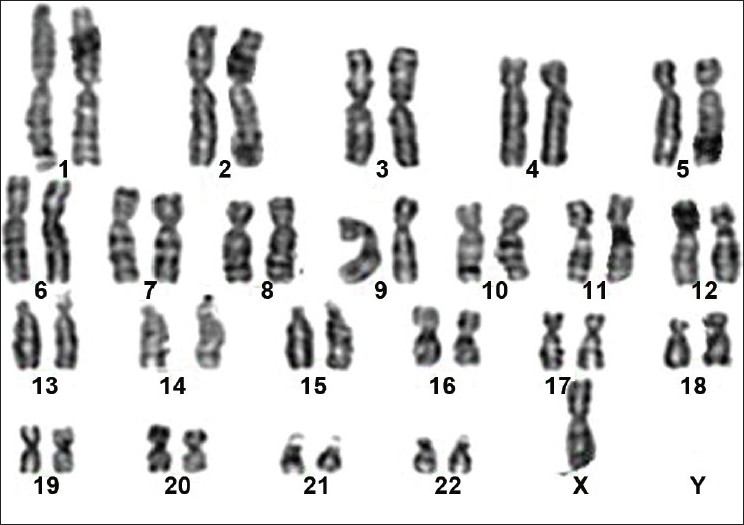
What is the gender of the individual whose karyotype is seen in the image?
a)
Male
b)
Female
39.
What is the chromosomal condition of the individual whose karyotype is seen in the image?
a)
Turner's Syndrome
b)
Trisomy 21 (Down Syndrome)
c)
Trisomy 13
d)
Trisomy 18
40.
What is the chromosomal condition of the individual whose karyotype is seen in the image?
a)
Trisomy 21 (Down Syndrome)
b)
Trisomy 13
c)
Trisomy 18
d)
Klinefelter's Syndrome
41.
What is the purpose of meiosis
a)
conserves chromosome number, produces genetically identical cells
b)
conserves chromosome number, produces haploid cells
c)
reduces chromosome number, produces diploid cells
d)
reduces chromosome number by half, produces gametes
42.
The different forms of a gene are known as _____________.
a)
Codons
b)
Proteins
c)
Alleles
d)
Nucleotides
43.
Which of Mendel's laws states that alleles are separated during meiosis?
a)
Law of Dominance
b)
Law of Segregation
c)
Law of Independent Assortment
d)
Law of Meiosis
44.

What can be determined by looking at this karyotype?

a)

This karyotype shows Trisomy 21

b)

This karyotype has no abnormality

c)

This karyotype is missing a sex chromosome

d)

This karyotype is from a gamete

45.
A parent has four children. Three of the children have dimples, and one child has no dimples. The allele that controls the presence of dimples is most likely a:
a)
dominant trait
b)
recessive trait
c)
codominant trait
d)
mutating trait
46.
A pattern of inheritance in which one allele is not completely dominant over the other.  The heterozygous phenotype is a blend of both alleles.
a)
Mendelian inheritance
b)
Co-dominance
c)
Incomplete dominance
d)
Sex-linked inheritance
47.
A pattern of inheritance in which a trait is carried on one of the sex-determining chromosomes.
a)
Mendelian Inheritance
b)
Co-dominance
c)
Incomplete dominance
d)
Sex-linked inheritance
48.
A pattern of inheritance in which one allele is not completely dominant over the other.  The heterozygous phenotype clearly expresses both alleles.
a)
Mendelian inheritance
b)
Co-dominance
c)
Incomplete dominance
d)
Sex-linked inheritance
49.
Which gender is TYPICALLY affected by sex-linked disorders?
a)
Men
b)
Women
50.
The cells produced via meiosis are called:
a)
sex cells
b)
somatic cells
c)
body cells
d)
skin cells
51.
This produces 2 identical cells.
a)
mitosis
b)
meiosis
52.
What is it called when a sperm and egg meet?
a)
meiosis
b)
fertilization
c)
cell division
d)
mitosis
53.
Unlike mitosis, meiosis in male mammals results in the formation of
a)
one haploid gamete
b)
three diploid gametes
c)
four diploid gametes
d)
four haploid gametes
54.
Which process and type of resulting cells are represented?
a)
mitosis, gametes
b)
mitosis, body cells
c)
meiosis, gametes
d)
meiosis, body cells
55.
If a somatic cell in a butterfly contains 24 chromosomes, a butterfly egg would contain
a)
3
b)
6
c)
12
d)
24
56.
A male shark has 40 chromosomes in each of its sex cells. How many would be present in its body cells?
a)
20
b)
40
c)
80
d)
160
57.
Sickle cell anemia is a disorder carried on the X chromosome.  What type of inheritance pattern does it follow?
a)

codominance

b)

sex-linked inheritance

c)

multiple allele inheritance

d)

incomplete dominance

58.
ABO blood types are an example of what type of inheritance?
a)
multiple alleles
b)
incomplete dominance
c)
polygenic inheritance
d)
genetic mutations
59.
AB blood type is an example of what type of inheritance?
a)
complete dominance
b)
incomplete dominance
c)
codominance
d)
polygenic inheritance
60.
The range of human skin colors is caused by a variety of genes, each of which has at least 2 alleles.  This is an example of:
a)
incomplete dominance
b)
codominance
c)
multiple alleles
d)
polygenic inheritance
61.
If a red biobug and a white biobug mate, their babies have red and white spots.  This is most likely due to what pattern of inheritance?
a)
incomplete dominance
b)
codominance
c)
polygenic inheritance
d)
compete dominance
62.
 Colorblindness is a trait that is seen more often in males and is passed to them by their mothers, who may not be colorblind.  Colorblindness is...
a)
a codominant trait
b)
a sex-linked trait
c)
carried on the Y chromosome
d)
associated with a dominant allele
63.
How much of your DNA do you inherit from your mom?
a)
10%
b)
25%
c)
50%
d)
it varies
64.
In which inheritance pattern are heterozygous individuals a blend of the dominant and recessive phenotypes?
a)
sex-linked inheritance
b)
complete dominance
c)
codominance
d)
incomplete dominance
65.
What do the circles represent in a pedigree chart?
a)
males
b)
females
c)
individuals with a disease
d)
children of either gender
66.
If a trait is controlled by one gene, but there are 4 possible alleles, the inheritance pattern is called...
a)
dominance
b)
sex-linked
c)
multiple alleles
d)
polygenic
67.
What causes genetic variation in meiosis?
a)
chromosomes lining up
b)
crossing over of chromosomes
c)
separation of chromosomes
d)
chromosomes pulling apart
68.
Unlike mitosis, meiosis in male mammals results in the formation of
a)
one haploid gamete
b)
three diploid gametes
c)
four diploid gametes
d)
four haploid gametes
69.
When an area of a chromatid is exchanged with the matching area on a chromatid of its homologous chromosome, _________________ occurs
a)
crossing over
b)
mutagenesis
c)
hybridization
d)
fertilization
70.
When homologous chromosomes match up, they form a structure call a ___________.
a)
tetrad
b)
triad
c)
diploid
d)
gamete
71.
Compared to the number of chromosomes contained in a body cell, how many chromosomes would normally be contained in a gamete?
a)
The same number
b)
One-fourth as many
c)
Twice as many
d)
Half as many
72.

The failure of one or more pairs of homologous chromosomes or sister chromatids to separate "normally" during meiosis is called _____________________.

a)

nondisjunction

b)

anaphase I

c)

nondiploidy

d)

karyotype

73.
If the Diploid number of Carrots is 18, the haploid number is
a)
18
b)
9
c)
27
d)
36
74.
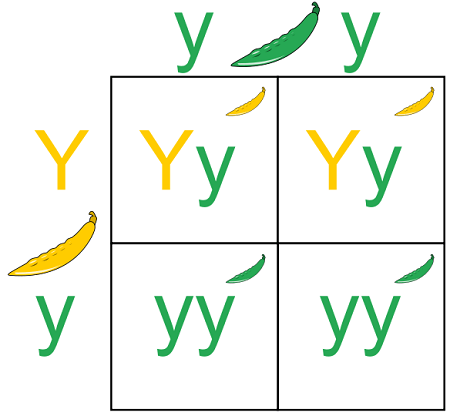
Which choice best represents the genotype of this cross?
a)
1 Yy: 2 yy: 0 YY
b)
2 Yy: 2 yy: 0 YY
c)
3 Yy: 1 yy: 0 YY
d)
1 Yy: 3 yy: 0 YY
75.
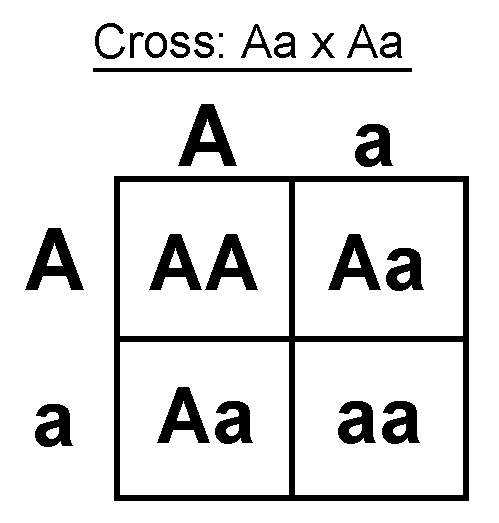
What is the phenotype of the offspring? (A-Brown hair; a-blond hair) 
a)
50 % Brown Hair and 50% Blond Hair 
b)
25 % Brown Hair and 75% Blond Hair 
c)
75 % Brown Hair and 25% Blond Hair 
d)
0% Brown Hair and 100% Blond Hair 
76.
This is an example of ___________?
a)
Incomplete dominance
b)
Co-Dominance
77.
This is an example of ___________.
a)
Incomplete Dominance
b)
Codominance
78.
A tall plant (TT) is crossed with a short plant (SS) and a medium plant (TS) results. This is what type of inheritance pattern?
a)
Incomplete Dominance
b)
Codominance
79.
This type of inheritance pattern is a MIXTURE of both traits.
a)
incomplete dominance
b)
co-dominance
c)
complete dominance
80.
If you cross a black chicken with a white chicken, only checkered chickens would be produced.  What kind of inheritance pattern does this follow?
a)
incomplete Dominance
b)
Co-Dominance
81.
A red flowered plant (RR) is crossed with a white flowered plant (WW). The gene for petal color in these plants expresses incomplete dominance.  What percentage of the offspring will have pink (RW) flowers?
a)
0%
b)
25%
c)
50%
d)
100%
82.

Which of the following is a cause of genetic variation?

a)

mitosis

b)

identical daughter cells

c)

cell membranes

d)

genetic mutations

83.

Genetic mutations can be...

a)

beneficial, harmful, or neutral

b)

beneficial only

c)

harmful only

d)

neutral only

84.
Would a mutation in the DNA of a skin cell be passed on to an organism's offspring?
a)
Yes, because any change to the DNA is passed on to the offspring
b)
Maybe. Sex cells only use half of the body's genetic code. It might get the copy of a gene that wasn't mutated.
c)
No. Only mutations that occur in the gametes (sex cells) are passed on to the offspring
d)
Without knowing the animal, it would be hard to tell whether or not the mutation would be passed on.
85.
How can a person's muscle cells have the same exact DNA sequences as their nerve cells even though the look and perform completely different?
a)
The two different cells become mutated
b)
The proteins expressed in each cell are different
c)
They actually have different DNA in the two types of cells.
d)
The genome of the different cells changes
86.
The lac operon genes only become expressed if:
a)
lactose binds to the repressor
b)
glucose binds to the repressor
c)
lactose binds to the operator
d)
the repressor binds to the operator
87.
The "on/off" switch for an operon is called the
a)
promoter
b)
repressor
c)
operator
d)
gene
88.
____ is the activation of a gene that results in transcription.
a)
Gene expression
b)
Gene technology
c)
Eukaryotic expression
d)
Prokaryotic expression
89.

What is 1 in the diagram?

a)

RNA polymerase

b)

Inducer

c)

Repressor

d)

Operator

90.

What is 2 in the diagram?

a)

RNA polymerase

b)

Inducer

c)

Repressor

d)

Operator

91.

In the top picture the operon is

a)

on

b)

off

92.

The pieces of DNA that are coded for are called:

a)

exons

b)

introns

c)

operons

d)

polymers

93.
Which of the following statements regarding mRNA is correct?
a)
Exons are included in the protein sequence, while introns are left out
b)
Introns are included in the protein sequence, while exons are left out
c)
Exons and Introns can both be included or left out depending on the protein
d)
Exons and Introns are both part of the mRNA sequence, but only exons are part of the rRNA and tRNA
94.
An example of a mutation where a piece of chromosome breaks off and attaches to another chromosome is called ___.
a)
trisomy
b)
translocation
c)
inversion
d)
deletion
95.
A chromosome is found to be shorter than it's homologous match.  Which type of mutation would this most likely be?
a)
insertion
b)
deletion
c)
translocation
d)
inversion
96.
What process occurs during meiosis that can result in chromosomal disorders?
a)
crossing over
b)
non-disjunction
c)
anaphase I
d)
prophase II
97.

A piece of a chromosome is copied and remains within the chromosome

a)

deletion

b)

duplication

c)

inversion

d)

translocation

98.

A piece of the chromosome detches, turns 180 degrees, and reattaches

a)

deletion

b)

duplication

c)

inversion

d)

translocation

99.

The chromosomal mutation shown in the image is a

a)

deletion

b)

duplication

c)

inversion

d)

translocation

100.

The chromosomal mutation shown in the image is a

a)

deletion

b)

duplication

c)

inversion

d)

translocation

101.

The chromosomal mutation shown in the image is a

a)

deletion

b)

duplication

c)

inversion

d)

translocation

102.

The chromosomal mutation shown in the image is a

a)

deletion

b)

duplication

c)

inversion

d)

translocation

103.
a)
This karyotype shows Trisomy 21
b)
This karyotype has no abnormality
c)
This karyotype is missing a sex chromosome (monosomy x)
d)
This karyotype is from a gamete
104.
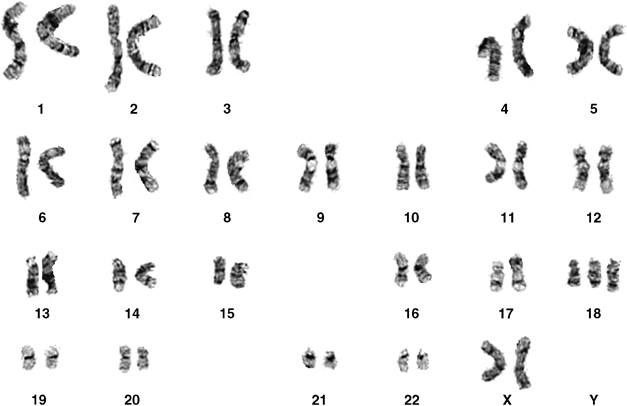
What is the chromosomal condition of the individual whose karyotype is seen in the image?
a)
Monosomy X (Turner's Syndrome)
b)
Trisomy 21 (Down's Syndrome)
c)
Trisomy 13 (Patau Syndrome)
d)
Trisomy 18 (Edwards's Syndrome)
105.
A pair of identical chromosomes shown in a karyotype, one inherited from mom, and one inherited from dad are called
a)
sister chromotids
b)
centromeres
c)
homologous chromosomes
d)
autosomes