
NEW
Font size
S
M
L
XL
 Worksheets
APES Chapter 8 - Earth Systems
Total questions: 43
Worksheet time: 25mins
Name
Class
Date
1.
This layer of Earth is the thickest part
a)
crust
b)
outer core
c)
mantle
d)
inner core
2.
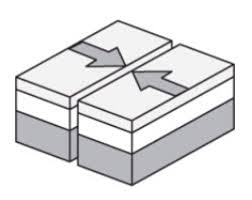
Name the boundary
a)
convergent boundary
b)
divergent boundary
c)
transform boundary
d)
sergent boundary
3.

Name the boundary
a)
convergent boundary
b)
divergent boundary
c)
transform boundary
d)
sergent boundary
4.
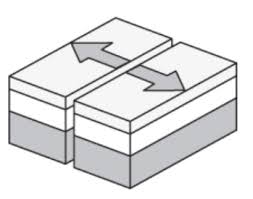
Name the boundary
a)
convergent boundary
b)
divergent boundary
c)
transform boundary
d)
sergent boundary
5.
A subduction zone is formed...
a)
when one tectonic plate sinks below another
b)
at every type of convergent plate boundary
c)
at every type of divergent plate boundary
d)
at transform boundaries
6.
Plate movement is caused by ______________.
a)
the rotation of the Earth
b)
ocean tides
c)
convection currents in the mantle
d)
the moon's gravity
7.
What does the theory of continental drift state?
a)
The continents were once joined in a super-continent and have moved over time
b)
Continents are stationary and do not move
c)
The Earth is broken into lithospheric plates that move due to convection currents
d)
none of the above
8.
During sea floor spreading, molten material rises up from the mantle...
a)
along the continents
b)
at the mid ocean ridges
c)
deep ocean trenches
d)
at north and south poles
9.
The area around the pacific plate where boundaries form is called...
a)
death ring
b)
fire zone
c)
ring of fire
d)
zone of fire
10.
Which ocean is expanding due to a mid-ocean ridge?
a)
Indian
b)
Dead Sea
c)
Atlantic
d)
Artic
11.
What two specific continents fit together most noticeably?
a)
Africa and North America
b)
South America and Europe
c)
South America and Africa
d)
Antartica and Africa
12.
Rock that forms when magma or lava cools and hardens to become solid, either beneath or on Earth’s surface
a)
Sedimentary Rock
b)
Metamorphic Rock
c)
Igneous Rock
d)
Rock Cycle
13.
Rock that forms when minerals form from solutions or sediment from older rocks get pressed and cemented together.
a)
Sedimentary Rock
b)
Metamorphic Rock
c)
Igneous Rock
14.
What is the name for the continuous changing of rocks from one type to another?
a)
rock cycle
b)
metamorphic
c)
weathering
d)
erosion
15.

This rock was formed by lots of fossils that settled on top of each other over time. What type of rock is this?
a)
Sedimentary
b)
Igneous
c)
Metamorphic
16.

This rock cooled on the outside of a volcano and contained air bubbles when it was forming. What type of rock is this?
a)
Sedimentary
b)
Igneous
c)
Metamorphic
17.

This rock started as molten magma. What type of rock is this?
a)
Sedimentary
b)
Igneous
c)
Metamorphic
18.

This rock was formed by smaller pieces of rock that settled at the bottom of a lake millions of years ago. What type of rock is this?
a)
Sedimentary
b)
Igneous
c)
Metamorphic
19.

This rock was molten lava that cooled quickly as it came out of a volcano. What type of rock is this?
a)
Sedimentary
b)
Igneous
c)
Metamorphic
20.

After lots of time, pressure, and heat, you get this kind of rock. What type of rock is this?
a)
Sedimentary
b)
Igneous
c)
Metamorphic
21.
Which type of rock would be likely to have fossils in it?
a)
lava
b)
igneous
c)
sedimentary
d)
metamorphic
22.
Older rocks and fossils tend to be at the.....
a)
Top
b)
Bottom
23.

This rock was another type of rock that was heated and compressed over time. What type of rock is this?
a)
Sedimentary
b)
Igneous
c)
Metamorphic
24.
A student finds a rock with seashells in it. What kind of rock is it?
a)
igneous
b)
sedimentary
c)
metamorphic
25.
What is weathering?
a)
The breaking down of rocks
b)
The movement of broken down rocks
c)
The weather
26.
What is erosion?
a)
The breaking down of rocks
b)
The movement of broken down rocks
c)
Where water expands and contracts
27.

From top to bottom, name the layers of soil.
a)
bedrock, topsoil, humus, clay
b)
humus, topsoil, clay,silt
c)
humus, topsoil, bedrock, subsoil
d)
humus, topsoil, subsoil, bedrock
28.
Part of the topsoil that is made of organic material is known as _______________.
a)
silt
b)
subsoil
c)
humus
d)
bedrock
29.
Which type of soil is best for growing plants?
a)
clay
b)
sand
c)
dirt
d)
loam
30.

Which horizon is made up of partially weathered rocks?
a)
Horizon A
b)
Horizon B
c)
Horizon C
d)
Horizon D or R
31.

In which horizon is most of the HUMUS?
a)
Horizon A
b)
Horizon B
c)
Horizon C
d)
Horizon D or R
32.

Which horizon contains clay, silt, minerals, and a little humus?
a)
Horizon A
b)
Horizon B
c)
Horizon C
d)
Horizon D or R
33.
Soil layers are called horizons because...
a)
The layers are all different
b)
The layers are vertical
c)
The layers are horizontal
d)
The layers are above one another
34.

Soil sample that is 60% clay, 30% silt, and 10% sand has which texture?
a)
clay
b)
clay loam
c)
sandy loam
d)
silt
35.
Which biome contains red soil?
a)
tundra
b)
desert
c)
tropical rainforest
d)
temperate forest
36.
What are the 3 main techniques used for mining?
a)
Strip Mining, Hard Mining, Above Ground mining
b)
Underground Mining, Strip Mining, Above ground mining
c)
Open pit mining, Strip Mining, Above ground mining
d)
Strip mining, Open pit mining, Underground mining
37.
What is the cheapest way to mine
a)
Strip ming
b)
Open pit mining
c)
Underground minig
d)
None of the above
38.
A company is likely to mine a site if the site...?
a)
is rich in minerals
b)
does not contain gangue minerals
c)
contains gold
d)
contains minerals that can be economically extracted
39.
Open pits called ________ are used to mine stone and gravel.
a)
overburdens
b)
cyanide heaps
c)
quarries
d)
solar evaporation ponds
40.
Reclamation is.....
a)
not required in the US.
b)
a process that causes significant environmental damage.
c)
required for surface mining in the US.
d)
required for every country and every type of mine in the world.
41.
Which of the following activities at a mining site will cause the least amount of harm to wildlife?
a)
removing soil from an area that is to be surfaced mined
b)
replacing the soil, with the lowest layers going in first
c)
dredging
d)
removing vegetation from an area that is to be surface mined
42.
Why is topsoil darker than all other levels of soil?
a)
It contains all the darker colored minerals
b)
It contains volcanic rock
c)
It contains more organic matter
d)
It contains bits of burned trees
43.
When sulfide ores are exposed to water and oxygen
a)
erosion happens.
b)
acid mine drainage occurs.
c)
slag is formed.
d)
tailings are formed.
Reset

