
 Worksheets
Human Reproduction
Total questions: 42
Worksheet time: 8hrs 12mins
Name
Class
Date
1.

The human male reproductive system is represented below. Which structure produces cells that have the potential to become gametes?
a)
A
b)
B
c)
C
d)
D
2.
One function of the male reproductive system in mammals is to
a)
produce insulin necessary for sexual reproduction
b)
transport eggs necessary for fertilization
c)
allow for delivery of gametes needed for reproduction
d)
provide protection for the developing zygote
3.

The diagrams below represent a human organ system. The major function of the system is to
a)
provide immunity essential for the survival of each individual in a population
b)
provide cells that are necessary for the survival of the species
c)
produce chemical messages that are necessary for nerve cell development
d)
control the passage of nutrients into and out of a developing fetus
4.
The primary function of the human male reproductive system is to
a)
provide a site for fertilization
b)
produce and transport gametes
c)
protect and nourish the embryo
d)
prevent urine from leaving the body
5.
The inability of sperm cells to move normally could prevent the production of offspring by interfering with
a)
meiosis
b)
fertilization
c)
mitosis
d)
differentiation
6.
Which structure is correctly paired with its function?
a)
ovary — provides milk for newborns
b)
placenta — storage of released eggs
c)
uterus — produces estrogen
d)
testis — development of sperm
7.
Testosterone directly affects the
a)
formation of a zygote
b)
changes within an ovary
c)
production of sperm cells
d)
development of a placenta
8.
Which situation would be part of the normal reproductive cycle of a human?
a)
the presence of testosterone regulating gamete production in a male
b)
estrogen in concentrations that would produce sperm in a female
c)
a high progesterone level in a male
d)
a low insulin level in either a male or a female
9.
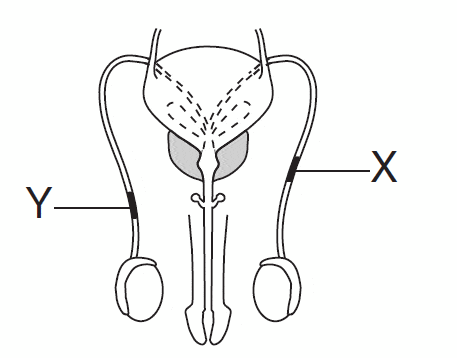
The diagram below represents the human male reproductive system. Which activity would be prevented by blockages at X and Y?
a)
transport of urine out of the body
b)
passage of testosterone to the female to stimulate egg production
c)
movement of sperm out of the body
d)
movement of testosterone to the testes to stimulate sperm production
10.
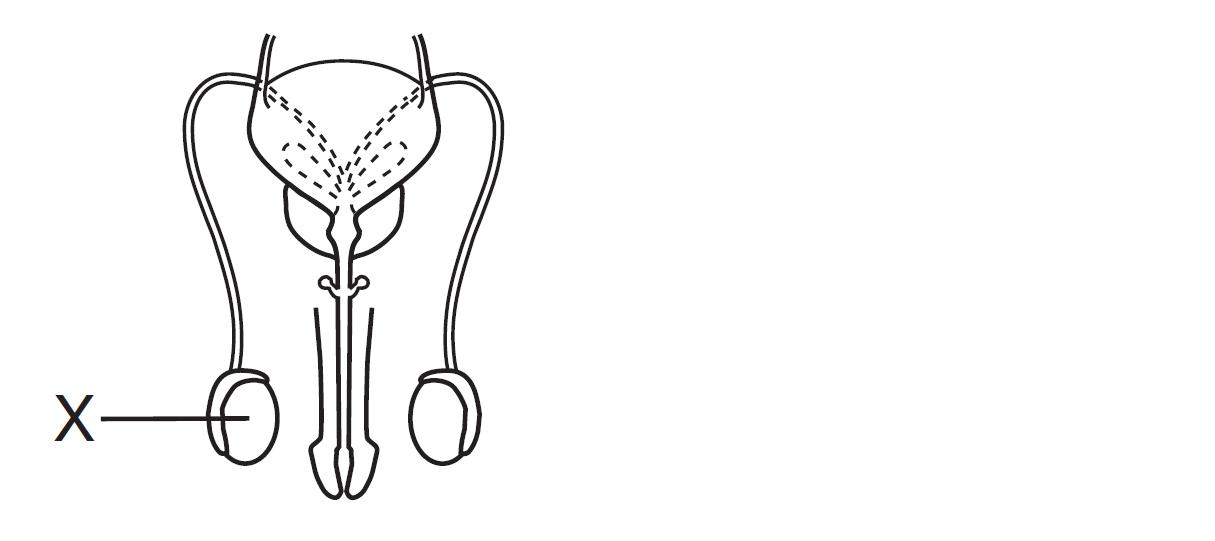
The diagram below represents a system in the human body. The primary function of structure X is to
a)
produce energy needed for sperm to move
b)
provide food for the sperm to carry to the egg
c)
produce and store urine
d)
form gametes that may be involved in fertilization
11.

Base your answer on on the picture below which represents systems in a human male and on your knowledge of biology. Which structure has both reproductive and excretory functions?
a)
A
b)
G
c)
C
d)
D
12.

The data in the table below indicate the presence of specific reproductive hormones in blood samples taken from three individuals. An X in the hormone column indicates a positive lab test for the appropriate levels necessary for normal reproductive functioning in that individual. Which processes could occur in individual 3?
a)
production of sperm, only
b)
production of sperm and production of eggs
c)
production of eggs and embryonic development
d)
production of eggs, only
13.

The diagram below represents a human reproductive system.
Meiosis occurs within structure
Meiosis occurs within structure
a)
A
b)
B
c)
C
d)
D
14.
Which statement describes the reproductive system of a human male?
a)
It releases sperm that can be used only in external fertilization.
b)
It synthesizes progesterone that regulates sperm formation.
c)
It produces gametes that transport food for embryo formation.
d)
It shares some structures with the excretory system.
15.
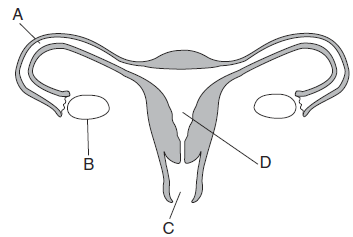
The human female reproductive system is represented below. Within which structure does the placenta normally develop?
a)
A
b)
B
c)
C
d)
D
16.

Sexual reproduction involves the processes listed below. Which sequence represents the order in which these processes occur?
a)
A > B > C > D
b)
B > A > C > D
c)
C > B > D > A
d)
D > B > C > A
17.

The diagram below represents early stages of embryo development. The greatest amount of differentiation for organ formation most likely occurs at arrow
a)
A
b)
B
c)
C
d)
D
18.
After a zygote is formed, specialization of cells occurs. Through which process do the cells of a zygote become specialized?
a)
sexual reproduction
b)
meiosis
c)
fertilization
d)
differentiation
19.

The development of nerve, muscle, and skin cells is represented in the diagram below. Which statement best explains how each of the different cell types can develop from the same embryo?
a)
The cells have identical genetic instructions, but different parts of these instructions are being expressed in each cell.
b)
The cells have identical genetic instructions, and all parts of these instructions are being expressed in each cell.
c)
The cells are produced by asexual reproduction and contain identical genetic instructions.
d)
The cells contain genetic instructions from two different parents and will express the instructions from one parent, only.
20.

Base your answer on the diagram below which represents a series of events in the development of a bird. Which series of terms best represents the sequence of processes shown?
a)
meiosis > growth > differentiation
b)
meiosis > differentiation > growth
c)
mitosis > meiosis > differentiation
d)
mitosis > differentiation > growth
21.

Which developmental process is represented by the diagram below?
a)
fertilization
b)
differentiation
c)
evolution
d)
mutation
22.

Part of embryonic development in a species is illustrated in the diagram below. Which set of factors plays the most direct role in controlling the events shown in the diagram?
a)
genes, hormones, and cell location
b)
antibodies, insulin, and starch
c)
ATP, amino acids, and inorganic compounds
d)
abiotic resources, homeostasis, and selective breeding
23.

Base your answer on the diagram below and on your knowledge of biology. The arrows in the diagram represent processes. Process B is known as
a)
meiosis
b)
oogenesis
c)
differentiation
d)
germination
24.
Which sequence represents the correct order of events for the formation and development of an embryo?
a)
meiosis > fertilization > cleavage > differentiation
b)
cleavage > meiosis > differentiation > fertilization
c)
differentiation > cleavage > meiosis > fertilization
d)
cleavage > fertilization > differentiation > meiosis
25.

The diagram below represents one stage during the human reproductive process. A function of structure A is to
a)
remove nutrients from the fetus
b)
provide the fetus with metabolic wastes
c)
remove all toxins from the blood of the mother
d)
provide for the exchange of oxygen and carbon dioxide
26.
Kangaroos are mammals that lack a placenta. Therefore, they must have an alternate way of supplying the developing embryo with
a)
nutrients
b)
carbon dioxide
c)
enzymes
d)
genetic information
27.
Most mammals have adaptations for
a)
internal fertilization and internal development of the fetus
b)
internal fertilization and external development of the fetus
c)
external fertilization and external development of the fetus
d)
external fertilization and internal development of the fetus
28.
The structure that makes nutrients most directly available to a human embryo is the
a)
gamete
b)
ovary
c)
stomach
d)
placenta
29.
In a rabbit, the embryo normally develops within the
a)
placenta
b)
uterus
c)
yolk sac
d)
umbilical cord
30.
In mammals, the placenta is essential to the embryo for
a)
nutrition, reproduction, and growth
b)
nutrition, respiration, and excretion
c)
locomotion, respiration, and excretion
d)
nutrition, reproduction, and excretion
31.
What is an advantage of internal fertilization and development over external fertilization and development?
a)
there is a greater chance for genetic variation
b)
only one sperm is needed to fertilize the egg
c)
genes can pass directly from the mother to the embryo
d)
the chance for zygote survival is increased
32.

The diagrams below illustrate types of asexual reproduction. Which statement correctly describes the offspring?
a)
They vary genetically from the parent.
b)
They are produced by the union of gametes.
c)
They are genetically identical to the parent.
d)
They result without the union of gametes
33.
A particular species of shark normally reproduces sexually. In captivity, it was found that a female could also reproduce asexually. One negative result from asexual reproduction is
a)
increased gene recombinations
b)
decreased biodiversity within the species
c)
increased number of males produced
d)
decreased number of eggs used
34.

Which statement concerning the reproductive cells in the diagram below is correct?
a)
The cells are produced by mitosis and contain all the genetic information of the father.
b)
If one of these cells fertilizes an egg, the offspring will be identical to the father.
c)
Each of these cells contains only half the genetic information necessary for the formation of an offspring.
d)
An egg fertilized by one of these cells will develop into a female with the same characteristics as the mother.
35.
Agriculturists have developed some varieties of vegetables from common wild mustard plants, which reproduce sexually. Which statement best explains the development of these different varieties of vegetables?
a)
Different varieties can develop from a single species as a result of the recombination of genetic information.
b)
Different species can develop from a single species as a result of the effect of similar environmental conditions.
c)
Mutations will occur in the genes of a species only if the environment changes.
d)
Variations in a species will increase when the rate of mitosis is decreased.
36.

Base your answer on the diagram below, which represents a necessary part of human reproduction. The embryo is protected from shock by a substance located at
a)
6
b)
7
c)
3
d)
4
37.
Substances can diffuse from the mother's blood into the fetal blood through the structure known as the
a)
amnion
b)
fallopian tube
c)
yolk sac
d)
placenta
38.

Base your answer on the diagram below, which represents a human embryo developing in the uterus, and on your knowledge of biology.
Structure 3 represents the
Structure 3 represents the
a)
membrane that protects the embryo from mechanical shock
b)
site of exchange of materials between the mother and the fetus
c)
site where the female gametes undergo meiosis during maturation
d)
structure that stores yolk for the developing fetus
39.
Most of the skeleton of a human embryo is composed of connective tissue known as
a)
cartilage
b)
tendons
c)
ligaments
d)
bone
40.

Base your answer on the diagram below.
The placenta develops in structure
The placenta develops in structure
a)
1
b)
2
c)
3
d)
4
41.

The development of an embryo is represented in the diagram below. These changes in the form of the embryo are a direct result of
a)
uncontrolled cell division and mutations
b)
differentiation and growth
c)
antibodies and antigens inherited from the father
d)
meiosis and fertilization
42.
Which is the normal sequence of events in the development of the embryo of an animal?
a)
gastrulation → fertilization → blastula formation → cleavage
b)
fertilization → cleavage → gastrulation → blastula formation
c)
cleavage → blastula formation → fertilization → gastrulation
d)
fertilization → cleavage → blastula formation → gastrulation
100 %

