
 Worksheets
AAP Weather
Total questions: 75
Worksheet time: 2hrs 57mins
Name
Class
Date
1.
A _______ forms when water vapor in a cloud is converted directly into ice crystals.
a)
hail storm
b)
raindrop
c)
snowflake
2.

This diagram shows how a certain type of precipitation is formed. Water drops are caught in up-drafts and down-drafts, over and over, before they fall to Earth as
a)
dew.
b)
hail.
c)
rain.
d)
snow.
3.
These are highest clouds in the sky. They are wispy with fuzzy edges, and usually mean good weather.
a)
Cumulus
b)
Cumulonimbus
c)
Cirrus
d)
Stratus
4.
What type of precipitation forms when raindrops fall through cold layer of air, and freeze before they hit the ground?
a)
Sleet
b)
Snow
c)
Rain
d)
Hail
5.
What form of precipitation is the only one that changes from water vapor directly to a solid?
a)
Rain
b)
Sleet
c)
Snow
d)
Hail
6.
This type of cloud is a sign of good weather, and means "heap" or "pile."
a)
Cumulus
b)
Stratus
c)
Cirrus
d)
Nimbus
7.
This type of cloud stretches in layers, and at ground level is known as fog.
a)
cirrus
b)
cumulus
c)
stratus
d)
nimbus
8.
This type of cloud is associated with violent thunderstorms and is the largest type of cloud.
a)
cirrus
b)
cumulus
c)
nimbostratus
d)
cumulonimbus
9.
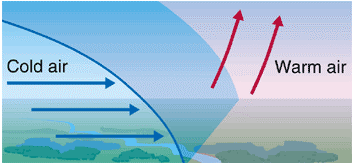
Identify the type of front.
a)
cold front
b)
warm front
c)
stationary front
d)
occluded front
10.

This symbol represents which type of front?
a)
cold front
b)
warm front
c)
stationary front
d)
occluded front
11.

This symbol represents which type of front?
a)
cold front
b)
warm front
c)
stationary front
d)
occluded front
12.

This symbol represents which type of front?
a)
cold front
b)
warm front
c)
stationary front
d)
occluded front
13.
This front may bring fog or a gentle rain for several days.
a)
cold front
b)
warm front
c)
stationary front
d)
occluded front
14.

What type of front is this?
a)
warm front
b)
cold front
c)
stationary front
d)
occluded front
15.
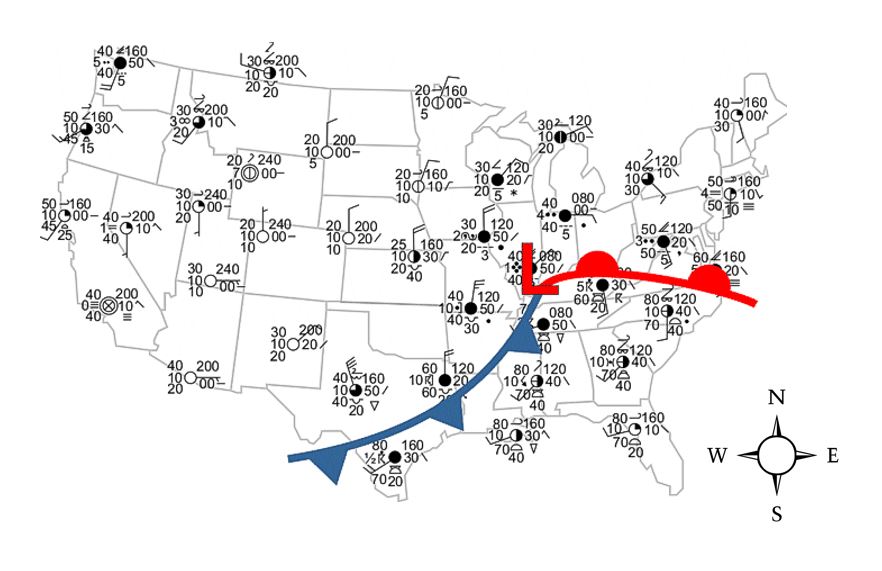
What direction is the cold front moving on the map?
a)
Southwest
b)
Northwest
c)
Southeast
d)
Northeast
16.
What direction is the warm front moving on the map?
a)
North
b)
South
c)
East
d)
West
17.
When a warm air mass and a cold air mass meet, but they push at each other and neither one can move, it is called a/an -
a)
warm front
b)
cold front
c)
occluded front
d)
stationary front
18.
When a fast-moving cold air mass moves into a slower-moving warm air mass, we may experience severe storms and cooler weather. What type of front is this?
a)
warm front
b)
cold front
c)
occluded front
d)
stationary front
19.
When a warm air mass slides on top of a cold air mass, and you have drizzly rain and then warmer weather, what type of front is it?
a)
warm front
b)
cold front
c)
occluded front
d)
stationary front
20.

What is the name of this tool?
a)
Barometer
b)
Hygrometer
c)
Rain Gauge
d)
Thermometer
21.

This weather instrument is a/an...
a)
anemometer
b)
barometer
c)
rain gauge
d)
thermometer
22.

This weather instrument is a/an...
a)
rain gauge
b)
anemometer
c)
barometer
d)
thermometer
23.
Which tool measures air pressure?
a)
Thermometer
b)
Barometer
c)
Wind Vane
d)
Hygrometer
24.
Which tool measures wind speed?
a)
Anemometer
b)
Hygrometer
c)
Barometer
d)
Wind Vane
25.
Convection takes place because
a)
warm air is more dense than humid air
b)
warm and cold air have the same density
c)
cold air is less dense than warm air
d)
cold air is more dense than warm air
26.
Winds are caused by differences in
a)
precipitation
b)
humidity
c)
air pressure
d)
turbulence
27.
As water vapor rises and cools in the atmosphere, it changes from a gas to a liquid. This is called:
a)
precipitation
b)
transpiration
c)
evaporation
d)
condensation
28.
As part of the water cycle, _____ happens when liquid changes to a gas.
a)
runoff
b)
precipitation
c)
condensation
d)
evaporation
29.
When you increase your altitude (height above sea level), the air pressure...
a)
increases
b)
decreases
c)
stays the same
30.
78% of earth's atmosphere is composed of ____?
a)
carbon dioxide
b)
oxygen
c)
argon
d)
nitrogen
31.
Cold air exerts _____________ pressure than warm air
a)
the same
b)
more
c)
less
32.
The air pressure is _____ when closest to the earth's surface.
a)
low
b)
stinky
c)
high
d)
thin
33.
This gas makes up 21% of the atmosphere
a)
ozone
b)
oxygen
c)
nitrogen
d)
argon
34.

Which BEST describes a front?
a)
a large mass of moving air
b)
a boundary between 2 air masses
c)
a high pressure system
d)
a low pressure system
35.

What conditions can lead to the formation of a hurricane?
a)
low-pressure over warm tropical ocean
b)
low-pressure system over artic tundra
c)
high-pressure over warm tropical ocean
d)
high-pressure system over hot, dry land
36.

Which of the following is a violently rotating column of air in contact with the ground?
a)
hurricane
b)
tornado
c)
thunderstorm
d)
blizzard
37.

Which type of front typically produces stratus clouds, drizzle, and warmer temperatures?
a)
cold
b)
warm
c)
stationary
d)
occluded
38.

Which type of front often produces thunderstorms?
a)
cold
b)
stationary
c)
warm
d)
occluded
39.
What do thunderstorms, tornadoes, and hurricanes have in common?
a)
High pressure
b)
Low pressure
c)
Slow winds
d)
Cold temperatures
40.
Which storm only forms over warm water?
a)
tornado
b)
lightning
c)
thunderstorm
d)
hurricane
41.
What type of weather front causes thunderstorms and tornadoes?
a)
cold
b)
occluded
c)
stationary
d)
warm
42.
When warm and cold air meet, which one sinks to the bottom?
a)
warm
b)
cold
c)
both
d)
neither
43.

What is this storm?
a)
rain storm
b)
tornado
c)
hurricane
d)
none of the above
44.

What is this storm?
a)
thunderstorm
b)
tornado
c)
hurricane
d)
blizzard
45.
True or False:
The eye is located at the center of a storm.
The eye is located at the center of a storm.
a)
True
b)
False
46.
True or False:
Hurricanes strengthen as they make landfall.
Hurricanes strengthen as they make landfall.
a)
True
b)
False
47.
What is the most common type of severe weather?
a)
Thunderstorms
b)
Tornadoes
c)
Hurricanes
d)
Blizzards
48.
Which of the following is not produced by thunderstorms?
a)
Snow
b)
Lightning
c)
Rain
d)
Strong winds
49.
True or False:
The Enhanced Fujita Scale is used to measure the intensity of...
The Enhanced Fujita Scale is used to measure the intensity of...
a)
Tornadoes
b)
Hurricanes
c)
Blizzards
d)
Droughts
50.
In what country do most tornadoes occur?
a)
U.S.A.
b)
Mexico
c)
France
d)
Australia
51.
What type of severe weather does the Saffir-Simpson Scale measure?
a)
Hurricanes
b)
Blizzards
c)
Tornadoes
d)
Earthquakes
52.
Which of these is an example of precipitation?
a)
snow
b)
air
c)
clouds
d)
vapor
53.
Snow, sleet, hail, and rain are all examples of ________________.
a)
evaporation
b)
condensation
c)
accumulation
d)
precipitation
54.

What is it called when plants give off water vapor as a waste product?
a)
condensation
b)
evaporation
c)
sublimation
d)
transpiration
55.

What is A?
a)
Solid
b)
Liquid
c)
Gas
56.

What is B?
a)
Solid
b)
Liquid
c)
Gas
57.

What is C?
a)
Solid
b)
Liquid
c)
Gas
58.

Which stage does the #3 show in the diagram?
a)
condensation
b)
evaporation
c)
precipitation
d)
run off
59.
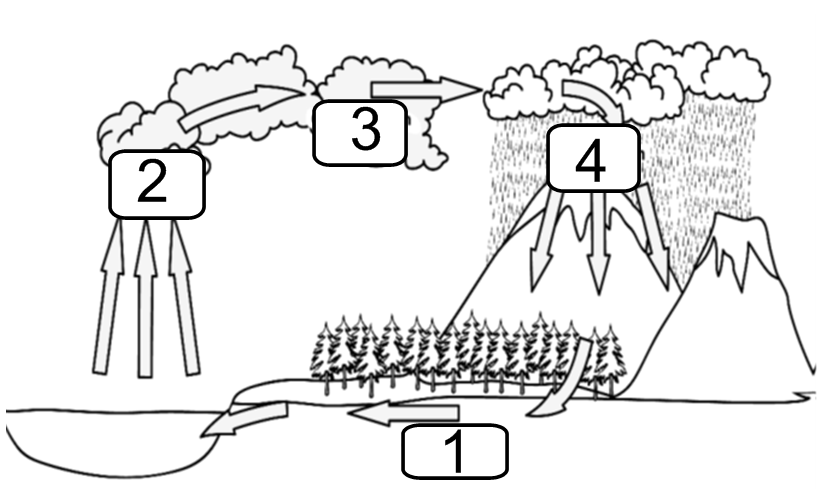
Which stage does the #2 show in the diagram?
a)
condensation
b)
evaporation
c)
precipitation
d)
run off
60.

What does the #4 show in the diagram?
a)
condensation
b)
evaporation
c)
precipitation
d)
run off
61.

During which stage do clouds form?
a)
condensation
b)
evaporation
c)
precipitation
62.

What is D representing in the water cycle?
a)
Evaporation
b)
Condensation
c)
Precipitation
d)
Runoff
63.
The sun drives the water cycle by doing what?
a)
Rotating on its axis
b)
Giving off light for plants
c)
Providing gravity to keep the Earth in orbit
d)
Providing heat for evaporation
64.
Water running down the side of a mountain is an example of:
a)
Runoff
b)
Groundwater
c)
Precipitation
d)
Accumulation
65.
Most of the water on Earth is in the form of salt water found in:
a)
The Ocean
b)
Rivers
c)
Rain
d)
Lakes
66.

Observe the illustration. Which type of front does it represent?
a)
cold front
b)
warm front
c)
occluded front
d)
stationary front
67.

Observe the illustration. Which type of front does it represent?
a)
warm front
b)
cold front
c)
occluded front
d)
stationary front
68.

Which type of front is near Seattle?
a)
cold front
b)
warm front
c)
occluded front
d)
stationary front
69.

Which front is located near San Diego?
a)
cold front
b)
warm front
c)
occluded front
d)
stationary front
70.
Which pressure system can produce storms?
a)
low pressure system
b)
high pressure system
71.
Which type of pressure system produces clear/fair/sunny weather?
a)
low pressure system
b)
high pressure system
72.
At which temperature would the air be least dense?
a)
70 degrees
b)
40 degrees
c)
0 degrees
d)
-10 degrees
73.
At which temperature would the air be most dense?
a)
70 degrees
b)
40 degrees
c)
0 degrees
d)
-10 degrees
74.
A scientist who studies weather is called a...
a)
Weatherologist
b)
Archaelogist
c)
Anthropologist
d)
Meteorologist
75.
As air heats up, the molecules...
a)
Condense
b)
Slow down
c)
Spread out
d)
Disappear
100 %

