
NEW
Font size
S
M
L
XL
 Worksheets
Evolution Summative #2 Review
Total questions: 49
Worksheet time: 57mins
Name
Class
Date
1.
Genetic drift is more likely to happen in...
a)
aquatic populations
b)
small populations
c)
terrestrial populations
d)
older populations
2.
Which of the following is an example of the bottleneck effect?
a)
Cheetah populations reach their lowest levels with reduced diversity and as they rebound are so genetically similar they appear to be inbred.
b)
Affected individuals with blue skin can trace their ancestry back to one of the first settlers in the region.
c)
The environment of a fox population changes and over time foxes who are white survive and pass on their genes to their offspring.
d)
Humans choose two dogs they like the characteristics of and breed them together.
3.
Which of the following is an example of the founder effect?
a)
Humans choose two dogs they like the characteristics of and breed them together.
b)
Affected individuals with blue skin can trace their ancestry back to one of the first settlers in the region.
c)
The environment of a fox population changes and over time foxes who are white survive and pass on their genes to their offspring.
d)
Cheetah populations reach their lowest levels with reduced diversity and as they rebound are so genetically similar they appear to be inbred.
4.
Genetic drift is change in the allele frequency of a population due to...
a)
random chance
b)
natural selection
c)
non-random mating (sexual selection)
d)
artificial selection
5.
Genetic drift is one of the mechanisms of...
a)
cellular respiration
b)
reproduction
c)
protein synthesis
d)
evolution
6.
A virus killed most of the seals in the North Sea (e.g. dropped the population from 8000 to 800). In an effort to help preserve the species, scientists caught 20 of the remaining seals and used them to start a new population in the northwest Pacific Ocean. Which of the following statements would accurately describe the new population?
a)
The new seal population is genetically less diverse than the original population
b)
The new seal population is genetically more diverse than the original population
c)
There is equal genetic variety compared to the original population
d)
None of the answers
7.
Happens only in small populations, and is the change in the frequency of a gene variant (allele) in a population due to random sampling of organisms.
a)
Extinction
b)
Genetic Drift
c)
Bottleneck Effect
d)
Founder Effect
8.
This mechanism of evolution occurs when populations migrate.
a)
Extinction
b)
Gene flow
c)
Genetic drift
d)
Natural Selection
9.

The model below shows a how populations of organisms can change. Which of the following concepts is best illustrated by this demonstration?
a)
Evolution of a predatory species
b)
Genetic drift
c)
Environmentally induced genetic mutations
d)
Gene flow
10.
Which of the following is true?
a)
Gene pool frequencies do not change as a result of migration in or out of a population.
b)
Gene flow occurs only as a result of isolation of a small population.
c)
Gene flow can cause new alleles to enter a population's gene pool.
d)
Gene flow is due the the selection of the most favorable traits.
11.
Which of the following cannot introduce new alleles into a population's gene pool?
a)
Mutataion
b)
Natural selection
c)
Gene Flow
d)
All of the above introduce new alleles into the population
12.
The differences among a species, like different bird beaks, are called
a)
genes.
b)
variations.
c)
traits.
d)
theories.
13.
Organisms with the most beneficial traits will survive. This is commonly known as
a)
theory of evolution.
b)
variations.
c)
survival of the fittest.
d)
ecosystems.
14.
What is the advantage of having different shaped beaks?
a)
To look different from other species.
b)
To be able to eat the food readily available in the environment.
c)
To protect itself against predators.
d)
To protect itself against prey.
15.
Why are advantageous traits more likely to be passed onto offspring?
a)
Because they are more likely to survive and reproduce.
b)
Because they come from dominant alleles.
c)
Because they come from recessive alleles.
d)
Because the trait is an acquired phenotype.
16.
Do organisms "decide" to evolve and change?
a)
Yes, they know they need to change to survive
b)
No, they change because of natural selection
17.
____ is when members of a species that are best suited for their environment survive and reproduce at a higher rate than other members of the species
a)
natural selection
b)
artificial selection
c)
speciation
d)
adaptation
18.
Which is necessary for speciation to occur?
a)
adaptation
b)
mass extinction
c)
isolation
d)
acquired traits
19.
Which of the following means "change over time"
a)
natural selection
b)
speciation
c)
evolution
d)
isolation
20.
Which structures are between species that are similar structure, but have different functions (mammal forearms), and show evolution from a common ancestor?
a)
vestigial structure
b)
homologous structure
c)
analogous structure
d)
mutation
21.
As developing embryos, some organisms appear to have features that are similar in structure. As these organisms continue their development, features that were similar in the embryonic stage develop into different structures that have different functions. What type of evidence of common ancestry do these features represent?
a)
vestigial structures
b)
fossil structures
c)
analogous structures
d)
homologous structures
22.
Which evolutionary mechanism is necessary for evolution to occur?
a)
genetic drift
b)
gene flow
c)
nonrandom mating
d)
mutation
23.
If a bacteria is antibiotic resistant, what does that mean?
a)
bacteria have inherited a favorable variation that is immune to antibiotics
b)
bacteria changed their DNA to be resistant to antibiotics
c)
bacteria do not like antibiotics
d)
bacteria will die if exposed to antibiotics
24.
The concept of gene flow is demonstrated a wolf leaves his pack, joins another, and reproduces. When the wolf contributes to the gene pool of the new herd, which of these most likely increases?
a)
natural selection
b)
genetic variation
c)
environmental fitness
d)
reproductive mutations
25.

A prey population consists of individuals with a variety of running speeds. The adaptation that allows some of these animals to run fast would be an example of natural selection if it helps them-
a)
Survive and undergo mutations in their DNA
b)
Lower the mortality rates of the population
c)
Produce offspring that run at average speeds
d)
Reproduce and increase the frequency of their genes in the population
26.
Which of the following is true of genetic drift?
a)
It can decrease genetic diversity in a population
b)
It is necessary in order for a population to be in equilibrium
c)
It can increase genetic diversity in a population
d)
It plays a much larger role in determining the genetic makeup of populations than natural selection
27.

What type of natural selection is this?
a)
Disruptive Selection
b)
Directional Selection
c)
Stabilizing Selection
d)
Sexy Selection
28.

What type of natural selection is this?
a)
Disruptive Selection
b)
Directional Selection
c)
Stabilizing Selection
d)
Sexy Selection
29.

What type of natural selection is this?
a)
Disruptive Selection
b)
Directional Selection
c)
Stabilizing Selection
d)
Sexy Selection
30.
An adaptation is
a)
how animals change over time.
b)
a characteristic that helps an organism survive in its environment.
c)
a theory of how organisms change.
d)
the genes in an organism that determine how an organism is going to look.
31.

Scientists believe the panda bear is related to the brown bear. However, the panda bear appears to have developed a thumb. Why would panda bears develop a thumb? (Choose the best answer.)
a)
The thumb has always been there but disappeared in the brown bear.
b)
The panda always had a thumb and is not related to the brown bear.
c)
The thumb helps the panda grab, hold, and eat bamboo.
d)
There is no evidence to support why the panda bear has a thumb.
32.
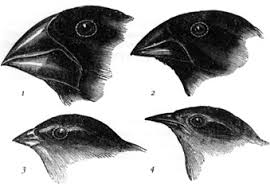
Which process produced the two different types of beaks in the ground finch and the tree finch?
a)
artificial selection
b)
geographical distribution
c)
natural selection
d)
disuse of the beak
33.

What is the correct explanation for what is happening in this graph?
a)
There are a lot of average-sized beaks
b)
There are no beaks
c)
There are a lot of small beaks only
d)
There are a lot of small and large beaks, but not average-sized ones
34.
What type of natural selection is this: When a group of deer migrated to a cold mountain, the thin-furred deer and average-furred deer died. The thick-furred deer survived and eventually the population became thicker-furred.
a)
Disruptive Selection
b)
Directional Selection
c)
Stabilizing Selection
d)
Slippery Selection
35.

A species of bird ate many types of seeds. The individuals vary in beak size. If a drought were to kill off the trees that produce small seeds and leave only large seeds, how would the population change?
a)
The birds with larger beaks were better at eating the large seeds than those with smaller beaks, so only the birds with larger beaks got enough food to survive, reproduce, and pass the trait of large beaks to the next generation.
b)
The birds with smaller beaks had to work harder than those with larger beaks to crack open the large seeds. The more they used their beaks, the larger their beaks became, so they were able to get enough food to survive, reproduce, and pass the traits of large beaks to the next generation.
c)
The birds with smaller beaks grew their beaks so that they would be better able to eat the large seeds and get enough food to survive, reproduce, and pass the trait of larger beaks to the next generation.
d)
Beak size is random and will not be determined by the types of seeds available.
36.
Which Hardy-Weinberg equation represents the genotype frequencies in a population?
a)
p + q = 1
b)
p2 + 2pq + q2 = 1
c)
p2 + pq2 + q2 = 1
d)
p + 2pq + q3 = 1
37.
Which Hardy-Weinberg factor represents the frequency of heterozygous individuals in a population?
a)
p2
b)
2pq
c)
q2
d)
p2 + 2pq
38.
A population of frogs has 37 individuals who are brown in color and 194 individuals who express the dominant green color. What is the dominant allele frequency for this population?
a)
0.2
b)
0.4
c)
0.6
d)
0.8
39.
When a population is at Hardy-Weinberg equilibrium, the allele frequencies should remain constant. Which of the following populations is most likely experiencing Hardy-Weinberg equilibrium?
a)
When a population is at Hardy-Weinberg equilibrium, the allele frequencies should remain constant. Which of the following populations is most likely experiencing Hardy-Weinberg equilibrium
b)
In a spider population, the males with the most intricate courtship dance get selected as mates more quickly than other male spiders.
c)
In a mosquito population, being heterozygous for a given trait makes the individuals resistant to four viral infections
d)
In a large moth population, both red and orange moths are consistently abundant
40.
If a population has the following genotype frequencies: AA = 0.42, Aa = 0.46, and aa = 0.12, what are the allele frequencies?
a)
A = 0.42, a = 0.12
b)
A = 0.6, a = 0.4
c)
A = 0.65, a = 0.35
d)
A = 0.84, a = 0.24
41.
Genetic drift is likely to be seen in a population
a)
That has a low mutation rate
b)
In which natural selection is occurring
c)
That is very small
d)
For which environmental conditions are changing
42.

Which of the following statements is supported by the graph below?
a)
The population is in Hardy-Weinberg equilibrium, as the sum of the frequency of the dominant allele and the recessive allele is always equal to 1
b)
The percentage of individuals homozygous recessive for this particular trait is increasing over time
c)
Selection has caused frequencies to change over time because individuals with a dominant allele survive at higher rates than individuals with recessive alleles
d)
Individuals who are homozygous recessive for this particular trait have migrated into the population, causing the frequency to approach 1
43.
Within a population of 500 butterflies, the color purple is dominant over the color white. 200 of the butterflies are white. What is the frequency of homozygous dominant individuals? Give your answer as a decimal to the nearest hundredth.
a)
.40
b)
.36
c)
.16
d)
.60
44.
Cystic fibrosis is a recessive condition that affects about 1 in 2,500 babies in the Caucasian population of the United States. Calculate the frequency of heterozygous individuals (carriers) in the U.S. population. Give your answer as a decimal to the nearest hundredth.
a)
.98
b)
.06
c)
.02
d)
.04
45.
A camel can go without water for a long time.
a)
Structural
b)
Behavioural
46.
A camel has long eyelashes to keep out the sand.
a)
Structural
b)
Behavioural
47.

Venus fly trap closes the leaves to trap insects.
a)
Structural
b)
Behavioural
48.
Birds migrate (move to) a warmer place during winter.
a)
Structural
b)
Behavioural
49.

Penguins huddle close together to keep warm.
a)
Structural
b)
Behavioural
Reset

