
 Worksheets
Enzymes
Total questions: 55
Worksheet time: 48mins
Name
Class
Date
1.
Where do substrates bind on an enzyme?
a)
voltage-gated channels
b)
surface receptor
c)
calcium channels
d)
active site
2.
Enzymes are capable of increasing the rate of a chemical reaction within a living cell. Enzymes accomplish this through which of the following means?
a)
reducing the number of products
b)
reducing the activation energy
c)
increasing the temperature of the cell
d)
increasing the concentration of reactants
3.

What is structure A?
a)
Substrate
b)
Active site
c)
Enzyme
d)
Products
4.

What is structure D?
a)
Substrate
b)
Active site
c)
Enzyme
d)
Products
5.

What is structure C?
a)
Substrate
b)
Active site
c)
Enzyme
d)
Products
6.

What is structure E, F, G?
a)
Substrate
b)
Active site
c)
Enzyme
d)
Products
7.
What is a substance called if it speeds up a chemical reaction?
a)
reusable
b)
catalyst
c)
specific
d)
fragile
8.
What 3 letters do enzymes typically end in?
a)
-ose
b)
-ase
c)
-ese
d)
-tic
9.

The graph shows how enzymes affect reactions in cells. Which statement best summarizes the information shown in the graph?
a)
Enzymes increase the energy of the reactants.
b)
Enzymes decrease the energy level of the products.
c)
Enzyme decrease the activation energy of the reaction.
d)
Enzymes reverse the direction of the reaction.
10.

Which of the following conclusions can be drawn from this graph?
a)
The optimum pH of the enzyme is 6.6.
b)
The optimum pH of the enzyme is 5.8
c)
The enzyme’s activity increases as pH increases 5.0 to 9.0
d)
The enzyme’s activity is greater around pH of 8.0 .
11.
Which chemical is classified as an enzyme?
a)
Galactose
b)
Lipid
c)
Protease
d)
Manganese dioxide
12.
The "lock and key hypothesis" attempts to explain the mechanism of?
a)
Vacuole formation
b)
Pinocytosis
c)
Sharing of electrons
d)
Enzyme specificity
13.
Isomerase is special kind of enzyme which converts?
a)
glucose-> sucrose
b)
fructose-> glucose
c)
glucose -> Fructose
d)
Sucrose -> Fructose
14.
What is the optimum pH of pepsin (found in the stomach gastric juice of humans)
a)
5
b)
2
c)
7
d)
9
15.
the pH at which an enzyme is most efficient is called the _________ pH of an enzyme
a)
neutral
b)
optimum
c)
minimum
d)
experimental
16.
What type of macromolecule are enzymes?
a)
Protein
b)
Carbohydrate
c)
Lipid
d)
Nucleic Acid
17.
Enzymes need certain environmental conditions in order to function properly. What happens when enzymes are heated to a high temperature?
a)
they die
b)
they denature
c)
they change their amino acid sequence
d)
they work better
18.
Which of these is NOT true.
a)
Enzymes can denature (change shape) when the temperature gets too high.
b)
Enzymes can only be used once in a chemical reaction.
c)
Enzymes can denature when the pH changes.
d)
Enzymes speed up chemical reactions.
19.
What is another name for enzymes?
a)
chemical catalyst
b)
microorganism
c)
biological catalyst
d)
catalyst
20.
As the temperature increases, enzyme's rate of reaction increases why?
a)
increased no. of enzymes
b)
substrates are active
c)
higher kinetic energy so higher collisions
d)
enzymes are occupied
21.
In the experiment conducted to check the affect of substrate concentration on rate of reaction. What is the independant variable?
a)
Time
b)
Reaction Rate
c)
concentration of substrate
d)
concentration of enzyme
22.
What is the substrate for the enzyme catalase?
a)
Hydrogen
b)
Water
c)
Oxygen
d)
Hydrogen Peroxide
23.
What is broken down by the enzyme Amylase?
a)
Sugar
b)
Starch
c)
Oils
d)
Meat
24.
Why does the reaction rate reaches plateau in the experiment conducted to test the affects of increasing concentration of enzyme?
a)
time
b)
limited by substrate
c)
enzymes are denatured
d)
enzymes are inactive
25.
What is the dependant variable in testing the effect of temperature on enzyme activity?
a)
enzyme
b)
rate of reaction
c)
temperature
d)
time
26.
If you are testing for the effect of enzyme concentration on rate of reaction, what IS NOT a control variable?
a)
type of enzyme
b)
enzyme concentration
c)
concentration of substrate
d)
Type of substrate
27.
You did the experiment to test for catalase using the potato strip and hydrogen peroxide. You noticed that if you replace the Hydrogen peroxide after the first reaction, Bubbles can be seeb again! Why?
a)
enzymes are used up
b)
enzymes are occupied
c)
enzymes can be reused
d)
enzymes are denatured
28.

Letter D...
a)
active site
b)
enzyme
c)
substrate
d)
products
29.

Letter B...
a)
active site
b)
enzyme
c)
substrate
d)
products
30.

Letter C...
a)
active site
b)
enzymes
c)
substrate
d)
products
31.

Letter E...
a)
active site
b)
enzyme
c)
substrate
d)
products
32.
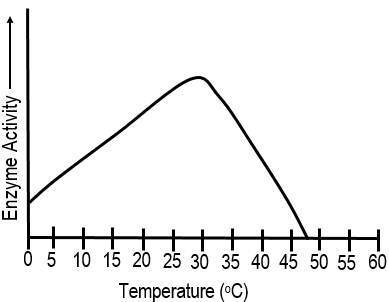
Based on the graph, what temperature does this enzyme work best?
a)
15 C
b)
40 C
c)
30 C
33.
Enzymes are composed of which of the following monomers?
a)
amino acids
b)
carbohydrates
c)
nucleotides
d)
monosaccharides
34.
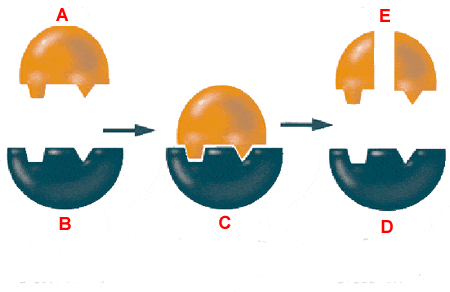
This reaction shows a(n) ____________ reaction
a)
Catabolic
b)
Anabolic
c)
Dehydration Synthesis
d)
Halogenation
35.
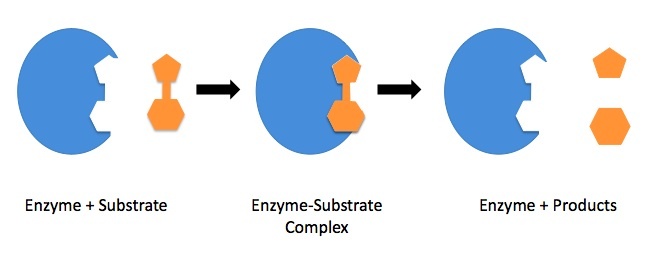
The current model of enzyme action is referred to as the:
a)
Induced Fit Model
b)
Lock & Key Model
c)
Singer-Nicolson Model
d)
Davson-Danielli Model
36.
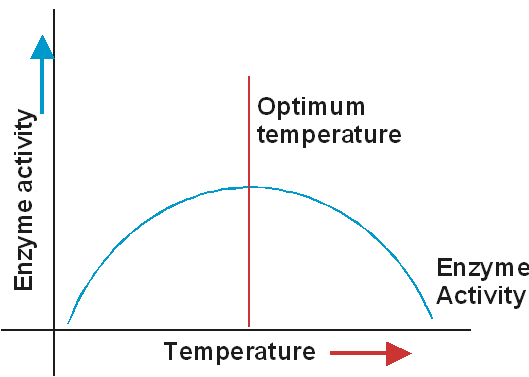
At high temperatures enzyme activity declines because of:
a)
Denaturation
b)
Decreased Kinetic Motion
c)
Increased H-Bonding
d)
Dissociation of Ionic Compounds
37.
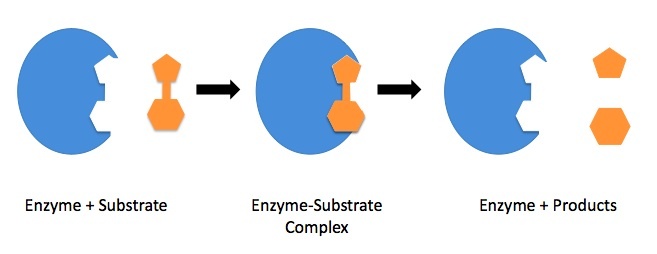
When a molecule can occupy the same active site as the substrate, a situation called __________________ can result
a)
Competitive lnhibition
b)
Allosteric Regulation
c)
Non-Competitive Inhibition
d)
Feedback Inhibition
38.
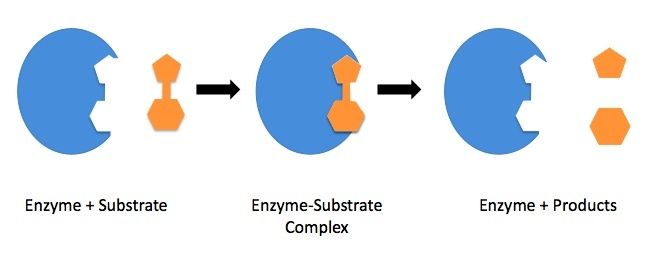
A receptor site that a molecule can bind to that changes the shape of the active site is called a(n):
a)
Allosteric Site
b)
Active Site
c)
DiSulphide Bridge
d)
MHC Receptor
39.
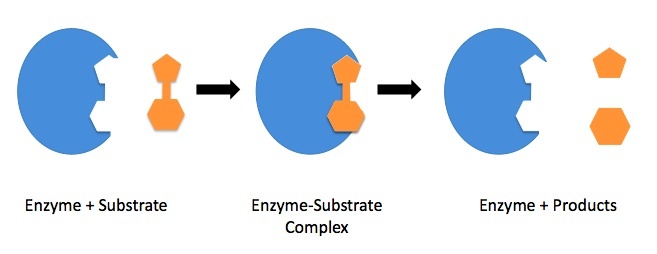
A molecule binds to an enzyme and opens the active site so it can bind to the substrate. This is called:
a)
Allosteric Activation
b)
Allosteric Inhibition
c)
Competitive Activation
d)
Competitive Inhibition
40.
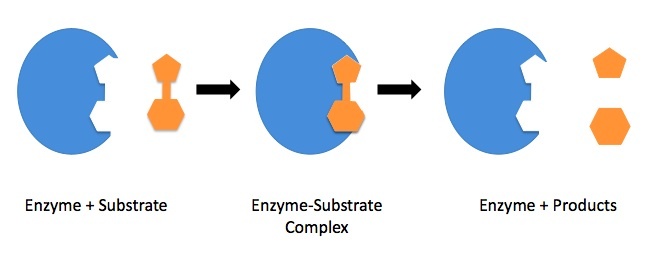
A molecule binds to an enzyme and decreases the ability of the active site to bind to the substrate. This is called:
a)
Allosteric Activation
b)
Allosteric Inhibition
c)
Competitive Activation
d)
Competitive Inhibition
41.
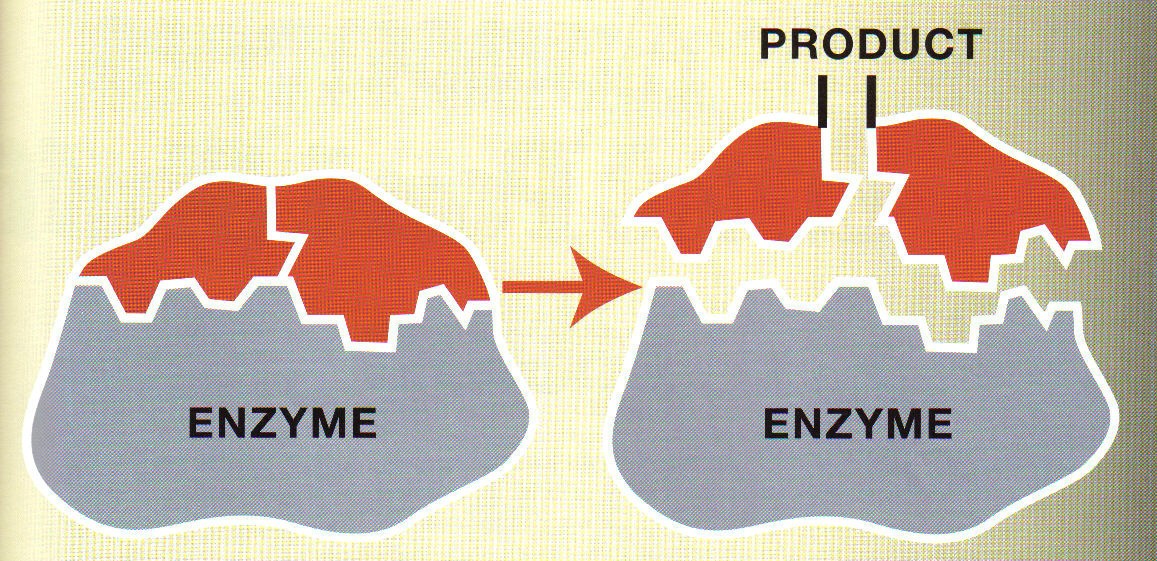
Molecules that bind to enzymes and enhance an enzyme's ability are called:
a)
CoFactors
b)
CoEnzymes
c)
Allosteric Inhibitors
d)
Allosteric Activators
42.
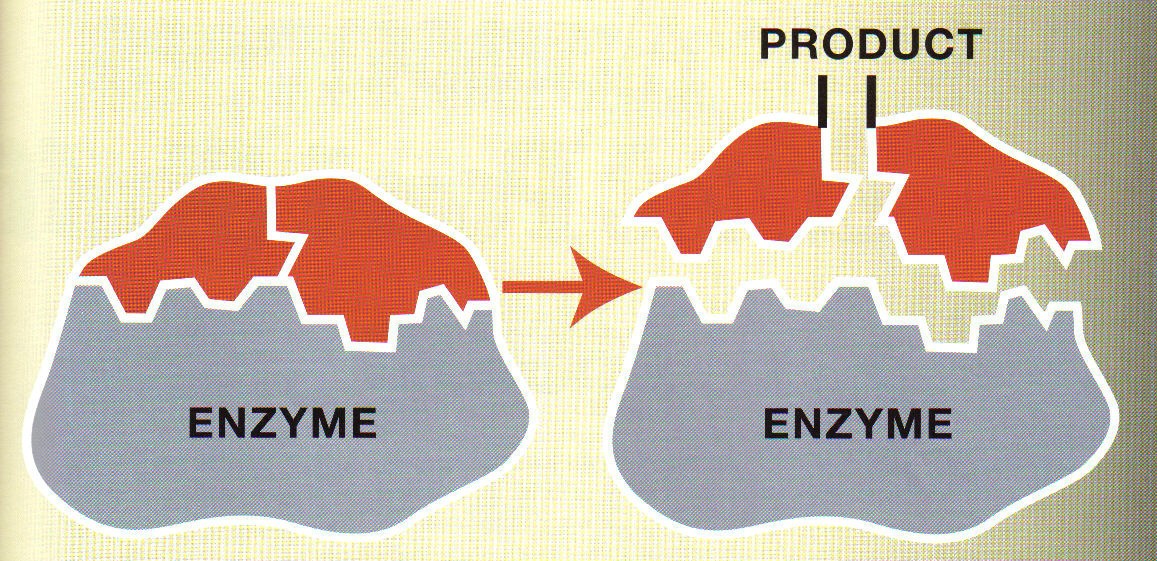
Organic molecules that temporarily bind to enzymes and enhance an enzyme's ability are called:
a)
CoFactors
b)
CoEnzymes
c)
Allosteric Inhibitors
d)
Allosteric Activators
43.
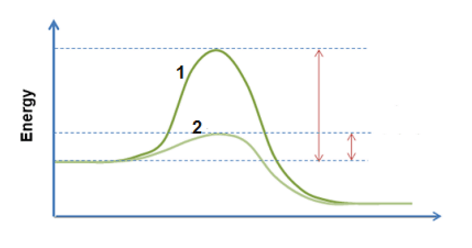
Which line represents an enzyme-catalyzed reaction?
a)
Line 1
b)
Line 2
44.

The diagram shows the series of a reactions that convert lactose into a usable form .
If enzyme 4 is denatured (stops working), the levels of which substance will increase?
If enzyme 4 is denatured (stops working), the levels of which substance will increase?
a)
Lactose
b)
Galactose
c)
Glucose-1-Phosphate
45.
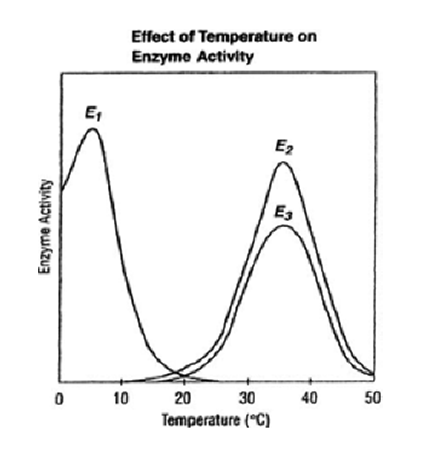
The graph shows the effect of temperature on enzyme action. What characteristic do enzymes E1, E2, and E3 share?
a)
Their activity increases between 20°C and 30°C.
b)
Their activity is greatest between 5°C and 10°C.
c)
Their activity is at a low level between 15°C and 25°C.
d)
Their activity is at a high level between 30°C and 40°C.
46.

The portion labeled "C" represents the
a)
reaction with enzyme
b)
reaction without enzyme
c)
reactants
d)
products
47.
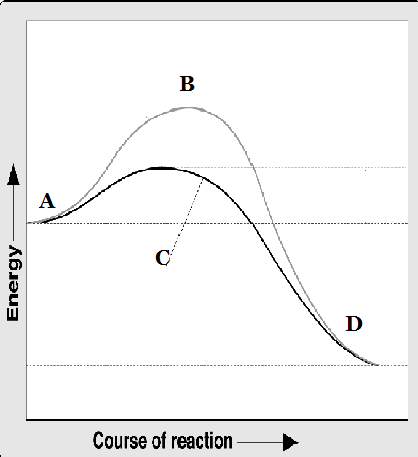
The portion labeled "B" represents the
a)
reaction with enzyme
b)
reaction without enzyme
c)
reactants
d)
products
48.
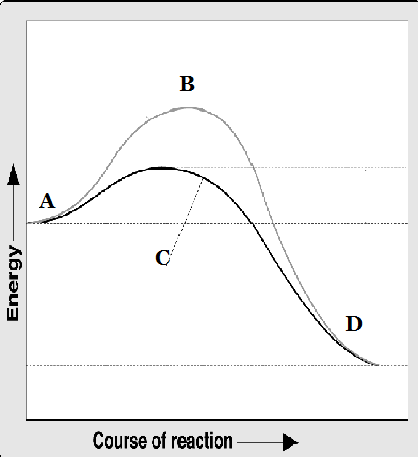
The portion labeled "D" represents the
a)
reaction with enzyme
b)
reaction without enzyme
c)
reactants
d)
products
49.
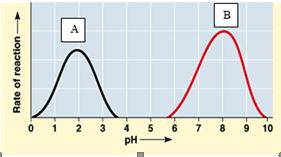
What is the optimal pH of enzyme A?
a)
8
b)
2
c)
5.7-10
d)
10
50.
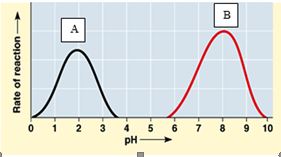
What is the pH range of enzyme A?
a)
2
b)
0-3.7
c)
3.7
d)
0
51.
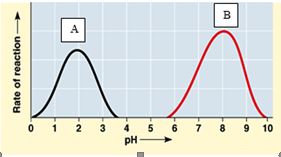
Which enzyme is most efficient in a basic solution?
a)
A
b)
B
52.

Which statement explains the effect of the inhibitor?
a)
The inhibitor changes the shape of the active site preventing the substrate from attaching.
b)
the inhibitor causes the substrate to attach to the active site
c)
the inhibitor has no effect on the enzyme
53.

Venus flytraps produce chemicals that break down insects into usable compounds. These chemicals are most likely:
a)
Hormones
b)
Lipids
c)
Enzymes
d)
Carbohydrates
54.

Lactose intolerance is most likely caused by -
a)
A lack of lactase enzyme to breakdown lactose
b)
Overproduction of glucose and galactose
c)
Excess lactase enzyme
d)
A lack of lactose sugar
55.

The graph shows the relative rates of action of four enzymes, A, B, C, and D. Which two enzymes would function in a region of the human body having a neutral pH?
a)
enzyme A and B
b)
enzyme B and C
c)
enzyme C and D
d)
enzyme B and D
100 %

