
 Worksheets
Midterm2
Total questions: 62
Worksheet time: 59mins
Name
Class
Date
1.

This image shows a...
a)
Punnett Square
b)
Phenotype
c)
Genotype
d)
Dominant allele
2.
A phenotype is the...
a)
letter combination
b)
dominant gene
c)
recessive gene
d)
physical appearance
3.
Another word for homozygous is...
a)
purebred
b)
hybrid
c)
heterozygous
d)
dominant
4.
Dominant alleles are-
a)
capital
b)
lowercase
c)
both
d)
neither
5.
Recessive alleles are-
a)
capital
b)
lowercase
c)
both
d)
neither
6.
Tt is-
a)
homozygous dominant
b)
homozygous recessive
c)
heterozygous
d)
none of these
7.
Pairs of genes that control the same trait are known as
a)
allelles
b)
gametes
c)
hybrids
d)
loci
8.
If the four existing children in a family are all sons, what chance would there be that the next child would also be a son?
a)
75%
b)
50%
c)
25%
d)
20%
9.
Brown (B) is dominant over white (b). Which genotype is a purebred for brown fur?
a)
BB
b)
Bb
c)
bb
d)
All of the above
10.
Who was Gregor Mendel?
a)
A French Botanist
b)
A German Physician
c)
An American Cowboy
d)
An Austrian Monk
11.
The genetic information inside an individual.
a)
Homozygous
b)
Heterozygous
c)
Genotype
d)
Phenotype
12.

bb crossed with BB, what is the probability of Bb?
a)
0%
b)
25%
c)
50%
d)
100%
13.
Which sequence of DNA bases would pair with this partial strand
ATG TGA CAG
ATG TGA CAG
a)
ATG TGA CAG
b)
TAC ACT GTC
c)
GTA AGT GAC
d)
CAT TCA CTG
14.
Which of the following units are repeatedly joined together to form a strand of DNA?
a)
amino acids
b)
nucleotides
c)
fatty acids
d)
polysaccharides
15.
Adenine bonds with ______________.
a)
Guanine
b)
Thymine
c)
Cytosine
d)
Adenine
16.
Why is DNA important?
a)
it is very small and very complicated
b)
it's in everything
c)
it serves as the blueprint for traits of all living things
d)
because we eat it every day for energy
17.
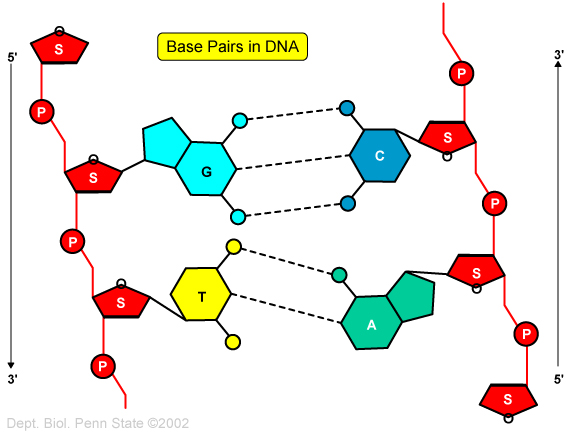
Nitrogenous bases are joined by which type of bond?
a)
polar bonds
b)
ionic bonds
c)
covalent bonds
d)
hydrogen bonds
18.
The enzyme that unzips the DNA to prepare for replication
a)
helicase
b)
replicase
c)
polymerase
d)
synthase
19.
A process in which DNA has the unique ability to make an exact copy of itself.
a)
Replication
b)
Translation
c)
Transcription
20.
what does mRNA do?
a)
carry info from genes to ribosomes
b)
carry amino acids to ribosomes
c)
help with RNA splicing
d)
make up ribosomes
21.
When a cell is not actively dividing, it is in what phase?
a)
interphase
b)
anaphase
c)
prophase
d)
telophase
22.
What portion of the cell cycle involves the actual dividing?
a)
interphase
b)
mitosis
c)
Gap 1
d)
Gap 2
23.
Before a cell can divide, what must happen?
a)
Nothing, it is always ready to divide
b)
The number of chromosomes must be cut in half
c)
The number of chromosomes must double
d)
The number of chromosomes must triple.
24.
What is the diploid number of cells found in a human body cell?
a)
23
b)
46
c)
92
d)
47
25.
Another name for a sex cell is a:
a)
gamete
b)
embryo
c)
bone cell
d)
muscle cell
26.

The process on the left is:
The process on the right is:
The process on the right is:
a)
Left: meiosis
Right: meiosis
Right: meiosis
b)
Left: meiosis
Right: cloning
Right: cloning
c)
Left: mitosis
Right: meiosis
Right: meiosis
d)
Left: mitosis
Right: mitosis
Right: mitosis
27.
Most of the cells in the human body are produced by
a)
mitosis
b)
meiosis
28.

a)
prophase
b)
metaphase
c)
anaphase
d)
telophase
29.

a)
prophase
b)
metaphase
c)
anaphase
d)
telophase
30.
Cells produced during meiosis are genetically
a)
different
b)
identical
31.
Cells produced during mitosis are genetically
a)
different
b)
identical
32.

a)
Anaphase
b)
Cytokinesis
c)
Telophase
d)
Metaphase
33.

a)
Prophase
b)
Interphase
c)
Anaphase
d)
Telophase
34.
During the process of gel electrophoresis, molecules are separated as they are pulled by an electric current through a molecular filter. Which best describes how molecules are separated?
a)
precisely by both size and charge
b)
approximately by size and charge
c)
by size only
d)
by charge only
35.
Why do the fragments of DNA in gel electrophoresis travel away from the negative electrode?
a)
DNA is negatively charged
b)
DNA is positively charged
c)
the agarose gel in negatively charged
d)
the agarose gel is positively charged
36.
Which is the primary purpose of using restriction enzymes in gel elctrophoresis?
a)
It allows the strands of DNA to be cut into various lengths for testing
b)
It restricts the number of base pairs that can be tested in a sample
c)
It makes the testing simpler by moving the strands into the gel faster
d)
It charges the DNA strands
37.
What type of macromolecule are restriction enzymes?
a)
nucleic acid
b)
carbohydrate
c)
protein
d)
lipid
38.
How do scientists cut DNA into smaller strands?
a)
restriction enzymes
b)
scissors
c)
ligase
d)
agarose
39.
A scientist cloned a goat. Which of these is a true statement about the cloned goat?
a)
It has new genes and traits
b)
It lacks the genes for reproduction
c)
It has the genes that are identical to the original goat
d)
It looks the same but has different genes.
40.

Which two bear species are most closely related?
a)
Bear 1 and Bear 2
b)
Bear 1 and Bear 3
c)
Bear 2 and Bear 3
d)
There’s no way to tell
41.

Based on these DNA fingerprints, whose blood was found in the blood stain at the crime scene?
a)
Bob
b)
Sue
c)
John
d)
Lisa
42.
What is recombinant DNA?
a)
Adding DNA from one organism into the DNA of another
b)
DNA which has been changed over generations by natural selection
c)
DNA that causes genetic disorders
d)
DNA that has been sequenced
43.
Debating whether or not we should do certain things in biology is called...
a)
cloning
b)
politics
c)
bioethics
d)
gene therapy
44.
Organisms that have DNA from a different species artificially inserted into their cells are called
a)
bioremediated
b)
transgenic
c)
cultured
d)
a clone
45.
GMO stands for
a)
Genetically Made Organism
b)
Growing More Organisms
c)
Genetically Modified Organism
d)
Growing Many Organisms
46.
____ is an application of the human genome project that involves the insertion of normal genes into cells with defective genes in order to correct genetic disorders.
a)
gene gun
b)
gene mapping
c)
gene linkage
d)
gene therapy
47.
The transfer of a gene from the DNA of one organism into another organism in order to produce an organism with desired traits.
a)
Genetic Engineering
b)
Karyotype
c)
Pedigree
d)
Genome
48.
What do viruses need to reproduce?
a)
they need genetic material
b)
They need a host cell
c)
They need bacteria
d)
They need insulin
49.
A(n) _____ is a virus that enters a bacterial cell.
a)
endospore
b)
decomposer
c)
plasmid
d)
bacteriophage
50.
When a virus invades a living cell, its _______
takes over the cell's functions.
takes over the cell's functions.
a)
outer coat
b)
genetic material
c)
core
d)
cytoplasm
51.
What do viruses have in common with living cells? They both...
a)
store genetic information
b)
have chloroplasts
c)
use glucose for cellular respiration
d)
have endoplasmic reticulum
52.
A virus can be classified by its type of
a)
mitochondria
b)
chromosomes
c)
nucleic acid
d)
carbohydrates
53.
Viruses attach to what structure on cell's surface?
a)
Cell Wall
b)
Membrane
c)
Nucleus
d)
Surface receptors
54.
Which of the following is more prone to killing a host cell?
a)
lytic cycle
b)
lysogenic cycle
c)
mitosis
d)
binary fission
55.
DNA viruses are more ______ than RNA viruses.
a)
deadly
b)
infectious
c)
stable
d)
random
56.
what is an operon?
a)
a part of a ribsome
b)
a part of a Rna
c)
a unit made up of linked genes that code for proteins needed to do a specific task
d)
needed for dna replication
57.
A protein that binds to the operator and blocks the RNA polymerase
a)
regulator
b)
repressor
c)
activator
d)
corepressor
58.
The "on/off" switch for an operon is called the
a)
promoter
b)
repressor
c)
operator
d)
gene
59.
What is the name of the stretch of DNA where RNA polymerase binds?
a)
operator
b)
promoter
c)
enhancer
d)
origin
60.
What is the role of operons in prokaryote gene expression?
a)
It makes the genes prokaryotes be turned on
b)
It accounts for the regulation of gene activity in response to the needs of the cells
c)
To make DNA for the gene
d)
To make the gene turn of and off
61.

Operons are found in the cells of which of the following types of organisms?
a)
prokaryotes (bacteria)
b)
eukaryotes (plant and animals)
c)
animals only
d)
viruses
62.
How can a person's muscle cells have the same exact DNA sequences as their nerve cells even though the look and perform completely different?
a)
The two different cells become mutated
b)
The proteins expressed in each cell are different
c)
They actually have different DNA in the two types of cells.
d)
The genome of the different cells changes
100 %

