
 Worksheets
Forces and motion
Total questions: 61
Worksheet time: 2hrs 54mins
Name
Class
Date
1.

What is speed?
a)
how far you go
b)
how much distance is covered over a period of time
c)
how fast you accelerate
d)
the change in the location of a object
2.

What does this graph represent?
a)
Constant Speed
b)
Acceleration
c)
Deacceleration
d)
Not moving
3.

According to the graph how far does the person travel in the first 5 seconds?
a)
2 m
b)
10 m
c)
0 m
d)
5 m
4.

What is happening at A?
a)
Stationary
b)
Accelerating
c)
Slower steady speed; moving away from the starting position
d)
Steady speed; returning to start position
5.

What is happening at E?
a)
Stationary
b)
Accelerating
c)
Fast steady speed; moving away from the starting position
d)
Steady speed; returning to start position
6.

A runner races in the 100 meter dash. It takes her 10 seconds to finish. What is her average speed?
a)
10 m/s
b)
1000 m/s
c)
100 seconds
d)
10 seconds
7.

The correct equation to calculate speed is
a)
distance/time
b)
time/distance
c)
distance x time
d)
distance/time2
8.

Shona cycles at an average speed of 8km/h. How far has she travelled if she cycles for 4 hours?
a)
55km
b)
32km
c)
43km
d)
32miles
9.

Bob runs from 4:50 pm until 5:20pm at an average speed of 7km/h. How far did he go?
a)
4.5km
b)
2.5km
c)
3.5km
d)
14km
10.

Alan travels 100 km in 5hrs. Find his average speed in km/h
a)
5km/hr
b)
10km/hr
c)
50km/hr
d)
20km/hr
11.

Joanna drives for 400km at an average speed of 80km/h. How long was her journey?
a)
Joanna's journey was 5hrs long
b)
Joanna's journey was 10hrs long
c)
Joanna's journey was 20hrs long
d)
Joanna's journey was 15hrs long
12.

What is the speed of an object that travels 60 meters in 4 seconds?
a)
240 m/s
b)
15 m/s
c)
0.067 m/s
d)
15 mph
13.

On one trip, the Skunk Train traveled at a constant speed of 20 mph. Passengers enjoyed the scenery for the 2 hours they were riding the train. How many miles was the trip?
a)
40 mi
b)
30 mi
c)
20 mi
d)
10 mi
14.

If the net force is equal to zero the forces acting on the object are
a)
balanced
b)
unbalanced
15.

The unit of force is
a)
m/s
b)
m/s^2
c)
newton
d)
kg
16.

What force brings the pencil down?
a)
Applied
b)
Magnetic
c)
Normal
d)
Gravitational
17.

What force ultimately slows the roller coaster to a stop?
a)
Applied
b)
Normal
c)
Friction
d)
Magnetic
18.

An _______ force must act on an object for it to CHANGE it's motion
a)
balanced
b)
unbalanced
c)
gravitational
d)
electrical
19.

You push on a tree with 20 N of force. If the tree doesn't move, the tree is pushing back on you with _____of force.
a)
20N
b)
40N
c)
10N
d)
70N
20.

What is a friction force acting upon an object on wheels?
a)
Static
b)
Sliding
c)
Rolling
d)
Fluid
21.

This is the amount of "stuff" in an object
a)
weight
b)
gravity
c)
mass
d)
volume
22.

Which way is the box moving?
a)
to the right
b)
to the left
c)
going up
d)
going down
23.

What is the net force?
a)
40 N left
b)
0 N Balalnced
c)
400 N right
d)
40 N right
24.

What is the net force in this picture?
a)
50 Newtons to the right
b)
950 Newtons to the right
c)
950 Newtons to the left
d)
50 Newtons to the left
25.

Forces that have a net force that is not zero.
a)
Balanced force
b)
Unbalanced force
26.

The force that pulls things toward earth.
a)
Speed
b)
Gravity
27.

If these boys are pulling with the same amount of force. What will happen?
a)
The boy in blue will win.
b)
They will not move at all.
c)
The boy in red will win.
d)
Both will fall down.
28.

If there are two forces going in the same direction how would you find the net force?
a)
Subtract
b)
Add
c)
Neither
d)
Multiply
29.

What makes a rolling ball stop moving?
a)
gravity
b)
friction
c)
a balanced force
30.
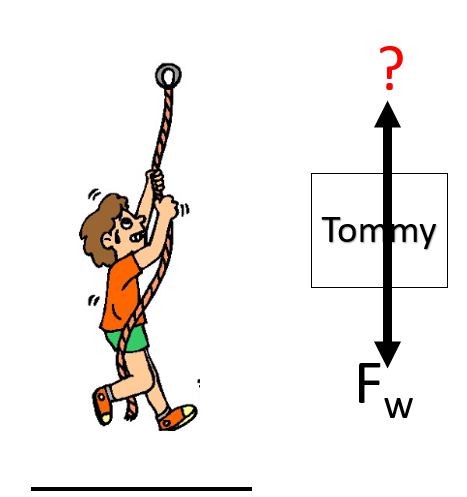
Name the missing force...
a)
tension force
b)
gravitational force
c)
normal force
d)
applied force
31.

What is the direction of the force of gravity acting on the box?
a)
down the ramp to the right
b)
straight up
c)
straight down
d)
up the ramp to the left
32.

A box is sliding across a floor while experiencing a frictional force between the box and floor. The box is sliding from left to right. What direction is the force of friction pointing?
a)
up
b)
down
c)
right
d)
left
33.

The force that acts on an object to stop its motion.
a)
Speed
b)
Friction
34.

Which of the following is a force?
a)
Inertia
b)
Friction
c)
Velocity
d)
Acceleration
35.

A ball is rolled across four different surfaces with the same force. Which surface will slow the movement of the ball most?
a)
tile floor
b)
paved road
c)
grassy field
d)
cement sidewalk
36.

A push or a pull that can move an object is a __________.
a)
gear
b)
lever
c)
force
d)
machine
37.

Is the force of gravity on the diver a push or a pull?
a)
push
b)
pull
38.
Is the force of gravity on the diver a push or a pull?
a)
push
b)
pull
39.

A person would weigh less on on the Moon than on the Earth because . . .
a)
Moon has more mass, and therefore more gravity
b)
Moon has less mass, and therefore more gravity
c)
Moon has more mass, and therefore less gravity
d)
Moon has less mass and therefore less gravity
40.

Which of the following will not change in different gravitational fields?
a)
wieght
b)
force
c)
mass
d)
pounds
41.

Which of the following will change with different gravitational forces?
a)
mass
b)
amount of matter in an object
c)
weight
d)
kilograms
42.

________ is a force that opposes the motion between two objects in contact
a)
friction
b)
gravity
c)
inertia
d)
weight
43.

In the free-body diagram shown above, which of the following is the gravitational force acting on the balloon?
a)
5120 N
b)
950 N
c)
1520 N
d)
4050 N
44.

What
is the net force acting on the block?
a)
4
lbs to the right
b)
6
lbs to the right
c)
14
lbs to the right
d)
40
lbs to the right
45.

On which surface would friction be the greatest?
a)
carpet
b)
ice
c)
snow
d)
satin
46.

What force holds the planets in motion around the sun?
a)
Magnetic
b)
Electrical
c)
Gravitational
d)
Air Resistance
47.

With unbalanced forces, the object will move in the direction of the _______ force.
a)
larger
b)
smaller
c)
equal
48.

Calculate the average speed (in meter/sec) if a cheetah runs 180 meters in 10 seconds.
a)
198 m/sec
b)
170 m/sec
c)
12 m/sec
d)
18 m/sec
49.

What does this graph represent?
a)
Constant speed
b)
Acceleration
c)
Not moving
50.

What key word tells me I'm measuring speed?
a)
how fast
b)
how far
c)
how long
51.

What key word tells me I'm measuring time?
a)
how fast
b)
how far
c)
how long
52.

What key word tells me I'm measuring distance?
a)
how fast
b)
how far
c)
how long
53.

TOO EASY!
What can be measured in meters per second (m/s)?
What can be measured in meters per second (m/s)?
a)
Distance
b)
Time
c)
Speed
d)
Acceleration
54.

What is this graph showing?
a)
Constant Speed
b)
Acceleration (speeding up)
c)
Deceleration (slowing down)
d)
No motion
55.

What is this graph showing?
a)
Constant Speed
b)
Acceleration (speeding up)
c)
Deceleration (slowing down)
d)
No motion
56.

What is happening in this graph from point B to C?
a)
The object is going down a hill.
b)
The object is returning to its starting location.
c)
The object is slowing down.
d)
The object is staying still.
57.

If you run around the football field (which is 2 miles) 3 times, what is your distance?
a)
0 miles
b)
3 miles
c)
6 miles
d)
9 miles
58.

How long did it take this object to travel back to its reference/starting point?
a)
20 s
b)
30 s
c)
60 s
d)
100 s
59.

At 60 seconds, how far had this object traveled?
a)
0 m
b)
10 m
c)
20 m
d)
40 m
60.

What two measurements are necessary for calculating speed?
a)
Mass and time
b)
Temperature and mass
c)
Mass and distance
d)
Distance and time
61.

Tom is a 13-year-old 7th grade-beginning scientist at North Pocono Middle School. Every morning, Tom walks along a straight road from his home to the bus stop. Below, is a graph representing Tom’s trip to school.
- What is the average speed of Tom’s journey throughout the first segment, which is between 0 seconds, and 50 seconds?
- What is the average speed of Tom’s journey throughout the first segment, which is between 0 seconds, and 50 seconds?
a)
3 m/s
b)
5 m/s
c)
2 m/s
d)
2 miles per second
100 %

