
 Worksheets
Transcription, Translation, & Control of Gene Expression
Total questions: 45
Worksheet time: 32mins
Name
Class
Date
1.
Which process is used to make mRNA from the DNA in the nucleus?
a)
transcription
b)
translation
c)
replication
2.
Which RNA bases would pair with TACGAA in transcription?
a)
AUGCUU
b)
ATGCTT
c)
GCATCC
d)
GCAUCC
3.
In DNA replication, which enzyme is responsible for adding an RNA primer, telling DNA polymerase where to go?
a)
helicase
b)
primase
c)
ligase
d)
polymerase
4.
In DNA replication, which enzyme is responsible for building the new DNA strand?
a)
helicase
b)
polymerase
c)
ligase
d)
primase
5.
Where does transcription take place?
a)
nucleus
b)
cytoplasm
c)
ribosome
6.
How many amino acids are coded for by this sequence of nucleotides:
ATG GGA ACT CCA
ATG GGA ACT CCA
a)
4
b)
2
c)
6
d)
12
7.
One difference between DNA and RNA is that....
a)
Only RNA has the base Uracil
b)
only RNA contains the base Thymine
c)
only RNA contains the base Cytocine
d)
only RNA contained the base Guanine
8.

The process represented in the diagram produces a molecule that is complementary to the template strand of DNA. What type of molecule is produced?
a)
New DNA
b)
Polypeptide
c)
Messenger RNA
d)
Carbohydrate
9.
what does mRNA do?
a)
carry info from genes to ribosomes
b)
carry amino acids to ribosomes
c)
help with RNA splicing
d)
make up ribosomes
10.
A triplet of mRNA is called a
a)
codon
b)
anticodon
c)
amino acid
d)
peptide bond
11.

DNA codes for...
a)
cholesterol
b)
proteins
c)
fatty acids
d)
a sandwich
12.
What do we need proteins for
a)
To make lipids
b)
to make carbohydrates
c)
Energy
d)
Almost everthing
13.
What is the monomer (building block) of proteins?
a)
Monosacchrides
b)
Polysaccharides
c)
amino acids
d)
Triglycerides
14.
The anti-codon
a)
contains a sequence the same as the codon
b)
contains a sequence complementary to the codon
c)
contains the base thymine
15.
tRNA is involved in
a)
carrying amino acids
b)
carrying ribosomes
c)
carrying glucose
d)
carrying lipids
16.

which process is shown?
a)
diffusion
b)
repiration
c)
recombination
d)
translation
17.

What is occurring in this picture?
a)
Translation
b)
DNA Replication
c)
Polymerase is unzipping the DNA
d)
Transcription
18.
When translating mRNA to amino acids, you work in triplet codons, which are sets of...
a)
1
b)
2
c)
3
d)
4
19.
When translating mRNA to amino acids, you start at the start codon which is...
a)
GGA
b)
AUG
c)
CUA
d)
ACC
20.
Which amino acid pairs with the codon GUA
a)
Val
b)
Ile
c)
Asp
d)
Gly
21.
Which amino acid pairs with the codon CUG
a)
Met
b)
STOP
c)
Leu
d)
Cys
22.
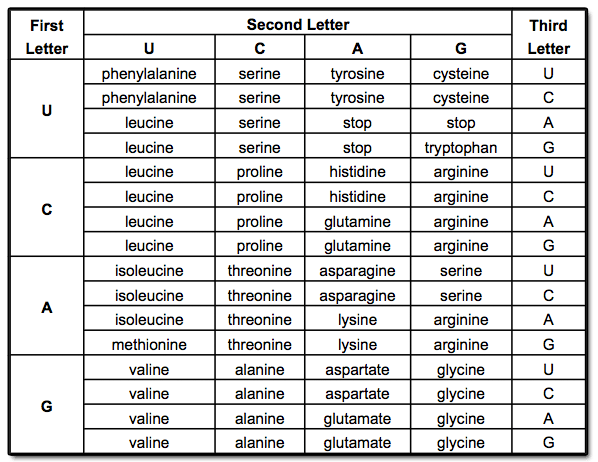
What is the correct amino acid sequence for the mRNA code AUGCCAGUAUGA
a)
Met-Pro-Ala-Val
b)
Met-Pro-Val
c)
Tyr-Gly-His
d)
Tyr-Gly-Arg-His
23.
What mutation has occurred here?
T-G-A-C-C-A
T-G-A-G-C-A
T-G-A-C-C-A
T-G-A-G-C-A
a)
Substitution
b)
Deletion
c)
Insertion
d)
Frameshift
24.
When bases are added or deleted, the mRNA will be read out of sync, to the right or left of normal. this is___.
a)
Deletion
b)
Insertion
c)
Frameshift
d)
Crossover
25.

Having multiple codons code for the same amino acids is important because:
a)
It reduces the chance of mutations having a negative effect
b)
It completely stops mutations from happening
c)
This is not important, it is just random chance.
d)
None of these
26.

What is the function of the ribosome?
a)
Carries genetic message from DNA to cytoplasm
b)
Transfers amino acids from cytoplasm to ribosome
c)
Stores genetic information in the nucleus
d)
Reads mRNA and links amino acids to form protein
27.
Which of the following occurs first in translation?
a)
The small ribosomal subunit binds to mRNA
b)
The large ribosomal subunit binds to mRNA
c)
tRNA binds to the mRNA
d)
A peptide bond forms between amino acids
28.
What type of bonds are forming during translation?
a)
Peptide bonds
b)
Hydrogen bonds
c)
Acid bonds
29.

What is a Gene?
a)
A segment of RNA that encodes for a protein
b)
A chromosome
c)
A segment of DNA that encodes for a protein
d)
Your genome
30.
The "on/off" switch for an operon is called the
a)
promoter
b)
repressor
c)
operator
d)
gene
31.
what does a promoter do?
a)
it allows a gene to be transcribed
b)
it creates a DNA segment
c)
it is another word for ribosomes
d)
it is another word for RNA
32.
what is an operon?
a)
a part of a ribsome
b)
a part of a Rna
c)
a unit made up of linked genes that code for proteins needed to do a specific task
d)
needed for dna replication
33.
A protein that binds to the operator and blocks the RNA polymerase
a)
regulator
b)
repressor
c)
activator
d)
corepressor
34.
A small molecule that binds to the repressor and makes it inactive is
a)
corepressor
b)
inducer
c)
promoter
d)
operator
35.
A protein that binds to the operator and blocks the RNA polymerase
a)
regulator
b)
repressor
c)
activator
d)
corepressor
36.
In eukaryotes, a cluster of proteins that assemble on the promoter is called the
a)
transcription initiation complex
b)
control element
c)
activator
d)
protein blobby thing
37.
differentiation and morphogenesis are controlled by external factors, such as contact and signals from neighboring cells... this is called
a)
cytoplasmic determinants
b)
inductive signals
c)
endosymbiotic theory
d)
epigenetic inheritance
38.
In embryonic development, the physical process of an organism developing its shape is called
a)
differentiation
b)
morphogenesis
c)
cell division
d)
topoisomerase
39.
In embryonic development, the process by which cells specialize is called
a)
differentiation
b)
morphogenesis
c)
cell division
d)
endoplasmic reticulum
40.
How can a person's muscle cells have the same exact DNA sequences as their nerve cells even though the look and perform completely different?
a)
The two different cells become mutated
b)
The proteins expressed in each cell are different
c)
They actually have different DNA in the two types of cells.
d)
The genome of the different cells changes
41.
What enzyme is responsible for adding nucleotides to the growing RNA strand?
a)
DNA Polymerase
b)
RNA Primase
c)
RNA Polymerase
d)
Topoisomerase
42.
In the lac operon model the genes within the operon will be expressed if:
a)
lactose is absent in the cell
b)
glucose is present in the cell
c)
lactose is present in the cell
43.
T3 - A section of the DNA molecule that regulates morphogenesis by controlling gene expression
a)
Morphogenesis
b)
Homeotic genes
c)
Cellular differentiation
d)
Gene expression
44.
T5 - What role does the tumor suppressor gene play in the cell cycle/cancer prevention?
a)
it allows cell division to occur indefinitely if there is an error in the cell cycle.
b)
it stops the division of the cell until errors can be corrected.
c)
it plays no role in cancer prevention.
d)
it prevents tumors by allowing the cell to continue with cell division.
45.
T5 - A gene that codes for the development of proteins affecting cell division
a)
Benign
b)
Malignant
c)
Proto-oncogenes
d)
Cancer
100 %

