
 Worksheets
Ecosystems
Total questions: 51
Worksheet time: 2hrs 25mins
Name
Class
Date
1.
An individual living thing is known as a(n)
a)
Species
b)
Population
c)
Community
d)
Organism
2.
All the member of the same species that live in the same place at the same time.
a)
Ecosystem
b)
Habitat
c)
Population
d)
Community
3.
A group of species that live in the same place and interact with each other is called a
a)
Population
b)
Community
c)
Habitat
d)
Species
4.
The place an organism lives is called its
a)
Habitat
b)
Population
c)
Ecosystem
d)
Community
5.
The series of steps in which a large fish eats a small fish that has eaten algae is a
a)
food web
b)
food chain
c)
biomass pyramid
d)
pyramid of numbers
6.

Based on the food web, which shows correctly the one way that energy flows?
a)
Plant -->Rat -->Owl
b)
Plant <--Rat <-- Owl
7.

What does a food web represent?
a)
All connections of energy flow throughout all organisms in a habitat.
b)
The specific ways that mutualism is carried out.
c)
A single pathway or energy flow between organisms.
d)
How carnivores get their food.
8.
A snake is eaten by a hawk. The hawk is the _______.
a)
prey
b)
parasite
c)
predator
d)
all of these
9.
What is the definition of Abiotic factors?
a)
Alive organisms or things
b)
Nonliving things or organisms
c)
panda
d)
insect
10.
What is an example of a biotic factor?
a)
skunk
b)
rocks
c)
soil
d)
water
11.
What is the definition of Biotic factors?
a)
Nonliving things
b)
plants
c)
Living things or organisms
d)
soil
12.

How many carnivores are shown in this food web?
a)
6
b)
4
c)
5
d)
3
13.
Which two biotic factors would compete for other biotic factors in a tundra?
a)
deer and lizards
b)
penguins and fish
c)
palm trees and spiders
d)
grass and rattlesnakes
14.
Which is an example of an ABIOTIC factor?
a)
hummingbird
b)
water
c)
dead tree branch
d)
skunk
15.
Which is an example of a BIOTIC factor?
a)
lightning
b)
algae
c)
sand
d)
clouds
16.
Which are located at the very BOTTOM of an energy pyramid?
a)
producers
b)
consumers - Level 1
c)
consumers - Level 2
d)
decomposers
17.
A relationship where both organisms benefit is called __________.
a)
mutualism
b)
commensalism
c)
parasitism
18.
A relationship where one organism benefits and one organism is harmed is called __________.
a)
mutualism
b)
commensalism
c)
parasitism
19.
A relationship where one organism benefits and one organism is unaffected is called __________.
a)
mutualism
b)
commensalism
c)
parasitism
20.
When writing an example of a food chain, you start by writing the smallest organism (with the most energy) ...
a)
all the way to the right
b)
all the way to the left
c)
in the middle
d)
the order doesn't matter
21.
Organisms that hunt other organisms for food are called __________.
a)
predators
b)
prey
c)
producers
d)
heterotrophs
22.
A bird in a tree watched as a lion stalked, attacked, and then ate a zebra. Which of these animals was the prey?
a)
bird
b)
lion
c)
zebra
d)
all of the above
23.
Carnivores, herbivores, omnivores, and scavengers are all examples of __________.
a)
producers
b)
consumers
c)
decomposers
d)
abiotic factors
24.
A __________ includes all living and non-living things in an environment.
a)
population
b)
niche
c)
abitotic
d)
ecosystem
25.
If the population of prey increases, the population of predators will ________because of the availability of food.
a)
decrease
b)
stay the same
c)
increase
26.
What would most likely happen if an ecosystem no longer received sunlight?
a)
The number of herbivores would increase
b)
The number of plants would increase
c)
all organisms would adapt
d)
All living organisms would eventually die
27.
All food chains_____________________
a)
have more consumers than producers
b)
produce and use same amount of energy
c)
begin with a producer
d)
are unhealthy
28.
How does energy enter an ecosystem?
a)
sunlight
b)
soil
c)
animals
d)
invasive species
29.
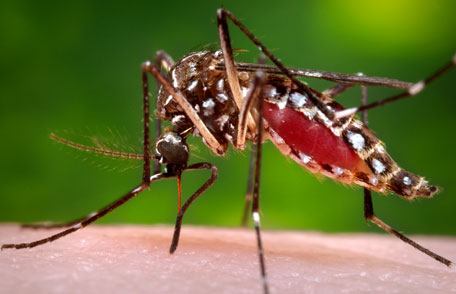
When a mosquito bites you, you are the __________ and the mosquito is the ____________.
a)
host, hostess
b)
parasite, host
c)
host, parasite
d)
prey, predator
30.
How do adaptations help animals?
a)
To escape animals
b)
to hunt for food
c)
to survive in their habitats
d)
All of these are correct
31.

Which of the following is a herbivore?
a)
cricket
b)
frog
c)
hawk
d)
shrew
32.

Which organism do the owl and the weasel compete for in the food web?
a)
Hawk
b)
Spider
c)
Grasshopper
d)
Shrew
33.

The rabbit in this food web would be considered a:
a)
Decomposer
b)
Producer
c)
Secondary Consumer
d)
Primary Consumer
34.

In the food web shown, the snail would be considered...
a)
primary consumer
b)
secondary consumer
c)
tertiary consumer
d)
producer
35.

How many primary consumers are there in this food web?
a)
1
b)
2
c)
3
d)
4
36.

How many herbivores are in this web?
a)
1
b)
2
c)
3
d)
4
37.
How are parasitism and predation similar?
a)
Both organisms are harmed.
b)
Both organism benefit.
c)
One organism benefits and the other is harmed.
d)
One organism benefits and the other is not harmed.
38.
Which type of organism is found at the top of an energy pyramid representing an ecosystem?
a)
Consumer
b)
decomposer
c)
prey
d)
predator
39.
Clown fish live among anemones acting as a lure for the sea anemone’s prey. The clown fish gets protection and shelter from the anemone. What type of relationship is this?
a)
parasitism
b)
commensalism
c)
mutualism
d)
predatation
40.
All the biotic and abiotic things living together with their physical environment.
a)
Ecosystem
b)
Population
c)
Community
d)
Habitat
41.

According to the energyy pyramid shown, which organism would eat the catepillar
a)
producer
b)
primary consumer
c)
secondary consumer
d)
tertiary consumer
42.
A bee taking the nectar from a flower and in return also pollinating it.
a)
mutualism
b)
parasitism
c)
hybernating
d)
commensalism
43.
When two or more organisms compete for the same resources, it is called what?
a)
symbiosis
b)
predation
c)
competition
d)
niche
44.
A tick digging it's head into the skin of a dog.
a)
Mutualism
b)
Parasitism
c)
Commensalism
d)
Torture
45.
The role of an organism in its habitat is called?
a)
symbiosis
b)
predation
c)
competition
d)
niche
46.

Remoras are small fish that swim close to or attach themselves to sharks. Remoras eat small scraps left as the sharks feed and the sharks are unaffected. What kind of relationship is this?
a)
Competition
b)
Predation
c)
Mutualism
d)
Commensalism
47.
Which type of organism is found at the top of an energy pyramid representing an ecosystem?
a)
Consumer
b)
decomposer
c)
prey
d)
predator
48.
Environmental factors that keep a population from increasing.
a)
Carrying Capacity
b)
Limiting Factors
49.
Limiting factors are sometimes helpful because they can keep the population from getting too large.
a)
True
b)
False
50.
A snake is eaten by a hawk. The hawk is the _______.
a)
prey
b)
parasite
c)
predator
d)
all of these
51.
A species that is not native to an area is called:
a)
Native Species
b)
Natural Species
c)
Invasive Species
d)
Symbiotic Species
100 %

