wayground logo

Free Printable Worksheets

Font size

S
M
L
XL
Worksheets

Ecology Review 2022 Pt. 1

Total questions: 55

Worksheet time: 3hrs 45mins

Name
Class
Date
1.

Which contribute to a positive population growth?

a)

immigration

b)

positive birth rate

c)

emigration

d)

positive death rate

2.

What type of factor has an increasing impact as the population size increases?

a)

density-independent

b)

density-dependent

c)

cohort effect

d)

survivorship factor

3.

Which of the following are density dependent factors?

a)

competition for resources

b)

predation

c)

disease

d)

natural disasters

4.

Which of the following are examples of a density independent factors?

a)

forest fire

b)

seasonal cycles

c)

storms

d)

disease

5.

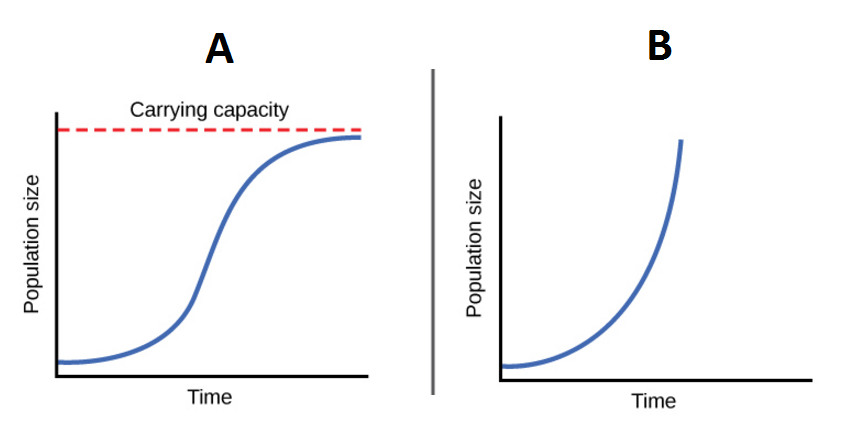
What type of growth model is shown in image A?

a)

Exponential

b)

Logistic

6.

What type of growth model is shown in image B?

a)

Exponential

b)

Logistic

7.

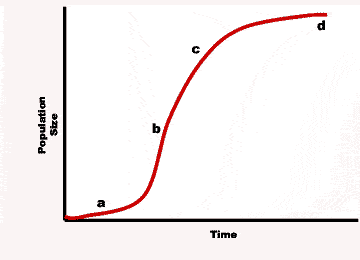
What point on the graph represents carrying capacity?

a)

a

b)

b

c)

c

d)

d

8.

At carrying capacity, a population __________.

a)

increases rapidly

b)

increases slowly

c)

decreases slowly

d)

is in dynamic equilibrium

9.

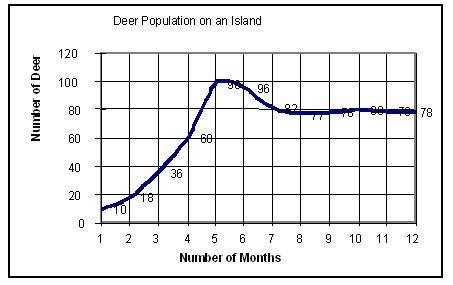
Which choice most closely approximates the deer population's carrying capacity based on the graph?

a)

100

b)

80

c)

60

d)

10

10.

Which population growth model most closely describes the human population in the modern age?

a)

logistic growth

b)

exponential growth

c)

upward growth

d)

tumor growth

11.
If the number of births in a population is the same as the number of deaths in a population, what will happen to the growth of the population?
a)
It will increase.
b)
It will decrease.
c)
It will stay the same.
d)
It will fluctuate.
12.
Largest number of individuals of a population that the environment can support...  
a)
carrying capacity
b)
population crash
c)
lag phase
d)
mutualism
13.
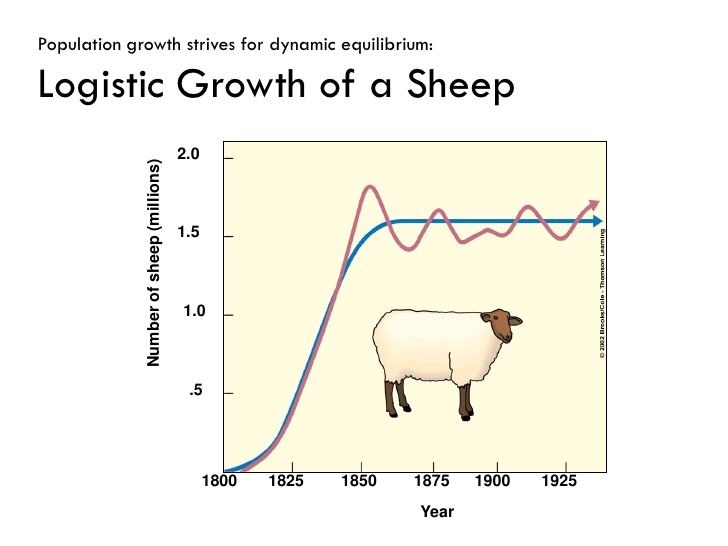
What is the carrying capacity for this sheep population?
a)
1.8 million
b)
1.25 million
c)
1.6 million
d)
1.o million
14.
When a population grows past the ecosystem's carrying capacity, what happens to the population?
a)
Continues to grow
b)
The population starts to die off to return to carrying capcity
c)
The population will go extinct due to lack of resources
d)
The population grows then finds a new carrying capacity
15.
Food, water, sunlight, shelter, and space are resources that are often __________.
a)
limiting factors
b)
wet
c)
messy
d)
found in rocks
16.
In a forest ecosystem, which of the following is the best example of a limiting factor for a rabbit population?
a)
Squirrel Population
b)
Sunlight
c)
Grass available
17.
When organisms move out of the population, this is known as
a)
emigration
b)
abandonment
c)
immigration
d)
succession
18.

This graph shows ....

a)

When one population increases, the other decreases.

b)

When one population decreases, the other increases.

c)

When one population increases, the other increases instantly.

d)

When one population increases, it causes the other to increases shortly after.

19.
Bald eagles can spot fish swimming in a lake from high altitudes, swoop down, and grab fish to feed their young back in the nest.
a)
Mutualism
b)
Commensalism
c)
Parasitism
d)
Predation
20.
Bacteria live in the intestines of cows and other organisms. Bacteria help to digest food for the cow. The cow provides a warm, moist environment to live.
a)
Mutualism
b)
Commensalism
c)
Parasitism
d)
Predation
21.
Athlete’s foot is a fungus growing between and around human toes. The fungus gets nutrients from the human skin. Athlete’s foot causes dry, scaly skin, itching, inflammation and even blisters.
a)
Mutualism
b)
Commensalism
c)
Parasitism
d)
Predation
22.
A relationship between two organisms in which both organisms benefit. 
a)
Mutualism 
b)
Predation
c)
Parasitism 
d)
Commensalism 
23.
Animals that eat only producers are called:
a)
Producers
b)
Primary Consumers
c)
Secondary Consumers
d)
Tertiary Consumers
24.
Found at the base of a food chain (also known as autotrophs)
a)
Producers
b)
Primary Consumer
c)
Secondary Consumer
d)
Tertiary Consumer 
25.
Organisms that break down dead or decaying organisms.
a)
Decomposers
b)
Producers
c)
Consumers
26.
A ______________ can be a primary, secondary, or tertiary consumer
a)
Heterotrophs 
b)
Autotrophs 
27.
How many secondary consumers are shown in this food web?
a)
1
b)
4
c)
2
d)
3
28.
All of the living and nonliving things that interact with each other in an area are called a/an ______.
a)
community
b)
biome
c)
population
d)
ecosystem
29.
Different populations living and interacting with each other in the same area
a)
Biome
b)
Ecosystem
c)
Community
d)
Niche
30.
The arrows in a food chain or web represent what?
a)
They point to the organism that is being eaten.
b)
It shows how sunlight flows within an ecosystem.
c)
They show what direction the energy is flowing between organisms. 
d)
They represent how water is transferred within a habitat.
31.

Producer

a)

An animal or plant (particularly insect- and invertebrate-eating plants) that requires a staple diet consisting mainly or exclusively of animal tissue through predation or scavenging.

b)

An autotrophic organism capable of producing complex organic compounds from simple inorganic molecules through the process of photosynthesis (using light energy) or by using chemical energy.

c)

is a kind of animal that eats either other animals or plants.

d)

A system that includes all living organisms (biotic factors) in an area as well as its physical environment (abiotic factors) functioning together as a unit.

32.
Barn owls hunt shrews. In this example what is a barn owl?
a)
Herbivore/Predator
b)
Carnivore/Prey
c)
Carnivore/Predator
33.
In the tropical regions of Africa, the crocodile lies with its mouth open. The plover flies into its mouth and feeds on bits of decaying meat stuck in the crocodile’s teeth. The crocodile does not eat the plover. Instead, he appreciates the dental work. The plover eats a meal and the crocodile gets his teeth cleaned. This is an example of 
a)
mutualism
b)
commensalism
c)
Parasitism:
34.
The deer tick attaches to a warm blooded animal and feeds on its blood. Ticks need blood at every stage of their life cycle. They also carry Lyme disease, an illness that can cause joint damage, heart complications, and kidney problems. The tick benefits from eating the animal's blood. Unfortunately, the animal suffers from the loss of blood and nutrients and may get sick.This is an example of 
a)
mutualism
b)
commensalism
c)
Parasitism:
35.
When an organism's energy source comes from both animals and plants, that organism is considered to be a what?
a)
predator
b)
omnivore
c)
herbivore
d)
carnivore
36.
What is the function of photosynthesis?
a)
to make light
b)
to make carbon dioxide
c)
to make food for the plant
37.
Two male rams fighting for territory is an example of which relationship?
a)
Symbiosis
b)
Parasitism
c)
Competition
38.

A model used to show many food chains together in a web.

a)

diagram

b)

food web

c)

food chain

39.
In an ecological pyramid, which type of organism always has the least amount of energy available?
a)
Producers
b)
Herbivores
c)
Carnivores
d)
Top Predator
40.
How much of the energy in each level of a ecological pyramid gets lost as heat or used by the organism so that it cannot be passed on to the next trophic level?
a)
80%
b)
90%
c)
10%
d)
20%
41.
If there are 100 Kcal of energy available in the producers, how much energy would be available in the herbivores?
a)
10 Kcal
b)
1 Kcal
c)
100 Kcal
d)
1000 Kcal
42.
The diagram represents a pyramid of energy in an ecosystem.  Which level would most likely contain organisms that do photosynthesis?
a)
A
b)
B
c)
C
d)
D
43.
If only 10% of an organism's energy is available for the next trophic level, what happens with the other 90% of the energy?
a)
It is destroyed after it is used up.
b)
It is used for life processes or lost as body heat.
c)
It remains for the next trophic level IF the predator consumes ALL of the organism.
d)
It is lost completely as body heat. 
44.

What type of organisms could box J contain?

a)

herbivores

b)

decomposers

c)

carnivores

d)

producers

45.

What type of organisms could box K contain?

a)

herbivores

b)

decomposers

c)

carnivores

d)

producers

46.

What would happen to the bird if the green fish died out?

a)

the bird population would grow

b)

the bird population would die out

c)

the smaller fish will die out

47.

What would happen if their were no producers?

a)

Every population would grow larger

b)

Everything would die out

c)

The animals would make their own food

48.
A food pyramid represent the relative amount of energy in trophic levels. Which of the following correctly shows a food pyramid?
a)
A
b)
B
c)
C
d)
D
49.
If these organisms were arranged in a food pyramid, which organism would have the least amount of total energy available?
a)
coyote
b)
insect
c)
lizard
d)
shrub
50.

A living relationship between two species in which one organism is harmed is called...

a)

mutualism

b)

commensalism

c)

parasitism

d)

niche

51.

Name the correct trophic level for level 4.

a)

Tertiary

b)

Consumer

c)

Producer

d)

Quatemary

52.

Name the trophic level in Level 2.

a)

Primary

b)

Tertiary

c)

Consumer

d)

Secondary

53.
If there is 1000 Kcal available in the producers in trophic level 1, how much energy is available in the herbivores in trophic level 2?
a)
10 Kcal
b)
1 Kcal
c)
100 Kcal
d)
1000 Kcal
54.

If a primary consumers have 650 kcals of energy available to them in the producers they eat, how many kcals of energy make it into the primary consumer trophic level?

a)

6.5

b)

65000

c)

650

d)

65

55.

An owl eats a rat that lived in an ecosystem where there was 2,800 kcals of energy in the insect population that the rat consumed. How many kcals would transfer to the trophic level the owl is in?

a)

28

b)

280

c)

2,800

d)

28,000