
NEW
Font size
S
M
L
XL
 Worksheets
Biology, Chapter 8, DNA to Proteins, Review
Total questions: 40
Worksheet time: 26mins
Name
Class
Date
1.
Guanine bonds with ______________.
a)
Adenine
b)
Guanine
c)
Cytosine
d)
Thymine
2.
What are the 4 nitrogen bases?
a)
adenine, thymine, cytoplasm, and guanine
b)
adenine, thymine cytosine, and guanine
c)
adenine, thymine, cytosine, and gylcerol
d)
adenine, thymine, cytosine, and glucose
3.
Which sequence of DNA bases would pair with this partial strand
ATG TGA CAG
ATG TGA CAG
a)
ATG TGA CAG
b)
TAC ACT GTC
c)
GTA AGT GAC
d)
CAT TCA CTG
4.
What sugar is found in DNA
a)
Sucrose
b)
deoxyribose
c)
Phosphate
5.
Which of the following units are repeatedly joined together to form a strand of DNA?
a)
amino acids
b)
nucleotides
c)
fatty acids
d)
polysaccharides
6.
What are the three components of a nucleotide?
a)
sugar, hydrogen, nitrogen base
b)
sugar, oxygen, nitrogen base
c)
sugar, phosphate, nitrogen base
d)
sugar, phosphate, protein
7.
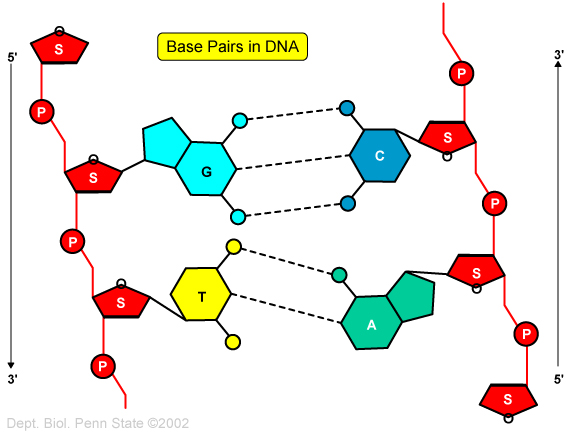
Nitrogenous bases are joined by which type of bond?
a)
polar bonds
b)
ionic bonds
c)
covalent bonds
d)
hydrogen bonds
8.

Nucleotides are made up of a sugar, phosphate, and..?
a)
nitrogenous base
b)
nucleic acid
c)
cholesterol
d)
fatty acid
9.
Which two bases are pyrimidines
a)
thymine and cytosine
b)
cytosine and guanine
c)
thymine and adenine
d)
guanine and thymine
10.
which two bases are purines
a)
adenine and guanine
b)
thymine and cytosine
c)
adenine and thymine
d)
guanine and cytosine
11.
What does DNA stand for
a)
deoxyribose nucleic acid
b)
ribose nucleic acid
c)
delicate nucleic acid
d)
double nucleotide acid
12.
Which shows the correct complementary base pairing for DNA?
a)
C-A, T-G
b)
A-G, C-T
c)
C-G, U-A
d)
T-A, G-C
13.
Watson and Crick were the first to suggest that DNA is _____
a)
a short molecule
b)
the shape of a double helix
c)
a protein molecule
d)
the genetic material
14.
A five-carbon sugar found in DNA.
a)
ribose
b)
guanine
c)
deoxyribose
d)
helicase
15.
A self-replicating material present in nearly all living organisms. It is a carrier of genetic information
a)
DNA
b)
RNA
c)
DNA Polymerase
d)
RNA Polymerase
16.
Which shows the correct complementary base pairing for DNA?
a)
C-A, T-G
b)
A-G, C-T
c)
C-G, U-A
d)
T-A, G-C
17.
Watson and Crick were the first to suggest that DNA is _____
a)
a short molecule
b)
the shape of a double helix
c)
a protein molecule
d)
the genetic material
18.
A five-carbon sugar found in DNA.
a)
ribose
b)
guanine
c)
deoxyribose
d)
helicase
19.
A self-replicating material present in nearly all living organisms. It is a carrier of genetic information
a)
DNA
b)
RNA
c)
DNA Polymerase
d)
RNA Polymerase
20.
Enzyme that is responsible for forming new copies of DNA.
a)
DNA
b)
RNA
c)
DNA Polymerase
d)
RNA Polymerase
21.
Process where one DNA molecule copies itself
a)
Transcription
b)
Translation
c)
Replication
d)
Mutation
22.
Received the noble prize for their discovery of DNA.
a)
Watson
b)
Crick
c)
Wilkins
d)
All of them
23.
What holds base pairs together?
a)
hydrogen bonds
b)
sugar-phosphate backbones
c)
pairs of double-ringed nucleotides
d)
nitrogen-carbon bonds
24.
Which of the following DNA sequences is complementary to the base sequence ACCGTAT?
a)
GTTACGC
b)
UCCGTAT
c)
TGGCATA
d)
CAATGCG
25.
A primary difference between transcription and replication is that transcription
a)
happens repeatedly throughout a single cell cycle.
b)
occurs within the nucleus of eukaryotic cells.
c)
is catalyzed by large and complex enzymes.
d)
proceeds according to careful cellular control.
26.
The main function of tRNA is to
a)
carry a message that, when translated, forms proteins.
b)
form a portion of ribosomes, a cell's protein factories.
c)
string together complementary RNA and DNA strands.
d)
bring amino acids from the cytoplasm to the ribosomes.
27.
Which of the following is an example of a mutagen?
a)
repair enzyme
b)
triglyceride
c)
UV sunlight
d)
thymine
28.
Cystic fibrosis is an example of a genetic disease caused by the deletion of a nucleotide. What is the term for this type of mutation?
a)
translocation
b)
chromosomal
c)
single gene
d)
frameshift
29.
The central dogma states that information flows from
a)
RNA to DNA to polysaccharides.
b)
DNA to RNA to proteins.
c)
RNA to DNA to proteins.
d)
DNA to polysaccharides to RNA.
30.
During transcription, what does messenger RNA do?
a)
It delivers DNA's instructions for making proteins.
b)
It constructs proteins out of random amino acids.
c)
It strings together two complementary DNA strands.
d)
It strings together two complementary RNA strands.
31.
The main difference between the four nucleotides that make up DNA is that they have different
a)
sugars.
b)
uracil.
c)
bonds.
d)
bases.
32.
What structure in a cell is the site for making proteins?
a)
ribosomes
b)
mitochondria
c)
lysosome
d)
Golgi body
33.
Which base is normally used in the synthesis of RNA but not in DNA?
a)
adenine
b)
uracil
c)
cytosine
d)
guanine
34.
As part of its structure, a known gene contains the base sequence AATCGA. An alteration of the sequence to AACCGA is known as
a)
deletion
b)
disjunction
c)
mutation
d)
segregation
35.
Where is DNA found in eukaryotic cells?
a)
Cytoplasm
b)
Vacuole
c)
Cell Membrane
d)
Nucleus
36.
This is the process of using a DNA template to make a strand of mRNA
a)
Translation
b)
Transcription
c)
Replication
d)
Mitosis
37.

Replicate the following strand of DNA:
AATCATGGA
AATCATGGA
a)
AATCATGGA
b)
TTAGTACCT
c)
UUAGUACCU
d)
GGATAUCUA
38.
What is the main function of ribosomes?
a)
Unwind DNA
b)
Create proteins
c)
Send messages in the nucleus
d)
Read RNA strands
39.
This cannot leave the nucleus
a)
DNA
b)
RNA
c)
Both
40.
One difference between DNA and RNA is that....
a)
Only RNA has the base URACIL
b)
only RNA contains the base THYMINE
c)
only RNA contains the base CYTOSINE
d)
only RNA contained the base GUANINE
Reset

