wayground logo

Free Printable Worksheets

NEW

Font size

S
M
L
XL
Worksheets

Electricity & Electromagnets

Total questions: 39

Worksheet time: 1hrs 17mins

Name
Class
Date
1.

A volt is a unit of

a)

Electric energy

b)

potential difference

c)

work

d)

power

2.
What does the switch do in a circuit?
a)
It supplies the power.
b)
It carries electricity.
c)
It opens and closes the circuit.
d)
It is an insulator.
3.
measure of resistance
a)
watt
b)
ohm
c)
volt
d)
amp
4.
measure of electric current
a)
watt
b)
ohm
c)
volt
d)
amp
5.
An example of a parallel circuit is
a)
the wiring in a house
b)
a flashlight
c)
a single circular path
d)
a string of old Christmas lights
6.
In Figure 21-2 above, which circuit is wired in series?
a)
circuit A
b)
circuit B
c)
both circuit A and B
d)
neither A nor B
7.
Calculate the electric power of an electrical appliance of 20 V having a resistance of 10 ohms.
 
Remember: I=V/R and P=VI
a)
200 W
b)
80 W
c)
2.5 A
d)
79.20 KJ
8.
In a cell, which form of energy is converted into electrical energy?
a)
Chemical energy
b)
Solar energy
c)
Mechanical energy
d)
Electrical energy
9.
When you remove a bulb from a three bulb circuit, and the other two bulbs go off, then the bulbs must have been connected in __________.
a)
parallel
b)
series
c)
open
d)
closed
10.
When we turn the switch to the off position the circuit is __________.
a)
closed
b)
open
c)
negative, positive
d)
overload
11.
When a short-circuit takes place, the fuse wire melts and breaks the __________.
a)
circuit
b)
electric shock
c)
Earth
d)
kilowatt-hour.
12.
A Charging system producing 14.5 Volts with a current flow of 43.5 Amps, what is the circuit resistance
a)
58 Amps
b)
0.33 Amps
c)
13 Amps
d)
1 Amp
13.
What size resistor would produce a 3 Amp current flow with a 12 Volt battery
a)
1 Ohm
b)
3 Ohms
c)
4 Ohms
d)
12 Ohms
14.
The tendency of a material to resist the flow of electricity is measured in.
a)
volts
b)
amps
c)
ohms
d)
watts
15.
A conductor is a
a)
material that does not allow electrons to flow easily.
b)
material that allows electrons to flow easily.
c)
device the detects an electric charge.
d)
device the changes voltage.
16.
What does a resistor do? 
a)
Reduces the flow of electrons
b)
Reduce the flow of the current
c)
Increase flow of electrons
d)
Decreases the flow of electrons 
17.
Which statement best describes an insulator?
a)
A material that allows electricity to flow through it
b)
A material that does not allow liquids to flow through it
c)
A material that does not allow heat to flow through it
d)
A material that cools down quickly when heated
18.
What is the purpose of a simple electric motor?
a)
To create a magnetic field
b)
To turn mechanical energy to electrical energy
c)
To convert electrical energy to kinetic energy
d)
To produce electrical energy
19.
If current decreases, what has likely happened to resistance?
a)
It increased.
b)
It decreased.
c)
It stayed the same.
20.
Which is an advantage of a parallel circuit over a series circuit?
a)
If one bulb goes out, the other stays lit.
b)
The bulbs get dimmer as you add more.
c)
If one bulb goes out, all go out.
d)
It is prettier.
21.
Bob made an electromagnet but it was very weak.  How can he make it stronger?
a)
take away a d-cell
b)
wrap the wire loosely
c)
use thicker wire
d)
use less winds
22.
Tasha tested several items to see if they could conduct electricity.  Her data is shown below. What is the best claim she could make from her data?
a)
Wood is an insulator.
b)
Metal is an insulator.
c)
Keys are insulators.
d)
Toothpicks are conductors.
23.

Which part of the electromagnet produces a magnetic field?

a)

Battery

b)

Coiled copper wire

c)

Bulb

d)

Iron nail

24.

Which part of the electromagnets turned into a magnet when electricity flows through a coiled wire?

a)

Battery

b)

Copper wire

c)

Iron Nail

d)

Bulb

25.

Law of electric charges states

a)

opposite charges attract and like charges repel

b)

opposite charges repel and like charges repel

c)

charges neither attract or repel

26.
What will happen if one light bulb is removed from this circuit?
a)
The other bulbs will go out.
b)
The other bulbs will stay on
c)
The other bulbs will get dimmer.
d)
The battery will become stronger.
27.
what is this symbol for?
a)
light bulb
b)
switch
c)
battery
d)
resistor
28.
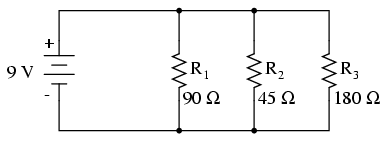
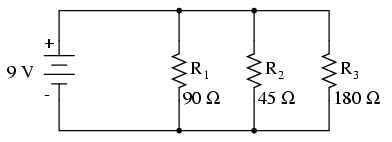
The current going through the 45 ohm resistor is 
a)
0.05 amps
b)
0.2 amps
c)
0.1 amps
d)
5 amps
29.

12. An overhead wire has a potential difference of 30,000 volts. If the current flowing through the wire is 1,000 amperes, what is the resistance of the wire?

a)

0.033 ohms

b)

30 ohms

c)

3.0 x 10^7 ohms

d)

3.0 x 10^8 ohms

30.

What is the current passing through this circuit?

a)

0.5 A

b)

0.05 A

c)

0.005 A

d)

0.0005

31.
what is this symbol for?
a)
light bulb
b)
switch
c)
battery
d)
resistor
32.
The total resistance of this circuit is 
a)
25.7 ohms
b)
315 ohms
c)
324 ohms
d)
90 ohms
33.
Electrical power can be calculated using
a)
Resistance x Voltage
b)
Voltage x Current 
c)
Voltage ÷ Current
34.

What is the unit of Electrical Power?

a)

Joule

b)

Watt

c)

Where

d)

Amp

35.
What is Resistance?
a)
The flow of electrons
b)
Electric potential difference
c)
A battery
d)
The ability to reduce the flow of electrons
36.
What is this symbol?
a)
resistor
b)
switch
c)
battery
d)
bulb
37.

A student collected the data shown above for the potential difference across a resistor and the corresponding power it dissipates. Which of the following best represents the data?

a)
b)
c)
d)
38.

A student wants to investigate how different values of resistance affect the total current in a circuit when the resistors are connected in parallel. Which of the following circuits will allow the student to do this?

a)
b)
c)
d)
39.

Students measure the potential across a lightbulb and the current through it using the circuit shown above. The results are shown in the graph. Which of the following is supported by evidence from the graph?

a)

The brightness of the lightbulb is proportional to the square of the current

b)

The brightness of the lightbulb is not proportional to the square of the potential difference

c)

The resistance of the lightbulb for each data point can be determined by dividing the potential difference by the current.

d)

The resistance of the lightbulb is not constant.