
 Worksheets
Reflection - Refraction - Diffration
Total questions: 64
Worksheet time: 44mins
Name
Class
Date
1.

The Law of Reflection states that the angle of incidence is _________ the angle of reflection
a)
bigger than
b)
the same as
c)
smaller than
2.
Which wave has the SHORTEST wavelength and, therefore, the highest frequency and most energy
a)
radio waves
b)
ultraviolet rays
c)
gamma rays
d)
x-rays
3.
A mirror with a surface that curves inward like the inside of a bowl
a)
concave mirror
b)
convex mirror
c)
plane mirror
d)
flat mirror
4.

Convex mirrors produce
a)
only virtual images
b)
virtual or real images
c)
only real images
d)
inverted images
5.
What type of waves are light waves
a)
longitudinal
b)
compression
c)
mechanical
d)
electromagnetic
6.
Which of the following statements is true?
a)
short wavelength means high frequency.
b)
short wavelength means low frequency.
c)
short wavelength means high amplitude.
d)
short wavelength means low amplitude.
7.

When a wave bounces off of a surface, it is
a)
reflecting
b)
refracting
c)
diffracting
d)
all of the above
8.

A plane (flat) mirror gives you a
a)
real image
b)
virtual image
c)
magnified image
d)
inverted image
9.

What is light?
a)
is only produced artificially
b)
is a form of energy you can see
c)
is when an object is easy to lift
10.

Primary colors of light can combine to make
a)
black light
b)
white light
c)
primary pigments
d)
ultraviolet light
11.

An object appears red because it
a)
reflects light waves of all colors
b)
reflects light waves of red
c)
absorbs light waves of red
d)
transmits light waves of "angry birds"
12.
When all 3 primary pigment colors are mixed which color is produced?
a)
black
b)
magenta
c)
white
d)
cyan
13.
What are the three primary colors of light?
a)
Red,Yellow,Blue
b)
Red,Green,Yellow
c)
Red,Green,Blue
d)
Yellow,Blue,Green
14.

What is the frequency of red light that has a wavelength of 702 x 10-9 m?
a)
4.27 x 10¹⁴
b)
2.34 X 10⁻¹⁵
c)
4.27 x 10⁻⁴
15.

Which one of the following types of electromagnetic wave travels through space the fastest?
a)
radio waves
b)
infrared waves
c)
microwaves
d)
they all travel through space at the same speed.
16.
Which of the following is NOT an electromagnetic wave?
a)
ultraviolet
b)
infrared
c)
radio waves
d)
sound waves
17.

Light travels at ___________________ km per second.
a)
30
b)
300,000
c)
3.00 x 10⁸
d)
3,000,000
18.

The following is a picture of what type of mirror?
a)
convex mirror
b)
concave mirror
c)
plane mirror
d)
one-way mirror
19.

The following is a picture of what type of mirror?
a)
convex mirror
b)
concave mirror
c)
plane mirror
d)
flat mirror
20.

Does the scarf reflect or absorb yellow?
a)
reflect
b)
absorb
21.

Does the frog reflect or absorb green?
a)
reflect
b)
absorb
22.
A curved piece of glass or other transparent material that is used to refract light is called...
a)
mirror
b)
lens
c)
reflector
d)
optical fiber
23.
What type of image does a plane mirror produce?
a)
real and inverted
b)
virtual and inverted
c)
real and upright
d)
virtual and upright
24.
Mixing yellow paint and magenta paint gives what color?
a)
red
b)
green
c)
blue
d)
cyan
25.

How does light behave as it enters these mediums?
a)
continues its path as a straight line
b)
bends toward the normal
c)
bends away from the normal
d)
reflects
26.

According to Willebord Snell, light passing from air to glass will cause the light to
a)
maintain its original speed
b)
accelerate while it is in glass
c)
increase its speed
d)
reduce its speed
27.
The velocity of light in vacuum is _______ ms(-1)
a)
3x10⁸
b)
3x10¹²
c)
3x10⁶
d)
3x10¹⁰
28.
In what medium does light travel the slowest?
a)
glass
b)
air
c)
water
d)
vacuum
29.
In what medium does light travel the fastest?
a)
vacuum
b)
air
c)
water
d)
glass
30.
What is a prism's primary function?
a)
disperse light
b)
enlarge an image
c)
shrink an image
d)
form white light
31.
When does the angle of refraction increase?
a)
when a wave's speed increases
b)
when a wave's speed decreases
c)
when a wave's speed is constant
d)
when a light wave stops
32.

What property of waves stays constant during refraction?
a)
frequency
b)
wavelength
c)
speed
d)
amplitude
33.

Is a convex lens thicker or thinner in the middle?
a)
Thicker
b)
Thinner
34.

What kind of lens is a magnifying glass?
a)
Convex Lens
b)
Concave Lens
35.
A converging lens has a focal length of 30 cm. A 5 cm tall candle is placed at a distance of 10 cm in front of the lens. Determine the image distance.
a)
- 45 cm
b)
-30 cm
c)
-15 cm
d)
6 cm
36.
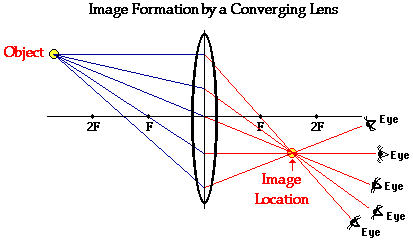
This image is.....
a)
inverted and smaller
b)
inverted and larger
c)
not inverted and smaller
d)
not inverted and larger
37.

This image is...
a)
Inverted and smaller
b)
inverted and bigger
c)
not inverted and smaller
d)
not inverted and bigger
38.
An incident ray that is parallel to the principal axis...
a)
will reflect parallel to the principal axis
b)
will refract through the focal point
c)
will reflect through the center of curvature
d)
will continue along the same path through the lens
39.

Glass has a _____________ index of refraction than air.
a)
Equal
b)
Greater
c)
Less
d)
Impossible to say
40.
Concave lenses always cause light rays to spread out and can only form ________ ____________
a)
virtual images
b)
real images
c)
concave lens
d)
concave mirror
41.
Critical angle is the angle of incidence that produces an angle of refraction at......
a)
180 degrees
b)
90 degrees
c)
20 degrees
d)
120 degrees
42.

Materials that have small critical angles are likely to cause most of the light entering them to be totally internally ____________
a)
reflected
b)
refracted
c)
faster
d)
slower
43.
The separation of white light into its component colors is known as:
a)
polarization
b)
refraction
c)
reflection
d)
dispersion
44.

Rainbows are produced when
a)
light exits many raindrops at different angles
b)
the sun causes a rainstorm
c)
the spectrum causes a rainstorm
d)
the sun comes out after a storm
45.
The combination of two or more waves that result in a single wave
a)
A. diffraction
b)
B. resonance
c)
C. reflection
d)
D. interference
46.
When the crests of one wave overlap the crests of another wave or waves, this occurs.
a)
A. diffraction
b)
B. destructive interference
c)
C. constructive interference
d)
D. resonant frequencies
47.

This image represents what kind of wave behavior?
a)
diffraction
b)
reflection
c)
refraction
d)
resonance
48.
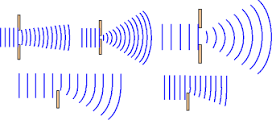
The picture represents:
a)
diffraction
b)
interference
49.

What type of polarized light is blocked with sunglasses?
a)
longitudinal waves
b)
transverse waves
50.
What type of poloraized light is blocked with sunglasses?
a)
horizontal
b)
vertical
c)
none
d)
all light
51.

Which window is opaque?
a)
window 1
b)
window 2
c)
window 3
d)
none of these windows
52.

The point where the rays meet is known as....
a)
the flash point
b)
the focal point
c)
the refraction point
d)
plane of the lens
53.

This is an example of a __________ mirror.
a)
concave
b)
convex
c)
plane
d)
magnifying
54.

Mirrors that bulge out are called:
a)
concave mirrors
b)
convex mirrors
c)
plane mirrors
55.

A converging lens is also known as a ______________ lens.
a)
concave
b)
convex
c)
concord
d)
plane
56.

A concave lens is also known as a __________________ lens.
a)
diverging
b)
converging
c)
optical
d)
plane
57.

Why is the sky blue?
a)
Light is reflected off of the ocean, causing the sky to appear blue
b)
Blue light waves have a shorter wavelength, causing them to hit more molecules in our atmosphere and scatter blue light
c)
The nitrogen and oxygen molecules in our atmosphere have a blue tint
d)
Clouds and rain droplets cause the sky to look blue
58.

The top of a spoon acts as a __________ mirror; the bottom of a spoon acts as a __________ mirror
a)
concave; convex
b)
convex; concave
c)
both sides are concave
d)
both sides are convex
59.

Primary pigments
a)
red yellow green
b)
red blue green
c)
blue green magenta
d)
yellow cyan magenta
60.

Polarized light
a)
light that has 2 planes of oscillation
b)
light that has 3 planes of oscillation
c)
light that has 1 plane of oscillation
d)
light that has 0 plane of oscillation
61.
What does LASER stand for?
a)
Light Amplification by Stimulated Emission of Radiation
b)
Light Applied Scientifically to Super Rangers
c)
Local Access Service & Equipment Records
d)
Light Amplification by Stimulated Energy of Radiation
62.
Which of the following is a property of lasers?
a)
monochromatic
b)
coherence
c)
high energy
d)
all of the above
63.
What keeps the photons bouncing back inside of a laser?
a)
a mirror at the end of the tube
b)
a piece of curved-in plastic at the end of the tube
c)
a mirror at the middle of the tube
d)
a mirror at the rear of the tube
64.
When electrons return to their ground state, the electrons emit _______.
a)
photons
b)
sound
c)
white light
d)
fusion
100 %

