wayground logo

Free Printable Worksheets

NEW

Font size

S
M
L
XL
Worksheets

Q3 Review

Total questions: 59

Worksheet time: 1hrs 28mins

Name
Class
Date
1.
When distance increases, electrostatic force ____________; we call this relationship ____________ proportional
a)
decreases;directly
b)
decreases;inversely
c)
increases;inversely
d)
increases;directly
2.
What variable is a Coulomb the unit for?
a)
Charge
b)
Force
c)
Distance
d)
Mass
3.
What variable do "Newtons" represent?
a)
Electrostatic Charge
b)
Force
c)
Distance
d)
Mass
4.
If each of the charges doubles, what happens to the force?
a)
Quadruples
b)
Doubles
c)
Stays the same
d)
Reduced by half
5.
If the distance doubles, what happens to the force?
a)
Reduced by half
b)
Reduced by 1/4
c)
Stays the same
d)
Quadruples
6.
Electrostatic force F is directly proportional to:
a)
r^2 (distance squared)
b)
q1
c)
q2
d)
both q1 and q2
7.
What variable do Coulombs represent?
a)
Electrostatic Charge
b)
Force
c)
Distance
d)
Mass
8.

Two plates are 2cm apart, a potential difference of 10 V is applied between them, the electric field between the plates is

a)

20 N/C

b)

500 N/C

c)

5 N/C

d)

250 N/C

9.

Two charge +Q and -Q are situated at a certain distance. At the point exactly midway between them

a)

Electric field and potential both are zero

b)

Electric field is zero but potential is not zero

c)

Electric field is not zero but potential is zero

d)

Neither electric field nor potential is zero

10.

A charge of 5 C experiences a force of 5000 N when it is kept in a uniform electric field. What is the potential difference between two points separated by a distance of 1cm

a)

10 V

b)

250 V

c)

1000 V

d)

2500 V

11.

When work is done on a positive test charge by an external force to move it from one location to another, potential energy _________ (increases, decreases) and electric potential _________ (increases, decreases).

a)

increases, increases

b)

increases, decreases

c)

decreases, increases

d)

decreases, decreases

12.

The quantity electric potential is defined as the amount of _____.

a)

electric potential energy

b)

force acting upon a charge

c)

potential energy per charge

d)

force per charge

13.

Moving an electron within an electric field would change the ____ the electron.

a)

mass of

b)

amount of charge on

c)

potential energy of

14.

Compared to point D, point A is _____ electric potential.

a)

12 V higher in

b)

12 V lower in

c)

exactly the same

d)

... impossible to tell

15.

The electric potential energy of a charge is zero at point _____.

a)

A

b)

B

c)

C

d)

D

16.

Energy is required to force a positive test charge to move ___.

a)

through the wire from point A to point B

b)

through the light bulb from point B to point C

c)

through the wire from point C to point D

d)

through the battery from point D to point A

17.
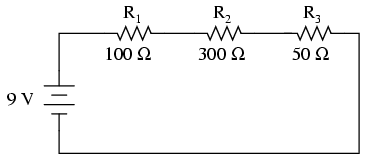
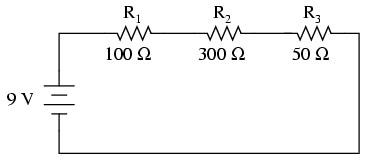
The picture shows an electrical circuit. This circuit is a series circuit because: 
a)
It has 3 light bulbs.
b)
The same current flows through all three light bulbs.
c)
It uses a single battery.
d)
The electrical current is divided between the three light bulbs.
18.
The total resistance in this circuit is 
a)
100 ohms
b)
450 ohms
c)
400 ohms
d)
30 ohms
19.
The total current through this circuit is
a)
0.02 amps
b)
0.09 amps
c)
50 amps
d)
9 amps
20.
The voltage dropped across the 300 ohm resistor is 
a)
6 V
b)
9 V
c)
2 V
d)
30 V
21.
As resistors are added in series to a circuit, the total resistance will...
a)
increase
b)
decrease
c)
stay the same
22.
As the resistance of a circuit increases, the current will...
a)
increase
b)
decrease
c)
stay the same
23.
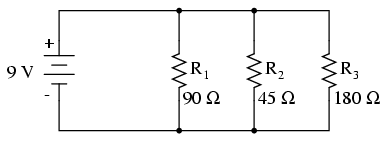
The current going through the 45 ohm resistor is 
a)
0.05 amps
b)
0.2 amps
c)
0.1 amps
d)
5 amps
24.
What is a switch's function in a circuit?
a)
to make the current hotter or colder
b)
turn on and off the flow of current
c)
the pathway that current flows
d)
to add more power to the circuit
25.
This circuit has more than one loop. When one light goes out, the others stay on. 
a)
closed circuit
b)
series circuit
c)
parallel circuit
d)
open circuit
26.
In a parallel circuit if one light bulb goes OUT; then they ALL go out. TRUE OR FALSE?
a)
TRUE
b)
FALSE
27.
What is a Parallel circuit? 
a)
Has only one path 
b)
Has more than one path 
c)
Allows energy to travel through easily 
d)
Has only one light bulb
28.
A series circuit has ____ path(s) that the electric current can take. 
a)
One
b)
Two 
c)
Three 
d)
Four
29.
Voltage is measured in __.
a)
volts.
b)
watts.
c)
coulombs. 
30.
What would the circuit resistance be if a 7.5 Amp draw was present with the engine running and the charging system producing 15 Volts
a)
15 Ohms
b)
4 Ohms
c)
0.3333 Ohms
d)
2 Ohms
31.
If the current through a circuit is 2 A and the resistance of a light bulb in the circuit is 10 Ohms, what is the voltage difference across the light bulb?
a)
5 V
b)
12 V
c)
0.2 V
d)
20 V
32.
Current has units: 
a)
kilowatt·hour 
b)
ampere 
c)
coulomb 
d)
volt 
33.
How many Volts would it take to push 1 Amp through a resistance of 1 Ohm
a)
10 volts
b)
1 volt
c)
48 volts
d)
5 volts
34.

Which equation can be used to calculate the resistance R of a resistor?

a)

V = I / R

b)

I = V x R

c)

R = V x I

d)

V = I x R

35.

Current can be measured using ............

a)

ammeter

b)

light bulb

c)

resistor

d)

voltmeter

36.

Voltage can be measured using ............

a)

ammeter

b)

light bulb

c)

resistor

d)

voltmeter

37.
At which point is the electric field the weakest?
a)
A because it is the furthest away
b)
A because the field lines are further apart
c)
C because the field lines are further apart
d)
C  because it is the furthest away
38.
At which point is the electric field the strongest
a)
A
b)
B
c)
C
d)
D
39.
The electrical force between charges is strongest when the charges are
a)
close together
b)
far apart
c)
 the electric force is constant everywhere.
d)
there is no pattern
40.

The electric field lines for a positive charge is always directed away from the charge. True or False?

a)

True

b)

False

41.
Electricity is made up of:
a)
Protons
b)
Neutrons
c)
Electrons
d)
Molecules
42.
When two objects have opposite charge (+ and -), they are:
a)
Attracted to each other
b)
Repelled by each other
c)
Have no effect on each other
43.
What is a closed path for electrons to flow through?
a)
static electricity
b)
circuit
c)
amperes
44.
Identify the insulator below.
a)
aluminum foil
b)
paperclip
c)
rubber eraser
45.
Which subatomic particles have a positive charge?
a)
neutrons
b)
electrons
c)
protons
46.
Which formulas represents Ohm's law?
a)
V=IR
b)
R=IV
c)
I=RV
47.

Identify the part of the circuit that is labeled 1.

a)

battery

b)

wire

c)

switch

d)

bulb

48.

Identify the part of a circuit that is labeled 2.

a)

battery

b)

wire

c)

switch

d)

bulb

49.

If the light is on, the circuit is _________________.

a)

closed

b)

open

50.

What supplies the energy or power in an electric circuit?

a)

light bulb

b)

wire

c)

battery

51.
Tasha tested several items to see if they could conduct electricity.  Her data is shown below. What is the best claim she could make from her data?
a)
Wood is an insulator.
b)
Metal is an insulator.
c)
Keys are insulators.
d)
Toothpicks are conductors.
52.
What voltage is needed to cause a 50A current flow through a 10Ω resistor?
a)
15V
b)
500V
c)
500 kV
d)
0.2V
53.
If the battery produced 12.6 Volts and what would be the current flow be for a 6 Ohm resistor
a)
2.1 Amps
b)
2.4 Amps
c)
1.71 Amps
d)
15 Amps
54.
With the engine running the charging system produces 14.5 Volts what would the current flow be if a resistance of 6 Ohms was present
a)
2.41 Ohms
b)
2.52 Ohms
c)
2.1 Ohms
d)
0.3333 Ohms
55.

What is the current through R1?

a)

10 A

b)

5 A

c)

7 A

d)

2 A

56.

What is the (hot) resistance of the bulb?

a)

100 ohm

b)

132 ohm

c)

0.01 ohm

d)

0.007 ohm

57.

Which is the right form of Ohm's Law?

a)

V=I/R

b)

V=R/I

c)

I=V/R

d)

I=R/V

58.

What is the resistance of a lightbulb that experiences 9 Volts and 3 amps of current?

a)

1/3 ohms

b)

3 ohms

c)

27 ohms

d)

9 ohms

59.

If all of the switches were closed, how many paths can the current take?

a)

4

b)

6

c)

8

d)

10