
 Worksheets
The Sun-Earth-Moon System
Total questions: 84
Worksheet time: 2hrs 41mins
Name
Class
Date
1.
The moon seems to change shape from day to day in a cycle that lasts about a month as it goes through _.
a)
revolutions
b)
phases
c)
rotations
d)
eclipses
2.
Which moon phase is when you can't see the moon at all?
a)
Waning crescent
b)
Full moon
c)
Waxing gibbous
d)
New moon
3.
Phases of the moon in which the moon appears to be getting larger are referred to as _.
a)
waxing
b)
waning
c)
new
d)
eclipse
4.
what is the reason for the season?
a)
Joy
b)
tilt
c)
revolution
d)
rotation
5.

Why do globes lean sideways?
a)
To allow them to spin easier.
b)
To demonstrate the tilt of Earth's axis.
c)
To demonstrate the effects of gravity.
d)
To demonstrate day and night.
6.

The Moon ________ around the Earth.
a)
moves parallel
b)
rotates
c)
moves perpendicular
d)
revolves
7.

Which type of eclipse is being modeled: Lunar or Solar
a)
Lunar Eclipse
b)
Solar Eclipse
8.
The phase of the moon that occurs between the sun and Earth
a)
Full moon
b)
Waxing crescent
c)
Waning Crescent�
d)
New Moon
9.
The 1st Quarter moon is lit on the:
a)
Left Side
b)
Right Side
10.
T/F The moon can be seen from Earth because it reflects the sun's light
a)
TRUE
b)
FALSE
11.
Earth’s _______________ causes the seasons.
a)
Tilted axis
b)
Distance from the sun
c)
Atmospheric conditions
d)
Global warming
12.
It takes the earth _____ days to make one revolution around the sun.
a)
1 day
b)
30 days
c)
185 ½
d)
365 ½ days
13.

The two major motions of Earth as it travels through space are:
a)
Rotation and revolution
b)
Axis and orbital
c)
Rotation and axis
d)
Revolution and orbital
14.
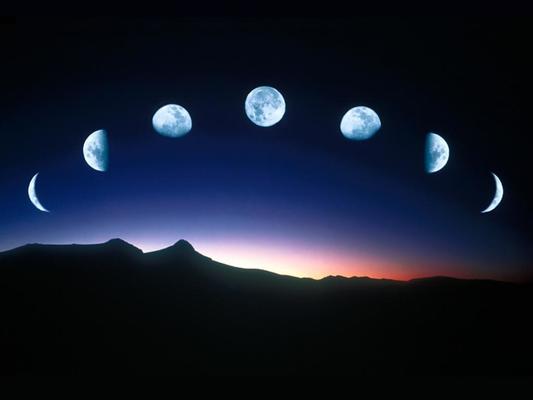
When the moon waxes, it ________.
a)
goes from a new moon to a full moon
b)
seems to get bigger in size
c)
goes from a full moon back to a new moon
d)
A and B only
15.
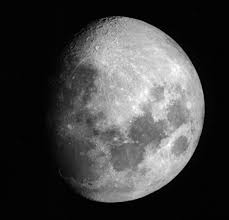
Name the moon phase
a)
waning crescent
b)
waxing crescent
c)
waning gibbous
d)
waxing gibbous
16.
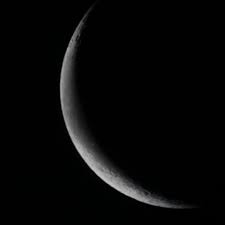
Name the moon phase
a)
waning crescent
b)
waxing crescent
c)
waning gibbous
d)
waxing gibbous
17.
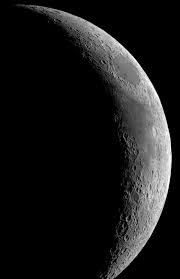
Name the moon phase
a)
waning crescent
b)
waxing crescent
c)
waning gibbous
d)
waxing gibbous
18.
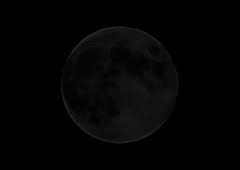
Name the moon phase
a)
First Quarter
b)
Last Quarter
c)
New Moon
d)
Full Moon
19.
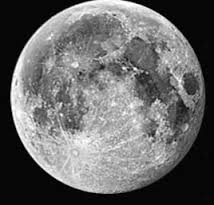
Name the moon phase
a)
First Quarter
b)
Last Quarter
c)
New Moon
d)
Full Moon
20.
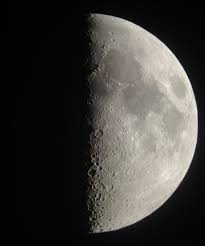
Name the moon phase
a)
First Quarter
b)
Last Quarter
c)
New Moon
d)
Full Moon
21.

Name the moon phase that would come AFTER this moon.
a)
waning crescent
b)
waxing crescent
c)
waning gibbous
d)
waxing gibbous
22.

Name this moon phase and indicate how long the moon is at this phase
a)
waxing crescent; one day
b)
waxing crescent; one week
c)
waning gibbous; one day
d)
waxing gibbous; one week
23.
Which motion takes us around the Sun?
a)
rotation
b)
revolution
c)
centrifugal
d)
random
24.
Approximately how far is the sun from Earth?
a)
1 million km
b)
150 million km
c)
140 million km
d)
20 million km
25.
The path an object follows as it move around another object is an orbit?
a)
true
b)
false
26.
The motion of one object around another object is called revolution?
a)
false
b)
true
27.
Why does Earth orbit the Sun?
a)
water that is on earth
b)
the mass Earth has
c)
sun gravity pulls on earth
d)
the mass the sun hass
28.
A spinning motion is called rotation?
a)
false
b)
true
29.
A line on which an object rotates is the rotation axis?
a)
true
b)
false
30.
How much time does Earth take to complete one rotation?
a)
16 hours
b)
2 days
c)
24 hours
d)
1 month
31.
The sun moves from East to West across the sky due to Earth's west to east rotation?
a)
false
b)
true
32.
The Moon makes one revolution around the Earth every?
a)
5.2 weeks
b)
26.2 days
c)
one year
d)
27.3 days
33.
The sun is always shining on half of the moon, just as the sun is always shinning on half of Earth?
a)
true
b)
false
34.
The portion of the Moon or a planet reflecting light as seen from Earth is called phase?
a)
False
b)
true
35.
An eclipse in which the sun is obscured (blocked) by the moon.
a)
Lunar Eclipse
b)
Equinox
c)
Solar Eclipse
d)
Solstice
36.
(Of the moon) have a progressively smaller part of its visible surface illuminated, so that it appears to decrease in size.
a)
Waxing
b)
Waning
c)
Axis
d)
Maria
37.
More and more light is being reflected onto the moon during this.
a)
Waxing
b)
Lighting
c)
Dimming
d)
Waning
38.
An imaginary line that goes through the Earth.
a)
North Pole
b)
South Pole
c)
Axis
d)
Axle
39.
The fully shaded inner region of a shadow. Especially the area on the moon experiencing the total phase of an eclipse.
a)
Umbrella
b)
Umbra
c)
Imbra
d)
Ombre
40.
Occurs twice each year (around June 21 and December 22) as the Sun reaches its most northerly or southerly point.
a)
Solar
b)
Solstice
c)
Summer
d)
Winter
41.

Which body has the greater effect on Earth's tides?
a)
Sun
b)
Saturn
c)
Moon
d)
Venus
42.

Why does the area around the equator stay the same temperature all year?
a)
The equator rotates slower than the poles.
b)
The equator remains the same distance from the sun.
c)
The equator always receives direct sunlight.
d)
The equator has 18 hour days.
43.

What are the reasons for the seasons?
a)
Earth's tilt and rotation.
b)
Earth's rotation and revolution.
c)
Earth's tilt and revolution.
d)
Earth's tilt and resolution
44.

What causes Day and Night on Earth?
a)
The rotation of the Earth
b)
Earth moving farther from and closer to the Sun
c)
The Revolution of Earth
d)
The Sun moving around Earth
45.

If these three bodies are lined up with each other, what would this diagram represent?
a)
full moon
b)
gibbous moon
c)
lunar eclipse
d)
solar eclipse
46.

If the sun, moon, and Earth are lined up, what does this diagram represent?
a)
cresent moon
b)
new moon
c)
lunar eclipse
d)
solar eclipse
47.
Which of the following has the GREATEST
effect on the Earth’s tides?
effect on the Earth’s tides?
a)
the Moon’s gravitational pull
b)
the Sun’s gravitational pull
c)
the position of Venus and Mars
d)
convection heat from thermal vents
48.
The time required for the Moon to complete one cycle of phases is about one
a)
day
b)
week
c)
month
d)
year
49.
The same side of the Moon always faces Earth because the
a)
Moon's period of rotation is longer than its period of revolution around the Earth
b)
Moon's period of rotation is shorter than its period of revolution around Earth
c)
Moon rotates once as it completes one revolution around Earth
d)
Moon does not rotate as it completes one revolution around Earth
50.
When are days and nights the same length all over the world?
a)
Equinox
b)
Solstice
c)
New Moon
d)
Eclipse
51.
In the Northern Hemisphere, the longest day occurs on the
a)
winter solstice
b)
vernal equinox
c)
summer solstice
d)
autumnal equinox
52.
The moon seems to change shape from day to day in a cycle that lasts about a month as it goes through _.
a)
revolutions
b)
phases
c)
rotations
d)
eclipses
53.
When the Northern Hemisphere is pointing towards the sun, what season is the Southern Hemisphere?
a)
Winter
b)
Spring
c)
Fall
d)
Summer
54.
The earth orbits around...
a)
The sun.
b)
the moon
c)
other planets
d)
the Milky Way
55.
The moon phase where the moon is between the earth and the sun. We are looking at the dark side of the moon.
a)
new moon
b)
full moon
c)
solar eclipse
d)
lunar eclipse
56.

What happens during a total solar eclipse?
a)
The shadow of Earth falls on the moon.
b)
A large ring of the sun shows through
c)
The moon completely covers the sun.
d)
The moon is about the same size as the sun.
57.

Which diagram(s) BEST represent(s) the position of the Moon during a New moon?
a)
A
b)
B
c)
C
d)
A and C
58.
The Earth's _?_ is an imaginary line that goes from the North Pole to the South Pole.
a)
equator
b)
axis
c)
prime meridian
d)
equinox
59.
The spinning of an object on its axis is called _?_.
a)
orbit
b)
rotation
c)
revolution
d)
tide
60.

If the Earth rotated slower, how would that affect the length of the day?
a)
longer day
b)
shorter day
c)
same time, 24 hours
61.

When the Northern Hemisphere of Earth is leaning away from the Sun, What season is the Southern Hemisphere experiencing?
a)
Summer
b)
Winter
c)
Spring
d)
Fall
62.
When the Northern Hemisphere is pointing towards the sun, what season is the Southern Hemisphere?
a)
Winter
b)
Spring
c)
Fall
d)
Summer
63.
What Moon phases do spring tides occur?
a)
new and full
b)
1st & 3rd quarters
64.
What Moon phases do neap tides occur?
a)
new and full
b)
1st & 3rd quarters
65.
Which of the following causes the ocean’s tides?
a)
The Earth's spinning makes the oceans slosh like a bathtub.
b)
The Earth's gravity pulling on the moon.
c)
The Sun and Moons gravity pulling on the Earth.
d)
The Sun's gravity pulling on the moon.
66.

Earth is an _________, which is a round, three dimensional object.
a)
ellipse
b)
sphere
c)
cone
d)
cylinder
67.
In the Sun, atoms combine during______________, producing huge amounts of energy.
a)
nuclear fussion
b)
biochemistry
c)
nuclear reaction
68.
Earth moves around the Sun because of the pull of _________ between Earth and Sun.
a)
light
b)
power
c)
gravity
d)
pull
69.
What does the force of gravity depend on?
a)
two objects mass
b)
three objects weight
c)
one objects weight
d)
one objects mass
70.
Earth's____________ change in a yearly cycle because of the tilt of its rotation axis and Earth's motion around the Sun.
a)
seasons
b)
holidays
c)
gravity
d)
motion
71.
How many solstices occur each year?
a)
2
b)
3
c)
0
d)
9
72.
During its revolution, Earth's axis does not learn toward or away from the sun during a(n)____________.
a)
full moon
b)
eclipse
c)
half moon
d)
equinox
73.
The lighter part of a shadow is called the _____________.
a)
penumba
b)
umbra
c)
solar
d)
tilted
74.
When the moon passes between Earth and the Sun, it casts a shawow on ______________.
a)
Jupiter
b)
Mar
c)
Venus
d)
Earth
75.
A solar eclipse can occur only during a _______________ moon.
a)
old
b)
new
c)
half
d)
no moon
76.
During a _____________eclipse, Earth casts a shadow on the Moon.
a)
lunar
b)
solar
77.
The daily rise and fall of sea level is called a _______________.
a)
current
b)
tide
c)
eclipse
78.
A(n) ______________occurs on the side of Earth that is closest to the Moon on the opposite side of Earth.
a)
tide
b)
tidal bulge
c)
waves
79.
____________ tides occur a tidal bulges.
a)
high
b)
low
c)
medium
d)
small
80.
______________ tides occur between tital bulges.
a)
low
b)
high
c)
large
d)
small
81.
During a(n) __________ tide, Earth, the Sun, and the Moon are formed in a straight line.
a)
fall tide
b)
spring tide
c)
winter tide
82.
During a(n) __________ tide, Earth, the Sun, and the Moon from a right angle.
a)
spring
b)
winter
c)
neap
d)
low
83.
Large, flat areas on the Moon are callled________.
a)
Maria
b)
craters
c)
holes
d)
moons
84.
_______________ are light-colored areas on the Moon's surface.
a)
badlands
b)
highlands
c)
lowlands
d)
midlands
100 %

