wayground logo

Free Printable Worksheets

NEW

Font size

S
M
L
XL
Worksheets

Unit 7 Test Review Spring 2019

Total questions: 70

Worksheet time: 42mins

Name
Class
Date
1.
Redi and Pasteur did experiments to disprove what idea?
a)
Biogenesis
b)
Oparin's Hypothesis
c)
Abiogenesis
d)
Endosymbiont Theory
2.
Endosymbiosis is thought to have given rise to a complex cell known as
a)
Anaerobic Prokaryotes
b)
Photosynthetic Prokaryotes
c)
Aerobic Prokaryotes
d)
Eukaryotes
3.
Which of the following describes the idea of Biogenesis?
a)
Life comes from things that are not living
b)
Living things come from other living things like them.
c)
Life on early Earth was possible even without  oxygen
d)
One cell consumed another cell  producing a eukaryotic cell.
4.
Which one is not considered an evidence for evolution?
a)
Anatomical Structures
b)
Fossils
c)
Proteins and Amino acids.
d)
Muscles
5.
Charles Darwin
a)
was a naturalist
b)
stated the Theory of Natural  Selection
c)
Sailed to the Galapagos Islands
d)
is all three of these things.
6.
It helps an organism survive better in its environment?
a)
Adaptation
b)
Generation Time
c)
Natural Selection
d)
Evolution
7.
When a single population evolves into two populations that cannot interbreed anymore?
a)
Evolution
b)
Selective Breeding
c)
Speciation
d)
Innate Behavior
8.
A group of organisms that can mate with each other to produce offspring is known as a(n) ___.
a)
species
b)
speciation
c)
adaptation
d)
selective breeding
9.
The process by which populations accumulate inherited changes over time is described as ___.
a)
evolution
b)
variation
c)
adaptation
d)
behavior
10.
The means by which Darwin's theory of evolution occurs is ____.
a)
On the Origin of Species
b)
Natural Selection
c)
Inheritance of acquired traits
d)
Speed of Evolution
11.
The species that did not help Darwin discover his theory is ___.
a)
Blue-footed Booby
b)
Turtle
c)
Iguana
d)
Finch
12.
Structures that are similar in structure (fins in whales, forearms in humans, paws in dogs) are
a)
homologous structures
b)
vestigal structures
c)
epigenetics
d)
analogous structures
13.
This pictures shows an example of
a)
natural selection
b)
artificial selection
c)
sexual selection
d)
epigenetics
14.
This picture is an example of
a)
natural selection
b)
mutation
c)
evolution
d)
geographic isolation
15.
Viruses differ from bacteria in that
a)
cause insect borne diseases
b)
can be destroyed by antibiotics
c)
have rigid cell walls
d)
must be reproduced by living cells
16.
Viral process where infection, immediate replication, and destruction of a host cell occurs.
a)
viral cycle
b)
replication cycle
c)
lytic cycle
d)
lysogenic cycle
17.
The only type of prokaryotes are ___.
a)
plants
b)
viruses
c)
bacteria
d)
animals
18.
A dichotomous key for trees is provided. Hikers found a tree that has large brown cones and single sharp needles. What species of tree have the hikers found?
a)
Juniper
b)
Pine
c)
Spruce
d)
Fir
19.
A student discovers an arachnid with a segmented abdomen, long legs, and a tail with no stinger. The student uses the dichotomous key below to identify it. Which arachnid has the student found?
a)
Whip Scorpion
b)
Wind Scorpion
c)
Daddy long legs
d)
Scorpion
20.
An illustration and a dichotomous key are given. What is the correct classification for this organism?
a)
Class Insecta
b)
Order Amblygygi
c)
Order Araneae
d)
Order Scorpiones
21.
Kangaroos and opossums both incubate their immature in pouches. This means they -
a)
share a common ancestor
b)
possess vestigial organs
c)
have similar skeleltal structures
d)
belong to the same species
22.
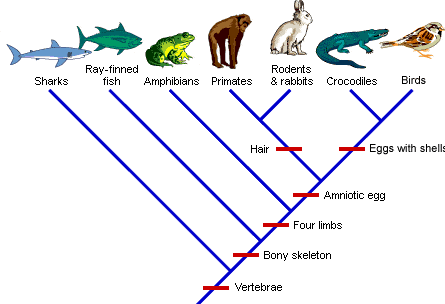
According to this cladogram, primates are most closely related to -
a)
Amphibians
b)
Rodents and rabbits
c)
Crocodiles
d)
Birds
23.
According to this cladogram, birds are LEAST related to -
a)
Amphibians
b)
Sharks
c)
Ray Finned Fish
d)
Crocodiles
24.
Which trait do only humans have, according to the cladogram?
a)
jaws
b)
mammary glands & hair
c)
terrestrial during all life stages
d)
opposable thumbs
25.
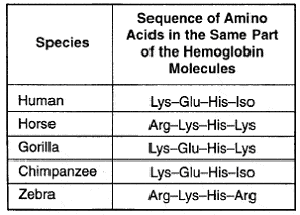
You look at two species and see very similar amino acid sequences. What does this likely tell you?
a)
These are the same animal.
b)
These animals have a common ancestor.
c)
These animals are not likely related.
d)
These animals are likely becoming one species.
26.
Which of these is a characteristic shared between Fungi and Plantae?
a)
Heterotrophic
b)
Mobile
c)
Prokaryotic
d)
Multicellular
27.
What is classification?
a)
organizing things into groups according to shared characteristics
b)
making a list of organisms
c)
the process of identifying different types of animals
d)
the study of animals
28.
Which organisms are closely related?
a)
Equus ceballas (horse) & Equus burchellii (zebra)
b)
Cyanea artica (jellyfish) & Asterias rubens (sea star)
c)
Naja naja (cobra) & Crotalus atrox (rattlesnake)
d)
Alligator mississippiensis (alligator) & Crocodylus porosus (crocodile)
29.
The method of naming organisms by using two names is known as
a)
binomial nomenclature
b)
dinomial menoclature
c)
dichotomous naming
d)
the scientific method
30.
The method of naming organisms by using two names is known as
a)
binomial nomenclature
b)
dinomial menoclature
c)
dichotomous naming
d)
the scientific method
31.

Who first proposed binomial nomenclature as a way of classifying organisms?

a)

Carlus Linneaus

b)

Charles Darwin

c)

Albert Einstein

d)

Francis Crick

32.
The science of classifying and naming organisms is 
a)
taxonomy
b)
grouping
c)
anatomy
d)
evolution
33.
Canis, in the scientific name Canis Lupus, is known as the...
a)
Genus 
b)
Species 
34.
The scientific name for an organism is made from the:
a)
class and family name
b)
genus and species name
c)
domain and kingdom name
d)
kingdom and phylum name
35.
Binomial nomenclature makes it easier for scientists to communicate because ...
a)
everyone speaks latin
b)
everyone uses the same scientific name
c)
everyone knows all the animals
d)
its fun to call organisms by name
36.
Which of the following is an example of binomial nomenclature?
a)
Moon Jelly
b)
Jelly fish
c)
Chrysaora fuscescens
d)
Cnidarian
37.
If two organisms are in the same phylum, they must also be in the same
a)
class
b)
species
c)
family
d)
kingdom
38.

I have a nuclear membrane, can do photosynthesis and am multicellular. What kingdom do I belong to?

a)

Animalia

b)

Archaebacteria

c)

Plantae

39.
In which kingdom do I belong if I am unicellular, autotrophic, and eukaryotic?
a)
Archaebacteria
b)
Protista
c)
Animalia
d)
Plantae
40.
What is the difference between Archaebacteria and Eubacteria?
a)
Eubacteria are eukaryotic.
b)
Archaebacteria are multicellular.
c)
Archaebacteria can live in extreme environments.
d)
Archaebacteria are found everywhere.
41.
Which Kingdom do Viruses belong to? 
a)
Protista
b)
Archaebacteria
c)
Eubacteria
d)
They don't belong to any Kingdom
42.
Some bacteria can reproduce asexually by splitting themselves in two. This is called ___
a)
Budding
b)
Binary Fission
c)
Conjugation
43.
What are the two types of Seed plants?
a)
Vascular and Non-vascular
b)
Monocots and Dicots
c)
Xylem and Phloem
d)
Gymnosperms and Angiosperms
44.
Which type of vascular tissue transports food through the plant?
a)
Xylem
b)
Phloem
45.
What is a behavior in which newborn animals recognize and follow the first moving object they see?
a)
courtship
b)
mimicry
c)
imprinting
d)
conditioning
46.
What is a process in which an animal learns that a stimulus and its response to that stimulus will bring about a good or bad result?
a)
conditioning
b)
imprinting
c)
inherited behavior
d)
mimicry
47.
Which of the following terms is another term for innate?
a)
instinct
b)
learned
c)
trial and error
d)
copying
48.
A soccer player kicking a field goal in his first football game is an example of
a)
imprinting
b)
conditioning
c)
trial and error
d)
insight
49.
A trainer using fish to reward a dolphin that jumps through a hoop is an example of
a)
imprinting
b)
conditioning
c)
trial and error
d)
insight
50.
A gymnast learning how to do a cartwheel is an example of
a)
imprinting
b)
conditioning
c)
trial and error
d)
insight
51.
A chick following a lawnmower because it was the first moving object it ever saw is an example of
a)
imprinting
b)
conditioning
c)
trial and error
d)
insight
52.
Michael went to the circus and saw a seal balance a beach ball on its nose.  This is an example of a...
a)
instinct
b)
mimicry
c)
camouflage
d)
learned behavior
53.
What is a seasonal movement of an animal to another location to find food called? 
a)
camouflage
b)
migration
c)
grouping
d)
mimicry
54.
In the old story, about the boy who cried wolf so many times that nobody was alarmed anymore, the story illustrates which type of learning? 
a)
habituation
b)
imprinting
c)
classic conditioning
d)
cognition
55.
How does this protist move? 
a)
Pseudopods 
b)
Cilia 
c)
Flagellum
56.
How does this protist move? 
a)
Flagellum
b)
Cilia 
c)
Pseudopods
57.
Which protist has an eyespot?
a)
Amoeba
b)
Volvox
c)
Euglena 
d)
Paramecium 
58.

The eyespot in a Euglena

a)

can see like our eye

b)

can detect light and activates the flagella to move toward it

c)

can detect light and move away from it

d)

is a type of camouflage

59.

Chemotaxis is the ability to detect chemicals in the environment and move toward or away from them.

a)

True

b)

False

60.

Positive phototaxis is

a)

the ability to locate chemicals and move toward them

b)

the ability to locate chemicals and move away from them

c)

the ability to detect light and move toward it

d)

the ability to detect light and move away from it

61.

Protists live in freshwater so they are constantly needing to push excess water out of their bodies. Which organelle is able to maintain homeostasis in this way?

a)

cytoplasm

b)

chloroplast

c)

contractile vacuole

d)

central vacuole

62.
Which is in the correct order that these processes evolved?
a)
anaerobic -> photosynthetic -> aerobic 
b)
photosynthetic -> anaerobic -> aerobic
c)
aerobic -> photosynthetic -> anaerobic
d)
aerobic -> anaerobic -> photosynthetic
63.
What 'building blocks of life' were made in the Miller Urey experiment?
a)
amino acids
b)
nucleic acids
c)
glucose
d)
lipids
64.
Which of the following could NOT have been part of earth's early atmosphere?
a)
Oxygen
b)
Water vapor
c)
Carbon Dioxide
d)
Methane
65.

Abiogensis is best described as:

a)

Theory that living cells arose from non-living matter

b)

Theory that living cells arose from living matter

66.

A cell that lives inside another cell with mutual benefit is termed:

a)

Symbiosis

b)

Endosymbiosis

c)

Mutualism

67.

The theory of endosymbiosis states:

a)

A eukaryote cell was engulfed by a prokaryote cell

b)

A prokaryote cell was engulfed by a eukaryote cell

c)

A prokaryote cell was engulfed by a prokaryote cell

d)

A eukaryote cell was engulfed by a eukaryote cell

68.

First scientist to disprove spontaneous generation, showing that flies come from other flies.

a)

Wallace

b)

Redi

c)

Pasteur

d)

Lyell

69.

This scientist finally disproved spontaneous generation by designing a broth experiment to confirm microorganisms could be found in the air.

a)

Pasteur

b)

Darwin

c)

Needham

d)

Redi

70.

Scientist who formed amino acids and other simple compounds with ammonia, methane, hydrogen and water vapor.

a)

Lamark

b)

Miller and Ulrey

c)

Malthus

d)

Needham