
 Worksheets
ngss
Total questions: 60
Worksheet time: 1hrs 3mins
Name
Class
Date
1.
The closer the charges, the ___________ the force between them
a)
closer
b)
further
c)
stronger
d)
weaker
2.
What are the two factors that determine gravitational force?
a)
mass and velocity
b)
mass and distance
c)
distance and speed
d)
gravity and mass
3.

Which objects are attracted to magnetics?
a)
Metals such as iron
b)
Wood
c)
Plastics
d)
Paper
4.

What is the name of the force of attraction that exists between any two bodies in the universe that have mass.
a)
Gravity
b)
Electrostatic
c)
Magnetic
d)
Friction
5.
The force of magnetism is stronger when magnets are ________________
a)
cold
b)
round
c)
closer together
d)
farther apart
6.
melting
a)
change of state from solid to liquid
b)
change of state from liquid to solid
7.
freezing
a)
change of state from solid to liquid
b)
change of state from liquid to solid
8.
Molecules are
a)
2 atoms bound together
b)
2 elements bound together
c)
2 or more atoms mixed together
d)
2 or more atoms bound together
9.
Matter is
a)
everything that has density
b)
everything made of atoms
c)
elements
d)
anything that has mass and takes up space
10.
Atoms make up
a)
Elements
b)
Molecules
c)
Compounds
d)
Protons Neutrons and Electrons
11.
Elements are made of
a)
Many types of atoms
b)
the Periodic Table
c)
One type of Atom
d)
Molecules
12.
Solid particles are...
a)
tightly packed.
b)
loosely bonded and flowing.
c)
free to fly in all directions.
d)
so hot that the electrons are removed from the nucleus.
13.
Gas particles are...
a)
tightly packed.
b)
loosely bonded and flowing.
c)
free to fly in all directions.
d)
so hot that the electrons are removed from the nucleus.
14.

What does this picture represent?
a)
solid
b)
liquid
c)
gas
d)
plasma
15.

What does this picture represent?
a)
solid
b)
liquid
c)
gas
d)
plasma
16.

Which state of matter do the particles in this picture represent?
a)
solid
b)
liquid
c)
gas
d)
plasma
17.
What kind of properties can only be observed when a substance changes into a different substance?
a)
physical properties
b)
chemical properties
c)
liquid properties
d)
real properties
18.
Which of the following is a sign that a chemical reaction has occurred?
a)
change in shape
b)
melting
c)
formation of a gas
d)
dissolving
19.
Is hammering wood together to build a house a chemical or physical change?
a)
chemical
b)
physical
20.

Photosynthesis is an example of a
a)
physical change
b)
chemical change
21.
Which is a chemical change?
a)
freezing fruit juice
b)
slicing a potato
c)
boiling water
d)
copper metal turning green
22.
What does it mean to refract?
a)
bounce off
b)
to bend
c)
curve outward
d)
reflect
23.
What happens when light hits a mirror?
a)
it makes a color
b)
it reflects
c)
it makes a rainbow
d)
it passes through
24.
A wave that does not require a medium
a)
A. electromagnetic wave.
b)
B. surface
wave
c)
C. medium
d)
D. transverse
wave
25.
The bouncing back of a ray of light, sound, or heat when the ray hits a surface that it does not penetrate
a)
A. refraction
b)
B. reflection
c)
C. resonance
d)
D. standing
wave
26.

This image represents what kind of wave behavior?
a)
Diffraction
b)
Reflection
c)
Refraction
d)
Resonance
27.
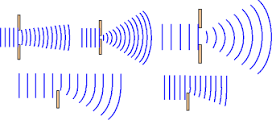
a)
Diffraction
b)
Interference
28.
Energy can be classified into two main categories, kinetic energy and potential energy. Kinetic energy is when an object is:
a)
standing still
b)
actively doing something
c)
changing states of matter
d)
objects do not have kinetic energy
29.
Which is an example of potential energy?
a)
a roller coaster speeding down a hill
b)
the pulled back string on an archers's bow
c)
releasing the strings on a guitar
d)
an electric current lighting a light bulb
30.
Choose the BEST answer that is an example of an energy transformation from potential energy to kinetic energy.
a)
a ball rolling down a ramp
b)
a picture hanging on the wall
c)
a swing swaying back and forth
d)
a coat hanging on a hook
31.
Stored mechanical energy is a type of...
a)
kinetic energy
b)
potential energy
32.
The ability to do work or cause change is called ________?
a)
force
b)
work
c)
energy
d)
power
33.
The highest point on a wave is:
a)
the crest
b)
the trough
c)
the top
d)
the coast
34.
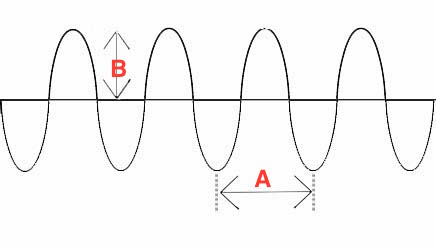
What property of the wave is represented by the letter "B"?
a)
amplitude
b)
crest
c)
trough
d)
wavelength
35.
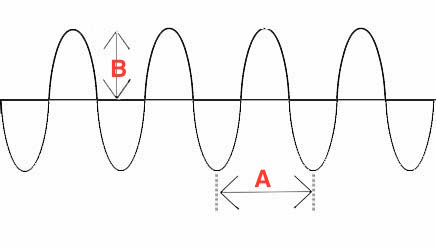
What property of this wave is represented by the letter "A"
a)
amplitude
b)
crest
c)
trough
d)
wavelength
36.
The number of wavelengths that pass a point each per second is:
a)
frequency
b)
period
c)
longitudinal
d)
transverse wave
37.
The type of waves that require medium to pass:
a)
Mechanical Waves
b)
Electromagnetic Waves
38.
Anything that has mass & takes up space
a)
gravity
b)
force
c)
matter
d)
volume
39.
What does the principle of conservation of mass mean?
a)
The total mass of the reactants is more than the products
b)
Matter is not created or destroyed
c)
The total mass of the reactants is less than the products
40.
An insulator . . .
a)
Allows a lot of heat to escape
b)
Makes the temperature of an object rise
c)
Moves heat from one place to another
d)
Traps heat inside an object
41.
What is the BEST example of a conductor?
a)
A plastic toy
b)
A wooden table
c)
A styrofoam cup
d)
A metal shed
42.
electromagnetic waves with the longest wavelengths are
a)
gamma rays
b)
x-rays
c)
infrared waves
d)
radio waves
43.
which of the following does NOT belong in the electromagnetic spectrum:
a)
X-ray
b)
sound wave
c)
ultra violet rays
d)
microwaves
44.
Which waves are the type that can give us suntans and sunburns?
a)
Infrared radiation
b)
Ultraviolet radiation
c)
Radio waves
d)
X-rays
45.

Electromagnetic waves________________travel through space.
a)
Never
b)
Cannot
c)
Can
d)
Wish they could
46.

_____________________light is the only type of EM wave detected by the human eye.
a)
Red
b)
Gamma
c)
Microwave
d)
Visible
47.

The higher the frequency the ______ the energy.
a)
higher
b)
lower
c)
neither, stays the same
48.
If you're moving from gamma rays to microwave, describe how the energy level changes
a)
Increases
b)
Decreases
c)
Energy level doesn't change
d)
We never talked about it
49.
What law is best described by inertia?
a)
1st
b)
2nd
c)
3rd
50.

"For every action, there is an equal and opposite reaction."
a)
Newton's 1st Law
b)
Newton's 2nd Law
c)
Newton's 3rd Law
d)
Newton's 4th Law
51.

Force = Mass x Acceleration
a)
Newton's 1st Law
b)
Newton's 2nd Law
c)
Newton's 3rd Law
d)
Newton's 4th Law
52.

"An object in motion (or at rest) will to stay in motion (or at rest) until an outside force acts upon it."
a)
Newton's 1st Law
b)
Newton's 2nd Law
c)
Newton's 3rd Law
d)
Newton's 4th Law
53.

Any push or pull on an object.
a)
force
b)
velocity
c)
inertia
d)
momentum
54.

What is the net force?
a)
5000 N right
b)
4000 N right
c)
40 N left
d)
4000 N left
55.
Heat is
a)
the movement of thermal energy from a warmer to cooler object
b)
moving particles
c)
the average kinetic energy of the particles that are in a substance
d)
the amount of matter in an object
56.
The sum of the kinetic energy and the potential energy of the particles that make up something is
a)
temperature
b)
heat
c)
thermal energy
d)
matter
57.
The average kinetic energy of the particles that make up a substance is
a)
temperature
b)
heat
c)
kinetic energy
d)
conduction
58.
When the temperature increases what else increases?
a)
potential energy
b)
kinetic energy
c)
gravitational potential energy
d)
total energy
59.
As energy transformations occur within a system, the total energy of the system ___.
a)
increases
b)
decreases
c)
is transferred out of the system
d)
remains constant
60.
What states that energy can never be created or destroyed?
a)
law of conservation of momentum
b)
law of conservation of energy
c)
law of conservation of matter
d)
law of conservation of water
100 %

