wayground logo

Free Printable Worksheets

NEW

Font size

S
M
L
XL
Worksheets

MOB Semester 2 Exam Review 18-19

Total questions: 57

Worksheet time: 41mins

Name
Class
Date
1.
Which cell is in a hypotonic environment?
a)
A
b)
B
c)
C
2.
Which cell is in a hypertonic environment?
a)
A
b)
B
c)
C
3.
Which cell is in an isotonic environment?
a)
A
b)
B
c)
C
4.
Osmosis moves water from a ___________ area to a ___________ area.
a)
hypotonic, hypertonic
b)
hypertonic, hypotonic
5.
Which beaker has a cell in a hypertonic environment?
a)
A
b)
B
c)
C
6.
Which beaker has a cell in a hypotonic environment?
a)
A
b)
B
c)
C
7.
If salt cannot permeate the membrane, which cell will lose the most water?
a)
A
b)
B
c)
C
8.
Which sequence of DNA bases would pair with this partial strand
ATG TGA CAG
a)
ATG TGA CAG
b)
TAC ACT GTC
c)
GTA AGT GAC
d)
CAT TCA CTG
9.
Which of the following best describes a DNA molecule?
a)
double helix
b)
contains ribose
c)
made of amino acids
d)
contains Uracil
10.
Which of the following units are repeatedly joined together to form a strand of DNA?
a)
amino acids
b)
nucleotides
c)
fatty acids
d)
polysaccharides
11.
In a molecule of double-stranded DNA, the amount of Adenine present is always equal to the amount of
a)
cytosine
b)
guanine
c)
thymine
d)
uracil
12.
Guanine bonds with ______________.
a)
Adenine
b)
Guanine
c)
Cytosine
d)
Thymine
13.
Why is DNA important?
a)
it is very small and very complicated
b)
it's in everything
c)
it serves as the blueprint for traits of all living things
d)
because we eat it every day for energy
14.
What determines the code, or information, of a DNA molecule?
a)
the shape (structure) of the nitrogen bases
b)
the order (sequence) of the nitrogen bases
c)
the color of the nitrogen bases
d)
the frequency (number) of nitrogen bases
15.
Which 2 molecules form the sides (backbone) of the DNA ladder?
a)
deoxyribose sugar and adenine
b)
deoxyribose sugar and a hydrogen bond
c)
deoxyribose sugar and the nucleus
d)
deoxyribose sugar and phosphate
16.
Which organelle is DNA usually found in?
a)
cell membrane
b)
vacuole
c)
chloroplast
d)
nucleus
17.
DNA replication results in two DNA molecules,
a)
each one with two original strands
b)
each one with two new strands
c)
each one with one new strand and one original strand
d)
one with two new strands and the other with two original strands
18.
What are the three components of a nucleotide?
a)
sugar, hydrogen, nitrogen base
b)
sugar, oxygen, nitrogen base
c)
sugar, phosphate, nitrogen base
d)
sugar, phosphate, protein
19.
ATT TGA GCC- Original
ATT GAG CC - Mutated
The example above is an example of a 
a)
Insertion- Frameshift
b)
Deletion- Substitution
c)
Deletion -Frameshift
d)
All of the above
20.
Why are insertion and deletion mutations so harmful?
a)
They change all of the codons from the mutation on down the line, which changes the amino acid sequence
b)
They insert things that an organism doesn't need.
c)
They often delete things that organisms need.
d)
Insertion and deletions are not any more harmful than substitution mutations.
21.
What is the correct amino acid sequence for the mRNA code AUGCCAGUAUGA
a)
Met-Pro-Ala-Val
b)
Met-Pro-Val
c)
Tyr-Gly-His
d)
Tyr-Gly-Arg-His
22.
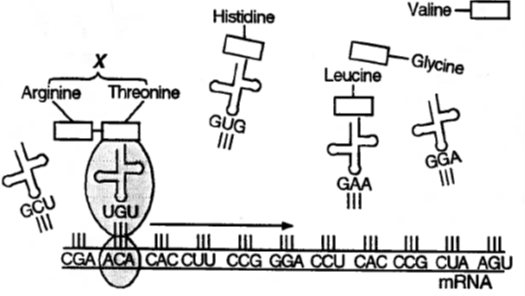
What does the diagram show?
a)
Transcription 
b)
Translation 
c)
Replication 
d)
All the above 
23.
A diagram of a cellular process is shown below. Which of the following identifies the process for Y? 
a)
translation 
b)
transcription 
c)
replication 
d)
translocation 
24.

The cells produced via meiosis are called:

a)

sex cells (gametes)

b)

somatic cells

c)

body cells

d)

skin cells

25.
This produces 2 identical cells.
a)
mitosis
b)
meiosis
26.
Meiosis makes sperm and egg cells. In humans, sperm and egg cells each have _____ chromosomes. Therefore a fertilized human egg cell (sperm and egg cell combined) would create a cell with _____ chromosomes.
a)
23, 46
b)
46, 23
c)
2, 4
d)
50, 100
27.
What kind of cells are made in MEIOSIS?
a)
Haploid Gametes
b)
Diploid Somatic Cells
c)
Skin Cells
d)
Liver Cells
28.
If the Diploid number of Carrots is 18, the haploid number is
a)
18
b)
9
c)
27
d)
36
29.
The chromosomes that pair up during meiosis, are called __________ chromosomes.  
a)
homozygous 
b)
asexual
c)
homologous
d)
genes
30.
A male shark has 40 chromosomes in each of its sex cells. How many would be present in its body cells?
a)
20
b)
40
c)
80
d)
160
31.
This picture shows which process? 
a)
mitosis
b)
meiosis
c)
the cell cycle
32.
Which process and type of resulting cells are represented?
a)
mitosis, gametes
b)
mitosis, body cells
c)
meiosis, gametes
d)
meiosis, body cells
33.
A dominant trait shows up __________.
a)
only when two dominant alleles are present
b)
only when two recessive alleles are present
c)
when at least one recessive allele is present
d)
when at least one dominant allele is present
34.
A recessive trait only shows up when __________.
a)
two dominant alleles are present
b)
one dominant allele is present
c)
two recessive alleles are present
d)
at least one dominant allele is present
35.
Two similar chromosomes that you inherit from your parens
a)
sister chromatids
b)
homologous chromosomes
c)
sex chromosomes
d)
homozygous alleles
36.
A person with type O blood marries a person with type AB blood. Possible blood genotypes of their children are
a)
I(A)i and I(B)I(B)
b)
I(B)I(B) and I(A)I(A)
c)
I(A)i and I(B)i
d)
I(A)I(B) and ii
37.
What is the genotype of a person with type A blood, who had a father with type O blood?
a)
IAIB
b)
IA i
c)
IAI
d)
ii
38.
Why would it be important to replicate DNA before a cell divides in mitosis or meiosis?
a)
In order for genetic information to be transferred into daughter cells.
b)
In order for the cell to be able to increase in size.
c)
In order for the DNA to be contained in the nucleus.
d)
In order for the cell to re-order the DNA sequencing in the new cells.
39.
In mitosis, the two resulting cells are
a)
different from the starting cell and identical to each other.
b)
different from the starting cell and different from each other.
c)
identical to the starting cell and different from each other.
d)
identical to the starting cell and identical to each other.
40.
The time between cell divisions in the life cycle of the cell is called
a)
anaphase
b)
interphase
c)
prophase
d)
metaphase
41.
Where does a cell contain it's genetic material?
a)
nucleus
b)
nucleolus
c)
cytoskeleton
d)
golgi
42.
In asexual reproduction
a)
DNA does not vary much between offspring
b)
Many offspring are produced in a short time
c)
Organisms may not be able to adapt to new environments
d)
All of the above
43.
If two organisms reproduce sexually, then their offspring will exhibit a genetic makeup that is -
a)
identical to only one parent
b)
identical to all of its siblings
c)
a unique combination of traits
d)
the recessive traits of each parent
44.
In looking at the graph, the crossing of the error bars at 15 and 25 degrees suggests
a)
there is a statistical difference in the average
b)
there is not a statistical difference in the average
45.
Which of the following is a circular DNA from bacteria that can hold a foreign gene?
a)
plasmid
b)
restriction enzyme
c)
ligase
d)
protein expression
46.
Which of the following is a protein that acts as DNA scissors?
a)
plasmid
b)
restriction enzyme
c)
ligase
d)
protein expression
47.
In bacteria, restriction enzymes are used for defense. They cut up the DNA of a virus that infects bacteria.
a)
True
b)
False
48.

This laboratory procedure is known as

a)

CLONING

b)

gel electrophoresis

c)

chromatography

d)

use of a dichotomous key

49.

The parents of a new baby believe they brought the wrong child home from the hospital. Gel electrophoresis was performed using DNA samples from the parents and the child. A section of the gel

electrophoresis results is shown below. Which conclusion is valid based on the gel electrophoresis results?

a)

They have the correct child, because her genetic information is identical to that of the father.


b)

They have the wrong child, because her genetic information does not match that of either parent.

c)

They have the correct child, because her genetic information came from both parents.


d)

They have the wrong child, because her genetic information matches only that of the mother.

50.

What is this technique an example of?

a)

chromatography

b)

gel electrophoresis

c)

direct harvesting

d)

recombinant DNA

51.
Based on these results whose blood was found in the blood stain at the crime scene?
a)
Bob
b)
Sue
c)
John
d)
Lisa
52.
Which suspect is likely guilty?
a)
Suspect #1
b)
Suspect #2
c)
Suspect #3
53.
In gel electrophoresis, the largest DNA fragment will appear
a)
closest to the starting wells
b)
farthest from the starting wells
c)
three quarters away from the starting wells
d)
it depends on how many fragments there are
54.
Why do the fragments of DNA in gel electrophoresis travel away from the negative electrode?
a)
DNA is negatively charged so attracted to the positive end of the unit
b)
DNA is positively charged to attracted to the negative end of the unit
c)
the agarose gel in negatively charged
d)
the agarose gel is positively charged
55.
Which is the primary purpose of using restriction enzymes in gel electrophoresis?
a)
It allows the strands of DNA to be cut into various lengths for testing
b)
It restricts the number of base pairs that can be tested in a sample
c)
It makes the testing simpler by moving the strands into the gel faster
d)
It charges the DNA strands
56.

In a DNA fingerprint, lighter-weight fragments can be found at the:

a)

Top

b)

Bottom

c)

Middle

d)

Front

57.

Which man is the actual father of the child?

a)

"Dad" 1

b)

"Dad" 2

c)

"Dad" 3