
Font size
S
M
L
XL
 Worksheets
Environmental Chemistry Final Exam Review, Part 2
Total questions: 104
Worksheet time: 2hrs 56mins
Name
Class
Date
1.
What is the pH of a 0.001M NaOH solution?
a)
3
b)
11
c)
1
d)
4
2.
What is the pH of a solution with an H+ concentration of 1 * 10-7?
a)
7
b)
14
c)
6
d)
4
3.
What is the concentration of OH- in 0.005 M LiOH?
a)
.005 M
b)
< .005M
c)
> .005 M
4.
What is the concentration of H+ in 0.005 M HF?
a)
.005M
b)
< .005M
c)
> .005M
5.
A weak acid is a weak electrolyte because
a)
it dissociates fully in solution
b)
it partially dissociates in solution
c)
it does not dissociate at all in solution
6.
Which of the following is a property of acids
a)
React with many metals
b)
turn litmus paper blue
c)
feel slipper
d)
taste bitter
7.
A substance tastes sour, what pH would you expect it to have?
a)
0
b)
14
c)
7
d)
Impossible to tell
8.
A substance is described as being slippery, what type of pH would you expect that substance to have?
a)
0
b)
14
c)
7
d)
Impossible to tell
9.
Ca(OH)2
a)
Strong acid
b)
Weak acid
c)
Strong base
d)
Weak base
10.
HSO4-(aq)+H2O(l) → H3O+(aq)+SO42-(aq)
Identify the Acid in the above reaction.
Identify the Acid in the above reaction.
a)
HSO4-
b)
H2O
c)
H3O+
d)
SO42-
11.
A compound that donates H+ ions is
a)
A Bronsted-Lowry Acid
b)
An Arrhenius Acid
c)
A Bronsted-Lowry Base
d)
An Arrhenius Base
12.
If a solution is basic which ion will be more present?
a)
H+
b)
K+
c)
OH-
d)
H-
13.
A substance that remains when a base has accepted an H+ ion is
a)
An acid
b)
A Base
c)
A Conjugate Acid
d)
A Conjugate Base
14.
Accepts a proton (H+ hydrogen ion)
a)
Lewis Base
b)
Arrhenius Base
c)
Bronstead Lowry Base
d)
Lewis Acid
15.
What happens when an acid and a base mix?
a)
Optimization
b)
Equalization
c)
Neutralization
d)
Nebulization
16.
Which of the following is a conjugate acid/base pair?
a)
HCl/OCl-
b)
H2SO4/SO42-
c)
NH4+/NH3
d)
H3O+/OH-
17.
What is the conjugate base of HCO3-?
a)
HCO3-
b)
H2CO3-
c)
H2CO3
d)
CO32-
18.
A solution in which [H+] > [OH-] is....
a)
Acidic
b)
Basic
c)
Neutral
d)
Water
19.
Orange Juice = pH 3.7
Bleach = pH 13
Pure water = pH 7
Battery acid = pH 1.3
Which of the following has the highest hydrogen ion concentration?
Bleach = pH 13
Pure water = pH 7
Battery acid = pH 1.3
Which of the following has the highest hydrogen ion concentration?
a)
orange juice
b)
bleach
c)
pure water
d)
battery acid
20.
Which statement is true?
a)
Acids start with H and bases end with OH
b)
Acids start with OH and bases end with H
c)
Acids end with H and bases start with OH
d)
Acids end with OH and bases start with H
21.
A strong acid:
a)
completely dissociates in water
b)
partly dissociates in water
c)
doesn't dissociate in water
d)
has a really high pH
22.
If the concentration of [OH-] is 3.4 * 10-3, what is the concentration of [H+]
a)
1 * 10-7
b)
2.9 * 10-12
c)
3.4 * 10-3
d)
1 * 10-14
23.
___Ba(OH)2 +__H2SO4 -----> __BaSO4 + __H2O
In the following unbalanced neutralization reaction, it took 55 mL of 1.5 M Ba(OH2) to completely neutralize the sample of 3.0 M H2SO4. What is the volume of the acid?
In the following unbalanced neutralization reaction, it took 55 mL of 1.5 M Ba(OH2) to completely neutralize the sample of 3.0 M H2SO4. What is the volume of the acid?
a)
55 mL
b)
110 mL
c)
33 mL
d)
235 mL
24.
___Ba(OH)2 +__H2SO4 -----> __BaSO4 + __H2O
If 341 g of barium hydroxide is neutralized by 250 mL of sulfuric acid, what is the molarity of the acid?
If 341 g of barium hydroxide is neutralized by 250 mL of sulfuric acid, what is the molarity of the acid?
a)
5 M
b)
8 M
c)
2 M
d)
1 M
25.
Beryllium will ____ valence electrons when forming an ionic bond.
a)
lose 4
b)
gain 4
c)
lose 2
d)
gain 2
26.
If an element has 3 valence electrons, what charge will likely form on its ion ?
a)
+3
b)
+5
c)
-3
d)
-5
27.
Cations are _______ charged ions.
a)
positively
b)
negatively
c)
neutrally
d)
none of the above
28.
Oxygen becomes an anion by _______ electrons.
a)
losing
b)
gaining
c)
sharing
d)
exciting
29.
Atoms that gain & lose electrons are called _________
a)
ions
b)
isotopes
c)
radioactive
d)
corrosive
30.

Where are the metalloids / semimetals located on the periodic table?
a)
Blue
b)
Red
c)
Green
31.
What element color typically loses electrons and forms cations?
a)
Blue
b)
Red
c)
Green
32.
Which element color commonly forms anions?
a)
Blue
b)
Red
c)
Green
33.

What section is the least reactive?
a)
yellow
b)
red
c)
dark blue
d)
orange
34.
Elements in the same ________ are more chemically similar.
a)
group
b)
period
c)
club
d)
table
35.
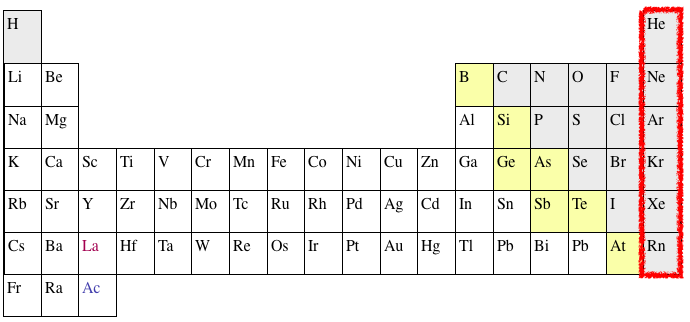
What element family is circled above?
a)
halogen
b)
Noble gases
c)
alkali metals
d)
transition metals
36.
The chemical formula for Barium Nitride is:
a)
Ba(NO3)2
b)
Ba3N2
c)
Ba(NO2)2
37.
The chemical formula for Barium Nitride is:
a)
Ba(NO3)2
b)
Ba3N2
c)
Ba(NO2)2
38.
The how many electrons does barium need to lose and nitrogen need to gain in order to form Barium nitride:
a)
barium loses 2, nitrogen gains 3
b)
barium loses 3, nitrogen gains 2
c)
barium loses 3, nitrogen gains 3
d)
barium loses 2, nitrogen gains 2
39.
The chemical formula for Barium Nitrate is:
a)
Ba(NO3)2
b)
Ba3N2
c)
Ba(NO2)2
40.
The chemical formula for Barium Nitrite is:
a)
Ba(NO3)2
b)
Ba3N2
c)
Ba(NO2)2
41.
Disulfur trioxide
a)
S3O2
b)
SO
c)
S2O3
d)
S2O
42.

Which of these is covalent?
a)
NaCl
b)
Pb(NO3)2
c)
CO2
d)
AlCl3
43.
Tribromine nonoxide
a)
Br3O9
b)
Br3O10
c)
Br3O6
d)
Br3O4
44.
Which has the greater electronegativity:
H, N, O or F?
H, N, O or F?
a)
H
b)
F
c)
N
d)
O
45.

a)
substitution
b)
addition
c)
polymerization
d)
fermentation
46.
Which compound belongs to the alkene series?
a)
C2H2
b)
C2H4
c)
C6H6
d)
C6H14
47.
Which type of bond occurs in a saturated hydrocarbon molecule?
a)
single covalent bond
b)
double covalent bond
c)
triple covalent bond
d)
ionic bond
48.

Is this hydrocarbon saturated or unsaturated?
a)
saturated
b)
unsaturated
49.

How many double bonds in the compound?
a)
1
b)
6
c)
12
d)
5
50.

what kind of molecule is this?
a)
alkane
b)
alkene
c)
alkyne
d)
cycloalkane
51.

Give the name of this compound...
C3H8
C3H8
a)
Propene
b)
Butyne
c)
Butene
d)
Propane
52.
If an alkane has 20 carbon atoms, how many hydrogen atoms will it have?
a)
20
b)
22
c)
40
d)
42
53.
Which of the following molecules has the greatest bond strength?
a)
Single
b)
Double
c)
Triple
54.
Which of the following molecules has the greatest bond length?
a)
Single
b)
Double
c)
Triple
55.
A::A represents a
a)
single bond
b)
triple bond
c)
double bond
d)
quadruple bond
56.
Disulfur trioxide
a)
S3O2
b)
SO
c)
S2O3
d)
S2O
57.
What is the correct formula for oxygen difluoride?
a)
OF
b)
OF2
c)
O2F
d)
O2F2
58.
A:::A represents a
a)
double bond
b)
triple bond
c)
single bond
d)
quadruple bond
59.
According to VSEPR, molecules adjust their shapes to keep which of the following as far away as possible?
a)
Pairs of valence electrons
b)
Inner shell electrons
c)
Mobile Electrons
d)
Electrons closest to the nucleus
60.
What is the measure of a tetrahedral bond angle?
a)
90 Degrees
b)
109.5 Degrees
c)
120 Degrees
d)
180 Degrees
61.
Which shapes are altered by unshared pairs of electrons?
a)
Bent and Pyramidal
b)
Trigonal Planar and Bent
c)
Tetrahedram and Bipyramidal
d)
Pyramidal and Linear
62.

Which of the following is an acceptable Lewis structure for CH3Cl?
a)
Option A
b)
Option B
c)
Option C
d)
Option D
63.

Which of the following is the correct Lewis structure for CH2O?
a)
Option A
b)
Option B
c)
Option C
d)
Option D
64.
If option D is the correct shape for CH2O, what is the molecular shape of this molecule?
a)
Tetrahedral
b)
Bent
c)
Trigonal Pyramidal
d)
Trigonal Planar
65.
What is the molecular shape of methane?
a)
Tetrahedral
b)
Bent
c)
Trigonal Pyramidal
d)
Trigonal Planar
66.
What is the molecular shape of PH3?
a)
Tetrahedral
b)
Bent
c)
Trigonal Pyramidal
d)
Trigonal Planar
67.
Oil is immiscible in water because
a)
Oil is polar
b)
Oil is non-polar
68.
If fluorine is stronger then carbon, what charge will the fluorine receive?
a)
negative
b)
slight negative
c)
positive
d)
slight positive
69.
Hydrocarbons will have which type of intermolecular forces?
a)
Dispersion
b)
dipole
c)
hydrogen bonds
70.
Because electrons are distributed equally, a hydrocarbon is ___.
a)
polar
b)
nontoxic
c)
nonpolar
d)
insoluble
71.
What characteristic of water makes it the universal solvent?
a)
nonpolar
b)
large molecules
c)
long-chain hydrocarbon
d)
polar
72.
A solution that contains all the solute it can hold at a given temperature is ___.
a)
unsaturated
b)
saturated
c)
supersaturated
d)
soluble
73.
Gases are ___ in cooler solvents.
a)
less soluble
b)
insoluble
c)
precipitates
d)
more soluble
74.
Which of the following actions increases the rate of dissolving?
a)
decreasing the temperature
b)
using larger-sized crystals
c)
decreasing the pressure
d)
stirring the solution
75.
The thing that does the dissolving
a)
Solute
b)
Solvent
c)
Colloid
d)
Solution
76.
You can make a solution more concentrated by adding __________.
a)
solute
b)
solvent
c)
water
77.

Attractions between water molecules are called
a)
Covalent bonds
b)
Ionic bonds
c)
Polar bonds
d)
Hydrogen bonds
78.

Water is polar because...
a)
The unequal sharing of electrons gives the water molecule a slight negative charge near its oxygen atom and a slight positive charge near its hydrogen atoms.
b)
The molecule has two poles, at which the it is colder than other regions of the molecule.
c)
The unequal sharing of electrons gives the water molecule a slight negative charge near its hydrogen atoms and a slight positive charge near its oxygen atom.
d)
The water molecule is neutral.
79.

True or false, water is a polar molecule?
a)
True
b)
False
80.
How many carbons are in the backbone (longest chain) of this organic compound: 2-ethyl-3-chloroheptane
a)
2
b)
4
c)
6
d)
7
81.

What is the name of this molecule?
a)
butane
b)
2-butene
c)
2-butyne
d)
cycloalkane
82.

Are the compounds shown isomers
a)
Yes
b)
No
83.

Are the compounds shown isomers
a)
Yes
b)
No
84.

Are the compounds shown isomers
a)
No
b)
Yes
85.
How many carbons are in the backbone (longest chain) of this organic compound: 2,3,3-triethyl-4-nonene
a)
2
b)
6
c)
7
d)
9
86.
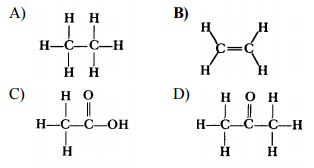
Which formula represents an unsaturated hydrocarbon?
a)
A
b)
B
c)
C
d)
D
87.
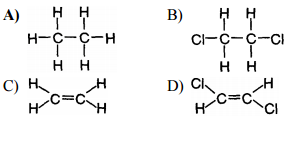
Which formula represents a saturated hydrocarbon?
a)
A
b)
B
c)
C
d)
D
88.

Name the following molecule?
a)
2,3-dichlorobutene
b)
cis-2,3-dichlorobutene
c)
trans-2,3-dichlorobutene
89.

Name the compound
a)
hexane
b)
2,3-dimethylbutane
c)
ethylbutane
d)
2,2-dimethylbutane
90.

Name the compound
a)
3-methyl-2-pentene
b)
2-ethyl-2-butene
c)
3-ethyl-2-butene
d)
1,1-dimethyl-propene
91.

Name the compound
a)
nonene
b)
2,2-dimethyl-3-heptene
c)
1,1,5-trimethyl-2-hexene
d)
2,6-dimethyl-3-heptene
92.

Name the organic family for this structure:
a)
alkanes
b)
alkenes
c)
alkynes
d)
aromatics
93.
What mass of NaCl was dissolved in a 500mL solution before it was diluted to 2.0L of a 1.5M concentration?
a)
174g
b)
6 M
c)
3 mol
d)
6g
94.
Benzene is used to make a non-polar solution, which of the following substances would best dissolve in benzene?
a)
water
b)
salt
c)
vinegar
d)
oil
95.
One grain of Sugar was added to a glass of sweet tea and several grains of sugar fell to the bottom of the glass. This solution is an example of a _________ solution.
a)
Saturated
b)
unsaturated
c)
super saturated
d)
dissolved
96.
Which of the following will dissolve most rapidly?
a)
sugar cubes in cold water
b)
sugar cubes in hot water
c)
powdered sugar in cold water
d)
powdered sugar in hot water
97.

According to saturation curves shown in the figure, which of the following solutions is supersaturated?
a)
80 g of NaCH3COO in 100 g of water at 40oC
b)
140 g of NaCH3COO in 100 g of water at 80oC
c)
40 g of NaCH3COO in 100 g of water at 40oC
d)
80 g of NaCH3COO in 200 g of water at 40oC
98.
The word equation for combustion is: fuel + oxygen --> water + ________ __________
a)
Carbon dioxide
b)
Limewater
99.
How much heat is released when 2.8 moles of methane reacts.
CH4 + O2 → CO2 + H2O + 891 kJ
CH4 + O2 → CO2 + H2O + 891 kJ
a)
2500 kJ
b)
890 kJ
c)
540 kJ
d)
240 kJ
100.
The product of reacting propene with hydrochloric acid is:
a)
2-chloropropane
b)
2-chloropropene
c)
2-chloropropyne
d)
chloropropane
101.

What is the product that forms from reaction 1 shown in the picture?
a)
1,2-dibromobutane
b)
1-bromobutane
c)
n-butane
d)
1-butanol
102.
What is the possible product that forms from reaction 2 shown in the picture?
a)
1,2-dibromobutane
b)
1-bromobutane
c)
n-butane
d)
1-butanol
103.
What is the possible product that forms from reaction 3 shown in the picture?
a)
1,2-dibromobutane
b)
1-bromobutane
c)
n-butane
d)
1-butanol
104.
What is the possible product that forms from reaction 4 shown in the picture?
a)
1,2-dibromobutane
b)
1-bromobutane
c)
n-butane
d)
1-butanol
Reset

