wayground logo

Free Printable Worksheets

Font size

S
M
L
XL
Worksheets

Redox and Electrochemistry Review

Total questions: 104

Worksheet time: 5hrs 30mins
Name
Class
Date
1.
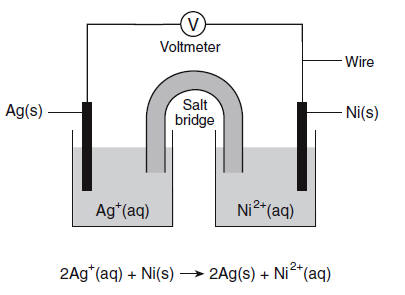
What reaction occurs at the anode?
a)
Ag+ + e- →Ag
b)
Ag → Ag+ + e-
c)
Ni2+ + 2e- → Ni
d)
Ni → Ni2+ + 2e-
2.
What element is being Oxidized?
a)
N
b)
H
c)
O
d)
S
3.
Reduction happens at the 
a)
anode
b)
cathode
c)
salt bridge
d)
voltmeter
4.
This electrode loses mass 
a)
anode
b)
cathode
5.
What coefficient would Fe+2 have in the following reaction?
___ Al + ___ Fe+2 → ___ Al+3 + ___ Fe
a)
1
b)
2
c)
3
d)
6
6.

Is calcium oxidized or reduced in the following reaction?  2CaO  2Ca + O22CaO\ \longrightarrow\ 2Ca\ +\ O_2

a)

Oxidized

b)

Reduced

7.
Which of the following half reactions correctly represents a reduction half reaction?
a)
Fe →Fe2+ + 2e-
b)
Pb4+ + 2e- →Pb2+
c)
2O-2 →O2 + 4e-
d)
Fe + 3e- →Fe3+
8.

Which energy conversion shown below takes place in a voltaic cell?

a)

Electrical to chemical

b)

Mechanical to chemical

c)

Mechanical to electrical

d)

Chemical to electrical

9.
In a voltaic cell the ions flow through the 
a)
wire
b)
salt bridge
10.
In a voltaic cell electrons flow
a)

through the salt bridge

b)

from the cathode to the anode through the wire

c)

from the anode to the cathode through the wire

11.
What occurs at the cathode in an electrolytic cell?
a)
oxidation
b)
reduction
12.
Which of the following reactions is balanced by both mass and charge?
a)
Fe+2 + Al →Fe + Al+3
b)
Cu + Fe+2 → Cu+1 + Fe+3
c)
F2 + Br- --> F- + Br2
d)
Fe+2 + 2 Cu --> 2 Cu+ + Fe
13.

What is the oxidation number of chlorine in HClO?

a)

0

b)

-1

c)

+1

d)

+5

14.

Oxidation is the _________ of electrons.

a)

loss

b)

gain

c)

sharing

d)

transfer

15.

Reduction is the ___________ of electrons.

a)

loss

b)

gain

c)

sharing

d)

transfer

16.

What is the oxidation number of nitrogen in N2?

a)

-3

b)

0

c)

+4

d)

-1

17.

The sum of the oxidation numbers in SCN- is equivalent to

a)

0

b)

-1

c)

+1

d)

+3

18.

The sum of the oxidation numbers in Na2CO3 is equivalent to

a)

0

b)

-2

c)

+1

d)

-1

19.

What is the oxidation number of iodine in KIO3?

a)

0

b)

-1

c)

+5

d)

+1

20.

Determine the oxidation number of chromate in CrO42-.

a)

+6

b)

0

c)

+2

d)

+3

21.

Which of the following represents oxidation?

a)

C → CH4

b)

Fe3+ → Fe2+

c)

Cl2 → 2Cl-

d)

Zn → ZnO

22.
Which of the following represents reduction?
a)
C →  CO
b)
N2 →  NH3
c)
Zn  →   Zn2+ 
d)
H2 →  H2O
23.

In the reaction Zn + 2HCl --> ZnCl2 + H2

which element, if any, is oxidized?

a)

Zinc

b)

Hydrogen

c)

Chlorine

d)

None

24.
In the reaction
2Ca(s) + O2(g) --> 2CaO(s), calcium is __________
a)
Reduced
b)
Synthesized
c)
Oxidized
d)
None of the above
25.
Which statement is true:
Mg → Mg2+ + 2e
a)
Mg gains 2 electrons
b)
Mg2+ loses 2 electrons
c)
Mg loses 1 electron
d)
Mg loses 2 electrons
26.
What substance is oxidized in the following reaction?
4Fe + 3O2 --> 2Fe2O3
a)
Iron
b)
Fluorine
c)
Oxygen
27.
Is calcium oxidized or reduced in the following reaction? 
2CaO--> 2Ca + O2
a)
Oxidized
b)
Reduced
28.
Which of the following half reactions correctly represents a reduction half reaction?
a)
Fe →Fe2+ + 2e-
b)
Pb4+ + 2e- →Pb2+
c)
2O-2 →O2 + 4e-
d)
Fe + 3e- →Fe3+
29.
If in a reaction, copper is reduced; its number of electrons has:
a)
Increased
b)
Decreased
c)
Remained Constant
d)
Varies Randomly
30.
What is oxidation number of O in O2 ?
a)
0
b)
-2
c)
+1
d)
+2
31.

What are the oxidation numbers of elements in phosphoric acid, H3PO4?

a)

H = +1, P = +1, O = -2

b)

H = +1, P = +5, O = -2

c)

H = +3, P = +1, O = -4

d)

H = +3, P = +5, O = -8

32.

What are the oxidation numbers of elements in sulfuric acid, H2SO4?

a)

H = +1, S = +6, O = -2

b)

H = +1, S = +4, O = -2

c)

H = +2, S = +1, O = +4

d)

H = +2, S = +6, O = -8

33.
Which of the following elements does NOT have an oxidation number of +2?
a)
Ca
b)
Sr
c)
K
d)
Ba
34.

Which of the following reaction types are redox? More than one answer is correct.

a)

Single replacement

b)

Synthesis

c)

Combustion

d)

Double replacement (precipitation)

e)

Double replacement (acid-base)

35.

What element is being reduced?


I2 + H2SO3 + H2O --> 2 HI + H2SO4

a)

I

b)

H

c)

S

d)

O

36.
What are the oxidation numbers for NH4Cl
a)
N: 3+   H: 1+   Cl: 1-
b)
N: 3-   H: 1+   Cl: 1+
c)
N: 3-   H: 1+   Cl: 1-
d)
cannot be determined
37.
Which equation shows an oxidation reaction?
a)
A
b)
B
c)
C
d)
D
38.

Which element is oxidized?

H2S + Cl2 → 2HCl + S

a)

H

b)

S

c)

Cl

d)

Not a redox reaction

39.
Oxygen always has an oxidation number of...
a)
-1
b)
1
c)
2
d)
-2
40.

Defined as the loss of electrons.

a)

oxidation

b)

reduction

c)

redox

d)

OIL RIG

41.

Defined as the gain of electrons.

a)

oxidation

b)

redox

c)

reduction

d)

LEO GER

42.

A redox reaction is NOT:

a)

all reactions

b)

a combustion reaction

c)

a reduction-oxidation reaction

d)

a reaction in which electrons are transferred from one atom to another

43.

These keep track of the movement of electrons.

a)

(+) and (-) signs

b)

oxidation numbers

c)

coefficients

d)

subscripts

44.

Cl2 + 2e- --> 2Cl - is an example of:

a)

a chemical reaction

b)

redox

c)

oxidation

d)

reduction

45.

In a redox reaction, the species that loses electrons

a)

is called the cathode

b)

is oxidized

c)

gains mass at the electrode

d)

decreases in oxidation number

46.

As an element is oxidized, its oxidation number

a)

decreases as electrons are lost

b)

increases as electrons are lost

c)

decreases as electrons are gained

d)

increases as electrons are gained

47.

The reaction 2NaCl → 2Na + Cl2 is an example of

a)

a reduction reaction, only

b)

both an oxidation and reduction reaction

c)

an oxidation reaction, only

d)

neither an oxidation nor a reduction reaction

48.

Oxidation-reduction reactions occur because of the competition between particles for

a)

electrons

b)

positrons

c)

protons

d)

neutrons

49.

Mg + PbCl2 → MgCl2 + Pb

Which statement correctly describes the oxidation and reduction that occur?

a)

Mg is oxidized and Pb+2 is reduced

b)

Mg is oxidized and Cl- is reduced

c)

Mg is reduced and Cl- is oxidized

d)

Mg is reduced and Pb+2 is oxidized

50.

Pb + 2Ag+ → Pb+2 + 2Ag


The chemical species being reduced is

a)

Ag

b)

Pb

c)

Pb+2

d)

Ag+

51.

In electrolysis of copper purification, at cathode

a)

pure copper gets deposited

b)

the object to be electroplated is kept

c)

impure copper gets deposited

d)

CuSO4 gets deposited

52.

An electrolytic cell uses electrical energy to drive

a)

chemical reaction

b)

physical reaction

c)

no reaction

d)

none of above

53.

Voltaic cells convert

a)

mechanical energy in to electrical energy

b)

potential energy in to electrical energy

c)

electrical energy in to chemical energy

d)

chemical energy in to electrical energy

54.

When water is electrolyzed, gas collected at cathode, is

a)

sulphur

b)

oxygen

c)

hydrogen

d)

sulphur dioxide

55.

In electrolysis, particles which move towards cathode are called

a)

anions

b)

cations

c)

photons

d)

positrons

56.
Which energy conversion shown below takes place in an electrochemical cell?
a)
Electrical to chemical
b)
Mechanical to chemical
c)
Mechanical to electrical
d)
Chemical to electrical
57.
Reduction happens at the 
a)
Spa
anode
b)
Cathode
c)
Salt bridge
d)
Anode
58.
Oxidation happens at the
a)
Anode
b)
Cathode
c)
Salt bridge
d)
Voltmeter
59.

This electrode in a voltaic cell gains mass

a)

Anode

b)

Cathode

60.

This electrode in a voltaic cell loses mass

a)

Anode

b)

Cathode

61.

In a voltaic cell, the half cell that receives anions from the salt bridge is

a)

Cathode

b)

Anode

62.
In which direction does electricity flow in a galvanic (voltaic) cell (battery)?
a)
Electrons flow from the cathode to the anode
b)
Electrons flow from left to right
c)
Electrons flow from anode to cathode
d)
Electrons flow from right to left
63.
The electrolysis of molten sodium chloride produces
a)
hydrochloric acid
b)
sodium metal and chlorine gas
c)
chlorine gas and aqueous sodium hydroxide
d)
glucose
64.
The electrolysis of water produces
a)
acids and bases
b)
hydrogen gas only
c)
hydrogen gas and oxygen gas
d)
oxygen gas only
65.
To electroplate an object it would have to be made to be the
a)
anode
b)
cathode
66.
The covering of a thin layer of metal is
a)
electrowinning
b)
electrorefining
c)
electroplating
d)
electromachining
67.
Which cell is not spontaneous?
a)
voltaic
b)
electrolytic
68.
Which cell has energy coming out?
a)
voltaic
b)
electrolytic
69.
Which type of electrochemical cell is used as a battery?
a)
voltaic
b)
electrolytic
70.
Which cell is used for metal plating?
a)
voltaic
b)
electrolytic
71.
An iron nail is put into a solution of copper nitrate, iron is above copper in the activity series of metals, what will happen?
a)
iron will be reduced
b)
bubbles of oxygen gas will form on iron nail
c)
the iron nail will become copper plated
d)
no reaction occurs
72.
If Al is above Co in the activity series of metals, which of the following will occur if Al metal is put into a solution of cobalt nitrate?
a)
a redox reaction takes place
b)
the Al strip dissolves
c)
the Al strip becomes coated with cobalt
d)
all of the above
73.
The electrode at which reduction occurs
a)
cathode
b)
anode
c)
salt bridge
d)
electrode
74.
The process in which electrical energy is used to bring about a chemical change
a)
fuel cell
b)
battery
c)
electrolysis
d)
voltaic cell
75.
     In the reaction Zn + H2O --> ZnO2 + H2
 which element, if any, is oxidized? 
a)
Zinc
b)
Hydrogen
c)
Oxygen
d)
None
76.
Another name for a "oxidation-reduction" reaction is
a)
chemical reaction
b)
neutralization reaction
c)
redox reaction
d)
nuclear reaction
77.
How would you write the electrons in the reaction O2 --> O2-2 ?
a)
+2e- on the products
b)
+2e- on the reactants
c)
+e- on the products
d)
+e- on the reactants
78.
Which of the following is the balanced half -reaction for the oxidation of Cu to Cu+2?
a)
Cu   --> Cu+2
b)
Cu + 2 e-   --> Cu+2
c)
Cu  --> Cu+2  + 2 e-
d)
Cu - 2e-  --> Cu+2
79.
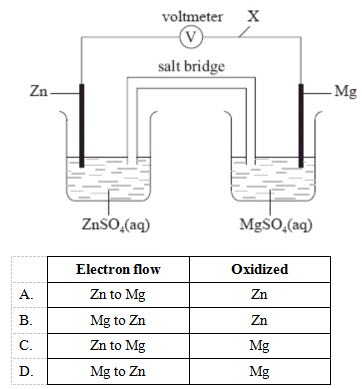
Which direction do the electrons flow in wire X and which metal is oxidized?
a)
A
b)
B
c)
C
d)
D
80.

Which statement best describes how a salt bridge maintains electrical neutrality in the half-cells of an electrochemical cell?

a)

It prevents the migration of electrons.

b)

It prevents the reaction from occurring spontaneously.

c)

It permits the migration of ions.

d)

It allows for the reaction from occurring spontaneously.

81.

What is the oxidation state for a lead atom?

a)

2+

b)

4+

c)

0

d)

2-

82.
Reactions in voltaic cells are
a)
spontaneous, redox reactions
b)
non-spontaneous, redox reactions
c)
spontaneous, non-redox reactions
d)
non-spontaneous, non-redox reactions
83.
Which of the following half reactions correctly represents a reduction half reaction?
a)
Fe →Fe2+ + 2e-
b)
Pb4+ + 2e- →Pb2+
c)
2O-2 →O2 + 4e-
d)
Fe + 3e- →Fe3+
84.

Which of the following statements refers to an oxidation process?

a)

Hydrogen is added to ethene

b)

Oxygen is removed from carbon dioxide

c)

Chlorine accepts electrons

d)

Increase in the oxidation number of magnesium metal

85.

In a redox reaction, there is a conservation of

a)

mass, only

b)

charge, only

c)

both mass and charge

d)

neither mass nor charge

86.

During an oxidation-reduction reaction, the number of electrons gained is

a)

equal to the number of electrons lost

b)

equal to the number of protons gained

c)

less than the number of electrons lost

d)

less than the number of protons gained

87.

When a lithium atom forms an Li+ ion, the lithium atom

a)

gains a proton

b)

gains an electron

c)

loses a proton

d)

loses an electron

88.
What is oxidation number of Fe in FeO ?
a)
+2
b)
-2
c)
0
d)
+1
89.
What is oxidation number of H in CaH2?
a)
+1
b)
-1
c)
0
d)
+2
90.
What is oxidation number of Cr in Cr2O72-?
a)
-2
b)
+2
c)
+6
d)
+12
91.
The sum of all oxidation numbers in a neutral compound is ___.
a)
0
b)
1
c)
-1
d)
depends on the compound
92.
Metal A is more reactive than metal B. Which statement is correct?
a)
Electrons flow in the external circuit from A to B
b)
Positive ions flow through salt bridge from A to B
c)
Positive ions flow in external circuit from B to A.
d)
Electrons flow through salt bridge from B to A
93.
Below shows a cell diagram for voltaic cell. Which of the following is FALSE?
a)
Electrons flow from anode to cathode
b)
Oxidation happens in anode
c)
Copper undergo reduction to form copper ions
d)
Zinc undergo oxidation to form Zinc ions
94.
In which direction does electricity flow in a voltaic cell (battery)?
a)
Electrons flow from the cathode to the anode
b)
Electrons flow from left to right
c)
Electrons flow from anode to cathode
d)
Electrons flow from right to left
95.

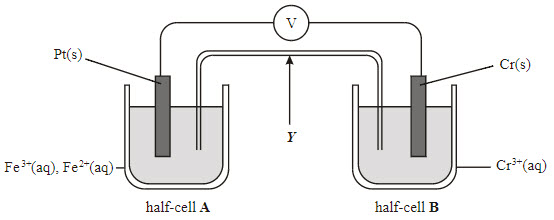
What is the function of Y in cell below?

a)

To complete the circuit

b)

To allow flow of electrons between both cells

c)

To allow flow of ions

d)

To connect both half cells

96.
What occurs during electrolysis of a molten salt?
a)
Electricity is produced by a spontaneous redox reaction
b)
Electricity cause a non-spontaneous redox reaction to occur
c)
Electrons flow through the molten salt
d)
Electrons are removed from both ions of the molten salt
97.
Object is electroplated with copper using copper(II) sulfate. Which statement is correct?
a)
Positive electrode increases in mass
b)
Concentration of Cu2+ ions in solution decreases
c)
Reduction occurs at positive electrode
d)
Reaction at negative electrode is Cu2+ + 2e → Cu
98.
What is electrolysis?
a)
breaking down of a compound using a current
b)
making a compound using a current
99.
Explain why the electrolyte has to be a liquid.
a)
So the ions can move
b)
So the electrons can move
c)
So that it doesn't get too hot
d)
So the fish are ok
100.

All chemical reactions must

a)

conserve all 3

b)

conserve mass

c)

conserve charge

d)

conserve energy

101.

What is happening at the Mg electrode/Half Cell 1

a)

Mg atoms are being oxidized to Mg+2 ions

b)

Mg+2 ions are being oxidized to Mg atoms

c)

Mg atoms are being reduced to Mg+2 ions

d)

Mg+2 ions are being reduced to Mg atoms

102.

What is happening at the Fe electrode/Half Cell 2

a)

Fe atoms are being reduced to Fe+2 ions

b)

Fe+2 ions are being oxidized to Fe atoms

c)

Fe+2 ions are being reduced to Fe atoms

d)

Fe atoms are being oxidized to Fe+2 ions

103.

What is happening at the Mg electrode/Half Cell 1

a)

Electrode mass decreases

b)

Electrode mass increases

c)

Ion concentration increases

d)

Ion concentration decreases

104.

What is happening at the Fe electrode/Half Cell 2

a)

Electrode mass decreases

b)

Electrode mass increases

c)

Ion concentration increases

d)

Ion concentration decreases