
NEW
Font size
S
M
L
XL
 Worksheets
LE: Evolution & Ecology
Total questions: 53
Worksheet time: 2hrs 30mins
Name
Class
Date
1.
Survival of at least a few members of a population after a major environmental change is most dependent on
a)
the population having an individual that is adapted to the original environment
b)
the population having an individual that is adapted to great changes in the temperature in its environment
c)
variations in many different traits in many individuals in the population
d)
no variations in the color of the fur, skin, or feathers of the individuals in the population
2.
The theory of evolution states that
a)
species that are extinct have no biological relationship to living species
b)
different animal species always interbreed to form new and different species
c)
species change over time, sometimes developing into new species
d)
the environment of Earth is constant over time
3.
Evolution can occur at different rates; however, for evolution to occur, there must be
a)
variations within a species
b)
extinction of the species
c)
asexual reproduction
d)
no change in the genes of an organism
4.
Natural selection is best described as
a)
a change in an organism in response to a need of that organism
b)
a process of nearly constant improvement that leads to an organism that is nearly perfect
c)
differences in survival rates as a result of different inherited characteristics
d)
) inheritance of characteristics acquired during the life of an organism
5.
Which statement best describes a situation where competition occurs in an ecosystem?
a)
A deer outruns an attacking wolf
b)
A deer, during the winter, consumes tree bark.
c)
A deer and a rabbit consume grass in a field
d)
A deer and a rabbit are both startled by a hawk flying overhead.
6.
Fossils provide evidence that
a)
life on Earth millions of years ago was more complex than life is today
b)
the changes that will occur in species in the future are easy to predict
c)
many species of organisms that lived long ago are now extinct
d)
most species of organisms that lived long ago are exactly the same today
7.
Plant species X lives in a hot, dry environment. Slowly, over hundreds of years, the climate becomes wetter. Fungi attack species X and cause the population of species X to decrease. However, plant species X could survive if the plants
a)
try to mutate quickly and synthesize new proteins
b)
are watered often and fertilized with extra nutrients
c)
can adapt to the new conditions by mating with the fungus
d)
have a few members of the population that are fungus-resistant
8.
Farmers may someday clone their best milkproducing cow into a whole herd. What potential disadvantage might be important to consider in having such a large group of clones on one farm?
a)
It may be difficult to tell the animals apart.
b)
Lack of variation may limit survival in the herd
c)
The cows could be fertilized by only one type of bull.
d)
The cows could be mated only with each other.
9.
Many animals have developed courtship behaviors. Males will often dance, swim, or sing in a particular way to attract a female. Males who are more successful at the courtship behavior will have a greater chance of having more offspring. This behavior is a result of
a)
natural selection
b)
genetic engineering
c)
asexual reproduction
d)
gene manipulation
10.
A farmer wanted to rid his apple trees of a particular leaf-eating insect. He sprayed his trees with an insecticide that killed 98% of the insects. The survival of 2% of this population of insects is most likely due to
a)
genes obtained from another species
b)
certain chemicals that stimulated overproduction
c)
variations that resulted from sexual reproduction
d)
their ability to produce food from the pesticide
11.
Which occurrence represents an example of evolution?
a)
Exposure to radiation reduces the rate of mutation in leaf cells.
b)
A mutation in a liver cell causes a person to produce an enzyme that is less efficient.
c)
Cells in a zygote eventually change into bone cells or skin cells.
d)
Some antibiotics are almost useless, because pathogens have developed a resistance to these antibiotics.
12.
Potato farmers in Ireland during the mid 1800s all grew the same type of potato. The potato plants were all produced as clones of one another. When a fungus infected the crop, all of the potatoes were destroyed. This occurred because these potato plants
a)
had little genetic variability
b)
had increased biodiversity
c)
were the product of fertilization
d)
were the result of biotechnology
13.
Over time, data that support the successful evolution of a species would include observations that describe
a)
an increase in the genetic changes occurring in body cells
b)
a decrease in the genetic variety carried in sex cells
c)
an increase in the proportion of offspring that have favorable characteristics
d)
a decrease in the proportion of the population that has beneficial traits
14.
Male turkeys are birds that naturally strut and display their large tail feathers, which attracts female turkeys. This display is an example of
a)
a behavioral adaptation
b)
selective breeding
c)
asexual reproduction
d)
a learned behavior
15.
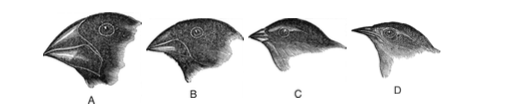
Base your answer(s) to question(s) on the diagram below and on your knowledge of biology. The diagram shows the heads of four different species of Galapagos Islands finches.
The four different types of beaks shown are most likely the result of
The four different types of beaks shown are most likely the result of
a)
gene manipulation
b)
natural selection
c)
unchanging environmental conditions
d)
patterns of behavior learned from parents
16.
Which two processes result in variations that commonly influence the evolution of sexually reproducing species?
a)
mutation and genetic recombination
b)
mitosis and natural selection
c)
extinction and gene replacement
d)
environmental selection and selective breeding
17.
In members of a bird species living on a remote island, the greatest number of beak variations in the population would most likely be found when
a)
there is a high level of competition for limited resources
b)
homeostasis is limited by a severe climate
c)
they have a large and varied food supply
d)
they are prey for a large number of predators
18.
What is the advantage of having different shaped beaks?
a)
To look different from other species.
b)
To be able to eat the food readily available in the environment.
c)
To protect itself against predators.
d)
To protect itself against prey.
19.
Why are advantageous traits more likely to be passed onto offspring?
a)
Because they are more likely to survive and reproduce.
b)
Because they come from dominant alleles.
c)
Because they come from recessive alleles.
d)
Because the trait is an acquired phenotype.
20.
How did different beak sizes first arise?
a)
They arose because of their need to be able to eat different food.
b)
The arose by chance (random mutation).
c)
The environment made the change happen.
d)
The finches beaks changed a little at a time each generation.
21.
What did the beak type of finches on different islands tell Darwin?
a)
Finch populations evolved over time to favor beaks based on food type
b)
Finch populations had not evolved over time
c)
The finch beaks had no relationship to the available food on the islands
d)
Humans artificially selected finches based on their desired beak type
22.

A predator changes its feeding habits to eat at night. What type of rabbit would live on and pass down its traits?
a)
Rabbits that feed during the day
b)
Rabbits that feed during the night
c)
Rabbits that feed in the open field
d)
Rabbits that feed at 12:00 am
23.
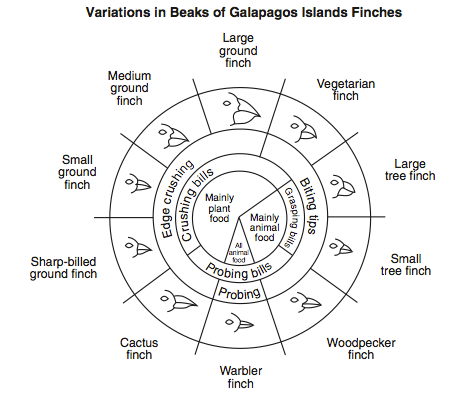
Base your answer(s) to the following question(s) on the diagram below and your knowledge of biology. Which species of finch has an edge-crushing bill that can also probe into plants for food?
a)
cactus finch
b)
sharp-billed ground finch
c)
warbler finch
d)
large ground finch
24.
Which statement best describes an ecosystem maintaining a state of approximate equilibrium?
a)
Nutrients from decayed organisms are
recycled in a forest ecosystem.
b)
All the frog species in a South American rain
forest become extinct.
c)
A mutation spreads through a species of
bacterium, making them unable to decompose
wastes
d)
Mice are released into a field ecosystem as
food for a declining predator population.
25.
Which type of organism helps to reduce atmospheric carbon dioxide?
a)
Carnivores
b)
Producers
c)
Decomposers
d)
Herbivores
26.
In some parts of the world, forests are being cut down and burned to clear land for new homes and new farmland. A negative effect of these activities might be
a)
an increase in global warming
b)
destruction of the ozone shield
c)
a decrease in the average temperature of the
atmosphere
d)
an increase in biodiversity of the deforested
areas
27.
Residents of a town are concerned that a recently built factory could pose health risks. Scientists were asked to investigate the effects of the factory on the health of local residents. The most relevant information they reported was that
a)
(4) local medical facilities have recently reported a 15% increase in the number of patients treated for asthma
b)
(3) residents have occasionally seen smoke coming from the factory
c)
(2) there have been reports that other types of factories have been linked with health issues
d)
(1) in a survey, residents felt that the air in town looks dirtier now
28.
A farmer wanted to rid his apple trees of a particular leaf-eating insect. He sprayed his trees with an insecticide that killed 98% of the insects. The survival of 2% of this population of insects is most likely due to
a)
(1) genes obtained from another species
b)
(2) certain chemicals that stimulated overproduction
c)
(3) variations that resulted from sexual reproduction
d)
(4) their ability to produce food from the pesticide
29.
Populations of aspen trees in the western United States are being destroyed by an unexplained illness. The altered landscape is affecting the animals that live there. Populations of deer mice are increasing greatly in these areas. Unfortunately, these mice often carry a virus that is deadly to humans. This scenario best illustrates that
a)
every population in an ecosystem is linked with other populations
b)
the stability of this ecosystem is limited by the amount of water available
c)
humans are the cause of the breakdown of this ecosystem
d)
a change in the environment always results in disease
30.

Which statement is true for all of the organisms in the ecosystem represented in the diagram below?
a)
Energy is used by the organisms to obtain and transport materials, and to eliminate wastes
b)
Energy stored in inorganic molecules is released during cellular respiration in these organisms.
c)
Stored energy cannot be used by these organisms as a source of energy for life processes.
d)
They use energy to combine the inorganic molecules carbon dioxide and water into energy-rich organic compounds.
31.
Decomposers are necessary in a food chain because they
a)
manufacture food by photosynthesis
b)
return nutrients to the ecosystem
c)
absorb energy from the Sun
d)
Produce organic nutrients
32.
In early spring, many wildflowers begin to grow, produce flowers, and release seeds. The leaves of the wildflowers make food before the leaves of the trees in the area begin to develop. the early growth pattern of the wildflowers would result in
a)
decreased competition for sunlight between the trees and the wildflowers
b)
decreased competition for suitable temperature between the trees and the wildflowers
c)
increased competition for space between the trees and the wildflowers
d)
increased competition for oxygen between the trees and wildflowers
33.
Photosynthesis and respiration are alike in that they both
a)
require the Sun as a direct source of energy
b)
result in the production of glucose molecules
c)
require specific catalysts
d)
occur within mitochondria
34.
Car manufactures have begun to explore the use of biofuels such as biodiesel, ethanol, and cooking oils made from plant material. The desired outcome of using these biofuels would be
a)
a decrease in the use of fossil fuels
b)
a decrease in the release of oxygen gas
c)
an increase in abiotic resources
d)
an increase in global warming
35.
Which process uses energy to combine inorganic molecules to synthesize organic molecules?
a)
respiration
b)
digestion
c)
photosynthesis
d)
decomposition
36.
The Nature Conservancy is an organization that protects a variety of habitats around the world. A project this organization would probably support is one that
a)
uses endangered animals for medical research
b)
protects the biodiversity of areas for future generations
c)
alters habitats for industry and housing
d)
prevents animals species from migration to other habitats
37.

What are the Abiotic factors in this image?
a)
water, sunlight, dirt, air
b)
birds and plants
c)
birds, water, dirt
d)
plants, water
38.
As you move upward, from level to level, in an energy pyramid, energy _____.
a)
increases
b)
decreases
c)
stays the same
d)
increases exponentially
39.
A collection of organisms that make up a community as well as all of the nonliving aspects of the environment.
a)
Population
b)
Community
c)
Habitat
d)
Ecosystem
40.
A graphic illustration that shows each trophic level and the amount of useable energy contained within.
a)
Food chain
b)
Food web
c)
Energy Pyramid
d)
All of these
41.
The living portions of the ecosystem.
a)
Biotic factors
b)
Abiotic factors
42.
An illustration that uses arrows to show the MANY possible directions in which matter and energy can pass through the organisms in an ecosystem.
a)
Food chain
b)
Food web
c)
Energy Pyramid
d)
Succession Map
43.
The amount of energy that usually transfers from one trophic level to the next...
a)
10%
b)
20%
c)
80%
d)
50%
44.

The image provided is an example of a(n):
a)
Carnivore
b)
Herbivore
c)
Producer
d)
Autotroph
45.

The rabbit in this food web would be considered a:
a)
Decomposer
b)
Producer
c)
Secondary Consumer
d)
Primary Consumer
46.

What does a food web represent?
a)
All connections of energy flow throughout all organisms in a habitat.
b)
The specific ways that mutualism is carried out.
c)
A single pathway or energy flow between organisms.
d)
How carnivores get their food.
47.
Which of the following is the correct equation for PHOTOSYNTHESIS?
a)
carbon dioxide + water --> oxygen + glucose
b)
carbon dioxide + glucose + water --> oxygen
c)
oxygen + water --> carbon dioxide + glucose
d)
glucose+ oxygen ---> water + carbon dioxide
48.
What PIGMENT absorbs sunlight for photosynthesis?
a)
chloroplast
b)
thylakoid
c)
grana
d)
chlorophyll
49.
What is one of the reactants of cellular respiration?
a)
energy
b)
glucose
c)
carbon dioxide
d)
water
50.
A plant is releasing a gas. What is most likely the gas?
a)
co2
b)
methane
c)
water vapor
d)
oxygen
51.
Which cell process is represented by this equation:
C6H12O6 + 6O2 → 6CO2 + 6H2O + ATP
C6H12O6 + 6O2 → 6CO2 + 6H2O + ATP
a)
diffusion
b)
photosynthesis
c)
cell respiration
d)
mitosis
52.
Where does cellular respiration take place?
a)
nucleus
b)
chloroplast
c)
mitochondria
d)
vesicle
53.
Where does photosynthesis occur?
a)
mitochondria
b)
stomata
c)
xylem
d)
chloroplast
Reset

