Wayground logo

Free Printable Worksheets

Font size

S
M
L
XL
Worksheets

Mock BIO Test

Total questions: 74

Worksheet time: 59mins

Name
Class
Date
1.
The energy needed to start a reaction
a)
activation energy
b)
adhesion energy
c)
chemical energy
d)
cohesion energy
2.
Which property makes water molecules stick to other water molecules?
a)
adhesion
b)
cohesion
c)
capillary action
d)
polarity
3.
All organic compounds contain the element
a)
carbon
b)
nitrogen
c)
phosphorus
d)
sulfur
4.
Which of the following elements make up nucleic acids?
a)
C, H, O
b)
C, H, O, N
c)
C, H, O, N, P
d)
C, H, O, Ca, S
5.
Carbohydrates are made of... 
a)
C H O
b)
C H O N
c)
C H O N P
d)
C H O N S
6.
Which macromolecule is shown?
a)
lipid
b)
protein
c)
nucleic acid
d)
carbohydrate
7.
Is this hydrocarbon saturated or unsaturated? 
a)
saturated
b)
unsaturated
8.
___________ are some functions of lipids.
a)
storing energy and  cell membrane structure
b)
providing actin & providing myosin
c)
cellulose structure and digestive assistance
d)
storing & transferring genetic info
9.
Changes in pH and temperature can damage an enzymes active site.  What is this called?
a)
reusable
b)
catalyst
c)
specific
d)
denature
10.
The monomer, building block, of carbohydrates; simple sugar
a)
Amino acid
b)
Fatty Acid
c)
Nucleotide
d)
Monosaccharide
11.
If someone is lactose intolerant, they lack the enzyme _____.
a)
lipase
b)
lactose
c)
lactase
d)
milk
12.
C6H12O6 is the formula for which sugar?
a)
glucose
b)
frucotose
c)
maltose
d)
sucrose
13.
Two organisms of different species exist in a relationship in which each individual benefits from the activity of the other:
a)
commensalism
b)
parasitism
c)
herbivory
d)
mutualism
14.
A herd of zebras would be considered a
a)
community
b)
species
c)
ecosystem
d)
population
15.
All of the following are density-dependent factors that limit animal populations EXCEPT.
a)
weather
b)
predation
c)
food competition
d)
birthrate
16.
Which organism contains the most energy?
a)
Rabbit
b)
Grains
c)
Birds
d)
Mice
17.
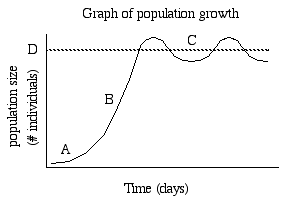
Which point on the graph represents carrying capacity?
a)
A
b)
B
c)
C
d)
D
18.
Why is only 10% of the energy passed along to the next trophic level?
a)
90% is lost through heat, reproduction, and movement
b)
90% is gained
c)
90% is lost in light energy
d)
because only 10% is lost
19.
A species that exerts a large, positive impaction on its ecosystem is known as a:
a)
Keystone species
b)
Invasive species
c)
Indicator species
d)
Poached species
20.

A weightlifter is using heavy weights in short bursts for a competition. Because his muscle cells are not able to take in enough oxygen to make very much ATP the weightlifter begins to get fatigue in his muscles. Which of the following processes is most likely going on in the muscles of the weightlifter as he competes in his event?

a)

As the cells run out of oxygen they switch to anaerobic respiration (fermentation), which allows the cell to make small amounts of ATP in the absence of oxygen.

b)

As the cells run out of oxygen, they die off gradually and the weightlifter's muscles have fewer contracting muscle cells.

c)

The cells will never run out of oxygen if the weightlifter is breathing.

d)

As the cells run out of oxygen, they will continue to make the same amount of ATP, since oxygen is not required to make ATP.

21.
Which process takes place in the presence of oxygen and produces nearly 20 times as much as ATP as glycolysis alone?
a)
photosynthesis
b)
lactic acid fermentation
c)
aerobic respiration
d)
alcoholic fermentation
22.
What function does ATP carry out in living things?
a)
aids in protein folding and coiling
b)
used to capture and transfer energy
c)
identifies DNA start sequences for transcription
d)
helps maintain the fluidity of cell membranes
23.
What are the reactants in the equation for cellular respiration?
a)
oxygen and lactic acid
b)
carbon dioxide and water
c)
glucose and oxygen
d)
water and glucose
24.
Where does glycolysis occur?
a)
Inner mitochondrial membrane
b)
Mitochondrial Matrix
c)
Cytosol
d)
At a ribosome
25.
NADH is a ______ form of NAD+.
a)
Reduced
b)
Oxidized
c)
Catabolized
d)
Hydrolized
26.
How many ATP are gained through glycolysis?
a)
0
b)
2
c)
4
d)
30-38
27.
Cellular respiration involves the net _______ of glucose.
a)
Reduction
b)
Oxidation
c)
ATP
d)
REDOX
28.
Which molecule enters Kreb's Cycle?
a)
Pyruvate
b)
Glucose
c)
Acetyl CoA
d)
reducing powers
29.
What enzyme in the ETC is responsible for generating the ATP molecules?
a)
ATPase
b)
ATP synthase
c)
Hexokinase
d)
none of the above
30.
Where does ETC occur?
a)
Mitochondrial matrix
b)
Outer mitochondrial membrane
c)
Inner mitochondrial membrane
d)
Cytosol
31.
Where do the light-dependent reactions occur? 
a)
thylakoid membrane
b)
stroma
c)
mesophyll
d)
mitochondria
32.
What is the primary function of the light reactions of photosynthesis?
a)
To produce glucose
b)
To produce NADPH and ATP
c)
To use ATP
d)
To produce RuBP
33.
What is the function of NADP+?
a)
It absorbs light
b)
It is an electron carrier
c)
It is a light-reflecting pigment
d)
It acts as long-term energy storage
34.
In the Calvin Cycle, carbohydrate molecules are:
a)
Reduced
b)
Oxidized
35.
The loss of H2O through stomata is referred to as:
a)
Transpiration
b)
Respiration
c)
Evaporation
d)
Photorespiration
36.
Carbon fixation in CAM plants occurs during the:
a)
Day
b)
Night
37.
Where does the carbon come from that is used to form glucose?
a)
The soil
b)
CO2 in the air
c)
From other carbohydrates
d)
Calvin Cycle
38.
What makes up the cell membrane?
a)
Lipid Monolayer
b)
Lipid Bilayer
c)
Protiens
d)
Carbohydrate Chains
39.
Number 1 is  a (the) - 
a)
Golgi Bodies
b)
Mitochondrion
c)
ribosome
d)
Nucleus
40.
Which organelle sorts, modifies and packages molecules for storage in the cell or secretion out of the cell?
a)
Mitochondria
b)
Smooth Endoplasmic Reticulum
c)
Rough Endoplasmic Reticulum
d)
Golgi Body
41.
What is a sac-like structure used to store water and nutrients? These are much larger in plant cells?
a)
Lysosomes
b)
Mitochondria
c)
Vacuoles
d)
Golgi Body
42.
The wing of a bat and a humans' arm have different functions and appear very different.  Yet, the underlying anatomy is basically the same.  therefore, these structures are examples of
a)
geographic isolation
b)
analogous structures
c)
homology
d)
reproductive isolation
43.
The population of peppered moths in England changed from white to black in 50 years
a)
stabilizing selection
b)
sexual selection
c)
directional selection
d)
disruptive selection
44.
The establishment of a genetically unique population through genetic drift
a)
adaptive radiation
b)
divergent evolution
c)
founder effect
d)
convergent evolution
45.
The Tasmanian devil is a marsupial that resembles the North America wolf, which is a placental mammal.
a)
adaptive radiation
b)
divergent evolution
c)
founder effect
d)
convergent evolution
46.
If an organism has a vestigial structure, that structure likely once had a function in a(n)
a)
close relative
b)
early ancestor
c)
unrelated organism
d)
embryological stage
47.
Which of the following types of reproductive barriers separate a pair of species that could interbreed except that one mates at dusk and the other at dawn?
a)
behavioral isolation
b)
mechanical isolation
c)
habitat isolation
d)
temporal isolation
48.
In the early 2000s, White Nose fungus caused a mass die-off of native American bat species. Those bats that survived will continue the population with their own allele frequencies.  What type of genetic drift is this?
a)
Founder Effect
b)
Bottlenose Effect
c)
Bottleneck Effect
d)
Migration Effect
49.
Which of the following is characterized by eukaryotic, heterotrophic and have a cell wall made of chitin?
a)
fungi
b)
plants
c)
animals
d)
bacteria
50.
What evidence of evolution? Kangoaroos are found only in Australia.
a)
comparative embryology
b)
comparative anatomy
c)
comparative biochemistry
d)
geographic distribution
51.
Which of the following is a major domain used for classification?
a)
Domain Plantae
b)
Domain Animalia
c)
Domain Archaea
d)
Domain Protista
52.
The theory of Endosymbiosis explains
a)
The origin of eukaryotes
b)
How species develop
c)
How bacteria live
d)
Why cells rely on one another
53.
____________ & _________________ are organelles that definitely arose from endosymbiosis.
a)
Rough ER & Smooth ER
b)
Mitochondria & Flagellum
c)
Chloroplast & Mitochondria
d)
Chloroplast and Golgi apparatus
54.
One of the main reasons genes assort independent of one another  is that 
a)
they produce unrelated traits
b)
they produce related traits
c)
they are on the same chromosome
d)
they are on different chromosomes.
55.
A single gene has 3 or more alternative forms. These are called
a)
heterozygotes
b)
multiple alleles
c)
epistatic
d)
polygenic
56.
A child has type O blood, if mother has type A blood, what would the fathers blood type be
a)
A,B, or O
b)
AB or A
c)
AB or B
d)
O only
57.
In mice, the homozygous mice are black and white. The heterozygous mice are gray. What pattern of inheritance is expressed in fur color in mice?
a)
complete dominance and recessiveness
b)
co-dominance
c)
incomplete dominance
d)
pleiotropy
58.
Blood type AB
a)
epistasis
b)
codominance
c)
incomplete dominance
d)
hybrid vigor
59.
In mitosis, the end product is...
a)
2 haploid cells
b)
2 diploid cells
c)
4 haploid cells
d)
4 diploid cells
60.
The longest phase of the cell cycle is...
a)
Interphase
b)
Prophase
c)
Metaphase
d)
Telophase
61.
In meiosis, the end product is...
a)
2 haploid cells
b)
2 diploid cells
c)
4 haploid cells
d)
4 diploid cells
62.
Crossing over occurs in...
a)
Prophase 1
b)
Prophase 2
c)
Metaphase 1
d)
Metaphase 2
63.
Sperm and Egg cells are produced using which process?
a)
Mitosis
b)
Meiosis
c)
Binary Fission
d)
None of these
64.
Which picture represents Metaphase?
a)
A
b)
B
c)
C
d)
D
65.
Name the phase:
a)
Prophase
b)
Metaphase
c)
Anaphase
d)
Telophase
66.
During meiosis I, what happens? 
a)
Sister chromatids are split
b)
Homologous chromosomes are split
c)
Four cells are created
d)
None of the other choices are correct
67.
When homologous chromosomes match up, they form a structure call a ___________.
a)
tetrad
b)
triad
c)
diploid
d)
gamete
68.
What phase is  shown in the picture?
a)
anaphase 1
b)
anaphase 2
c)
metaphase 1
d)
telophase 1
69.
Fungi are like animals because...
a)
they all reproduce sexually.
b)
they get their food from other organisms.
c)
they can move from one place to another.
d)
They are not like animals.
70.
Which most likely spreads diseases such as rabies or Lyme disease?
a)
contact with an infected animal
b)
contact with an infected human
c)
ingesting contaminated food
d)
breathing contaminated air
71.
Which would be least effective in preventing the spread of a disease-causing organism?
a)
using vaccines
b)
decreasing pesticide use
c)
using antibiotics
72.
Which vector could lead to a malaria epidemic?
a)
mosquitoes
b)
bats
c)
flies
73.
How do viruses and bacteria compare?
a)
They are both living
b)
They both have DNA
c)
They are both nonliving
74.
Which organisms require a host cell to reproduce?
a)
protozoans
b)
bacteria
c)
viruses