
NEW
Font size
S
M
L
XL
 Worksheets
The Earth and Minerals
Total questions: 56
Worksheet time: 38mins
Name
Class
Date
1.
How have scientists been able to study Earth's mantle?
a)
In some places, Earth's crust thins enough to see mantle.
b)
Earth's surface heat warms the crust turning it into mantle.
c)
Cooling crust material becomes mantle over time.
d)
In some places, mantle rock pushes to Earth's surface.
2.
Which layer of the Earth is the most dense?
a)
crust
b)
mantle
c)
inner core
d)
outer core
3.
Which layer of the Earth is responsible for Earth's magnetic field?
a)
outer core
b)
inner core
c)
mantle
d)
crust
4.
True or FalseThe most abundant elements in the Earth's crust are silicon and oxygen.
a)
True
b)
False
5.
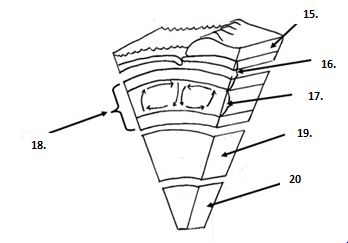
Identify each layer - #15.
a)
Lithosphere
b)
Mantle
c)
Crust
d)
Asthenosphere
6.
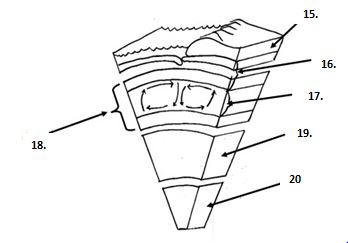
Identify each layer - #20.
a)
mantle
b)
asthenosphere
c)
inner core
d)
outer core
7.
The central part of the Earth below the mantle
a)
Crust
b)
Asthenosphere
c)
Core
d)
Mantle
8.
The soft layer of the mantle on which the tectonic plates move
a)
Asthenosphere
b)
Outer Core
c)
Mantle
d)
Mesosphere
9.
The layer of rock between the Earth's crust and core
a)
Inner Core
b)
Outer Core
c)
Crust
d)
Mantle
10.

The core is made-up of what two elements?
a)
iron and nickel
b)
iron and oxygen
c)
nickel and silicon
d)
oxygen and silicon
11.

What is the thinnest layer of the earth’s composition?
a)
mantle
b)
inner core
c)
crust
d)
outer core
12.

The thickest layer of the earth is the
a)
crust
b)
mantle
c)
inner core
d)
outer core
13.
The order of the earth’s compositional layers from most dense to least dense are
a)
Inner Core, Crust, Mantle and Outer Core
b)
Crust, Mantle, Outer Core and Inner Core
c)
Inner Core, Outer Core, Mantle and Crust
d)
Crust, Outer Core, Inner Core and Mantle.
14.
The solid, outer layer of the Earth that consists of the crust and the rigid upper part of the mantle
a)
Lithosphere
b)
Mesosphere
c)
Mantle
d)
Crust
15.
Temperature _____________________ as you go deeper into the earth.
a)
increases
b)
decreases
c)
goes up and down depending on the layer
d)
stays the same
16.
Pressure ______________________ as you go deeper into the Earth
a)
increases
b)
decreases
c)
goes up or down depending on the layer
d)
stays the same
17.

What are the two kinds of crust that the Earth has?
a)
Oceanic and Crustatious Crust
b)
Oceanic and Continental Crust
c)
Optic and Continental Crust
18.
Which layer of Earth is characterized by rock that is plastic, or soft enough to flow?
a)
asthenosphere
b)
crust
c)
lithosphere
d)
inner core
19.
The process by which water, ice, wind or gravity moves weathered rock and soil from one place to another.
a)
weathering
b)
erosion
c)
deposition
d)
dumptruck
20.
The proces where soil and rock are moved from one place to another.
a)
Deposition
b)
Abrasion
c)
Erosion
d)
conservation
21.
The process when soil or rock are left or placed in a new location.
a)
Erosion
b)
Weathering
c)
Mass movement
d)
Deposition
22.
At the beach which agent of erosion affects the coast?
a)
Wind
b)
Water
c)
Animals
d)
Gravity
23.
What is the cause of mass movement?
a)
Chemical weathering
b)
Abrasion
c)
Erosion
d)
Gravity
24.
When a large amount of dirt and rock move downhill, this is known as a
a)
mudflow
b)
landslide
c)
creep
d)
lahar
25.
The process of grinding rocks is called
a)
tilling
b)
surging
c)
plucking
d)
abrasion
26.
The rapid movement of water, soil, and rocks downhill is called a
a)
mudflow
b)
landslide
c)
slump
d)
creep
27.
A glacier is a large mass of
a)
water
b)
soil
c)
rocks
d)
ice
28.
The best method to prevent erosion is to
a)
remove all trees
b)
build homes
c)
grow plants
d)
mine
29.
Which of the following is NOT a type of physical weathering?
a)
burrowing plants
b)
ice wedging
c)
plant roots
d)
acid rain
30.
What is physical weathering?
a)
The process that breaks down rock
through dissolving rock and chemical
changes.
through dissolving rock and chemical
changes.
b)
Process by which rocks are broken down
into smaller pieces.
into smaller pieces.
31.
Which landforms can be created by deposition?
a)
plateaus and mesas
b)
canyons and valleys
c)
prairies, plains
d)
sand dunes and deltas
32.
What is chemical weathering?
a)
The process that breaks down rock
through dissolving rock and chemical
changes.
through dissolving rock and chemical
changes.
b)
Process by which rocks are broken down
into smaller pieces.
into smaller pieces.
33.
What landforms are formed by ice erosion?
a)
beaches, sand dunes, deltas
b)
plateaus, mesas, arches
c)
moraines, u-shaped valleys, fiords
d)
hills, mountains, slopes
34.
What landforms are formed by water erosion?
a)
beaches, sand dunes, deltas
b)
plateaus, mesas, arches
c)
moraines, u-shaped valleys, fiords
d)
sea arches, canyons
35.
How is mechanical weathering different from chemical weathering?
a)
Chemical weathering happens over much shorter time frame than mechanical weathering.
b)
Chemical weathering changes the chemical composition of rocks; mechanical weathering does not.
c)
Chemical weathering occurs only in tropical climates; mechanical weathering occurs only in cool climates.
d)
Chemical weathering occurs only in the mountains; mechanical weathering occurs only on flat land.
36.
Wind blowing sand from one location to another
a)
Weathering
b)
Erosion
c)
Deposition
37.
The ___________of a mountain weathers the fastest
a)
bottom
b)
middle
c)
top
d)
all parts weather the same
38.
Which process is most directly related to constructing new land?
a)
erosion
b)
polluting
c)
deposition
d)
weathering
39.
Weeds growing into the cracks in a sidewalk and the sidewalk begins to crumble is an example of:
a)
mechanical weathering
b)
chemical weathering
40.
A metal statue slowly turning green after years of being outside is an example of:
a)
mechanical weathering
b)
chemical weathering
41.
The color of a mineral in powder form is called the mineral's
a)
hardness
b)
specific gravity
c)
luster
d)
streak
42.
How light reflects off of a mineral is called the mineral's
a)
luster
b)
streak
c)
cleavage
d)
fracture
43.
Diamond has a hardness of ___ on Mohs Hardness Scale.
a)
1
b)
5
c)
8
d)
10
44.
Dull, silky, waxy, pearly, and earthy are terms that best describe which property of minerals?
a)
luster
b)
color
c)
streak
d)
cleavage
45.

By definition, a mineral has which of the following characteristic(s)?
a)
definite chemical composition
b)
crystal structure
c)
naturally occuring
d)
all of the above
46.
How do you test the hardness of a mineral?
a)
Throw it against a wall
b)
Step on it
c)
Scratch Test
d)
Kick it until it breaks
47.

What mineral is used for pencils?
a)
Graphite
b)
Galena
c)
Magnetite
d)
Quartz
48.
A naturally occurring, inorganic solid with a crystal structure and a definite chemical composition is referring to
a)
density
b)
streak
c)
mineral
d)
non silicate mineral
49.
What mineral is the softest mineral on Moh's Hardness Scale and the main ingredient in baby powder?
a)
feldspar
b)
talc
c)
gypsum
d)
kaolinite
50.
A mineral's resistance to being scratched is called?
a)
streak
b)
luster
c)
hardness
d)
heft
51.
The mineral iron is primarily used to make
a)
jewelry
b)
tools
c)
cement
d)
glass
52.
A rock which contains a useful mineral is call a/an
a)
gem
b)
quarry
c)
ore
d)
alloy
53.

Aluminum ore comes from this mineral?
a)
cinnabar
b)
hematite
c)
bauxite
d)
sphalerite
54.

The principal ore from the minerals Magnetite and Hematite is
a)
copper
b)
zinc
c)
tin
d)
iron
55.

The principal ore from the minerals Bornite and Chalchopyrite is
a)
copper
b)
iron
c)
lead
d)
zinc
56.

Lead ore comes from the mineral
a)
chalcopyrite
b)
bornite
c)
hematite
d)
galena
Reset

